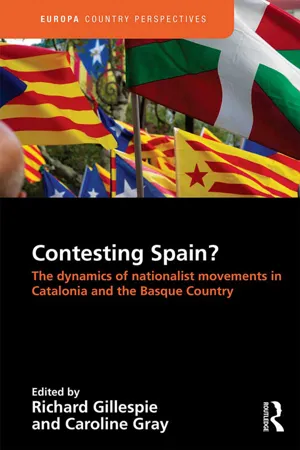
European interest in nationalist movements that seek to enhance or go beyond autonomy to create new states has grown in the early years of the twenty-first century. Seen during the 1990s more as a Central-Eastern European phenomenon reappearing at the end of the Cold War, nationalism has more recently attracted additional interest in response to the rise of pro-sovereignty sentiment in Western Europe within nationalist parties that previously had seemed reconciled to the parameters of devolved government and unlikely to push actively for independence. Demands for a ‘right to decide’ on questions of statehood based on independence or co-sovereignty formulas have become mainstream in various states of the ‘old’ Western Europe. Salient examples include the rise of the Scottish National Party and its achievement of the referendum on the future of Scotland’s constitutional status in September 2014, and the recent electoral breakthrough made by the Nieuw-Vlaamse Alliantie (New Flemish Alliance) in Belgium.
Spain is of special interest in that it has seen two strong pro-sovereignty movements, each seeking—at different junctures—to break with or secure a reconfiguration of the Spanish state. Notwithstanding different circumstances and approaches, the Basque and Catalan mainstream nationalist parties share the demand for their home territory to be granted a ‘right to decide’ its own political future and the ambition to achieve direct representation within the European Union (EU) through acquiring sovereign powers.1
The actual holding of, or ambition to hold, referendums on the issue of statehood has made pro-sovereignty parties and movements a major preoccupation of central state and EU authorities. Notwithstanding warnings from senior EU representatives that secession would imply at least temporary exclusion from the Union, popular demand for consultation over state structures has persisted. Pro-independence politicians have argued that once a clear public pronouncement in favour of change is achieved, more pragmatic responses would prevail at the European and member state levels.
Several collective works have provided comparative analysis of the evolution of nationalist parties in terms of their own political development or attitudes towards European integration.2 Much of the literature on their evolution has concentrated on the road from opposition to participation in government, often involving processes of moderation and accommodation as parties representing stateless national minorities have adapted to the limited opportunities to achieve their objectives within the political system of an established state. Recently, however, Europe has seen existing states challenged by major shifts in a different direction: involving electorally successful nationalist parties that had seemed to be largely devoted to autonomist politics (at least in practice), yet which have started to adopt, or have rescued from their original repertoires, demands involving sovereignty, in some instances by pressing for full independence. This collection is an exploration of the dynamics behind shifts in the orientation of nationalist parties and movements once they have already established themselves as electorally successful at regional level. It inquires into the drivers that influence shifts between pragmatic accommodationism and bids to assert claims to national sovereignty.
This book is one of the first to focus comparatively on the rise of pro-sovereignty politics in mainstream nationalist parties, whose evolution still also features more traditional impulses towards ‘territorial accommodation’. The latter is defined as ‘the capacity of states to contain conflict within the mechanisms and procedures embedded in existing institutional arrangements’.3 It may involve the active engagement of nationalist parties in pacts with central political forces or a more passive acceptance of the existing state framework.4 While the aim of the editors is to move towards broader European comparison in future work, our starting point in this volume is the exceptionally rich laboratory provided by Spain, which affords the possibility of comparison of cases involving a common state, and yet considerable variation as well.
Spain has inspired many notable contributions to the academic literature on devolved forms of government, nationalism and nationalist movements. These include: historically informed comparison of the Basque and Catalan nationalist movements;5 individual case studies of their historical dynamics, often in the context of the historical emergence of regional autonomy;6 and case studies of nationalist parties.7
In this book, we attempt to offer a decentred study of the return to prominence of national and sovereignty-based challenges to the Spanish state, possessing potential to bring changes to the constitutional order and territorial map of the country. The focus here is on the recent evolution of the Catalan and Basque nationalist movements and the factors underlying shifts in their relationships with central government over time. In terms of strategic emphasis, these take place along a continuum extending from pro-sovereignty politics to accommodation with the Spanish state.
Dimensions to analysis
The two movements examined in this collection are both territorially based largely within a single member state of the EU. Paradoxically, the Basque and Catalan cases have rarely been compared in political research projects, despite being frequently contrasted in everyday conversation and media coverage. While differences between the Basque Country and Catalonia certainly must be identified and respected, the view taken here is that these cases are comparable in view of a number of commonalities: economic record of relative success compared with other Spanish regions in recent decades, historical tradition of self-government, own language and culture, structure of the nationalist movement (with both a traditionally pragmatic mainstream party and more radical pro-independence forces), existence of party competition within the nationalist-autonomist camp as well as across a nationalist/unionist division, predominance of nationalist parties in regional government since the creation of the current State of the Autonomies, and capacity on occasion to affect government formation or survival in Madrid.8
Since the 1990s, both mainstream Basque and Catalan parties have undertaken major strategic shifts, yet rather than evolve broadly in the same direction they have followed different itineraries that allow us to compare and contrast and in that way identify the principal dynamics involved. Why have mainstream nationalist parties that had previously achieved objectives within the framework of the Spanish state taken up pro-sovereignty political formulas? Why have the patterns of evolution associated with the strategies of the Partido Nacionalista Vasco (PNV—Basque Nationalist Party) and the Catalan Convergència i Unió (CiU—Convergence and Union) alliance differed so substantially in recent years, even though sovereignty politics have found expression in both cases?
The contributors to this book were selected with a view to ensuring disciplinary diversity and a range of relevant subject specializations. In exploring the above questions, they were asked to focus on what they saw as the key drivers behind movement in one direction or another along a continuum extending from, at one end, ‘accommodation’ with the existing state context, implying the pursuit of goals within the existing institutional order and, at the other end, ‘contestation’, involving political assertiveness around the aim of achieving some degree of sovereignty and statehood. In exploring the dynamics behind nationalist party evolution, three major dimensions of analysis were explored in preparing this collection.
The first is the well-established theme of centre-periphery relations, long used in analysis of regionally based nationalist parties and of Spanish nationalism.9 Whereas this cleavage was originally identified to account for the phenomenon of differentiated party system formation in European countries and tensions between centre and periphery within modern states, it is necessary here to place this discussion within wider European and global contexts. We question whether confrontations over territorial political agendas should still be seen primarily at the level of dynamics at work within a country such as Spain, or as reflecting more the European and global influences impacting at state and regional levels. In particular, how important have the global financial crisis of 2008 and ensuing economic recession been in the modification of nationalist party agendas in Catalonia and the Basque Country? To what extent, in this broader context, do the different financing arrangements of these territories account for contrasting nationalist ideas on sovereignty? Why is it that the PNV has continued to question the existing constitutional framework of Spain, despite what many Spaniards regard as a relatively ‘privileged’ bilateral fiscal relationship between the Basque Country and Madrid?
It is important to qualify references to the centre-periphery dimension by acknowledging its interaction with periphery-periphery or ‘horizontal’ tensions. Reactions against pro-sovereignty initiatives in Catalonia and the Basque Country have come not only from the centre but from other regions of Spain, particularly since the financial crisis of 2008, which raised the economic stakes considerably. There has been pressure on central government and Spanish party leaders from publics and political elites in various regions of Spain, complaining variously that decentralization of the state may have gone ‘too far’ and become an obstacle to economic recovery, or about Basque and Catalan positions on the subject of inter-territorial solidarity. Both the conservative Partido Popular (PP—People’s Party) and the centre-left Partido Socialista Obrero Español (PSOE—Spanish Socialist Workers’ Party) have taken note of the concerns of regionally based defenders of the unity of the Spanish state, not least because they have to compete in regional elections every four years. Elements within the PP, meanwhile, have made ideological efforts to reaffirm a Spanish nationalist discourse while showing a lack of empathy for the ambitions of other nationalisms within the country. Thus, in contrast to simplistic depictions of a ‘rise in regionally based nationalism’, there is evidence of tension, if not a clash, between different national sentiments and regional interests. Although dual identities (Spanish/Basque, Spanish/ Catalan) have traditionally been widespread in Catalonia and the Basque Country, negative interactions between what many see as rival nationalisms (Spanish/Basque, Catalan/Spanish) may be occurring now at more profound and extensive levels, making the politics of accommodation more difficult to return to in the Catalan case.
A second dimension of analysis involves the relationship between nationalist political elites and the communities in which they are primarily based. Besides being involved in an interactive relationship with central authorities in Madrid, nationalist elites in Catalonia and the Basque Country interact with their own support bases, and appeal for support in autonomous community elections every four years. Both CiU and PNV were immediately successful at the regional level during the early years of democracy, although a particularly damaging split in the PNV in 1986 was to render it more reliant on coalitions and parliamentary pacts to remain in office. CiU governed Catalonia from 1980 to 2003 without interruption, before returning to office in 2010. The PNV was in government in Euskadi (the Basque autonomous community of Spain) from 1980 to 2009 and returned in 2012. Such success has bred a pervasive level of dominance and, in a context of relatively frequent elections (general, regional, local, European), has made electoral calculations a key component of decision making at all organizational levels of these parties.
In both cases, clientelistic nationalist party dominance has given party elites considerable autonomy to develop territorial strategies,10 but in recent years, at least in the Catalan case, they have had to respond to a stronger mobilization of demands from below, as society has become more assertive. The dominance of nationalist party elites has been affected by the rise of citizen-based politics, associated with the rise of new generations and the march of globalization. The adverse economic circumstances that ensued after the financial crisis of 2008 propelled many individuals into activism as they perceived existing political elites to be losing the capacity to make a difference and instead to be implementing austerity measures and reforms decided by ‘external’ forces and international organizations acting under pressure from financial markets.
CiU, and more specifically the first government headed by Artur Mas, lived a key moment in September 2012 when their political discourse shifted decisively to one drawn from an overt pro-sovereignty lexicon under the direct influence of a massive popular mobilization organized by civil society groups on Catalonia’s national day, the Diada. Thus the evolution of nationalist party behaviour needs also to be considered in terms of ‘top-down’ and ‘bottom-up’ processes, as well as complex interactions between the two.11
A third dimension to the evolution of nationalist parties vis-à-vis the Spanish context is based in the domain of party systems and associated coalition potential. Both the PNV and CiU have held office at Spanish regional level for most of the period since devolved structures of government were introduced more than 30 years ago. If not formal coalition governments, as in the Basque case, the mainstream parties (at least since the 1990s) have had to reach pragmatic agreements with other parties in order to govern, with evident implications or consequences for the weighting of territorial elements within the agenda of the mainstream nationalist party. When they have been involved in transversal co-operation with state-wide parties at regional level, new territorial designs have tended to be downplayed. PNV co-operation with the Partido Socialista de Euskadi (PSE-PSOE—Basque Socialist Party) and CiU collaboration with the PP inevitably worked in favour of accommodative behaviour. Against that tendency, however, the existence of more radical pro-independence parties in both Catalonia and the Basque Country has also featured in the political calculations and behaviour of mainstream nationalist parties. At certain points in their evolution, the ‘radicalization’ of mainstream nationalist parties, in the sense of placing strategic emphasis on the attainment of sovereignty, may be associated with their involvement together with rising radical nationalist or left-wing pro-independence parties in a competitive process of mutual ‘outbidding’.12 The existence of such rivalry around sovereignty objectives may lead mainstream nationalist parties to increase both the prominence and scope/ambition of territorial demands within their overall programmes. Although relations between relatively moderate mainstream parties and radical pro-independence parties have varied over time, in both of the cases focused on here, competition between these parties is invariably a sub-text even when political/electoral logics have driven them towards ‘alignment’ in competition with state-wide political forces. This book takes account of this competitive inter-party dimension and thus ventures into the wider domain of pro-sovereignty movements, within which there has been much fluidity over time. The ERC, a minor player in the latter part of the twentieth century, had been the mainstream Catalan autonomist party in the 1930s and showed signs of becoming pre-eminent again in 2014.13
The relevance of each of these dimensions will be evident in the next section, offering an overview of nationalist party evolution in the Catalan and Basque cases, and they will be returned to as organizing themes in the final section, in which the various contributions will be drawn together and some tentative conclusions drawn.