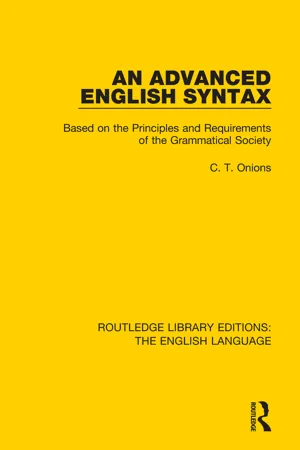
This book, first published in 1970, is the reissue of the sixth edition of C. T. Onions' standard introductory text-book, based on the principles and requirements of the Grammatical Society. The Introduction is designed to provide a full scheme of sentence analysis. The rest of the book is arranged in two parts: Part I offers a treatment of syntactical phenomena based on the analysis of sentences, while Part II classifies the use of forms. This book will be of interest to students of English language and linguistics.
eBook - ePub
An Advanced English Syntax
Based on the Principles and Requirements of the Grammatical Society
- 166 pages
- English
- ePUB (mobile friendly)
- Available on iOS & Android
eBook - ePub
An Advanced English Syntax
Based on the Principles and Requirements of the Grammatical Society
About this book
Information
Syntax.
Syntax means arranging together [Greek syn 'together' and taxis ' an arranging'] and is the name given to that part of Grammar which treats of the ways in which words are arranged together in sentences.
The two parts of Syntax.
Syntax has to answer two questions:—
- How are meanings expressed in sentences and parts of sentences? The answer is given in Part I. of Syntax (§§ 16-71), which deals with Sentence Construction.
- What are the various meanings of words and their forms? The answer is given in Part II. of Syntax (§§ 72 foil.), which deals with Meanings of Forms.

Part I.—Sentence Construction.
The Subject.
16
I. As in other languages:—
- The Subject is either a Noun or Noun-equivalent (§ 9).
- If the Subject is a declinable word, it stands in the Nominative Case.
In modern English, Pronouns are the only words which have a distinct form for the Nominative Case.
- I am here. Thou art the man. There he lies.
- We could hardly believe it. Who is at the door?
- Man is mortal. To err is human—to forgive divine.

Caution. In sentences like 'There was a great calm', 'There rose a mighty shout', there belongs to the Predicate (cf. § 2, Obs. 2), though its position at the beginning of the sentence serves to indicate that the Subject follows. In French and German we have a Formal Subject, il, es, in such cases: Es regierte ein König, 'there reigned a King'; il sortit trois messieurs, 'there came out three gentlemen'.
OBS.—English offers nothing analogous to the impersonal Passive Construction with a Vague Subject which is so common in Latin and German; e.g. Latin itur, 'it is gone', i.e. ' there is a going', 'someone is going'; pugnātum est, 'it was fought', 'there was fighting'; mihi parcitur, 'it is spared to me' (i.e. I am spared); German es wird getanzt 'it is danced', 'there is dancing.'
2. The Subject is ordinarily omitted in Commands and Prohibitions:
- Let the cat alone. Do not go yet.
- Come unto these yellow sands.
Notice also the omission of the Subject ' I' in common expressions such as, 'Thank you,' 'Pray' (compare German danke, bitte); and in very colloquial speech: 'Who do you think has come?'—' Haven't the remotest idea'.
The Predicate.
The Verb.
17
Agreement of the Verb with the Subject.
As in other languages, the finite Verb agrees with the Subject in Number and Person. In modern English, this agreement is not shown by difference of form except in the 3rd Person Sing. Present Indic, (-es, -s, or in poetry sometimes -eth), and the 2nd Person Sing. Pres. and Past Indic, (-est, -st: these forms are liturgical and poetical).
- The boy shout-s (is shouting). The boys shout (are shouting).
- I teach. Thou teach-est. He teach-es. We teach.
- He com-eth not, she said.
Caution. Be careful to observe the rule of agreement in longer sentences, where mistake is easy (especially where the subject is singular and a plural noun comes between it and the verb); e.g. 'The appearance of many things in the country, in the villages one passed through, and in this town, reminds [not reminds me of Dutch pictures.' 'Nothing but dreary dykes occurs [not occur] to break the monotony of the landscape.'
18
Construction according to Sense.
A Singular Noun of Multitude (or Collective Singular) may take either a Singular or a Plural Verb according to whether collective or individual action is to be indicated. Thus:
- Parliament is now sitting. The senate has ruled otherwise.
- The crowd has dispersed. Our army was in a sad plight.
- The majority is thus resolved.
- Three shillings is an excessive price. Two-thirds of the city lies in ruins.
In each case the 'multitude' is conceived of in the mass, acting as a body. But in the following each individual of the 'multitude' is regarded as acting separately; hence the Plural Verb:
The majority are going home.
The lowing herd wind slowly o'er the lea. [The picture which Gray presents to us in this line is that of each one of the cattle following its own path over the meadow.]
But times are altered; trade's unfeeling train
Usurp the land, and dispossess the swain.—GOLDSMITH.
Note also:
- The military [= the soldiers] were called out.
- The poultry [= the fowls, ducks, etc.] are being fed.
In this connexion, Bain in his Companion to the Higher English Grammar (ed. 2) p. 289 has an interesting passage on what he calls the 'convenience of a neutral number.' He refers to the facilities there are in English for avoiding awkwardness or the committing oneself definitely to singular or ...
Table of contents
- Cover
- Half Title
- Title
- Copyright
- Original Title
- Original Copyright
- Contents
- PREFACE
- INTRODUCTION TO SYNTAX (ANALYSIS OF SENTENCES)
- PART I. OF SYNTAX: SENTENCE CONSTRUCTION
- PART II. OF SYNTAX: MEANINGS OF FORMS
- INDEX
Trusted by 375,005 students
Access to over 1.5 million titles for a fair monthly price.
Study more efficiently using our study tools.
Frequently asked questions
Yes, you can cancel anytime from the Subscription tab in your account settings on the Perlego website. Your subscription will stay active until the end of your current billing period. Learn how to cancel your subscription
No, books cannot be downloaded as external files, such as PDFs, for use outside of Perlego. However, you can download books within the Perlego app for offline reading on mobile or tablet. Learn how to download books offline
Perlego offers two plans: Essential and Complete
- Essential is ideal for learners and professionals who enjoy exploring a wide range of subjects. Access the Essential Library with 800,000+ trusted titles and best-sellers across business, personal growth, and the humanities. Includes unlimited reading time and Standard Read Aloud voice.
- Complete: Perfect for advanced learners and researchers needing full, unrestricted access. Unlock 1.5M+ books across hundreds of subjects, including academic and specialized titles. The Complete Plan also includes advanced features like Premium Read Aloud and Research Assistant.
We are an online textbook subscription service, where you can get access to an entire online library for less than the price of a single book per month. With over 1.5 million books across 990+ topics, we’ve got you covered! Learn about our mission
Look out for the read-aloud symbol on your next book to see if you can listen to it. The read-aloud tool reads text aloud for you, highlighting the text as it is being read. You can pause it, speed it up and slow it down. Learn more about Read Aloud
Yes! You can use the Perlego app on both iOS and Android devices to read anytime, anywhere — even offline. Perfect for commutes or when you’re on the go.
Please note we cannot support devices running on iOS 13 and Android 7 or earlier. Learn more about using the app
Please note we cannot support devices running on iOS 13 and Android 7 or earlier. Learn more about using the app
Yes, you can access An Advanced English Syntax by C. T. Onions in PDF and/or ePUB format, as well as other popular books in Languages & Linguistics & Linguistics. We have over 1.5 million books available in our catalogue for you to explore.