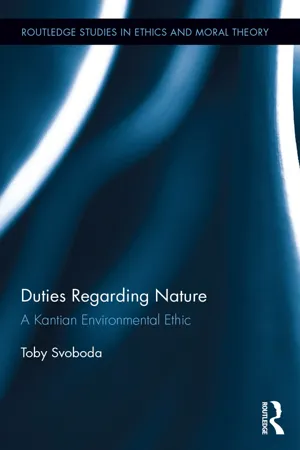
In this book, Toby Svoboda develops and defends a Kantian environmental virtue ethic, challenging the widely-held view that Kant's moral philosophy has little to offer environmental ethics. On the contrary, Svoboda contends that on Kantian grounds, there is good moral reason to care about non-human organisms in their own right and to value their flourishing independently of human interests, since doing so is constitutive of certain (environmental) virtues. Svoboda argues that Kant's account of indirect duties regarding nature can ground a compelling environmental ethic: the Kantian duty to develop morally virtuous dispositions strictly proscribes unnecessarily harming organisms, and it also gives us moral reason to act in ways that benefit such organisms. Svoboda's account engages the recent literature on environmental virtue (including Rosalind Hursthouse, Philip Cafaro, Ronald Sandler, Thomas Hill, and Louke van Wensveen) and provides an original argument for an environmental ethic firmly rooted in Kant's moral philosophy.
- 172 pages
- English
- ePUB (mobile friendly)
- Available on iOS & Android
eBook - ePub
About this book
Information
1Standard Approaches to Environmental Ethics
Many environmental ethicists are committed non-anthropocentrists who hold that human moral agents have direct moral obligations to some non-human natural entities. This commitment is often closely tied to claims regarding the intrinsic value of such entities. Non-anthropocentric positions have the virtue of fitting well with intuitions regarding the evidently moral features of actions and attitudes regarding non-human nature, for such positions can ground the moral assessability of such actions and attitudes. But non-anthropocentric positions also face certain problems. Some depend on the alleged existence of metaphysically suspect value properties and many entail far-reaching deontic conflict. Alternatively, standard anthropocentric approaches avoid these problems, but usually at the cost of failing to ground the moral assessability of actions and attitudes regarding non-human nature. I will examine some of these problems for standard approaches in the present chapter. My purpose is not to demonstrate that standard approaches to environmental ethics are hopeless, but rather to trace some of the difficult challenges faced by them. All else being equal, an approach that avoids these problems is to be preferred. As we shall see, the Kantian environmental virtue ethic is attractive in part because it avoids the problems of standard non-anthropocentric views yet accounts in a plausible way for the moral assessability of actions and attitudes regarding non-human nature.
The Turn to Non-Anthropocentrism
In one of the earliest papers devoted to environmental ethics, Richard Routley (later Sylvan) argues that traditional ethical approaches should be abandoned because they are committed to a principle he calls “basic human chauvinism.” According to this principle, a human being is morally permitted to act however he wishes provided that (1) he does not harm other humans and (2) he does not harm himself.1 Routley attempted to refute this principle by offering his so-called “last person” argument. He asks us to imagine a scenario in which a single person has survived a global cataclysm, leaving him the only remaining human on Earth, although numerous non-human organisms and ecosystems have also survived intact. For recreational purposes, this last person proceeds to destroy every living entity he can find, eliminating vast numbers of plants and animals. Since he is careful to avoid harming himself in this process, and since there are no other humans alive, the last person’s actions involve no harm to human beings. Moreover, since there is no prospect for the last person to reproduce, there will be no future humans, and thus his actions will not have any harmful impact on future generations of human beings.
This scenario is designed to provide a case in which it is intuitively plausible to hold that a person’s actions are morally wrong despite the fact that they do not involve harm to human persons. According to the principle of basic human chauvinism, the last person’s actions are morally permissible, given that they harm only non-human entities. Yet most are likely to share the intuition that the last person’s actions are morally wrong despite the fact that they cause no harm to himself or other humans. Routley inferred from this that the principle of basic human chauvinism should be rejected. Further, since traditional ethical approaches are allegedly based on this principle, he argued that these approaches should likewise be abandoned and replaced with one that can account for the moral wrongness of the last person’s actions.2 Hence the need for a new, an environmental ethic, one that can ground the moral significance of our interactions with non-human nature. Routley’s paper signaled the rise of an influential trajectory in environmental ethics, constituted by approaches seeking to develop non-anthropocentric ethics. We may define anthropocentrism as the position that all and only human beings deserve moral consideration.3 The principle of basic human chauvinism that Routley critiques is, of course, an anthropocentric one. Conversely, we may define non-anthropocentrism as the position that at least some non-human entities deserve moral consideration.
In the wake of Routley’s paper, Kenneth Goodpaster argued for the non-anthropocentric position that moral consideration, or “basic forms of practical respect,” ought to be granted to all living entities.4 This means that human moral agents ought to have practical respect for humans, animals, and plants. Those who accept this position reject what Routley called the principle of basic human chauvinism, replacing it with a biocentric principle that treats all living entities as having moral standing—or, as Goodpaster puts it, as “being morally considerable”—and thus making moral claims on human beings. Such a position can account for the intuition that the last person’s actions are morally wrong, since he presumably fails to respect the entities with moral standing that he harms and destroys. The position of Goodpaster and many other non-anthropocentrists may be classified as a direct duty view, or the position that human moral agents have obligations to non-human entities themselves, such as to respect non-humans or to promote their well-being. This can be contrasted with anthropocentric views that hold human moral agents have direct duties only to human beings. In general, an entity has moral standing if and only if it deserves moral consideration from moral agents.
One concern about Goodpaster’s and other non-anthropocentric approaches, however, is that it is unclear what should ground the claim that non-human entities deserve moral consideration. What is it about animals, flora, or micro-organisms that makes them have moral standing? Goodpaster suggests that restricting moral standing to some subset of living entities would be arbitrary, but we might wonder whether it is less arbitrary to restrict moral standing to living entities alone. David Schmidtz, for example, takes a more expansive view, arguing that “living things and beautiful things and well-functioning things” all warrant respect, although perhaps not equal respect.5 Peter Singer takes a less expansive view, limiting moral standing to sentient entities alone.6 It is a challenge for non-anthropocentrists to establish non-arbitrarily that some non-human entities deserve moral consideration. One way of doing this is to formulate criteria for moral standing, such that an entity deserves moral consideration if and only if it meets these criteria. Philosophers who accept that non-human natural entities have moral standing disagree on both the question of what the necessary and sufficient conditions are for an entity to deserve moral consideration and the question of which entities in fact satisfy these conditions. In answering the first question, some environmental ethicists rely on concepts of intrinsic value.7 Those who do so argue both that an entity’s possession of intrinsic value is at least a sufficient condition for it to have moral standing and that at least some non-human entities in fact possess intrinsic value.
However, “intrinsic value” remains an ambiguous term subject to equivocation in the literature.8 I will distinguish between two types of intrinsic value, namely “realist intrinsic value” and “mind-dependent intrinsic value.” I shall begin with a discussion and critique of realist intrinsic value, turning to the question of mind-dependent intrinsic value later in this chapter. Realist intrinsic value is a mind-independent property that would be possessed by entities regardless of their relations to human valuers. Those who hold that some non-human entities possess realist intrinsic value deny that all value is human-dependent, holding instead that some non-human entities have the property of intrinsic value in their own right and would retain this property even if there were no humans in the world to appreciate that fact. Proponents of realist intrinsic value are thus committed to the existence of real value properties in the universe. Their view is a kind of value realism, according to which mind-independent moral facts exist in the actual world.
Realist Intrinsic Value
Perhaps the best known proponent of realistic intrinsic value in nature is Holmes Rolston III. In defending this position, Rolston relies on a modified version of the last person argument. He asks us to imagine that nuclear war has sterilized all humans while leaving other animals and plant-life unscathed. After the current generation of humans dies, there will continue to be a biosphere, but a one that lacks human valuers. Rolston appeals to two distinct intuitions about this case: (1) that the last generation ought not to destroy the biosphere, and (2) that after the last generation of valuers perishes, it would be better for this biosphere to continue to exist than not to exist.9 The first intuition is deontic in nature and is familiar from Routley’s last person argument: it seems morally wrong to destroy non-human entities in this case, even if such destruction involves no harm to present or future humans. The second intuition is slightly different from any to which Routley appeals, for it is axiological rather than deontic, involving the thought that it would be a good thing for the biosphere to survive, even if no valuers are around to appreciate that good thing. Rolston takes intuitions (1) and (2) to count as evidence that there is some mind-independent value in non-human nature.
Yet it is not clear that these intuitions provide evidence that some non-humans have realist intrinsic value, for it seems that both intuitions can be plausibly accounted for without appealing to such value. As for intuition (1), Rolston’s idea seems to be that nature’s having realistic intrinsic value would provide a neat explanation for why the last generation is obligated not to destroy the biosphere. While it seems true that this would provide such an explanation—we typically think it wrong to destroy intrinsically valuable things, absent good reasons for doing so—there are also competing explanations for why the last generation’s action would be impermissible. Perhaps destroying the biosphere fosters and/or expresses a morally bad character and thus ought not be done for virtue-ethical reasons, as John O’Neill argues.10 I will defend a similar view in chapter five, but for now we need only note that the last generation’s behavior could be impermissible on account of its viciousness alone. This account does not require any axiological commitments regarding non-human nature, and so it provides a way to affirm and explain intuition (1) without making any reference to the alleged realist intrinsic value of non-human entities. Hence, this intuition by itself is not sufficient to show that non-human entities have realist intrinsic value.
Those who harbor intuition (2) find a biosphere without valuers to be in some sense better than no biosphere at all. But once again, it seems that there is nothing about this intuition that provides any particular reason to believe that non-humans in the biosphere have realist intrinsic value. Those who share the intuition find one state to be more valuable than another. Perhaps this is because their intuitions are tracking a mind-independent value property in the biosphere, but, as with intuition (1), there are other plausible explanations. Perhaps the intuition is grounded in the fact that one finds the biosphere beautiful and desires the continuation of entities one finds beautiful, or perhaps one has a personal distaste for destruction simpliciter and so would abhor the biosphere’s destruction. While I am not here endorsing any of these alternative explanations, Rolston’s argument provides no particular reason to accept that non-human entities have realist intrinsic value, since both intuitions can be explained without invoking such value.
Objections to Realist Intrinsic Value
Prominent critics of Rolston’s position that non-human natural entities have realist intrinsic value include J. Baird Callicott and Bryan Norton.11 Callicott holds that Rolston’s position suffers from not offering an alternative to “the metaphysical foundations of modern science,” such as the distinction between primary and secondary qualities.12 He glosses Rolston’s position as follows: “… while the greenness (the qual, not the radiation) of the tree exists only in the mind of the beholder, the moral and aesthetical value of the tree is really out there—no less categorically objective than the electromagnetic waves of precisely 550 nanometers—irrespective of the existence or non-existence of minds and beholders.”13 According to Callicott, it is implausible to treat value as a primary quality of things themselves while treating color as a secondary quality partly dependent on visual observers.14 To make his conception of the intrinsic value of non-humans plausible, Rolston would have to reject these underlying assumptions of modern science. According to Callicott, these assumptions make it more plausible to suppose that values are subjectively produced by valuers rather than objective properties of entities themselves. This suggests a “projectivist” theory of value, according to which the value of non-human natural entities has its source in human valuers who project that value onto them.
Norton critiques Rolston for claiming to know what states of affairs are like independently of any human standpoint. As Norton writes, Rolston’s position, if justified, would require “epistemological access to the ‘independent’ and ‘objective’ world outside human experience in order to offer evidence for attributions of characteristics [such as intrinsic value] to objects. If that access is impossible … then Rolston’s theory cannot escape a skeptical collapse.”15 Norton appeals to Quine and Sellars, who allegedly show that the “representational realism” and “foundationalism” on which Rolston relies are untenable.16 Following Quine and Sellars, Norton argues that if Rolston’s intrinsic value is “an observable, natural property,” then knowledge of that property is already conditioned by human perception and language.17 Accordingly, the property of realist intrinsic value is not known independently of any “human ...
Table of contents
- Cover
- Title
- Copyright
- Dedication
- Contents
- Frequently Cited Works of Kant
- Acknowledgements
- Introduction: Kant and Environmental Ethics
- 1 Standard Approaches to Environmental Ethics
- 2 Kantian Approaches to Animal Ethics and Environmental Ethics
- 3 Indirect Duties, Moral Perfection, and Virtuous Dispositions
- 4 Teleology and Non-Human Flourishing
- 5 A Kantian Environmental Virtue Ethic
- 6 Advantages of the Kantian Environmental Virtue Ethic
- Bibliography
- Index
Trusted by 375,005 students
Access to over 1.5 million titles for a fair monthly price.
Study more efficiently using our study tools.
Frequently asked questions
Yes, you can cancel anytime from the Subscription tab in your account settings on the Perlego website. Your subscription will stay active until the end of your current billing period. Learn how to cancel your subscription
No, books cannot be downloaded as external files, such as PDFs, for use outside of Perlego. However, you can download books within the Perlego app for offline reading on mobile or tablet. Learn how to download books offline
Perlego offers two plans: Essential and Complete
- Essential is ideal for learners and professionals who enjoy exploring a wide range of subjects. Access the Essential Library with 800,000+ trusted titles and best-sellers across business, personal growth, and the humanities. Includes unlimited reading time and Standard Read Aloud voice.
- Complete: Perfect for advanced learners and researchers needing full, unrestricted access. Unlock 1.5M+ books across hundreds of subjects, including academic and specialized titles. The Complete Plan also includes advanced features like Premium Read Aloud and Research Assistant.
We are an online textbook subscription service, where you can get access to an entire online library for less than the price of a single book per month. With over 1.5 million books across 990+ topics, we’ve got you covered! Learn about our mission
Look out for the read-aloud symbol on your next book to see if you can listen to it. The read-aloud tool reads text aloud for you, highlighting the text as it is being read. You can pause it, speed it up and slow it down. Learn more about Read Aloud
Yes! You can use the Perlego app on both iOS and Android devices to read anytime, anywhere — even offline. Perfect for commutes or when you’re on the go.
Please note we cannot support devices running on iOS 13 and Android 7 or earlier. Learn more about using the app
Please note we cannot support devices running on iOS 13 and Android 7 or earlier. Learn more about using the app
Yes, you can access Duties Regarding Nature by Toby Svoboda in PDF and/or ePUB format, as well as other popular books in Philosophy & Ethics & Moral Philosophy. We have over 1.5 million books available in our catalogue for you to explore.