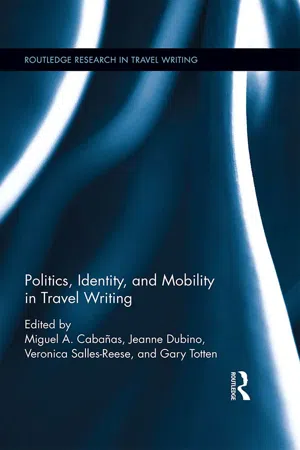
This collection examines the intersections between the personal and the political in travel writing, and the dialectic between mobility and stasis, through an analysis of specific cases across geographical and historical boundaries. The authors explore the various ways in which travel texts represent actual political conditions and thus engage in discussions about national, transnational, and global citizenship; how they propose real-world political interventions in the places where the traveler goes; what tone they take toward political or socio-political violence; and how they intersect with political debates. Travel writing can be viewed as political in a purely instrumental sense, but, as this volume also demonstrates, travel writing's reception and ideological interventions also transform personal and cultural realities. This book thus examines the ways in which politics' material effects inform and intersect with personal experience in travel texts and engage with travel's dialectic of mobility and stasis. In spite of globalization and efforts to eradicate the colonial vision in travel writing and in travel writing criticism, this vision persists in various and complex ways. While the travelogue can be a space of discursive and direct oppression, these essays suggest that the travelogue is also a narrative space in which the traveler employs the genre to assert authority over his or her experiences of mobility. This book will be an important contribution for interdisciplinary scholars with interests in travel writing studies, global and transnational studies, women's studies, multicultural studies, the social sciences, and history.
eBook - ePub
Politics, Identity, and Mobility in Travel Writing
- 254 pages
- English
- ePUB (mobile friendly)
- Available on iOS & Android
eBook - ePub
Politics, Identity, and Mobility in Travel Writing
About this book
Information
Part I Travel and the Politics of Perception
1 “The Pain of 40 Lashes” Anton Chekhov's Sakhalin Island and the Emergence of the Russian Prison System
DOI: 10.4324/9781315742076-1
Closed Spaces and Open Terrains
In 1889, as he was in the early planning stages for his journey to the Far East prison colony on Sakhalin Island in Siberia, Anton Chekhov published “The Bet”, a short story about a group of intellectuals and socialites who, during a party, debate the relative merits of the death penalty and life imprisonment. 1 Typical of their class, status, and enlightened viewpoints, their arguments about state-sanctioned punishment emerge from humanistic principles. The host, a banker, while acknowledging the a priori nature of his opinion, speaks in favor of the death penalty although in doing so he eschews retributive justice and appeals instead to a sense of mercy: “which executioner is the more humane, he who kills you in a few minutes or he who drags the life out of you in the course of many years?” (“Bet”, p. 61). One guest, a young lawyer, proposes to the contrary that life imprisonment is the more humane punishment because “[to] live anyhow is better than not at all” (“Bet”, p. 62). The debate escalates, turning absurd when the banker bets two million rubles that the lawyer cannot remain in solitary confinement for fifteen years, a wager to which the lawyer agrees.
After enduring most of the self-imposed sentence, the lawyer breaks the contract at the very last moment, both in words and in action. Hours before the stipulated end of the bet, the young man escapes, leaving behind a letter in which he renounces not only the money but also wisdom, happiness, and “all that in your books is called the good things of the world” (“Bet”, p. 66). This letter, addressed to the banker and to the world, and “as before God, who beholds me,” serves as testimony to the horrors and solitude of his 15 years in prison (“Bet”, p. 66). In this renunciation of the world, we see the chasm between the lawyer’s original humanistic impulses and his experiences in the cell. After reading this letter addressed to the world, the banker locks it away in a fireproof safe, in a final act of betrayal of the lawyer’s intent. The lawyer’s testimony never reaches its intended audience.
“The Bet” is a useful entry point to Chekhov’s lesser known travel book, Sakhalin Island (1895), in which again the subject is long term imprisonment. 2 As in “The Bet”, we see an attempt to understand prison life and the reality of solitary confinement. In both “The Bet” and Sakhalin Island, we see a priori notions of the value of incarceration clash with the bleak reality of prison life. Both works are political in nature in that they address in different ways the subject of state-sanctioned punishment and the public discourse surrounding it. However, in Sakhalin Island Chekhov goes beyond using this political issue as the backdrop to philosophical speculations and instead foregrounds not only the extent and conditions of incarceration on the distant margins of Russian society but also its virtual invisibility to those in the West. Chekhov traveled expressly to reveal to an audience back home the consequences of Russia’s penal policy and the reality of prison life. The firsthand nature of the travel narrative with the implicit authority of the traveler as witness was key to this project. However, the genre was new to Chekhov (and unique in his oeuvre), and he was never satisfied with the book that emerged. His frustrations with seeing the manuscript into print speak to the difficulty he had in understanding the relationship between what he expected to see, what he actually saw, and what he felt he needed to say about the bleak conditions of Sakhalin. Even the form he used evolved over time. He set out intending to complete a survey of the population on Sakhalin. When he arrived, he drew on his artistic talents for description, narrative, and portraiture. He published the materials he gathered in a travel book, a form he chose not for its proven ability to promulgate political arguments about, in this case, penology and the social awareness of prison life but rather as a form that could contain such disparate concerns and methodologies.
“Unnecessary Rumors” and Epistemological Crises: Reading Sakhalin Island Politically
Critics and readers have largely ignored Sakhalin Island, seeing it as an aberrant experiment while acknowledging Chekhov’s humanistic impulses and admiring his fortitude in seeing the project through. 3 In one of the few essays to critically engage Chekhov’s political and social goals, “Chekhov as Ethnographer: Epistemological Crisis on Sakhalin Island”, Cathy Popkin sees Sakhalin Island as a failure, both as a travel book and as a humanistic project of elucidation. 4 Popkin documents the numerous contradictions in Chekhov’s text that reveal, in her view, evidence of “the breakdown of knowability itself”. She claims, “What takes place on Sakhalin Island is a kind of epistemological crisis, and the text itself reproduces the collapse of Chekhov’s project” (p. 38). Furthermore, in this failure, Popkin gleans evidence of Chekhov’s complicity with colonization. 5 She argues that Chekhov’s humanistic desire to make this prison system “known” is by its nature complicit with the policy that it seeks to reveal: “This ‘known-making’ as ‘own-making’ is the intellectual correlative of the colonization project that is the real agenda of Russia’s exile system; both colonization and elucidation are expansionist enterprises to appropriate the other” (p. 38). Popkin sees Sakhalin Island as a work bound up with the imperial politics on which it seeks to shed light. She faults Chekhov for failing scientifically in his attempt to elucidate the reality of the prison colony just as she faults him for failing artistically to provide the people he encounters with literary wholeness. Popkin’s argument is important for the way that it takes the politics of Chekhov’s travel book seriously and considers the political implications of the travel narrative more generally.
Popkin’s critique of Chekhov and of Sakhalin Island is premised on two arguments. First, the aesthetic failure of the travel narrative is at least as important as the scientific failure of the project. This argument sees the travel narrative as a limited genre, one in which either scientific objectivity or aesthetic narrative prevail. The second premise is that Chekhov’s original intent to elucidate his a priori ideas about Sakhalin remained with him throughout his travels and through the publication of the book. What Popkin calls an “epistemological crisis” is only a crisis because she sees Chekhov adhering throughout to his original ideas. However, even if we acknowledge the ultimate failure of Sakhalin Island to create a satisfactory harmony between artistic and scientific ways of knowing, it can still be useful to trace the strands of these different discourses in Chekhov’s text to understand how his thinking evolved.
Tracing these strands, we can see the contradictions of the text as symptoms of a deeper political engagement and argument. A political reading of the travel genre must take into account not just what the traveler sees, but how the traveler sees. In trying to determine what it is that Chekhov “sees” and how the travel narrative allows the reader to “see” not just landscapes and people but also the consequences of policy, political reality, and even, in this case, the growth of social and cultural institutions, I draw on François Hartog’s The Mirror of Herodotus (1988), where he explores the relationship between witnessing and reporting in Herodotus’s Histories (2008), a work that is not only one of the first books of history but also the first known travel narrative. 6 According to Hartog, firsthand reporting derives its unique authority from a juridical function both as autopsy and as testimony. Even Popkin acknowledges that “perhaps Chekhov’s failure to contain textual sense makes him a truer witness” (p. 49). In the writing of history, the value of autopsy lies not in the authority of perception so much as the judgment of the historian. According to Hartog, “[autopsy] is more a matter of pondering what is visible and the conditions of visibility. What is it that is visible? Not what I have seen, but what is it that I have seen?” (p. 267). In other words, it is not just an itinerary of objects, landscapes, scenes, and peoples that characterizes the travel narrative but also opportunities to consider the processes, consequences, and implications of what the traveler sees. This is as true when the travel writer encounters the cultures of foreign lands as it is when she records the lives of people who for political reasons have been removed to the margins of a country. In referencing Hartog, I suggest that, despite any aesthetic or scientific failure of form, Chekhov’s travel narrative makes the political reality of the prison colony thinkable to the public in a way that it was not before. In what follows, I trace the evolution of Chekhov’s way of seeing through the stages of his journey in order to ultimately argue that Sakhalin Island serves as testimony to the realities of life on Sakhalin, even if Chekhov himself is an imperfect witness and travel writer. 7
Researching Sakhalin: Preparations for the Journey
Chekhov began his journey to the Far East Russian penal colony located on Sakhalin Island in April of 1890. His stated goal was to conduct a census of the prisoner population there, a population that had grown steadily since the 1850s when the colony was first established, partly in response to Japanese land claims. Throughout the nineteenth century, Russia and Japan frequently engaged in bitter disputes over the island until 1875 when Japan ceded control over Sakhalin. The first labor camp established in the north in 1857 lay the groundwork for the administrative takeover of the island two decades later.
Although he had been reading accounts of the Far East prison colonies, especially those by George Kennan, the US traveler, who, in works such as Tent Life in Siberia (1870) and the two-volume Siberia and the Exile System (1891), did the most to publicize the real effects of Russian penal policy in the nineteenth century, 8 Chekhov wanted to see Sakhalin, the largest of these colonies, for himself. To his editor, Alexsei Suvorin, he describes the noble and serious purpose of his travel:
I shall discover and learn a great deal from all the reading, looking around, and listening. Even before setting out, the books I have had to read have taught me a great deal that everyone should know under pain of forty lashes, but which I have hitherto been completely ignorant about. 9
In linking reading and experiential learning this way, Chekhov is already strongly aware of the powerful although incomplete impact that the written text can have in revealing a social reality that is outside the ken of most people.
In his correspondence with Suvorin in the time leading up to his journey, however, we see no set purpose, no single rationale for embarking on this trip. At times, Chekhov questions whether he is even up for the job. He writes to Suvorin in March: “the only regret I have is that it is I going there rather than somebody more experienced in the field, and more able to generate interest in society at large. My personal reasons for going are trivial” (Letters, p. 205). On other occasions he eschews the literary entirely: “I must turn myself into a geologist and then a meteorologist and then an ethnographer” (Letters, p. 200). In the account of his preparations here, Chekhov seems almost unsure of his status, as if he needed to take on the role of a specialist because he did not feel certain of his own authority. From the beginning, Chekhov’s humanistic purposes were mixed with uncertainty. In a letter again to Suvorin, Chekhov writes, “I am going there perfectly convinced that my trip will make no useful contribution either to literature or to science” (Letters, p. 203). In the months before he embarked on his journey, and as his project became more real in his mind, he became increasingly interested in reports that would contextualize the accounts that he had read about in newspapers and journals. In a 25 February 1890 letter to his brother Alexander, Chekhov writes of his need to understand the historical discourse on Sakhalin:
I need as much and as detailed information as I can get about what the newspapers have published about Sakhalin, because my interest in the articles goes beyond the purely factual information in them. The facts and figures are clearly important in themselves but, Gusev, I also need to know the historical context in which they have been set out. The articles were written either by people who had never been to Sakhalin and had no conception of what it was really like, or by interested parties who had invested capital in Sakhalin business and wanted to protect their innocence. The rashness of the first and the deviousness of the second alike obscure the truth and impede progress, and, as such, can be even more revealing to the researcher than the factual information itself, which is for the most part random and inaccurate; the elements I am talking about brilliantly illuminate our society’s attitude to the whole business, and to imprisonment in particular. (Letters, p. 202)
At least for a moment, his subject becomes not Sakhalin Island itself, but the various accounts of the travelers and explorers who were representing it. This is an important point because we see Chekhov reaching the limits of what these texts can teach him about the prison colony without actually experiencing it himself. The different motivations for going that he articulates in the letters to his brother and his editor similarly speak to the impossibility of any a priori sense of certainty. In the 25 February letter to his brother Alexander, Chekhov is interested not so much in the way that Sakhalin emerges as an object of knowledge as he is in the various ways that these reports came to constitute a social reality. All that is left is for Chekhov to see Sakhalin for himself.
The Road to Sakhalin: A Priori Judgments and Impressions on the Way
Chekhov traveled the rough roads and withstood the harsh weather conditions for over two months before reaching the remote colony. Along the way, he posted accounts of his journey to the Moscow newspaper New Times as serialized articles under the heading “From Siberia”. The final dispatch appeared on 20 June 1890, almost a full month before he finally arrived on Sakhalin. To conduct the census that was his stated goal, he brought with him ten thousand questionnaires, in which he would record the data he collected from interviews with the prisoners, guards, free men and women, and prison administrators. He stayed on the island until October, all the while filling those cards with data and notebooks with impressions.
In his 1993 translation, Brian Reeve includes both Sakhalin Island and the articles that Chekhov had dispatched from the road but that were not part of the original published book, suggesting a simila...
Table of contents
- Cover
- Halftitle Page
- Routledge Page
- Title Page
- Copyright Page
- Contents
- List of Figures
- Permissions
- Acknowledgments
- Introduction
- PART I Travel and the Politics of Perception
- 1 “The Pain of 40 Lashes”: Anton Chekhov’s Sakhalin Island and the Emergence of the Russian Prison System
- 2 Traveling Lies: Bruce Chatwin’s In Patagonia and Adrián Giménez Hutton’s La Patagonia de Chatwin
- 3 “Road to Road”: Syncretism and the Politics of Identity in M. G. Vassanji’s A Place Within
- PART II Gender and Sexuality
- 4 Clashing Tastes: European Femininity and Race in Maria Graham’s Journal of a Voyage to Brazil
- 5 Exceptional Perspectives: National Identity in US Women’s Travel Accounts of Greece, 1840–1913
- 6 Great Mirrors Shattered: John Whittier Treat and the Politics of Queer Travels through Gay Japan
- PART III Race, Ethnicity, and Otherness
- 7 “A Herd of Deer Chased by the Hunters”: Travel Writers on the Dilemma of Indian Removal
- 8 Racial Identity, Travel, and Music in Philippa Duke Schuyler’s Adventures in Black and White
- 9 The Dystopia of Border Crossings in Luis Alberto Urrea’s The Devil’s Highway
- PART IV Empire
- 10 Traveling to Ithaca
- 11 Representations of the Near East in Travel Writing and Conjectural History during the Late Eighteenth Century
- 12 “Picturesque in Its Motley Processions”: The Infrastructure of Empire in Emily Eden’s Up the Country
- 13 Seeing with a New Lens: Louise Arner Boyd’s Polar Expeditions
- PART V Travel, Globalization, and Geopolitics
- 14 Seeing for Themselves: US Travel Writers in Early Revolutionary Cuba
- 15 “And I am the king of May”: Allen Ginsberg’s Travel Poetry and the Cold War Politics of Dissent
- 16 From 香港 to Hà Nội: Travel Guidebook Writing as a Political Act
- Notes on Contributors
- Index
Trusted by 375,005 students
Access to over 1.5 million titles for a fair monthly price.
Study more efficiently using our study tools.
Frequently asked questions
Yes, you can cancel anytime from the Subscription tab in your account settings on the Perlego website. Your subscription will stay active until the end of your current billing period. Learn how to cancel your subscription
No, books cannot be downloaded as external files, such as PDFs, for use outside of Perlego. However, you can download books within the Perlego app for offline reading on mobile or tablet. Learn how to download books offline
Perlego offers two plans: Essential and Complete
- Essential is ideal for learners and professionals who enjoy exploring a wide range of subjects. Access the Essential Library with 800,000+ trusted titles and best-sellers across business, personal growth, and the humanities. Includes unlimited reading time and Standard Read Aloud voice.
- Complete: Perfect for advanced learners and researchers needing full, unrestricted access. Unlock 1.5M+ books across hundreds of subjects, including academic and specialized titles. The Complete Plan also includes advanced features like Premium Read Aloud and Research Assistant.
We are an online textbook subscription service, where you can get access to an entire online library for less than the price of a single book per month. With over 1.5 million books across 990+ topics, we’ve got you covered! Learn about our mission
Look out for the read-aloud symbol on your next book to see if you can listen to it. The read-aloud tool reads text aloud for you, highlighting the text as it is being read. You can pause it, speed it up and slow it down. Learn more about Read Aloud
Yes! You can use the Perlego app on both iOS and Android devices to read anytime, anywhere — even offline. Perfect for commutes or when you’re on the go.
Please note we cannot support devices running on iOS 13 and Android 7 or earlier. Learn more about using the app
Please note we cannot support devices running on iOS 13 and Android 7 or earlier. Learn more about using the app
Yes, you can access Politics, Identity, and Mobility in Travel Writing by Miguel A. Cabañas, Jeanne Dubino, Veronica Salles-Reese, Gary Totten, Miguel A. Cabañas,Jeanne Dubino,Veronica Salles-Reese,Gary Totten in PDF and/or ePUB format, as well as other popular books in Politics & International Relations & Literary Criticism. We have over 1.5 million books available in our catalogue for you to explore.