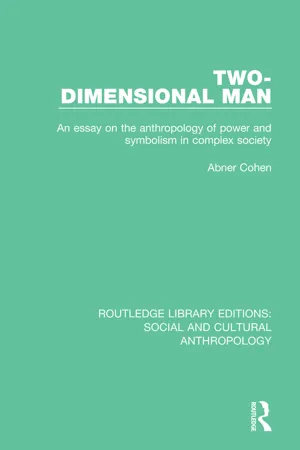
Central to this original study, first published in 1974, is that Political Man is also Symbolist Man, that man is two-dimensional. The book explores the possibilities of the systematic study of the dialectical interdependence between power relationships and symbolic action in modern, complex society. The discussion focuses on the processes by which interest groups, that cannot organise themselves formally, manipulate different types of symbolic formations to articulate a number of basic organisational functions: distinctiveness, communication, decision-making, authority, ideology and socialisation. The analysis is worked out in terms of specific case studies of different types of groupings, or 'invisible organisations' – ethnic, elitist, religious, ritually secret, cousinhood – which go through processes of cultural metamorphosis, shifting from one symbolic strategy to another, in response to changes in their circumstances. In conclusion, the discussion is brought to bear on the study of stratification in large-scale industrial society generally.
eBook - ePub
Two-Dimensional Man
An Essay on the Anthropology of Power and Symbolism in Complex Society
- 166 pages
- English
- ePUB (mobile friendly)
- Available on iOS & Android
eBook - ePub
Two-Dimensional Man
An Essay on the Anthropology of Power and Symbolism in Complex Society
About this book
Information
1 Introduction: the bizarre and the mystical in modern society
| The hidden dimension of organisation |
| Psychological and culturological explanations |
| Orientations in sociology and political science |
| The approach from political anthropology |
| Outline of the argument |
The hidden dimension of organisation
The view, implicit in the evolutionary formulations of Weber and others, that modern society is distinct from primitive society in being organised on the basis of contract, in being secular, rational, manipulative and impersonal, has recently been seriously challenged by many students of society. A rapidly accumulating body of evidence indicates that the bizarre and the exotic in the patterns of social behaviour are not the exclusive monopoly of pre-industrial societies. In many situations in modern society custom is as strange and as sovereign as it is in 'primitive' society.
Scholars are now 'rediscovering' in modern society the existence and significance of an endless array of patterns of symbolic behaviour that have been for long associated exclusively with 'primitive' society. In the field of interpersonal relationships, numerous studies have been carried out of extended kinship relations, different types of friendship, ritualised relationships, and a host of other types of 'informal', non-contractual, relationships that pervade the whole fabric of social life. Extensive studies in the USA and UK show that a great deal of business is arranged and regulated, not by the law of contract, but by non-contractual mechanisms. Studies of the City of London have indicated that millions of pounds worth of trans actions are concluded daily without the use of documents, through the mechanisms of customary rules and practices that are observed within a distinct culture group-the City men.
In the field of ritual, the revival of religious activities among a large proportion of the population of the USA has been reported by scholars. In the UK, although Sunday attendance in church has dwindled, the demand on organised religion for rites of passage continues with little change (Wilson 1969:22). About four million Americans and three-quarters of a million Britons are affiliated with in what has been described as the greatest secret society on earth Freemasonry (Dewar 1966). The overwhelming majority of these men are from the wealthy and professional classes. They meet periodically in their local centres and, behind the locked and well-guarded doors of their temples, they wear the colourful and elaborately embroidered regalia, carry the jewels, swords and other emblems of office, and perform their 'ancient' rituals. These rituals, and the beliefs that are associated with them, are as dramatic and as strange as those found in any tribal society in Africa. The 'rediscovery of the supernatural' has been discussed by many writers (see, for example, Berger 1969) and surveys of superstitious beliefs and practices in modern society have been made by others (see Jahoda 1969), indicating massive preoccupation with such esoteric activities as fortune telling, witchcraft and sorcery. In a recent official document, Sir John Foster reports that a large number of persons in Britain today are members of 'Scientology', a pseudo-religious, pseudo-scientific organisation (Foster 1971). One may also mention here the many types of 'hippy' groupings that have been formed during the last decade, with their own brands of ecstatic and mystical pursuits. Youths from Europe and the USA halt their university studies to trek reverently to the mystics of the Orient hoping to find new formulae for explaining the meaning of life in modern society.
In numerous cases, ritual behaviour merges indistinguishably with so-called ceremonial behaviour. In every hour of the day, public dramas are enacted by the state, by groups of all sorts, and by persons interacting with other persons. One may include under this heading such patterns of symbolic behaviour as those manifested in manners, etiquette, dress, gift and visit exchanges, eating and drinking together. As Goffman (1969) shows, all our behaviour is in fact couched in endless series of dramatic performances.
Another type of symbolic behaviour can be found in the organisation of play of all sorts, sports and leisure-time activities. Yet another important related field of activity is that of popular art and drama that is daily presented to millions of people in cinemas, radio and television programmes, newspapers, books and on the stage.
All this is true, not only of capitalist societies, as Marx maintained, but also of socialist societies that are officially organised under 'scientific communism'. Here emblems, slogans, banners, mass parades, titles, patriotic music and songs and, inevitably, the 'world view' of dialectical materialism-these and a host of all sorts of other symbolic forms play their part in the maintenance of the political order. The cost in time, effort and resources, for both individuals and groups in staging and performing these symbolic activities is colossal.
Psychological and culturological explanations
Some of these patterns of symbolic action have sometimes been explained, or rather explained away, historically, as 'cultural lags'. However, although many of them are indeed survivals from the past, they continue into the present, not because of inertia or of conservatism, but because they play important roles within the contemporary social settings. Indeed some of them are revived from the past to serve in the same way. Others are of recent origin and yet others are being continuously created for new, or for old, purposes. The history of a cultural trait will tell us very little about its social significance within the situation in which it is found at present. Thus as I show later (pp. 91-8), although ethnicity involves the extensive use of old customs and traditions, it is not itself the outcome of cultural conservatism or continuity. The continuities of customs are certainly there, but their functions have changed. Within the contemporary situation ethnicity is essentially a political phenomenon, as traditional customs are used only as idioms and as mechanisms for political alignments.
Similarly, although symbolic action is always involved in psychic processes, psychology cannot by itself explain the nature of these symbolic forms. Collective ritual is not the product of recurring spontaneous individual creativity resulting from recurring psychic states. On the contrary, for the majority of people it is the ritual that recreates certain psychic states in the minds of the participants, not the other way round. The ritual might have been originally the spontaneous creation of an individual with exclusive autonomous subjective experience, like a prophet or an artist. But once the created symbols are adopted by a group, they are no longer subjective or individual. They become objective, in the sense that they confront the members of the group as things that exist outside their psyches and that will constrain them in their behaviour. They also become public, the collective representations of a group.
As I show later, psychology can certainly shed light on the nature of the psychic 'origin' of symbolic action in general. It can contribute significantly towards the analysis of symbolic and artistic creativity and of the psychic experience which is induced by the performance of ceremonials and rituals. But the social significance of symbolic action can be discovered only when it is studied within the context of social re1ationships. Symbolic action is an essential process for the development of selfhood, but its patterns are provided by society and are always loaded with social consequences, many of which are unintended by the actors. Thus the same pattern of symbolic action has both psychological and social consequences at one and the same time. To put it differently, the same phenomenon, namely symbolic action, can be explained psychologically and sociologically. But these explanations are different and are developed within two separate conceptual schemes. Even if they may sometimes support one another or shed light on one another, they should nevertheless be kept analytically separate and not confused one with the other (see Leach 1958; Gluckman 1964, 1968; Turner 1964).
Some serious attempts have been made to explain symbolic forms in their own right, in terms of their own 'logic'. Two major orientations can be mentioned here. The one of a number of individual scholars who envisage the development of a 'science of symbolic behaviour'. Some interesting, intelligent and imaginative formulations in the 'interpretation' of symbolic forms have been made by these scholars. But these formulations have often been conjectural, non-verifiable, non-cumulative, 'meanings' attributed to symbols and are mostly arrived at by sheer intuition and individual guess-work. The studies by these writers have inevitably been 'undisciplined', in the sense that they have had no specific aim or frame of reference and have often wandered in different directions, mixing metaphysics with logic, art, psychology, theology, linguistics and history, frequently marshalling impressive arrays of inspiring statements, intuitions, apt illustrations and quotations. Above all, they offer no clear programme for further research and no indication how the subject is to be developed. I believe that this is why writers like Langer (1964) and Geertz (1964), who hoped to develop such a science, complain of how little has been achieved.
The other orientation is the more systematic attempt by Lévi-Strauss and by the proliferating 'schools' of his followers, to explain symbolic behaviour in terms of a logical structure underlying all human thinking. But, as I indicate later, this is made at the expense of ignoring the social actor - political man - with the result that the analysis fails to deal with the dynamics of interaction between men in society. Symbols in Levi-Strauss's system are logical categories, while in the dynamics of socio-cultural life they are 'valences', being not only cognitive, but also agitative and conative.
Orientations in sociology and political science
Symbolic action can be systematically analysed only when it is related to other variables with which it is significantly inter connected. Public, or collective, symbols are essentially objective and are intimately related to social factors. Some important contributions to their analysis have been made within sociology. As Parsons (1951:1-16) puts it, 'the central concern of sociological theory is with the phenomena of institutionalisation'. 'Institutionalisation' writes Blau (1969:67, 71) 'refers to the processes that perpetuate a social pattern and make it endure ... and thus outlast the lives of human beings.' Underlying the whole phenomenon of institutionalisation is the symbolisation process. Social relations are developed and maintained through symbolic forms and action. The great sociologists, among them Marx, Weber, Durkheim, Edmund Burke, greatly illuminated the sociological interconnections between social relations and symbolic action. More recently, some important contributions in this respect have been made by sociologists in the study of norms and values, in the development: of the sociology of religion, of art, and of thought systems. But a number of factors practical, theoretical, methodological and epistemological - have seriously thwarted the development of a sociology of symbolic behaviour (for a discussion of some of these problems see Duncan 1968 and 1969).
Sociology has been developed in the study of the advanced socially differentiated industrial societies of the West. These are highly complex societies with a bewildering array of formal and of less formal groupings, representing a variety of interests, competing, federating and manoeuvring to achieve their ends. Often increasing differentiation and specialisation result in the separation between a group and its legitimating cult of symbolic formations. In this way ideologies become separately organised and the links between them and the groups that created them become blurred or 'hidden'. In due course the now autonomous symbolic cult is adopted by other interest groups and its function may thereby be drastically changed. More frequently, the same cult can serve different interest groups, providing each with different organisational functions. Further differentiation leads to the fragmentation of the cult into specialised sectors, each promoted by a separate organisation. An interest group may thus construct its cult from drawing on the formulations and services of different cult organisations like churches. For example, in their efforts to articulate an informal organisation to co-ordinate their political activities, the Creoles of Sierra Leone have adopted a variety of beliefs and practices from organised church religion, from the Freemasonic order, and from other specialised organisations (for details see below pp. 83-4, 107-9, 112-18).
The complexity resulting from all this is further intensified through the dynamics of change which affect the different elements of a group organisation differently, so that some elements will change, while others will hardly change, though their functions may alter. And, as these societies are large in scale, a holistic view of symbolic forms and social relationships will be almost impossible.
At the same time, sociologists have inevitably been forced to specialise, some in different types of social relations, others - few in number - in symbolic systems. And as sociologists have often been keen to develop their research on 'scientific lines', they tended to apply rigorous quantification to the phenomena they studied. Gradually this has led to a concentration on easily quantifiable phenomena and to the neglect of phenomena that are not given to intensive quantitive analysis.
As symbolic formations and action are essentially dramatistic and are thus not given to direct and precise measurement, less and less sociologists have bothered to study them. Imperceptibly, the phenomena that are not studied come to be regarded as sociologically insignificant and this perpetuates further the view that modern society is predominantly secular, manipulative and rational. But how will the process of institutionalisation, which is regarded as the central concern of sociological theory, be analysed without the detailed analysis of symbolic forms and action?
Political science solves the problems of institutional differentiation and of scale by concentrating on the study of one variable-power, within the total universe of the state. Instead of studying the vaguely conceived 'social relationships' with which sociology is concerned, it concentrates on the study of power relationships, of subordination, superordination, and equality in various combinations. But of course this solution is accomplished by political science at the expense of its becoming an essentially descriptive endeavour. In the words of one of its practitioners (Young 1968: 5), its effort is mainly 'to delineate relevant phenomena, to generate useful classifications and breakdowns, and to pinpoint the important characteristics of political activities'. Furthermore, even the descriptive picture tends in the work of many political scientists to be limited to the organisation and activities of the state and of formally organised groupings within the state.
Some political scientists extend the domain of their study to include the political aspects of formally non-political institutions, such as religion, and thereby come closer to the study of the relation between symbolic action and power relations. Some of them have been concerned with the study of 'influence', usually that of business, within local communities. Others have studied political, mainly state, symbols. But these studies have been marginal and the scholars engaged in them are often branded as 'political sociologists'. Their research has been fragmentary, without forming a special 'school' through the accumulation of their findings. Their analysis has not been systematic. Above all, they suffer from an implicit assumption that political symbols are consciously intended symbols and when some of them write of 'political socialisation' their accounts are mechanical and unidimensional. And this leads the discussion to another major difficulty in the study of symbolism in modern society.
Most of sociology and political science have been developed by scholars studying their own societies. This means that these scholars are themselves personally caught up in the same body of symbols which they try to decode. Most symbols are largely rooted in the unconscious mind and are thus difficult to identify and analyse by people who live under them. As the proverb says: It is hardly a fish that can discover the existence of water. The very concepts and categories of thought which sociologists and political scientists employ in their analysis are themselves part of the very political ideology which they try to understand. It is true that this paradox (Mannheim 1936) can to some extent be resolved by the slow, cumulative, empirical and comparative research. But little has been achieved in this way so far. This is not only because sociologists and political scientists are directed in the choice of problems for research by the donors of research funds (usually interest groups, including the state) and by the current problems of the day. But because there is an element of nihilism in this line of research. Symbols are essential for the development and maintenance of social order. To do their job efficiently their social functions must remain largely unconscious and unintended by the actors. Once these functions become known to the actors, the symbols lose a great deal of their efficacy. This is one of the reasons why students of society are often so 'revolutionary'. But against this, it can be argued that the symbols of society are manipulated by interest groups for their own benefits and that unless we understand the nature of the symbols and of the ways in which they are manipulated we shall be exploited without our knowledge. This of course is a meta-sociological issue, concerning the uses of sociology. But the paradox that Mannheim posed is there and it is a problem that is at the basis of all social science, more particularly so at the basis of any politico-symbolic analysis.
The approach from political anthropology
The methodological problems of differentiation, scale and the paradox of sociological knowledge that have impeded the development of a sociology of symbolic behaviour, have been easily overcome by social anthropologists in the course of their studies in preindustrial societies. These societies have had relatively simple technologies, little institutional differentiation, and have been small in scale. The anthropologist working on them has very often been a stranger from a different culture, and was thus in a better position than either the native or the sociologist studying his own society to study the social significance of symbolic behaviour.
I must hasten to say that even under these methodologically and epistemologically favourable conditions, social anthropology has not yet developed into a well-defined discipline. Some of what goes on under its banner is descriptive ethnography with little original analysis or theory. Sociologists are sometimes right in saying that what saves some anthropologists is their ethnography. Readers of anthropological monographs usually find intrinsic interest in the accounts of the strange customs of other peoples, even when they find little or no theory in these monographs. If you take away ethnography from some anthropological monographs there will be very little left which is of sociological significance. This is only partly due to the emphasis placed by anthropologists on empirical field data and to their initial reservations against speculative armchair theorising. Social anthropology began by criticising sociology for having a methodology but no subject-matter; it has itself so far ended by having a great deal of subject-matter but relatively little methodology or theory. Indeed a few leading social anthropologists have expressed serious doubts about the possibility of developing a science of society, and Evans-Pritchard (1963) has gone so far as to s...
Table of contents
- Cover
- Half Title
- Title
- Copyright
- Original Title
- Original Copyright
- Dedication
- Contents
- Preface
- 1 Introduction: the bizarre and the mystical in modern society
- 2 Power relations and symbolic action
- 3 The dialectics of politico-symbolic interdependence
- 4 Political man—symbolist man
- 5 Symbolic strategies in group organisation
- 6 'Invisible' organisations: some case studies
- 7 Conclusions: symbolic action in the politics of stratification
- Bibliography
- Author index
- Subject index
Trusted by 375,005 students
Access to over 1.5 million titles for a fair monthly price.
Study more efficiently using our study tools.
Frequently asked questions
Yes, you can cancel anytime from the Subscription tab in your account settings on the Perlego website. Your subscription will stay active until the end of your current billing period. Learn how to cancel your subscription
No, books cannot be downloaded as external files, such as PDFs, for use outside of Perlego. However, you can download books within the Perlego app for offline reading on mobile or tablet. Learn how to download books offline
Perlego offers two plans: Essential and Complete
- Essential is ideal for learners and professionals who enjoy exploring a wide range of subjects. Access the Essential Library with 800,000+ trusted titles and best-sellers across business, personal growth, and the humanities. Includes unlimited reading time and Standard Read Aloud voice.
- Complete: Perfect for advanced learners and researchers needing full, unrestricted access. Unlock 1.5M+ books across hundreds of subjects, including academic and specialized titles. The Complete Plan also includes advanced features like Premium Read Aloud and Research Assistant.
We are an online textbook subscription service, where you can get access to an entire online library for less than the price of a single book per month. With over 1.5 million books across 990+ topics, we’ve got you covered! Learn about our mission
Look out for the read-aloud symbol on your next book to see if you can listen to it. The read-aloud tool reads text aloud for you, highlighting the text as it is being read. You can pause it, speed it up and slow it down. Learn more about Read Aloud
Yes! You can use the Perlego app on both iOS and Android devices to read anytime, anywhere — even offline. Perfect for commutes or when you’re on the go.
Please note we cannot support devices running on iOS 13 and Android 7 or earlier. Learn more about using the app
Please note we cannot support devices running on iOS 13 and Android 7 or earlier. Learn more about using the app
Yes, you can access Two-Dimensional Man by Abner Cohen in PDF and/or ePUB format, as well as other popular books in Social Sciences & Sociology. We have over 1.5 million books available in our catalogue for you to explore.