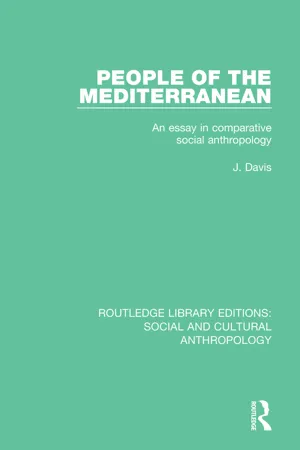
The Mediterranean countries have long attracted the attention of social anthropologists, from Frazer and Durkheim to the present day. In this volume, first published in 1977, Dr Davis reviews the extensive anthropological material collected and published by people who have worked in the area and claims that social anthropologists have a distinctive opportunity to compare similar kinds of institution and process in a variety of contexts – political, economic, bureaucratic, religious. He examines countries, tribes and communities stretching from Spain all the way round the Mediterranean and back along the coast of North Africa. In chapters on economics, stratification, politics, family and kinship, he has found it possible and sensible to set Albanian and Berber tribesmen beside each other, and to discuss Italian and Lebanese peasants in the same paragraph. The result is both a survey of the anthropological material and an essay in comparison, founded on a critique of the work of his predecessors and colleagues. The last chapter is an account of the uses anthropologists have made of the historical sources available to them.
- 298 pages
- English
- ePUB (mobile friendly)
- Available on iOS & Android
eBook - ePub
About this book
Information
1
Introduction
I The distinctiveness of mediterranean anthropology
The mediterranean attracted anthropologists almost before any other region of the world. Maine, Fustel de Coulanges, Robertson-Smith, Frazer, Durkheim, Westermarck - the roll-call of those early generals marks out mediterranean anthropology as a special case: does any other region boast such a field-staff, so distinguished by their contemporaries? One reason they were attracted was the wealth of accessible information and subsequent literary, archaeological, legal, historical scholarship which made it possible to study mediterranean institutions without visiting the mediterranean: of those men only Durkheim and Westermarck were chiefly concerned with the living, and only Westermarck visited his southern contemporaries to conduct his inquiries en poste. Although Mauss visited Morocco and took an interest in what ethnographers were doing there (1930) his major works refer only to classical sources. Men whose understanding of classical or semitic antiquity was of the highest order regarded their southern contemporaries as a source of charming anecdotes or as survivals (e.g. Myres, 1905, 1933, Casson, 1938).
Nevertheless, a consequence of that early interest is that the analysis of mediterranean institutions produced seminal ideas that have influenced the analysis of more remote societies, even if anthropologists in the late twentieth century are not always aware that this is so. Of course, Maine's general statement that progressive societies move from status to contract will probably be identified by most readers as based on the study of ancient mediterranean law; but would the same readers be able to trace the theory of segmentary organisation back to its origins in mediterranean ethnography? The line begins with Hanoteau and Letourneaux, one a lawyer the other a soldier, whose three volumes of guidance to French administrators in Algeria (second edition, 1893) provided Durkheim with the ethnographic evidence on the Kabyle which he uses, in chapter 5 of De Ia division du travail social, to produce his theory of segmentary solidarity - whence it passed into the common currency of anthropology.
Mediterranean anthropology is not merely an intellectual quartermaster's stores, however, for it is also a museum of research strategies. Maine, Fustel de Coulanges, Robertson-Smith, each compressed an eclectic set of evidences, relating to a considerable span of time, to produce an account of some aspect of the structure of a time-island, a period of the past in which change might occur but which was regarded as more or less discrete. Frazer marshalled evidence to produce a generalised account of the fundamental processes of all human society. True, he mixed evidence from the mediterranean, as Ferguson and Millar had done before him, with evidence from other parts of the world but he began and ended in those fearful woods outside Rome where, incidentally, the walls of the temple of Diana now enclose several market gardens. Durkheim, although prepared to discuss living people, relied on his scouts in the field (and they included military men) to provide him with the data which he then analysed so brilliantly. Westermarck, unique among these early men, lived for some decades in the Villa Westermarck in Tangier and with the recognised aid of local assistants (one of whom was decorated at Westermarck's insistence by the President of Finland for his services to scholarship) conducted extensive inquiries each summer. In complete contrast to Durkheim, Westermarck performed almost no analysis on the data he collected: they are presented as a list of customs and beliefs on particular topics as they may be found in nearly every Moroccan group which claims a separate identity. His books read like a territorially restricted Frazer, but without the impetus given by that writer's preoccupation with the dark rituals at Nemi. On Westermarck, Berque's judgment is definitive: his works he says, 'ont inspirées aux chercheurs plus jeunes à la fois admiration, défiance et lassitude' (1955: 129). Fieldwork so prolonged was never so wasted. The two strategies - of structural analysis and of fieldwork - were to be combined elsewhere in other fields, but mediterranean anthropology is an almost complete museum of pre-modern research techniques.
These remarks are about the history of the discipline, and the use which later anthropologists have made of the substantive history of the mediterranean is a topic of such importance it has a chapter of this book to itself. There is one further point which can be made at this introductory stage. Mediterranean people have been affected, sometimes in important ways, by the anthropological works which have been written about them: for better and worse, anthropology has helped create the history of the mediterranean. The French armies in the Maghreb were accompanied by gazetted ethnographers whose task it was to investigate and record the customs and laws of the tribes of Algeria and later Morocco. The Spanish seem to have followed the same policy (see Hart, 1958). For example Montagne, whose work is still of great importance (e.g. Seddon, 1973b; Gellner, 1969; Hart, 1970; Vinogradoff, 1974b), was a capitaine de corvette when Mauss met him in 1930, but a sea captain with one major ethnographic study already published and a distinguished anthropological career to follow. Montagne's work, like that of his less illustrious predecessors, deeply influenced French colonial policy and Moroccan reaction to it (e.g. Brown, 1973) and it was also to some extent a misrepresentation of the facts (e.g. Burke, 1973; and see below, p. 113). Even though there is no way to show that Montagne would not have misrepresented the facts if he had been something other than he was, the direct involvement of serving ethnographers of considerable intellectual merit in military pacification and civil administration permits the student of the history of ideas to examine the fourfold relation between office, intellectual creativity, policy and government as perhaps it can be studied in no other area of the world. Moreover such a study could be complemented by an examination of the other ways in which anthropological ideas have influenced major political movements. The relation between linguistic, sociological, folkloric and physical anthropological studies and nationalistic movements has yet to be studied in detail, but it undoubtedly exists in Balkan movements against Turkish rule and would provide a contrast to the perhaps banally indignant fashion for examining the relation between anthropology and colonial oppression. In some countries the work of providing a scientific basis for nationalist claims took on such symbolic significance that anthropology ceased to be a developing academic activity altogether but was rather fossilised so that a contemporary ethnographer from France or England or America, carrying the very latest lightweight intellectual machine gun in his pack, may be suddenly confronted by a Tylorean or Frazerian professor appearing like a Japanese corporal from the jungle to wage a battle only he knows is still on. Finally, note that if Slavs might use anthropology to justify claims against Turks, the Turks themselves, when their military began the task of creating a new state, would use the work of Durkheim to inspire an official ideology of national unity (Spenser, 1958; Stirling, 1957, 1958).
Mediterranean anthropology is thus distinctive: it attracted early attention from the old heroes; it was the field in which important ideas and techniques were worked out; it is one in which it should be impossible to ignore extensive historical and literary evidence (but see ch. 6), and it is one in which anthropology has had a variety of consequences - as an adjutant of colonial policy perhaps, but also as one element in nationalist struggles for independence and in the formation of that most complex (and un-anthropological) social creation, the nation-state.
Although anthropologists in other areas have begun to come to grips with the unaccustomed problems of description and analysis which a salient and intrusive state and national government may bring, and although it cannot be said that mediterraneanists have tackled the problems with much success, nevertheless it is clear that at least in terms of opportunity the mediterranean is once again a distinctive area. For while Indianists, say, develop notions and conventions for relating the village to the state, and do so with considerable success, the mediterranean affords opportunities for comparison which are unparalleled elsewhere in the world. Consider that there are accounts of political institutions of a recognisably similar kind, from Spain, Portugal, Italy, Greece, the Lebanon and Morocco: by comparing accounts of patronage in these countries the reader may come to some judgements, interim and tentative no doubt, about the consequences of varieties of corporativism, patrimonialism, and parliamentary democracy on village politics, and may add some depth to the rather undifferentiated accounts of 'mediterranean patronage' which have sometimes been allowed to pass. It should also be possible to compare the effects which different kinds of bureaucracy may have on local politics, and to control generalisation by careful study of the interaction of state system and political system. It is the sheer variety of political forms within a sufficiently homogeneous area which makes mediterranean anthropology so promising.
II Its failures
Needless to say the unique opportunities which the mediterranean affords may also be listed as the most significant failures of anthropology there since the Second World War. The lack of comparison has been remarked on before (e.g. Freeman, 1973) but to read ethnography after ethnography, article after article in which no serious attempt is made to compare the author's findings with those of another, is to realise the extent of the desolation. The reader may think he is in a luxuriant intellectual field, but gradually sees there is no controversy; he may think he is in the company of scientists, but finds they do not compare their results. It is a constant theme of this book that mediterraneanists have failed in their plain duty to be comparative and to produce even the most tentative proposition concerning concomitant variations, and so it need not be elaborated here: one example will suffice. The two most rightly respected English mediterraneanists have studied two communities and from the available figures it appears that one of these is the mediterranean community where resources are most unequally distributed and the other is the one where resources are least unequally distributed (the matter is exceedingly complex, see below, pp. 87-8). Neither of them in fact discusses this point at any length, but each insists that his is an egalitarian society in which every man is considered as good as every other man. The simple comparison raises a number of important sociological problems which remain undiscussed. Is it possible to say that one society is more egalitarian than another? What is the relation between considering people to be equals, and the actual distribution of wealth? What sort of institutions exist to allow people to maintain an ideology of equality when the reality is so different? In fact, because these two eminent men have not compared their own findings, or not in print, it is left to others to do so; and the conclusion in this book is that neither society is egalitarian in any sense at all. It is impossible to dispel the suspicion that the discipline might be in better shape if such a discussion had taken place between them, but it has not been the common practice of mediterraneanists to compare their findings and to draw out the intellectual implications. Even in North Africa, where the Berberologists might give some grounds for qualifying that judgement (see especially Hart, 1973), comparison generally remains of a descriptive not an explanatory kind.
Another major failure concerns history: the record is examined in some detail below (see ch. 6) and here it is enough to point to the usually very shallow time-scale in which communities have been set. It is quite rare to read, for example, about the systems of stratification which preceeded those observed by the authors of the monographs, and writers have neglected to show how a contemporary system may be related to what is known of its precursors: that it is valuable to do this is sufficiently shown by those few cases in which it has been done. Or consider family organisation. It is almost universally assumed that the rules of residence, rules of transmission of property which a contemporary anthropologist observes are ancient and unchanging. Yet to consult the studies of Le Play's followers, for example, is to read the record of forms of organisation which have disappeared in the last century; and those ethnographers who have studied records can sometimes show significant changes have occurred in the villages they studied - even if they then present this data as the decay of some family system which is itself taken to have been ancient and unchanging (as is the case with Balkan zadrugas). While most ethnographers of Spain and Italy will mention the consequences of post-Napoleonic tenurial reforms to liberalise landholding and to convert land to a marketable commodity, there is not one who has pointed out that the consequences are different in different places, or has tried to explain in the most cursory way why that should be so. On the southern shore the ethnographers mention the consequences of French or Spanish or Italian conquest and administration, but in many cases the authors confine themselves to a reconstruction of a precolonial era and, with only one or two exceptions, make little attempt to trace a development through the colonial era. Yet as soon as history is allied to comparison important general movements and varations emerge: it is just becoming clear for example that there was a general change in Greece and Cyprus, if not elsewhere too, from bridewealth to dowry in the course of the nineteenth century (a conference on this topic was to have been held in Cyprus by Peristiany), and some account of changes of this kind, or of the different consequences of liberal tenurial reform is clearly of the greatest importance. It is only in the last few years that people have begun to think in these terms, or to give some account of the evolution or development of institutions in the communities they study; and yet the mediterranean has perhaps the most documented and researched history of any region of the world.
It is difficult to explain these failures: some part may be a sense of professional insecurity which mediterraneanists seem to feel. Of course that is only an impression, but it seems current certainly among those who have worked in countries on the European littoral: a sense that anthropology is only anthropology if it is done very much a broad, in unpleasant conditions, in societies which are very different from the ethnographer's native habitat, very different from the sort of place where he might go on holiday. It is not uncommon, at any rate in England, to meet backwoods anthropologists who clearly convey their sense of superiority: mediterraneanists do not undergo a complete cultural disorientation such as those who work in sub-Saharan Africa or New Guinea sometimes claim to have experienced and benefited from. This book is not the place to discuss the rights and wrongs of such judgements: it may be, indeed, that experience of privation and disorientation heightens an anthropologist's sense of the problematic; and it must be agreed that mediterraneanists do often enough take for granted forms of organisation (for example, of the family), which, had they been stimulated by disorientation, they might have investigated more thoroughly. That is possible. But it remains the case that there is no necessary connection between hard ship and the sense of the problematic; and the intellectual failures of mediterraneanists are therefore not solely attributable to the fact that they work close to home. Nevertheless it is perhaps a consequence of their sense of professional insecurity that mediterraneanists have tended to under-emphasise those qualities of the mediterranean which might distinguish their work and lead them to differentiate themselves from their colleagues: they have ignored or abused history, and ignored those millennia of intensive interaction which have made mediterranean societies. For that is what the failure to compare, the failure to establish simple patterns of concomitant variation amounts to.
The desire to be as primitive as every other colleague may be equally responsible for two other failures which must be mentioned here. Mediterraneanists have chosen to work in the marginal areas of the region – in the mountains, in the small peasant communities, in the tribal hinterlands of the Maghreb. It is not really adequate to explain this almost complete uniformity of choice by saying that anthropologists work alone and that they cannot therefore grasp the complexities of cities. On the one hand, it can be done, as the late Lloyd Fallers showed in his work in Turkey. On the other hand, even if it requires unaccustomed techniques and a willingness to abandon the pretence at holistic analysis, it is possible to investigate the relation between bourgeois and villageois. That is what M. Corbin did, for example, when she investigated the patterns of marriage and migration into the Spanish city of Ronda from its satellite settlements, using part of her fieldwork period to investigate municipal records (Corbin and Stirling, 1973). In the Lebanon alone it seems to have been impossible to ignore the ties of kinship and patronage which link the towns and the villages; consequently there are a number of excellent or interesting articles on this subject (Khuri, 1976; Nader, 1965a; Peters, 1972; Gilsenan, 1973a). But on the whole the study of the links of rural populations with urban ones has not been seriously undertaken, and there are very few city studies - even though cities derive their populations from the country, even though every mediterraneanist makes an obligatory reference to the fact that peasant societies are part societies, encapsulated in nation states.
That is the fourth weakness in mediterranean anthropology. It may be said that some progress has been made in discussion of political and administrative links between villages and their controlling communities: Pitt-Rivers's early discussion of mediation set a good example; Weingrod (1967-8) and Silverman (1965) have made important contributions to the study of patronage and the way it may, in various forms, link the village to the 'state'. However, discussion is still largely limited to the important but partial topic of the consequences of mediation for villagers and village political institutions. Loizos (1975) was able to follow some cases through from village to minister or party leader; Waterbury (1970) has a unique analysis of elite politics in Morocco, and Khalaf (1976) has a short account of political and electoral loyalties in the Lebanon. But with these exceptions the investigation of national politics is in its infancy.
Politics is only one part of the problem, and it would be wrong to concentrate on it because successes may be signalled there. At least it may be said that politics is observable: the institutions and rituals of representation can be described; decisions are or are not taken; conversations do or do not take place – politics is, in spite of the obvious difficulties, the most accessible part of a much larger problem, formulated by Redfield in terms of 'big' and 'little' traditions, and not advanced by mediterraneanists since then (but cf. Pitkin, 1959b). The fact is that all the communities of the mediterranean share in cultures which are extremely rich, contribute part of their identity, and are not coterminous with the community. A Pisticcese can listen at festivals to the band playing medleys from Verdi and Puccini, and condescend to foreigners – 'We Italians are naturally musical.' Peasants quote Dante and read Manzoni; educated men infiltrate lines of Leopardi into their conversation and watch for signs of recognition. In the same category come the Berber's recognition of the spiritual authority of the Sultanate, and the Cypriot child called Ariadne. Tokens of what is misleadingly called 'Italian' (or Islamic or Greek) culture continually appear in remote villages, and constitute a problem of explanation.
Perhaps the problem can be stated most clearly with the example of religion. Mediterranean religions are all 'of the Book', have highly developed theologies, exegetical apparatus and cosmologies. There are authorities on religion, in some cases with powers to sanction erroneous practice or belief. The religious life, customs and beliefs of villagers and tribesmen rarely coincide with the prescriptions of exegetically elaborated and sanctioned religion, and the intellectual problem is to explain the relation between the two. At an administrative level it is a matter of discovering what people in authority think and do about the 'simple faith' of their co-religionists. At another level, it is a problem of trying to explain the principles by which some 'official' religious doctrines and practices are accepted locally and others not. Campbell (1965) has described the way in which Sarakatsani recognise the sinfulness and inevitability of some of their idiosyncratic behaviour – but they are not convinced that what they do is part of the official religion, linking them into a broad community of the faithful.
Only Gearing (1968) has said that the question is one of selectivity, but his preliminary note has not yet been filled out. Clearly, in addition to an explanatory theory of selectivity, anthropologists need to discuss those elements of local religion which are purely local – where do they come from? What anthropologists have done does not meet the problem: they have described festivals and the part they play in community life (see especially Gower Chapman, 1973; Boissevain, 1965; Freeman, l968b, 1970); they have described the roles of priests and of spiritual rel...
Table of contents
- Cover
- Half Title
- Title
- Copyright
- Original Title
- Original Copyright
- Contents
- Dedication
- Preface
- 1 Introduction
- 2 Economic anthropology of mediterranean societies
- 3 Stratification
- 4 Politics
- 5 Family and kinship
- 6 Anthropologists and history in the mediterranean
- Notes
- Bibliography
- Index
Trusted by 375,005 students
Access to over 1.5 million titles for a fair monthly price.
Study more efficiently using our study tools.
Frequently asked questions
Yes, you can cancel anytime from the Subscription tab in your account settings on the Perlego website. Your subscription will stay active until the end of your current billing period. Learn how to cancel your subscription
No, books cannot be downloaded as external files, such as PDFs, for use outside of Perlego. However, you can download books within the Perlego app for offline reading on mobile or tablet. Learn how to download books offline
Perlego offers two plans: Essential and Complete
- Essential is ideal for learners and professionals who enjoy exploring a wide range of subjects. Access the Essential Library with 800,000+ trusted titles and best-sellers across business, personal growth, and the humanities. Includes unlimited reading time and Standard Read Aloud voice.
- Complete: Perfect for advanced learners and researchers needing full, unrestricted access. Unlock 1.5M+ books across hundreds of subjects, including academic and specialized titles. The Complete Plan also includes advanced features like Premium Read Aloud and Research Assistant.
We are an online textbook subscription service, where you can get access to an entire online library for less than the price of a single book per month. With over 1.5 million books across 990+ topics, we’ve got you covered! Learn about our mission
Look out for the read-aloud symbol on your next book to see if you can listen to it. The read-aloud tool reads text aloud for you, highlighting the text as it is being read. You can pause it, speed it up and slow it down. Learn more about Read Aloud
Yes! You can use the Perlego app on both iOS and Android devices to read anytime, anywhere — even offline. Perfect for commutes or when you’re on the go.
Please note we cannot support devices running on iOS 13 and Android 7 or earlier. Learn more about using the app
Please note we cannot support devices running on iOS 13 and Android 7 or earlier. Learn more about using the app
Yes, you can access People of the Mediterranean by J. Davis in PDF and/or ePUB format, as well as other popular books in Social Sciences & Sociology. We have over 1.5 million books available in our catalogue for you to explore.