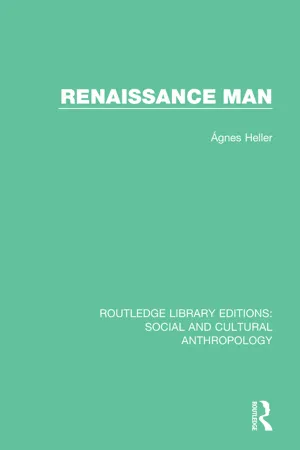
Considering such witnesses of the time as Shakespeare, Dante, Petrarch, Michelangelo, Machiavelli, Montaigne, More and Bacon, Agnes Heller looks at both the concept and the image of a Renaissance man. The concept was generalised and accepted by all; its characteristic features were man as a dynamic being, creating and re-creating himself throughout his life. The images of man, however, were very different, having been formed through the ideas and imagination of artists, politicians, philosophers, scientists and theologians and viewed from the different aspects of work, love, fate, death, friendship, devotion and the concepts of space and time. Renaissance Man thus stood as both as a leading protagonist of his time, one who led and formulated the substantial attitudes of his time, and as one who stood as a witness on the sidelines of the discussion. This book, first published in English in 1978, is based on the diverse but equally important sources of autobiographies, works of art and literature, and the writings of philosophers. Although she uses Florence as a starting point, Agnes Heller points out that the Renaissance was a social and cultural phenomenon common to all of Western Europe; her Renaissance Man is thus a figure to be found throughout Europe.
- 488 pages
- English
- ePUB (mobile friendly)
- Available on iOS & Android
eBook - ePub
Renaissance Man
About this book
Information
Part One
Uneven development
Part One
Uneven development
The basis for the uneven development of the Renaissance era was of course the uneven development of the forces of production in the social structure of the Middle Ages — but the 'unevenness' of the Renaissance displays important differences, quantitative and qualitative, by comparison with the earlier age. I will single out only a few essential factors. As it became possible to develop the forces of production at an accelerated tempo, existing and ever-growing differences in tempo, ranging from stagnation all the way to maximum exploitation of the possibilities of development (the beginnings of capitalist reproduction on a large scale) were accentuated. As a result, there appeared a number of decisively different possible paths and forms for the emergence of capitalist relations of production. After the nation became the economic unit, these various paths and forms came to appear as national paths and national forms, going to shape the varieties of national character; henceforward national character was to have its effect on the further development of the economic structure, on one hand, and gradually to set its stamp on the tone of each culture, on the other. The differentiated and uneven development of the various nations was made even more explicit by the transformation of history first into European history and then, later, into world history. Those nations whose development was more rapid and took classical forms left a more pronounced mark on the total historical process — but without being able to stop the stagnation of other nations; within a unitary Europe advanced and backward nations appeared, and with them an awareness of advanced development and underdevelopment was also born. Petrarch, travelling in France and Italy, observed only differences in customs and manners; any idea of 'development' and 'underdevelopment' was entirely foreign to the world of his thinking. But Vives thought he had found in England a country that was 'not Spanish' and a society that afforded a path towards greater possibilities; Machiavelli in his polemic against mercenary armies cited the superiority of the popular levies of the Swiss war of independence; Giordano Bruno all but fled from Italy to the countries where real or imaginary freedom of thought existed; Galileo regarded his colleagues in Holland with justified envy; Campanella asked and received asylum in France. Common to the last three examples was a fear of the Inquisition. But the revival of the Inquisition in sixteenth-century Italy was itself one factor in the process of refeudalization.
The fact of the unity of European development — and at the same time its unevenness — appears in all its explicit brutality only in the sixteenth century. It is linked with three dates (the dates, of course, are only conjunctures at which previous differences in development came to a head, creating the basis for a further parting of the ways). These dates are 1517, 1527, and 1579 (or 1588). The first marks the Reformation, embodying and setting off the first great popular movement of the age (culminating in the Peasant War), and at the same time making possible the expression in religious and ideological terms of the parting of ways among the nations; Calvinism would create the religious form most appropriate for the development of capitalism (as Max Weber recognized, while reversing the terms). In 1527, with the Sack of Rome, the fate of the Italian Renaissance was sealed; hopes for a united Italy, and hence for the further development of Italian capitalism, were shattered once and for all; the influence of Spanish power worked on the Church to give an unequivocal answer to the Reformation: the wing led by Sadoleto, which strove to humanize the Church in the spirit of the Renaissance, had to give way to a hard-fisted Jesuit leadership supported by the Inquisition; and thus the process by which the Church had begun to accommodate itself to the new situation created by capitalism came to a reactionary end. Again, the growth of Spanish influence was itself a consequence of an earlier economic conflict, the exhaustion of the financial resources of a Florence (the party of the Black Guelphs) which had supported the Renaissance papacy, when in the new European situation the Church needed a far broader material basis to survive — but that is a problem which we cannot touch upon here.
In the general course of social development 1579 and 1588 may be regarded as forming, in the last analysis, one date. They mark the failure of the Spanish path of bourgeois development as well. The year 1579 saw the triumph of the Netherlands war of independence, the first modern war of national liberation, led and supported by the national bourgeoisie, and 1588 brought the destruction of the 'Invincible' Armada. Here already we meet with the results of the first English wave of primitive capital accumulation; at the same time the last obstacles to the classical course of capitalist development fall away.
The greatness of the thinkers and artists of the sixteenth century is to a great extent determined by how deeply they experienced or thought through these critical passages. From this point of view it is all the same whether they were natural philosophers or social reformers, painters or poets. (Of course, the question of whether they experienced them or thought them through arose only to the degree that the conflicts came to the surface in a given place. Thus Tintoretto's vision of reality became a tragic one only after Lepanto, for in Venice it was only then that the critical turning-point came.) Nor does it matter whether they affirmed or rejected the new course of development — though it does matter what they affirmed in it and what they rejected. Here I should only like to characterize in a few words the main types. Here one finds Aretino, unwilling to understand anything, immersing himself in the world of the Venetian aristocracy and going on playing the fool as if he were still at the court of Leo X. Here is Castiglione, recalling with no small amount of resignation the harmonious life of the High Renaissance, at a time when its foundations had already become eroded. Here is Erasmus, who foresaw nothing of the cataclysms of the century, dreaming, together with Vives and More at the court of the young Henry VIII, of a world in which the pax romana would return, a rationalized and universal Christianity would reign, the feudal world would go down to defeat, and knightly ideals would die away and be replaced by gradual social reforms and the trained humanists who would bring them about, the 'knights of Christianity'. But the critical junctures arrived just the same. Erasmus saw the situation but was unable to deal with it; he could neither formulate the new problems nor understand them. Hence the bitter but undirected trenchancy of the Praise of Folly; but the wit and veracity of the details cannot conceal the confusion of the total conception. Erasmus clung to a literate humanism whose time had already gone by, but at the same time he was too much the plebeian to be satisfied with a bookish, intensive kind of humanism, such as the Counter-Reformation was. He clung even more to a unitary devotio Christiana and to the compromising over of conflicts, and, as a consequence, he was unable to join the movement which attracted others with a plebeian attitude like his: the Reformation. At the same time he was sceptical about capitalist development: he viewed both the unfolding of productive forces and the advance of scientific thinking with a sceptical eye. Before 1517, an abstract synthesis of all the forces of the Renaissance still seemed possible; at that time Erasmus's viewpoint was not a profound one, but it was certainly not compromising either. Between 1517 and 1527 the same attitude became objectively both compromising and superficial. We are far from accepting Stefan Zweig's interpretation of Erasmus, which makes of the philosopher of Rotterdam a cringing petty bourgeois opposed to any kind of engagement. Nothing was further from Erasmus than fear of making a commitment. It was simply that, as a result of his own standpoint, there was no longer anything to commit himself to; his compromise, be it repeated, was not a subjective but an objective one, which did not exclude personal honour and courage.
Thomas More's stance may be understood as a counterpoint to that of his friend Erasmus. More, in contrast to Erasmus, recognized the new situation for what it was, and knew that things had happened which were irrevocable. It was in this vein that he dealt with the demand that he act as some sort of 'philosophical tutor' to Henry VIII: he realized that Henry VIII would never be a 'Christian prince' and that the age of 'Christian princes' generally was over. He saw, too, that the reception and official approval of Calvinism would open the gates to the process which we call 'primitive accumulation', and that thereby the social reforms which he and Erasmus had dreamed of would become impossible once and for all. He did not doubt for an instant that it was necessary to shoulder the consequences which sprang from his recognition of these facts; his martyrdom only sealed his readiness to do so. The same profound understanding of the age provides the pathos of Giordano Bruno's life, though with the terms reversed. It must be emphasized that Bruno was not the only man summoned before the Inquisition during the first wave of the Counter-Reformation. But the majority of thinkers kept to the age-old custom of making a formal recantation. Later, when Galileo did the same thing, he was not acting in any unusual way; he was merely following the ancient custom amid changed circumstances. Thus it was that in his day Valla retracted his discoveries of fabrications of the Bible, Nicholas of Cusa his denial of original sin, and Cardano the many medical discoveries of his which had appeared in magical trappings. Of course, we must emphasize the changed circumstances of the Counter-Reformation, for these found expression in the consequences as well. Not only did Valla and Cusa go on living as free and respected men after they had made their recantations. Nicholas of Cusa even retained his ecclesiastical office; the Renaissance popes themselves regarded the retractions as a formality. During the age of the Counter-Reformation, however, severe punishments were imposed on the victims of the Inquisition; though they might save their lives, they were often condemned to life imprisonment. The Church's demand for recantation was no longer a formality: it implied an ideological victory over the opponent. Bruno recognized the fact when he broke the tradition of recantation and accepted the ideological struggle, regarding the Church as the enemy of his efforts. Bruno treated the Copernican picture of the cosmos not as a scientific discovery, but as a new world-view which entailed the affirmation of the changes that had taken place. For he regarded the great changes which the century had brought as irrevocable; he took the side of Calvinism as a movement, while viewing its concrete Genevan form and its religious content with growing reservations and eventually rejecting it, and taking his stand for an English type of solution he went to do battle, on the basis of this conscious world-view, with the Counter-Reformation. If, among those who deeply understood the age, we wish to refer to an artist, we must mention the name of Michelangelo. He became the universal artist of the epoch because in every period of his long life he lived through and generalized the conflicts of his time. One and the same man represented in the David the symbol of the Florentine polis and in the Medici tombs the ruin of its hopes, and made magnificent compositions of the idea of man deified in the tomb of Julius II and of the historical vision of man as dynamic in the Sistine frescoes; and the same man gave expression to the latest cataclysms in the Last Judgment and to a despairing sorrow in the last pietás.
In discussing the uneven pace of development and the conjunctures of world-historical importance which marked the sixteenth century, we cannot escape the problem of mannerism. This designation for the art (chiefly the Italian art) of the period following the Sack of Rome is rather unfortunate, for it employs a secondary formal characteristic to define a whole historical and artistic period. But however inadequate the concept of mannerism may be, it contains a most important problem: the fact that after the Sack of Rome (the date, of course, is only an approximation) Italian art can no longer be regarded as Renaissance art, but can not yet be considered baroque. Max Dvorak applies this term (correctly, we believe) to Cervantes as well, a creative artist in a nation where, as in Italy, the course of development had become 'petrified'. (At the same time he applies it — mistakenly — to all of Shakespeare, for in England artistic problems and categories evolved differently as a result of decisive differences in social development.) The marks of mannerism are the dissolution of harmony, a shift in the proportions of subjectivity and objectivity in the direction of subjectivity, the depiction of conflicts which remain artistically unresolved, and a greater prominence of the tragic and the comic; in their unity and complexity these are indeed characteristics which sharply distinguish the artistic experiments of the period from the manifold but still unitary course of Renaissance art. The category of 'mannerism' also obscures the essential distinction which can be drawn between the purely formal innovators and conformists of the period, like Veronese or Bassano, and those whose search for new forms sprang from an experience of new problems, like Parmigianino or Tintoretto. For our purposes, the important thing in this connection is to establish that the depiction of man by the most profound artists who are usually considered mannerists is no longer essentially a part of the problematics of the Renaissance concept and ideal of man, and can be dealt with only in terms of the dissolution of that concept and ideal.
In Italian philosophy the Renaissance character prevails for about half a century longer than in art. This was so first of all because the subject matter of philosophy was much more international and hence could take up the problems of social development beyond the frontiers of Italy as well. At the same time, the technical and scientific discoveries of the century, culminating in the Copernican picture of the universe, made it possible to deal with questions which gave such a powerful impetus to the immanent development of the earlier natural philosophy (and the attempts at an anthropology which were inseparably bound up with it) that philosophy was able to spill over the usual historical boundaries. And finally, the necessity of launching a counter-attack against the onslaught of the Counter-Reformation sprang primarily from the development of natural philosophy, which demanded a further elaboration of its categories. Italy's crisis found expression here in the fact that Italian natural philosophy was unable to go beyond the limits of the Renaissance in posing the relevant questions. When the creativity of Renaissance natural philosophy (and anthropology) came objectively to an end with Galileo, and a new methodology became necessary, there was no one in Italy capable of taking that step. While in France Montaigne and Charron were followed by Descartes, and in England Bacon was succeeded by Hobbes, in Italy the development of philosophy comes to a close with Campanella — the same Campanella who, visiting France in 1634(!), sought the friendship not of Descartes but of Gassendi.
I have dwelt at length on the great international turning-points of the sixteenth century, those conjunctures at which the uneven pace of development suddenly burst out into the open, closing the golden age of the Renaissance in some places and opening the way to it in others. I should like to stress, however, that in between these great international turning-points local victories and disasters did not, of course, cease. I might cite the fact (important for our purposes) that Venice, the Italian republic most independent of the papacy, did not immediately feel the impact of the Sack of Rome. For Venice, the battle of Lepanto was the turning-point. On the other hand, the French occupation of 1500 had already put an end to the more superficial Renaissance development of Milan. French developments received a strong setback between François I and Henri IV from the wars of religion and the extirpation of a part of the Huguenots. These facts, however, do not alter the central importance of the dates cited above.
From the standpoint of the emergence of a dynamic concept of man the Italian course of development is the most important. But even this was uneven, from the very beginning of the Renaissance. We must often bear in mind the great differences in the concrete character of the economic base, of political forms, of the breadth of the Renaissance life style, and of the degree of its impact on the common people.
In grouping the Italian states first of all from the standpoint of their political forms, I will be considering one of the explicit criteria of overall bourgeois development. From the fourteenth to the sixteenth centuries the kingdom of Naples was, with respect to bourgeois development, the most retarded; here Renaissance cultures spread in a noble and aristocratic form and the people remained untouched by it. The principalities where 'tyrants' ruled — Ferrara, Milan, Urbino, and Rimini, to mention only the most important —were founded on an equilibrium between nobility and bourgeoisie; feudal distinctions still existed, but no single estate had an economic preponderance. From the fifteenth century — when the tyrants began to come more and more from the ranks of the condottieri — the stability of their social systems was based on a complicated and regular system of taxation, which was left unchanged; the assassination of the tyrant was a recurrent event but went on 'over the heads' of the people, and in no way overturned the whole system as similar political murders did in Florence, for example. The Renaissance manner of life and way of thinking were more or less general among the bourgeoisie of these towns, but the 'high culture' of the Renaissance was still peculiar to the courts of the tyrants. The golden age of their culture is bound up with the name and power of one or another of their culture-loving princes, and to this degree the Renaissance was a superficial phenomenon there ...
Table of contents
- Cover Page
- Half-Title Page
- Title Page
- Copyright Page
- Original Title Page
- Original Copyright Page
- Table of Contents
- Acknowledgments
- Introduction Is there a 'Renaissance ideal of man'?
- Part 1 Uneven development
- Part 2 Antiquity and the Judaeo-Christian tradition
- Part 3 Ethics and life: man's practical possibilities
- Part 4 Philosophical anthropology
- Index
- Index
Trusted by 375,005 students
Access to over 1.5 million titles for a fair monthly price.
Study more efficiently using our study tools.
Frequently asked questions
Yes, you can cancel anytime from the Subscription tab in your account settings on the Perlego website. Your subscription will stay active until the end of your current billing period. Learn how to cancel your subscription
No, books cannot be downloaded as external files, such as PDFs, for use outside of Perlego. However, you can download books within the Perlego app for offline reading on mobile or tablet. Learn how to download books offline
Perlego offers two plans: Essential and Complete
- Essential is ideal for learners and professionals who enjoy exploring a wide range of subjects. Access the Essential Library with 800,000+ trusted titles and best-sellers across business, personal growth, and the humanities. Includes unlimited reading time and Standard Read Aloud voice.
- Complete: Perfect for advanced learners and researchers needing full, unrestricted access. Unlock 1.5M+ books across hundreds of subjects, including academic and specialized titles. The Complete Plan also includes advanced features like Premium Read Aloud and Research Assistant.
We are an online textbook subscription service, where you can get access to an entire online library for less than the price of a single book per month. With over 1.5 million books across 990+ topics, we’ve got you covered! Learn about our mission
Look out for the read-aloud symbol on your next book to see if you can listen to it. The read-aloud tool reads text aloud for you, highlighting the text as it is being read. You can pause it, speed it up and slow it down. Learn more about Read Aloud
Yes! You can use the Perlego app on both iOS and Android devices to read anytime, anywhere — even offline. Perfect for commutes or when you’re on the go.
Please note we cannot support devices running on iOS 13 and Android 7 or earlier. Learn more about using the app
Please note we cannot support devices running on iOS 13 and Android 7 or earlier. Learn more about using the app
Yes, you can access Renaissance Man by Ágnes Heller in PDF and/or ePUB format, as well as other popular books in Social Sciences & Sociology. We have over 1.5 million books available in our catalogue for you to explore.