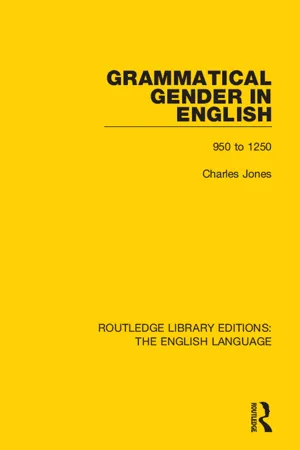
First published in 1988, this book explores the grammatical loss of gender in English. It demonstrates that from the end of the Old English period, there was a considerable time period, of about three hundred years, during which there existed "echoes" of the gender classification of nouns. The study records the best known conclusions concerning the behaviour of anaphoric pronouns under grammatical gender "stress" in the late Old English and Middle English periods. It focuses on a discussion of attributive word morphology in the noun phrase.
- 246 pages
- English
- ePUB (mobile friendly)
- Available on iOS & Android
eBook - ePub
About this book
Information
1 | INTRODUCTION GRAMMATICAL GENDER IN WEST SAXON OLD ENGLISH |
1.1 GENDER CLASSIFICATION AND ITS CRITERIA
It is possibly the syntactic and morphological consequences of its having a system whereby nominal lexical items were classified by grammatical gender that more than anything else causes Old English to appear so unlike the language at any later period. The fact that the grammar of Old English demanded the dictionary grouping of its nominal word stock into gender classes was responsible for the production of some of the rich morphological patterns so characteristic of the language’s nominal attributive and anaphoric pronominal systems. Although there was a considerable degree of overlap in actual phonetic output shape, the function of this morphological diversity was at least in part to reflect the case relationship characteristics of nominal and pronominal arguments in propositions in a shape appropriate to the the lexical gender assignment of their “head” or controlling noun. The terminations of attributive words like definite determiners and “strong” adjectives in the noun phrase, together with the diversity of phonetic shape in “third person” anaphoric pronouns in singular number contexts all attested, albeit never in any one–to–one fashion, to the case relationship status of the nominal argument with which they were associated vis a vis the sentential predicate; in addition, that case relationship indicating shape could itself reflect the gender classification of the nominal item with which it was in construction or which it “replaced”. The details of this case/gender expression we shall set out below.
Those “periods” of the language traditionally referred to as late Old English and early Middle English (the temporal span encompassing the tenth to the thirteenth centuries) witnessed, as is well known, a considerable degree of syntactic and morphological change in this area of the grammar to an extent to which the inflectional morphology of nominal attributives eventually came to be totally depleted, while the criteria for anaphoric “replacement” of pronominal forms were “rationalized” upon a model more or less dependent upon extra–linguistic, biological factors (Moore (1921)). This monograph will describe the processes whereby the first of these two great changes came about. Its main aim will be to show that the gender reflecting morphology of such attributive words as definite articles, possessive pronouns, “strong” adjectives and the like was not immediately the subject of a “sudden” catastrophic neutralization; on the contrary, with the lack of a thorough–going and coherent set of criteria for the assignment of nominal gender class, the inflexional morphology which that historical assignment produced was “reanalyzed” on the basis of several sets of semantic and other norms. Rather than produce complete de–morphologizing of attributive words in noun phrases, we shall show that such a reanalysis resulted (at least for a time) in the creation of a rule system whereby specific manifestations of that attributive morphology were assigned an innovative set of expressive functions not all of which were historically inherent in it (Samuels (1972) p. 156).
The semantic and syntactic bases for the assignment of nouns to particular gender classes rarely appears to be a straightforward matter for those languages which exhibit the phenomenon of grammatical gender. In the Torricelli and Lower–Sepik language group of New Guinea, for instance, while some nominal item gender classification is based on factors relating to animacy, sex and human–ness, others are categorized according to the dictates of their phonological shape. Foley and van Valin (1984) point to the classification of some nouns in this language group on the basis of the syllable final consonantal and vocalic terminations of noun “stems”, and even when semantic, biology based gender class specifying criteria are utilized, they are far from being simple:
“Yimes is a thoroughgoing gender system language with ten major gender classes and half a dozen or so minor classes. Four of the major classes have membership determined on semantic grounds: one denotes female humans, another, male humans, a third, higher animals, like dogs, pigs or crocodiles, and the last plants, which serve a useful function within the culture.”
The principles lying behind the gender grouping of West Saxon Old English nominal lexical items has been the subject of much debate and has tended to centre around both syntactic (or at least morpho–syntactic) and semantic sets of motivation. Among the former might be a model for gender assignation based upon nominal declensional class. Fodor (1959) goes so far as to argue that gender systems themselves actually originated through the process of a simple “copy” by attributive items in the noun phrase of the inflectional morphological characteristics of the head noun itself, such that there existed in the beginning a one to one correspondence between declensional and gender specific paradigms (van Royen (1929); Kuryłowicz (1964); Lafont (1970); Flasdieck (1930)). But whatever the proto language situation, by the time we come across Old English materials any such system has been rendered irrecoverable by, among other factors, phonetic attrition to the extent that there was considerable syncretism between nominal declensional category and a much depleted three gender classificatory model. Yet there appear to be some residual effects of a gender/declensional correlation in that < –a; –að; –dom; –hal; –ing and –scipe> nominal terminations appear to be regularly associated with the masculine, < –nes; –ung; –ðo/ðu and –ræden> with the feminine and < –et, –lac> with the neuter (Mitchell (1986) §§ 58–61), but in most declensional types the gender class symmetry has effectively been neutralized (Meringer (1887)).
More promising as a template upon which to assign gender class to nominal lexical items might be the semantic criteria relating to the biological (especially sexual) characteristics of nominal referents. Clearly in a three gender system like that of Old English (and that only in singular contexts – gender assignment having been rendered unproductive in the plural) there will necessarily be conflation between possible real world biological subdivision under fairly “rough and ready” headings whereas in a language such as Yimas referred to above with its ten and more gender classes or in Bantu where there are at least nine (Givón (1970); Gazdar, Klein and Pullum (1983) pp. 184 ff) a greater degree of syntactic class to natural biological grouping is obviously possible, although it is not always achieved in such a simplistic way. Bruce (1979) for example points out that in the Alamblak of Papua and New Guinea “masculine gender with inanimate objects denotes long thin things, while feminine denotes short, fat and round objects” (Foley and van Valin (1984) p. 325). Most commentators however assert that nominal gender class assignation in “classical” Old English was at least partially determined by semantic criteria centred upon notions such as animacy/inanimacy, human/non–human–ness and male/female (Mitchell (1986) §§ 55–56; Mōri (1979); Wyss (1982); Dekeyser (1973); Ross (1936); Moore (1921); Ausbüttel (1904); Landwedr (1911); Martin (1971); von Lindheim (1969); Lommel (1924); de la Grasserie (1904); Ervin (1962); Wienold (1967); Lohmann (1932)). An examination of nominal lexical items in Bosworth–Toller (1882) reveals that there indeed appears to have been a strong tendency to at least associate human male animates with a particular gender class traditionally (and perhaps circuitously) called the masculine. Likewise, although as we shall shortly see it was not as fully developed, there was a tendency to restrict human females to a single gender class grouping – the feminine.
In the case of the former, this classification was in most cases accompanied by inflectional morphological identification: there were at least four productive nominal inflectional shapes in “subject” marking contexts – < –a>; < –ere>; < –ende> and < –man(n)>. Of these the numerically largest group of items occurs with the < –a> type, for instance:
andsaca “adversary”; beodena “praeceptor”; berebrytta “barn keeper”; bora “ruler”; brytta “lord”; byrnunga “warrior”; ciepa “merchant”; crocwyrhta “potter”; cypa “tradesman”; dema “judge”; ealda “old man”; efengelica “fellow”; fliema “out law”; folctoga “chief”; fricca “herald”; geonga “young man”; goldgiefa “prince”; heahgerefa “lord”; hereræswa “commander”; swangerefa “reeve”; syla “ploughman”; tidscripta “chronicler”; treowyhta “carpenter”; wesa “drunkard”; wuduwa “widower”
of which there are some two hundred and fifty items of this type listed in Bosworth–Toller (1882). Almost as common are those nominal items terminated by < –end(e)> and < –ere> suffixes:
æsceberende “warrior”; bewerigende “protector”; bodigende “teacher”; frumsceppende “creator”; hatigende “enemy”; lufigende “lover”; metigende “ruler”; nowende “sailor”; ofersceawigende “bishop”; scipierende “sailor”; beatere “boxer”; cancelere “chancellor”; clænsere “priest”; demere “judge”; drihtere “steward”; efenscolere “scholar”; feohtere “fighter”; hæsere “lord”; hlytere “priest”; notere “scribe”; roþere “sailor”; tannere “dyer”; witnere “torturer”.
Least productive, at least in terms of the number of tokens recorded in Bosworth–Toller (1882) – only some eighty in all – are those items suffixed by < –man(n)>, for example:
æcermann “farmer”; æscmann “sailor”; bærmann “porter”; dryhtealdormann “bridesman”; ealdorman “ruler”; fostermann “bondsman”; heremann “warrior”; lahmann “lawman”; lidman “sailor”; mynstermann “monk”; plegman “athlete”; steorman “pilot”; wæpnedman “male person”
Yet we must bear in mind that all three of the above suffixes could be appended to items which presumably (although it is not always easy to be sure) could have both male and female reference:
burhman “citizen”; cearlman “peasant”; feþeman “pedestrian”; lefman “sick person”; neahman “neighbour”; æslitende “law breaker”; forewyrcende “servant”; lufiende “lover”; retende “comforter”; wegferende “traveller”; heahsangere “singer”; murcnere “complainer”; slæpere “sleeper”; tumbere “dancer”; godwebwyrhta “weaver”; fulwihtbena “candidate for baptism”.
Inflectionally marked female humans assigned to the feminine gender are relatively few in number, only some thirty four appearing with suffixes like < –i(n)cge>; < –i/estre>; < –cwen(e)> and < –moder>, for instance:
acennincge “mother”; byrdicge “sorc...
Table of contents
- Cover
- Half Title
- Title Page
- Copyright Page
- Original Copyright Page
- Dedication
- Table of Contents
- PREFACE
- CHAPTER ONE Introduction: Grammatical Gender in West Saxon Old English
- CHAPTER TWO The Tenth Century: The late Old English gloss to the Lindisfarne Gospels
- CHAPTER THREE The Tenth Century: The late Old English gloss to the Durham Ritual
- CHAPTER FOUR The Twelfth Century: The Peterborough Chronicle
- CHAPTER FIVE The Thirteenth Century: Laʒamon’s Brut and Vices and Virtues
- REFERENCES
- SUBJECT INDEX
Trusted by 375,005 students
Access to over 1.5 million titles for a fair monthly price.
Study more efficiently using our study tools.
Frequently asked questions
Yes, you can cancel anytime from the Subscription tab in your account settings on the Perlego website. Your subscription will stay active until the end of your current billing period. Learn how to cancel your subscription
No, books cannot be downloaded as external files, such as PDFs, for use outside of Perlego. However, you can download books within the Perlego app for offline reading on mobile or tablet. Learn how to download books offline
Perlego offers two plans: Essential and Complete
- Essential is ideal for learners and professionals who enjoy exploring a wide range of subjects. Access the Essential Library with 800,000+ trusted titles and best-sellers across business, personal growth, and the humanities. Includes unlimited reading time and Standard Read Aloud voice.
- Complete: Perfect for advanced learners and researchers needing full, unrestricted access. Unlock 1.5M+ books across hundreds of subjects, including academic and specialized titles. The Complete Plan also includes advanced features like Premium Read Aloud and Research Assistant.
We are an online textbook subscription service, where you can get access to an entire online library for less than the price of a single book per month. With over 1.5 million books across 990+ topics, we’ve got you covered! Learn about our mission
Look out for the read-aloud symbol on your next book to see if you can listen to it. The read-aloud tool reads text aloud for you, highlighting the text as it is being read. You can pause it, speed it up and slow it down. Learn more about Read Aloud
Yes! You can use the Perlego app on both iOS and Android devices to read anytime, anywhere — even offline. Perfect for commutes or when you’re on the go.
Please note we cannot support devices running on iOS 13 and Android 7 or earlier. Learn more about using the app
Please note we cannot support devices running on iOS 13 and Android 7 or earlier. Learn more about using the app
Yes, you can access Grammatical Gender in English by Charles Jones in PDF and/or ePUB format, as well as other popular books in Languages & Linguistics & Linguistics. We have over 1.5 million books available in our catalogue for you to explore.