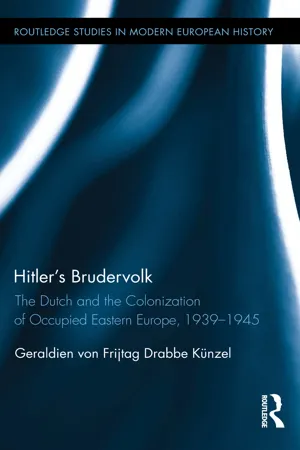
This is the first academic book on Dutch colonial aspirations and initiatives during WWII. Between the summers of 1941 and 1944, some 5,500 Dutch men and women left their occupied homeland to find employment in the so-called German Occupied Eastern Territories: Belarus, the Baltic countries and parts of Ukraine. This was the area designated for colonization by Germanic people. It was also the stage of the "Holocaust by Bullets," a centrally coordinated policy of exploitation and oppression and a ruthless anti-partisan war. This book seeks to answer why the Dutch decided to go there, how their recruitment, transfer and stay were organized, and how they reacted to this scene of genocidal violence. It is a close-up study of racial monomania, of empire-building on the old continent and of collaboration in Nazi-occupied Europe.
eBook - ePub
Hitler’s Brudervolk
The Dutch and the Colonization of Occupied Eastern Europe, 1939-1945
- 210 pages
- English
- ePUB (mobile friendly)
- Available on iOS & Android
eBook - ePub
Hitler’s Brudervolk
The Dutch and the Colonization of Occupied Eastern Europe, 1939-1945
1 Hunger for Land
The Dutch is, like his kinsmen (stamverwanten) of Germanic descent, and contrary to southern people, hefty and sturdily built. The purest expression of this type one still finds in our villages on the coast and on the islands in our seas. Yet (. . .) the Dutch is more heavy and coarse rather than muscled. This is true in particular with regard to the inhabitants of the low, watery lands of the provinces of Holland and Zeeland. In our larger cities more blending with foreign blood is visible (. . .) Living close together, less light and air, bad housing, poor food, work that requires little exercise and physical strength, more temptation to indecency—behold the various causes that hold the urban population back.1
These words were written in 1871 by Robert Jacobus Fruin. Eleven years before, Fruin was installed as the first professor of Dutch national history at Leiden University. The foundation of this chair at the oldest and most renowned of the Dutch universities underscored the value Dutch authorities attached to the study of national history. The young academic discipline was founded to increase awareness of a shared past. It was generally believed that knowledge of the nation’s past could produce a collective identity.
Fruin was a formidable chair for more than thirty years. In his writings he repeatedly asserted that the Dutch people, in his eyes a branch of the Germanic tribe (stam), were characterized by their love of freedom, their phlegmatic attitude in life, their sternness, their industriousness, and their commercial instincts: they were a people of reticent, thrifty farmers who successfully cultivated and reclaimed land and were competent tradesmen who sailed the seas to find new markets and established rule over ‘vast territories on the other side of the ocean.’2 According to Fruin, the preservation of these overseas acquisitions was of national importance—not only as a source of revenue, but also as a confirmation of Dutch power on the world stage: without colonies and people overseas, the Netherlands would slide down into a third-class country.3
Clearly, Fruin’s opinions and efforts should be considered in the broader context of increased nationalism in nineteenth-century Europe. Nationalism also gave rise to a more aggressive policy outside the continent, where European powers contended with each other over land, markets, and resources. In their quest for new colonies they continuously tried to oust each other. The main purpose of the international conferences in Berlin in 1884 and 1885 was to regulate the ‘Scramble for Africa’ in an orderly fashion, yet in reality the rivalries persisted.4 During this wave of ‘new imperialism’ most of the European empires also firmed up their grip on their colonies’ population. Buoyed up Social-Darwinist ideas of fixed racial hierarchies, military expeditions were carried out to submit the local population to the colonizer’s authority. In turn, these military triumphs in the colonies reinforced nationalism at home.5
For a long time the commonly held opinion amongst Dutch historians was that both interconnected phenomena—nationalism and new imperialism— simply passed by the Netherlands: the chauvinistic fever that touched so many in Europe did not infect the Dutch crowds and government. At the very most there was some degree of ‘cultural nationalism’—a concept introduced by Jan Bank in 1990, referring to the memorialization of the main purveyors of Dutch seventeenth-century culture.6 Rembrandt, Frans Hals, and the poet Joost van den Vondel, each exponents of the Dutch Golden Age, epitomized this Dutch nationalistic movement. They entered the Dutch public sphere with statues in their honor and having streets named after them.
Dutch nationalism certainly found its expression in the glorification of the nation’s cultural heritage, yet the Golden Age was not the only jewel that shone. The overseas Dutch colonies, the Boer colonies in southern Africa, and Germanic Antiquity also became prime sources of nationalistic zeal in the Netherlands. Dutch overseas possessions gained in importance, both for economic and political reasons. In the motherland, Dutch conquests were celebrated more than ever before. At the same time, the Dutch Germanic past was rediscovered. It was believed that Germanic customs, culture, and character (volksaard) were best preserved in Dutch peasantry and, thus, the reassessment of Germanic ancestry was often coupled with an idolization of rural life.7
Hence, Dutch nationalism, although a species of its own, encompassed more than the field of art and culture. Dutch people also gave vent to their nationalist feelings by honoring their country’s colonizing power, their supposed Germanic roots, and Dutch country life. At the same time, these sources of nationalist inspiration were experiencing some changes. Marked as matters of national concern, both Dutch agriculture and colonial rule were being placed high on the political agenda. From the nineteenth century onwards, the nation’s prime Dutch colony (the Dutch East Indies) as well as Dutch agriculture were subject to state-led intervention.
The Farmers and the People
‘Farmer is an honorary title and the task of the farmer is of the highest order. Firstly, there’s the task of supplying food for our people. What is more important, is the mental and spiritual task: providing a healthy offspring, preserving our folk culture (volkseigen cultuur) and protecting our moral and ethical values. That is the essence of farmer’s life.’8
Evert Jan Roskam was born in 1892 in Barneveld, a small village in the central part of the Netherlands. Most members of his family were active in agriculture: Roskam’s father ran a small business in food products. At the age of fifteen Roskam became his father’s youngest employee. Five years later he took over his father’s job. Roskam enjoyed his new position only for two years. In 1924, he was bankrupt and Roskam left Barneveld to move to Amsterdam, where he set up a new company. Unfortunately for Roskam, this company also was liquidated.9
By then Roskam had found another focal point in life. The young, unsuccessful businessman from the rural town of Barneveld became one of the main political agitators of the Dutch National-Socialist Movement. Roskam’s membership dates from 1934, three years after the NSB was founded. Within the Movement Roskam revealed himself as the main advocate of the doctrine of ‘blood and soil’ (Blut und Boden) in the Netherlands. Blown from across the border, this doctrine was rooted in German ruralism, burgeoning at the turn of the century and coming into bloom in the 1920s. The German agronomist Walther Darré was one of its most ardent followers. Already before he joined the German Nazi Party in 1930, Darré had published on German farmers which he considered the ‘new nobility’ of society. In writings and speeches he glorified rural life and the indissoluble bond between a people and the land they lived on and cultivated.10 In the early 1930s Roskam set himself up as the spokesman and leader of the Dutch peasantry within the NSB. In his vision the Dutch were essentially Germanic farmers, with an aversion of modernity yet respectful of their surroundings and community. As opposed to townspeople they were the true keepers of Dutch customs and traditions: in their way of life the Germanic heritage lived on. Farmer became a sobriquet for the ‘real’ Dutch.11
This penchant for farmers and ancient Germanic history was characteristic of Dutch national-socialism, yet it was not the sole province of Roskam and his political associates. Since the end of the nineteenth century, folklorists and alike traveled to the countryside and studied the farmers’ time-honored traditions, purportedly Germanic customs, handed on from father to son. In these days the study of folklore received ample attention. Folk dancing in particular became popular. Some lobbied to get ethnology academic recognition and anchoring.12 The First World War sparked a renewal of public interest in folk culture and history in the Netherlands. The country had successfully kept its position of neutrality and stayed out of the war, yet four years of fighting by its neighbors also affected Dutch society. It was deemed necessary to redefine national identity, all the more because Belgian authorities made territorial claims to Dutch land.13 In this climate, the star of some folklorists and ethnologists rocketed. Folklorist Dirk Jan van der Ven, for example, attracted a larger audience with seminars on folk culture and folk dancing. In his writings he did not mince matters: Dutch peasantry was the true bearer of Dutch, Germanic culture.14 Conspicuous was also the gain of authority of Jan de Vries, professor of Ancient Germanic Language and Literature in Leiden since 1926. For years De Vries lobbied for revaluation of Germanic Antiquity. Loyalty to tribe and family were virtues of Germanic tribal life, De Vries argued: the same ordering principles were still in force in rural communities.15
The glorification of Dutch peasantry is rather surprising, for agriculture in the Netherlands was in a permanent state of emergency since the 1870s. The global agrarian crisis of 1870 had hit the Dutch economy hard and thousands of peasants had left the countryside for the city.16 Modernization was putting pressure on Dutch farming methods, as machines took over jobs of men. Urbanization caused population pressure to build up. Between 1850 and 1925, the Dutch population had grown from three to over seven million people. Where once were fields and cattle, towns and houses emerged.
Scarcity of land had become a major concern in this small country surrounded by and drenched in water. Aware of this problem, the Dutch government gradually took on a more active role in the reclamation of land within Dutch national borders. Set up by larger landowners in 1888, the Dutch Heathland Society (Nederlandse Heidemaatschappij, or Heidemij) aimed for the cultivation of wasteland to create additional land for Dutch peasantry. Members of the board were often also members of government and central administration. During the First World War ties with the government grew even stronger. In order to halt unemployment, the Dutch government came up with a program of relief works that often involved land development projects. The supervision of these works was handed down to the Heidemij. In 1915 the first group of unemployed workers was put to work.17
The Dutch government also engaged in larger hydraulic projects to reclaim land from the water. Not far from the city of Amsterdam, a committee headed by the Dutch king had supervised the drainage of a larger lake (Haarlemmermeer). In the 1920s, a start was made to close off and drain a huge inland sea (Zuiderzee). A dam was built to connect the island of Wieringen to the mainland and in 1926 a very small part of the Zuiderzee was surrounded by dikes and pumped dry. Four years later, the first larger polder of some 5,000 acres of land was created.18 It was not enough to prevent another crisis. Caused by a new plummet of prices on the global market, massive unemployment struck the Dutch countryside again and thousands of farmers, agricultural and seasonal workers lost their jobs.19 Following the example set by governments abroad, Dutch authorities initiated major relief programs. Again the Heidemij was the main supervising body. Compared to the relief works the Heidemij had undertaken in the First World War, the new projects were gigantic. Thousands of unemployed were forced to perform hard manual labor: by 1939, some 68,000 men were employed by the Heidemij. They were digging canals, laying out parks, cutting trees, cleaning hea...
Table of contents
- Cover
- Title
- Copyright
- Dedication
- Contents
- List of Abbreviations
- Note on Privacy and Place Names
- Acknowledgments
- Introduction
- 1 Hunger for Land
- 2 Pure-Blooded Germanics
- 3 Embarking on a Great Adventure
- 4 Towards Absolute Monopoly
- 5 The Benefits of Crime
- 6 Fragments of Colonial Dreams
- 7 The Final Act
- 8 Imperium Neerlandicum
- Selected Bibliography
- Index
Trusted by 375,005 students
Access to over 1.5 million titles for a fair monthly price.
Study more efficiently using our study tools.
Frequently asked questions
Yes, you can cancel anytime from the Subscription tab in your account settings on the Perlego website. Your subscription will stay active until the end of your current billing period. Learn how to cancel your subscription
No, books cannot be downloaded as external files, such as PDFs, for use outside of Perlego. However, you can download books within the Perlego app for offline reading on mobile or tablet. Learn how to download books offline
Perlego offers two plans: Essential and Complete
- Essential is ideal for learners and professionals who enjoy exploring a wide range of subjects. Access the Essential Library with 800,000+ trusted titles and best-sellers across business, personal growth, and the humanities. Includes unlimited reading time and Standard Read Aloud voice.
- Complete: Perfect for advanced learners and researchers needing full, unrestricted access. Unlock 1.5M+ books across hundreds of subjects, including academic and specialized titles. The Complete Plan also includes advanced features like Premium Read Aloud and Research Assistant.
We are an online textbook subscription service, where you can get access to an entire online library for less than the price of a single book per month. With over 1.5 million books across 990+ topics, we’ve got you covered! Learn about our mission
Look out for the read-aloud symbol on your next book to see if you can listen to it. The read-aloud tool reads text aloud for you, highlighting the text as it is being read. You can pause it, speed it up and slow it down. Learn more about Read Aloud
Yes! You can use the Perlego app on both iOS and Android devices to read anytime, anywhere — even offline. Perfect for commutes or when you’re on the go.
Please note we cannot support devices running on iOS 13 and Android 7 or earlier. Learn more about using the app
Please note we cannot support devices running on iOS 13 and Android 7 or earlier. Learn more about using the app
Yes, you can access Hitler’s Brudervolk by Geraldien von Frijtag Drabbe Künzel in PDF and/or ePUB format, as well as other popular books in History & 20th Century History. We have over 1.5 million books available in our catalogue for you to explore.