The Rise and Fall of Countryside Management
eBook - ePub

The Rise and Fall of Countryside Management

A Historical Account

  1. 352 pages
  2. English
  3. ePUB (mobile friendly)
  4. Available on iOS & Android
eBook - ePub

The Rise and Fall of Countryside Management

A Historical Account

About this book

For at least half a century since the emergence of Country Parks and Forest Parks, countryside services have provided leisure, tourism, conservation, restoration and regeneration across Britain. Yet these services are currently being decimated as public services are sacrificed to the new era of austerity.

The role and importance of countryside management have been barely documented, and the consequences and ramifications of cuts to these services are overlooked and misunderstood. This volume rigorously examines the issues surrounding countryside management in Britain. The author brings together the results of stakeholder workshops and interviews, and in-depth individual case studies, as well as a major study for the Countryside Agency which assessed and evaluated every countryside service provision in England. A full and extensive literature review traces the ideas of countryside management back to their origins, and the author considers the wider relationships and ramifications with countryside and ranger provisions around the world, including North America and Europe.

The book provides a critical overview of the history and importance of countryside management, detailing the achievements of a largely forgotten sector and highlighting its pivotal yet often underappreciated role in the wellbeing of people and communities. It serves as a challenge to students, planners, politicians, conservationists, environmentalists, and land managers, in a diversity of disciplines that work with or have interests in countryside, leisure and tourism, community issues, education, and nature conservation.

Frequently asked questions

Yes, you can cancel anytime from the Subscription tab in your account settings on the Perlego website. Your subscription will stay active until the end of your current billing period. Learn how to cancel your subscription.
No, books cannot be downloaded as external files, such as PDFs, for use outside of Perlego. However, you can download books within the Perlego app for offline reading on mobile or tablet. Learn more here.
Perlego offers two plans: Essential and Complete
  • Essential is ideal for learners and professionals who enjoy exploring a wide range of subjects. Access the Essential Library with 800,000+ trusted titles and best-sellers across business, personal growth, and the humanities. Includes unlimited reading time and Standard Read Aloud voice.
  • Complete: Perfect for advanced learners and researchers needing full, unrestricted access. Unlock 1.4M+ books across hundreds of subjects, including academic and specialized titles. The Complete Plan also includes advanced features like Premium Read Aloud and Research Assistant.
Both plans are available with monthly, semester, or annual billing cycles.
We are an online textbook subscription service, where you can get access to an entire online library for less than the price of a single book per month. With over 1 million books across 1000+ topics, we’ve got you covered! Learn more here.
Look out for the read-aloud symbol on your next book to see if you can listen to it. The read-aloud tool reads text aloud for you, highlighting the text as it is being read. You can pause it, speed it up and slow it down. Learn more here.
Yes! You can use the Perlego app on both iOS or Android devices to read anytime, anywhere — even offline. Perfect for commutes or when you’re on the go.
Please note we cannot support devices running on iOS 13 and Android 7 or earlier. Learn more about using the app.
Yes, you can access The Rise and Fall of Countryside Management by Ian D. Rotherham in PDF and/or ePUB format, as well as other popular books in Scienze biologiche & Conservazione e Tutela dell'Ambiente. We have over one million books available in our catalogue for you to explore.

Information

1
The history and development of countryside management in Britain

There is a tide in the affairs of men.
Which, taken at the flood, leads on to fortune;
Omitted, all the voyage of their life
Is bound in shallows and in miseries.
On such a full sea are we now afloat,
And we must take the current when it serves,
Or lose our ventures.
Brutus, Julius Caesar, Act 4, Scene 3, 218–224
(William Shakespeare, c.1599)

Summary

Countryside management services and projects represent one of the most successful and transformational public sector interventions in local planning processes since the 1950s. Yet their rise and now rapid decline, at least in the public sector, have been almost totally overlooked by planners and other decision-makers. This book draws on thirty years or more of observational and participatory action research, and on major reviews of the sector.
Chapter 1 sets the scene and context for the book, establishing the history and development of countryside management and the broad range of disciplines and professions that together form this unique sector. Furthermore, the diversity of actors and players in countryside management and associated activities, and the balance between public sector, NGOs, and private businesses are considered. In a society in which senior politicians speak of the ‘Big Society’ and ‘active citizenship’, it seems remarkable that the main mechanism for delivering such things, and with a record of accomplishment of success, of professional standards, and of value for money, is ending. Even more surprising perhaps is that this sector is being cut to the bone with barely a murmur with decades of good works undone. However, some impacts of public sector cuts with changed government were predicted (Rotherham, 2010).
The introduction provides an overview of issues and factors that drove the development of first National Parks and then Country Parks, Forest
Table 1.1 A time-line of key events in the development of countryside management
Date Event Significance

1949 The National Parks and Access to the Countryside Act National Parks Commission (NPC) and the creation of National Parks, Nature Conservancy, AONBs, and the establishment of long-distance footpaths and more
1951 The Peak District became Britain’s first National Park
1968 Countryside Act Establishment of Countryside Commission(s)
Country Parks being designated and funded
1969 Upland Management Experiments (UMEX) Pioneering testing of approaches; emergence of ‘countryside management’
early 1970s Urban Fringe Management Experiment (UFEX) Tested new approaches in the Manchester Bollin Valley
1973 The Heritage Coasts initiative began Three pilot projects: Purbeck, Suffolk, and Glamorgan
1973 Nature Conservancy becomes the Nature Conservancy Council NCC was the United Kingdom agency responsible for designating and managing National Nature Reserves and other nature conservation areas between 1973 and 1991; excluding Northern Ireland
1973 Britain’s entry into the EU/EEC Huge implications for policy, grant aid, and legislation
1974 UFEX on a larger scale in the Metropolitan Green Belt of London at Barnet and at Havering Extending the approach
1974 Local Government Act Commission gained wide-ranging grant giving powers
Restructuring of local government
1976 CoCo established regional offices Beginning to develop programmes of urban-fringe work with local authorities
1975/76 34 urban-fringe projects supported Moving beyond just project officer approaches of the early UMEX and UFEX projects
1977 Announcement by CoCo of move to larger-scale urban-fringe experiments to begin in 1980 Call for candidate local authorities led to the project established in the Metropolitan Borough of St Helens and Knowsley on Merseyside.
Emergence of the Groundwork concept
1979 Election of the Conservative ‘Thatcher’ government with Michael Heseltine as Secretary of State for the Environment Evolution of the public–private partnership of the Groundwork Trusts
1980 World Conservation Strategy published Growing impetus for holistic action to solve environmental problems
1980s Growth of local authority countryside services and urban-fringe project areas
1980s Compulsory Competitive Tendering for local authority services Long-term implications for delivery; other processes and reviews followed throughout the period to the present
1981 First Operation Groundwork formerly established
1981 Wildlife and Countryside Act Baseline legislation for years to come
1982 Urban riots in Toxteth and elsewhere New focus on areas of urban deprivation and despoliation
1983 Groundwork model extended to other boroughs
1987 Introduction of first agri-environment schemes in Britain Led to Countryside Stewardship, Environment Stewardship, and Environmentally Sensitive Areas projects
1990 Town and Country Planning Act Local authorities able to enter agreements with private landowners to minimise adverse impacts of developments on local communities
1990 The New National Forest and Community Forest Initiatives introduced by the Countryside Commission Refocus of CoCo grant aid and support and emergence of ideas on urban forestry and sustainable woodlands
1990 Environmental Protection Act
1991 Following the above and the Natural Heritage (Scotland) Act 1991, the Nature Conservancy Council split into three
England retained the separate agencies of English Nature, and the Countryside Commission
The Joint Nature Conservation Committee (JNCC) coordinated nature conservation between the three country agencies (and their equivalent in Northern Ireland)
Amalgamated with the Countryside Commission for Scotland, the Scottish part became Scottish Natural Heritage
Amalgamated with the Welsh part of the Countryside Commission for England and Wales, the Welsh part became the Countryside Council for Wales
1992 Scott Report on local authority delivery of countryside services First in-depth assessment of achievement
1992 Rio ‘Earth Summit’ Legacy of ‘Agenda 21’
Convention of Biological Diversity
1992 European Habitats Directive Policy driver
1994 National Lottery Increasing importance of Heritage Lottery and other grants
1998 Regional Agencies Development Act Established the Countryside Agency by merging the Countryside Commission and the Rural Development Commission
1998 onwards Process of devolution of political authority from Westminster to Scotland and to Wales begun Major implications for delivery of countryside services and of consistency of national quality and standards
2000 Countryside Rights of Way Act (CROW Act) Transformation and rationalisation of access to open countryside
2000 European Water Framework Directive Major policy implications yet to be fully realised
2003 Haskins Review Identified areas of disadvantage in rural sectors, and issues for government services
2004 Major consultation launched by Countryside Agency and Groundwork ‘Unlocking the potential of the rural urban fringe’ Impacts limited by the move of CoAg to become part of Natural England and the subsequent effects of political and economic turmoil
2006 Natural England established CoAg and English Nature merged
2006 Britain signed the European Landscape Convention Major policy implications
2008 Global economic crisis and recession Emergence of the new ‘austerity’ and ongoing deep cuts to government agencies and to local authorities
2010 UK general election and establishment of coalition government Radical cuts to government and local government services and moves to do away with ‘environmental red tape’
Parks, Countryside Management Areas and Projects, and countryside services. Origins in the forestry services of the Empire and the Commonwealth are explained in Chapter 13, as is the link to the North American Forest rangers and National Park rangers. The sometimes-uneasy relationships between nature reserves, nature conservation, and countryside management are explored, along with the emergence of Community Forest Projects and the New National Forest. Alongside services and projects, the growth of professional status, qualifications, training, and careers are noted, and so too is the rise of the non-governmental conservation sector such as the Wildlife Trusts, the Woodland Trust, the National Trust, the RSPB, and others. Again, in Chapter 13, the wider international influences and histories are discussed. From the perspective of research and understanding of the sector, one remarkable aspect is its almost complete absence from the standard literature on planning, housing, and community-related matters. The only significant statement on related matters was by Lavery (1982). Key texts, for example on UK housing policy and planning issues, such as Goodchild (2008), do not refer to these major policy interventions. This is even more surprising when planners working closely with local tenants’ associations and others, led many countryside projects in the urban fringe.

Introduction

Early origins

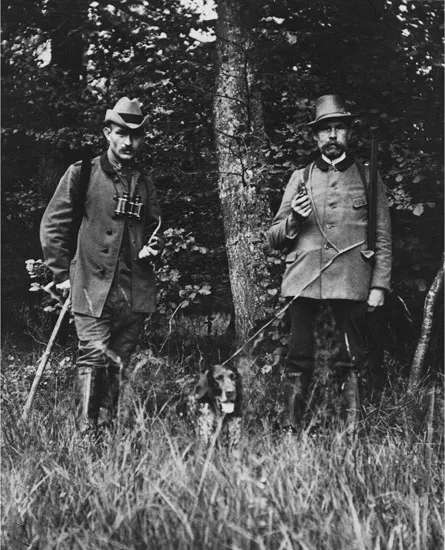
It is often said that there is no such thing as a new ‘good idea’, and the concept of a countryside ranger falls into this category. Whilst today’s countryside rangers, forest rangers and National Park rangers are of relatively recent origin, the idea goes back to early medieval times or before. In this context, and not so different from today, rangers were officials employed to ‘range’ through the countryside providing law and order. Originally, their tasks were limited to the enforcement of the Forest Laws and was enforced in the purlieus or lands of the Royal Forests. The term ‘ranger’ derived from the medieval Latin word ‘regardatores’ and this was noted in the 1217 Charter of the Forest, with appointments of rangers documented from the 1300s. The office of ‘Ranger of Windsor Great Park’, which continues to this day, was created in 1601 and the present Ranger is HRH Prince Philip.
Areas of mixed economic and social use, but with sporting and recreational activities subject to the Forest Laws, the Royal Forests were important in the British medieval landscape. Essentially, these gave precedence to royal ownership of hunting rights of defined beasts of the chase, to the king, and through the king to favoured aristocrats. The laws also addressed certain economic resource rights and particularly the right to take trees for timber. However, the forest was not a landscape set aside
Figure 1.1 Forest rangers, Germany, 1935.
for these purposes (as some parks were) but a multi-functional, economically driven countryside. As a contested space with different landowners, residents, and users, the forest required supervision and policing, just as modern countryside does. Specially appointed officials including those termed wardens or rangers undertook the supervision. Administration was complex and hierarchical, in the way that a contemporary National Park or local authority might be. Justices of the forest were the Justice in Eyre and the verderers. The senior royal official was the Warden, often an eminent, busy landowner. In this case, the day-to-day powers were delegated to a deputy who supervised Foresters and Under-foresters (or Rangers). These latter officials were responsible for preserving the forest and game, and for apprehending offenders against the Forest Laws. Other officers included Agisters supervising pannage, agistment, and collecting fees. There was a Forest Constable and Foresters-in-fee (or Woodwards). The Royal Forests also had Surveyors to agree and oversee the boundaries of the forest, and Regarders who provided advice to the Warden. The Forest Rangers were also termed the Patrollers of the purlieu (or land), and with Serjeants-in-fee, patrolled the forest, apprehended offenders, liaised with local communities, and generally administered the area. This system was largely abandoned as lands were ‘improved’ and deer hunting declined in popularity. With commons enclosed and commoners left to swell the ranks of the Victorian urban poor, the countryside was more-or-less closed to ordinary people. Rangers and similar posts morphed into gamekeepers employed to deter poachers and trespassers.
However, as described later, as Victorian industry fuelled massive growth in urban populations, demand for open spaces and recreational lands grew. By the late 1800s and early 1900s, the suburbs and wider countryside were dotted with urban parks with park keepers, landscaped country parks with parkers and gamekeepers, nature reserves with wardens, and forestry areas with foresters. It was from these beginnings that the countryside services we recognise today evolved. Furthermore, the evolution of the countryside professionals did not occur in isolation but against a backdrop of radical changes in politics, economics, society and the environment, the context for both need and demand (Rotherham, 2014).

Today’s countryside officers

Local authority countryside services play crucial roles in providing a balance for competing demands for public access and recreation, visual and aesthetic quality, and wildlife and natural history interest of the area they cover (Bromley, 1990). Unfortunately, during times of financial austerity, countryside service teams take a lowly place in local government priorities (Seabrooke and Miles, 1993). Indeed, many aspects of government expenditure on environmental activities, including funding to government agencies, grants for conservation work, support to non-governmental organisations, and to local authority parks and countryside services, are easy to cut (Townsend, 2012).
Recent decisions made by central government to cut funding to local authorities mean that they in turn have had to, and continue to make, tough fiscal decisions. This is simply to bring about financial savings to balance their books, whilst maintaining supposedly ‘frontline’ or priority services. Countryside management and associated services are seen as ‘soft options’ by comparison with, say, housing, health, or education. This was the case in the early 1990s, and it remains so today. These central government decisions inevitably mean service budget cuts, job losses and restructuring, or even axing of local authority countryside services. The NGOs pick up some of the challenges, but, even then, the work must be funded.

Economic austerity

Carnall (2013) reviewed the consequences of the economic austerity measures. In 2010, the UK coalition government presented its spending review that set out how it was to carry out its deficit reduction plan up to the financial year 2014–2015. This came at a time when the state was spending considerably more money than it raised in taxes and had to borrow at supposedly record levels, to meet the shortfall. The aim was to cut public spending by £81 billion over the following five years. Each government department had their budgets cut by an average 19 per cent over the review period (HM Treasury, 2010). The spending review was underpinned by a radical programme of public sector reforms, which claimed to focus on removing power from central government and redistributing it to local level. The aim was to build a ‘Big Society’ that supported communities, citizens, and volunteers in playing a bigger role in shaping provision and delivery of public services (HM Treasury, 2010). The three key elements to the Big Society agenda were described as community empowerment, opening up public services, and social action (Cabinet Office, undated).
However, the overall reduction in funding allocations from central government presented tough decisions to local authorities on how they deliver services. To make matters even worse, in June 2013, the government announced a further spending review outlining how the deficit would be further reduced. This meant an additional budget cut totalling £11.5 billion for the financial year 2015–2016 (HM Treasury, 2013) and additional challenges to local authorities. Despite claims of devolving powers and responsibilities to local government, the reality is that core services and skills have been axed to the extent that many environmental services now barely function, proactive planning has been emasculated, and support to local communities and charitable bodies withdrawn. Additional cuts of a further 10 per cent budget reduction to the Department for Communities and Local Government simply reinforced political ‘double-speak’. The Department for Environment, Food and Rural Affairs would also take a further 10 per cent cut, and a further loss of 144,000 public sector jobs within local authorities was predicted (BBC, 2013).
Over the period since the 1950s, the historical progression from the National Parks Commission, to the Countryside Commission to the Countryside Agency has resulted in numerous and frequent changes in remits and emphasis of project delivery. The amount of associated legislation and policy discussion in these decades was notable and restructuring and reorganisation continue to this day. Consequently, many people today take things like access to the countryside for granted. Along wi...

Table of contents

  1. Cover
  2. Title
  3. Copyright
  4. Contents
  5. List of figures
  6. List of tables
  7. About the author
  8. Foreword
  9. Preface
  10. Acknowledgements
  11. List of abbreviations
  12. 1 The history and development of countryside management in Britain
  13. 2 Country Parks and Forest Parks
  14. 3 Delivering countryside services
  15. 4 Countryside Management Areas, projects, and services
  16. 5 Case studies of countryside services
  17. 6 Becoming a profession in Britain
  18. 7 Education, training, and engaging the community
  19. 8 A positive economic impact
  20. 9 Transforming landscapes, places, and people
  21. 10 Trails and tribulations – managing countryside access
  22. 11 A new millennium
  23. 12 Decline and fall
  24. 13 Countryside services – a global perspective
  25. 14 The wider policy context
  26. 15 Issues and opportunities for countryside services
  27. 16 Concluding thoughts and the future
  28. Bibliography
  29. Index