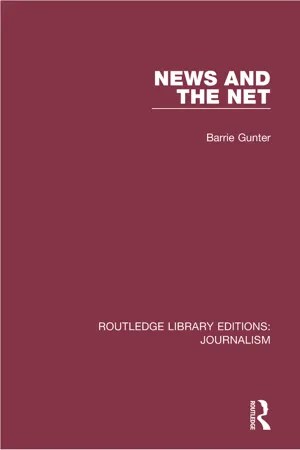
Originally published in 2003. This book examines the growth of news provision on the internet and its implications for news presentation, journalism practice, news consumers, and the business of running news organizations. Much of the focus is placed on the migration of newspapers onto the internet, but references are also made to the establishment of news websites by other organizations. The book examines the growth of online technology as a source of information and entertainment and considers how this development can be framed within models of communication and comments, on the apparent shortage of new models to explain the use, role, effectiveness, and impact of online communications.
- 226 pages
- English
- ePUB (mobile friendly)
- Available on iOS & Android
eBook - ePub
News and the Net
About this book
Information
Chapter 1
The Expanding Online World
The 20th century witnessed the emergence of more new forms of communication than any other period in history. As successive new media have come into being, ordinary people have enjoyed an expanded quantity, range, and choice of entertainment and information content. Further, they have been given greater personal control over the reception of this content and, of late, have moved from being mere passive recipients to content creators and information senders courtesy of sophisticated communications technologies.
The expansion of mass media has not simply meant more competition for the owners of these media, and the producers and distributors of media content, it has changed the nature of media audiences. Audiences have become more fragmented. Hence, established mass media can no longer depend on a virtually guaranteed market of consumers of their products. Moreover, "mass" communication has become integrated with "interpersonal" communication, meaning that media consumers now expect to be able to select what they want to consume when it suits them by placing individual orders at their own convenience.
Such developments have had important implications for the provision and consumption of news. News provision is one of the most important functions of the mass media. Indeed, the first truly mass media were the newspapers of the 19th century. The subsequent establishment of first radio and then television as mass media was founded upon their news services. As such, mass publics became accustomed to there ception of news in prepackaged formats-whether in print or as sound or video transmissions. The development of communications technologies in the late 20th century, however, opened up new possibilities for news delivery. Perhaps the most significant development is the transition to digital transmission systems that facilitate the convergence of broadcasting, publishing, telecommunications, and computing technologies. New digital appliances, such as the "flat screen" mark the evolution of the traditional television set into an interactive, multimedia entertainment and information center (Fidler, 1994).
Such technological convergence leads to business convergence, such that newspapers, magazines, television, and radio will no longer operate as separate services-where the separation is most clearly marked for consumers in a technological sense. These services are received via a single type of technology and users are able to switch seamlessly between them. Instead of choosing whether to tune in to news from a particular television channel or radio station or to read a particular newspaper, news consumers are able to decide the specific news stories they want to receive information about from a multitude of information sources and can also decide whether they want it only in text or as a mixture of text and video (Negroponte, 1995). Individuals are able to print off their own "newspaper," edit their own newsreel, or download an electronic news sheet onto a portable flat screen device (Fidler, 1994).
The Growth of Online Communications
Online communications can be traced back to the 1970s, but flourished only during the 1990s. With the growth of the Internet and commercial online services, the increased capacity of the public telecommunications network and the increased speed of communications modems and personal computers, online communications have become an effective, worldwide communications medium.
Consumer online services provide personal computer users with an electronic commercial link to a growing network of other computer users. By subscribing to an online service, such as Prodigy TM, American Online™, or Compuserve™, users of personal computers equipped with a modem, appropriate communications software, and a connection to a Touch-Tone telephone can dial into a broad array of electronic services. These Internet service suppliers are providing ever easier access to the Internet, the global web of computer networks, through graphical user interfaces. The potential market for online services has grown significantly. In the early 1980s in the United States, for example, only 2 to 3 million homes were equipped with personal computers, whereas by 1994, the number had risen to 35 million machines. Nearly ⅔ of these homes (62%) had a modem (Pavlik, 1996).
The potential market for online news is growing all the time. In the United States, for instance, estimates at the close of the 20th century projected the Internet market at 144 million adult users by the turn of the millennium (Nielsen Media Research, 1996; Office of Research, 1999). By September 2000, worldwide Internet users aged 12+ were put at 360 million (NUA, 2000). There were over 1 billion Web pages on 5 million unique servers, though it is estimated that 70% of traffic goes to less than 5,000 sites (Savage, 2000).
The appeal of the Internet as a possible news medium stems not just from the volume of potential consumers to which it provides access, but also in terms of the composition of that market. Internet use is popular among younger people, in contrast to news consumption via traditional and older established media, especially newspapers. Women represent another group of Internet users on the increase. Jupiter Communications reported that more than 46 million women were online in 1999. NetSmart™ predicted that women would make up more than half of Internet users by 2002 (see Pavlik, 2001 ).
Internet diffusion internationally has been widespread and rapid. Across the top ten economies in the world, by 1998, average Internet use was 43% of the population (Juliussen & Petska-Juliussen, 1999). Although these figures are encouraging to news producers who have migrated onto the Web or who are thinking about doing so, it is important to put them in perspective. Even if there are 360 million Internet users around the globe, that still leaves 5.64 billion people (94%) of the world's population) without access (Pavlik, 2001).
The prevalence of the Internet is not just a result of its open and dynamic nature; its rapid spread has been facilitated by its increased user friendliness to noncomputer literate people. The advent of the World Wide Web (WWW) and the freely distributed smart point-and-click browsers, such as Netscape™ and Explorer™, have made surfing the Net as a source of knowledge and entertainment more attractive. Despite concerns about issues such as privacy, copyright, cultural identity, and pornography, the Internet continues its expansion, rendering it a medium that is impossible to ignore. As a result, publishing industries have begun to explore new, Internet-related markets, services and products in response to the recent advances in information and communication technologies (Scupola, 1999).
Today, news and information from any part of the world can be read with just a click of a button. A new breed of media businesses has emerged in association with the Internet that have become the information world's obsession (Nicholas, Williams, Cole, & Martin, 2000). Even the newspaper industry, never one traditionally quick to embrace technological change, has looked seriously at new ways of adapting its business to this new technology (J. Katz, 1994).
News media uses of the WWW and Internet have grown rapidly since the middle of the 1990s. Some commentators have referred to the Internet as the future for news (Katz, 1999). Although the dominance of the Internet over other, longer established forms of communication may still be some way off in the context of news dissemination, there is growing evidence that new online technologies are having an impact on journalism practice and the business strategies of news organizations (Alshehri, 2000; Chyi & Sylvie, 1998; Singer, 1998, 1999). A rapidly growing number of printed newspapers established Web sites and electronic publications during the final years of the 20th century and that growth has continued apace during the new millennium. Many of these sites have been established simply to obtain a Web presence, with minimal resources devoted to them; in other cases, their publishers have regarded the transition from print to electronic distribution as a key component of the future business strategy (Noack, 1999).
The Latest Communications Era
The widespread penetration of the Internet and the establishment of the WWW and digital forms of communications facilitated through a merger of computers and telecommunications networks has been envisaged as the sixth major communications revolution (Fang, 1997). The "information superhighway" that has been constructed out of the convergence of text- and image-based systems of electronic communication represents a key milestone in the development of communications-an important aspect of history in the making.
Fang (1997) divided the history of communication initially into five revolutions. The first revolution began with the invention of writing in Greece around the 8th century B.C. The second revolution was the invention of the printing press by Gutenberg in Europe in the second half of the 15th century. The third revolution began (in western Europe and the eastern United States in the middle of the 19th century) with the convergence of advances in paper production and printing press technology, enabling, for the first time, the mass production and circulation of communications, in the form of newspapers and magazines. During the same period, an entertainment revolution emerged as the fourth phase toward the end of the 19th century, with the emergence of the affordable camera and motion photography. The fifth revolution was the creation of what Fang calls the "Communication Toolshed Home" that evolved during the middle of the 20th century, transforming the home into the central location for receiving information and entertainment, thanks to the telephone, broadcasting, sound and video recording technology, improvements in print technologies, and cheap, universal mail services. A sixth revolution, as noted, embraces the merger of formerly distinctive technologies, such as telecommunications, broadcasting, and computing to create a digitized, multimedia, interactive communications interchange in which the division between senders and receivers becomes blurred.
Can Traditional Communication Theory Help?
With the establishment of mass communications, in the form of print media, sound broadcasting, and audiovisual broadcasting, film and video recording, scholars turned their attention to explaining the social, psychological, and political significance of these technologies and the messages they conveyed. Accordingly, "media research has evolved over time, in part reflecting paradigm shifts and the evolution of analytical models in the wider social sciences" (Gunter, 2000, p. 9). Media historians have noted a number of distinct milestones in the development of mass communications theory (De Fleur & Ball-Rokeach, 1989). Theories of mass communication focused variously on media production, the way the media represented various aspects of society, the structure and organization of the media, and media effects (McQuail, 1987). Much theoretical development took place during the era of Fang's (1997) fifth communications revolution.
Initial mass communications theory development focused on the role of the mass media as propaganda machinery especially, though not exclusively, during wartime. Early filmmakers and the printing presses were co-opted as arms of the dominant political ethos within countries at times of internal or international conflict during the early part of the 20th century (Gunter, 2000). Later on in the century, radio and television came to be used in similar roles as their penetration of societies grew. An early assumption was that mass communications could exert direct effects on the populace at whom they were aimed. The impact of such media messages was powerful enough to shape public opinion and influence patterns of behavior-especially behavior linked to the political process, such as voting. During the time of World War I, there was a general belief that mass communications could act as a magic bullet. Propaganda messages were fired at mass audiences and readerships and exerted a direct influence on the public's thought processes (see De Fleur & Ball-Rokeach, 1989; Lasswell, 1927). This all-powerful concept of media effects, however, was to be found wanting when put to more serious test in later years as research methodologies evolved.
Further tests of the media as a key aspect of political propaganda machinery during World War II led to a more moderate view of the impact of mass communications (Hovland, Lumsdaine, & Sheffield, 1949; Lazarsfeld, Berelson, & Gaudet, 1944; Star & Hughes, 1950). A revised notion of media effects dropped the idea that they acted directly on individuals to change them, and instead hypothesized that the media operated on their audiences and readers in a less direct fashion. The impact of mass communications was modified by the social context in which media and audiences interfaced, by the functions the media served for their users, and by other influential interpersonal forces. Indeed, in many ways, the media came to be regarded less as forces for change, and more as reinforcers of the status quo (Klapper, 1960).
One important model that emerged in the 1950s conceived of media influences operating in more than one stage. A two-step flow idea emerged to explain the effects of mass media in the political context, whereby the media were believed to act initially on opinion leaders within the community, who then in turn influenced the political thinking of the remainder of their community (Katz & Lazarsfeld, 1959).
The apparently weakened position of mass communication as a source of social and political influence was not universally accepted. A number of prominent writers observed that there were occasions on which the media could be seen to exert direct and quite powerful effects on the public. On some of these occasions, however, such influences were quite subtle (Blumler, 1964; Halloran, 1965; Lang & Lang, 1959). The "minimal" effects model therefore came under serious theoretical and, in due course, empirical challenge during the 1960s and 1970s. One commentator observed that fashions in media effects models and the tendency to veer from maximal to minimal effects orientations reflected to some extent the stability of society at different times (Carey, 1978).
During the economic depression years of the 1930s that led to international tensions and war, there was a need to understand the role of the increasingly popular mass media in this process. During the period of stability of the 1950s and 1960s, there was less reason to view the media as a source of social upheaval. Changing economic conditions and civil and political discord that characterized the late 1960s and 1970s once again drew attention to the media as arbiters of unrest.
The effects of the media were distinguished, however, by the level at which these effects occurred. Thus, although powerful effects of mass communications were conceived to be possible, they did not occur indiscriminately at any psychological level. The idea that the media could shape people's behavior was supported by an accumulating body of evidence concerned in particular with media effects on antisocial conduct. There remained a dominant school of thought, nevertheless, that media influences on public opinion and behavior needed to be understood in the context of mediating factors. Direct effects of media operated at a more superficial level such as by setting the public agenda or telling people which issues were the most important ones for them to think about (McCombs & Shaw, 1972).
As communications theory continued to evolve in the 1970s and 1980s, there was growing recognition that relationships between mass communications systems and the public are circular. The media can act on their audiences and audiences can act on the media they choose to consume. It is no longer informative or helpful to our understanding of the role and impact of mass communications in society to think about media effects as operating in one direction-whether such effects are deemed to be powerful or minimal.
Regardless of whether media effects are envisaged to occur in the form of agenda setting, the cultivation of social beliefs, learning of new information and knowledge, or attitude change or behavior modification, they are, for the most part, likely to be moderated by users' reasons for media consumption, the cognitive information processing systems brought to bear on interpreting media content, and social contextual factors that represent other forces of influence on public knowledge, opinion, and conduct (Gunter, 2000).
With the development of communications technologies, the public are experiencing new kinds of relationships with information and entertainment media. The Internet revolution has changed the face of media provision and patterns of media consumption. The key aspect of change is increased interactivity between the senders and receivers of messages and the redefinition of media consumers as senders as well as receivers. This means that traditional theories of mass communication, grounded as they have been in the fifth communications revolution, characterized by a communications environment in which there is clear distinction between senders and receivers, may be inappropriate to explain the significance and possible impact of the new electronic communications systems operating through merged broadcasting, telecommunications, and computing technologies. Instead, there is a need for an evolution in conceptual modeling in which theory grounded in a one-directional flow of information context embraces thinking that can accommodate bidirectional message flows.
This kind of thinking was reflected in a model put forward by Kincaid (1979). This Convergence Model defined communication as a process in which participants create and share information with one another in order to reach a mutual understanding. Information shared by two or more participants in the communication process may lead to collective action, mutual agreements, and mutual understanding and the communication process has no beginning and no end. The convergence model represents human communication as a dynamic, cyclical process taking place over time.
Unlike traditional mass media that represent a one-to-many communication model, the Internet represents both many-to-one and many-to-many models (Hoffman & Novak, 199 5; Morris & Ogan, 1996). Many consumers can initiate communication to the same Web site at the same time. This many-to-one scenario is unique to the Web because many points of origination and destination co-exist in cyberspace. With such features as cyberchat and the listserve mailing list that simultaneously connect people with common interests, the Web becomes a means for many-to-many communications. There is no single source of message origination or single destination on the Web. All information is digitized, which renders it readily transformable into a variety of presentation formats. With this flexibility, information can be customized to the demand of the consumer. According to some writers, new computer technology will increase the power of the consumer and "blow apart all the monopolies, hierarchies, pyramids and power grids of established society" (Gilder, 1990, p. 31).
The Need for Theoretical Development
The new interactive communications media requires new theoretical conceptualizations. Interactivity between communicators, such as those using the Internet, can occur at a number of levels. In varying instances, communications can be from one to one, from one to many, from many to one, or from many to many. In some situations, therefore, Internet communications can be conceptualized as forms of mass communication; in other instances, however, they represent a form of interpersonal communication (Kaye & Medoff, 1999).
The need for fresh impetus and direction in communications research has already been noted by eminent scholars who have made a point of following theory developments across the decades. A pessimistic view has surfaced that, of late, there has been a lack of creativity in theory development. In his examination of this issue, De Fleur (1998) argued that research in mass communication in general has stalled. He asked, "Where have all the milestones gone?" Defleur's main argument was based on his belief that there is a decline of significant rese...
Table of contents
- Cover
- Half Title
- Title
- Copyright
- Original Title
- Original Copyright
- Contents
- Preface
- 1 The Expanding Online World
- 2 Electronic Delivery of News
- 3 Business Implications of Internet News
- 4 News Presentation on the Net
- 5 Implications for Journalism Practice
- 6 Online News and Legal Issues
- 7 Readers and Electronic Newspapers
- 8 The Future of News Online
- References
- Author Index
- Subject Index
Trusted by 375,005 students
Access to over 1.5 million titles for a fair monthly price.
Study more efficiently using our study tools.
Frequently asked questions
Yes, you can cancel anytime from the Subscription tab in your account settings on the Perlego website. Your subscription will stay active until the end of your current billing period. Learn how to cancel your subscription
No, books cannot be downloaded as external files, such as PDFs, for use outside of Perlego. However, you can download books within the Perlego app for offline reading on mobile or tablet. Learn how to download books offline
Perlego offers two plans: Essential and Complete
- Essential is ideal for learners and professionals who enjoy exploring a wide range of subjects. Access the Essential Library with 800,000+ trusted titles and best-sellers across business, personal growth, and the humanities. Includes unlimited reading time and Standard Read Aloud voice.
- Complete: Perfect for advanced learners and researchers needing full, unrestricted access. Unlock 1.5M+ books across hundreds of subjects, including academic and specialized titles. The Complete Plan also includes advanced features like Premium Read Aloud and Research Assistant.
We are an online textbook subscription service, where you can get access to an entire online library for less than the price of a single book per month. With over 1.5 million books across 990+ topics, we’ve got you covered! Learn about our mission
Look out for the read-aloud symbol on your next book to see if you can listen to it. The read-aloud tool reads text aloud for you, highlighting the text as it is being read. You can pause it, speed it up and slow it down. Learn more about Read Aloud
Yes! You can use the Perlego app on both iOS and Android devices to read anytime, anywhere — even offline. Perfect for commutes or when you’re on the go.
Please note we cannot support devices running on iOS 13 and Android 7 or earlier. Learn more about using the app
Please note we cannot support devices running on iOS 13 and Android 7 or earlier. Learn more about using the app
Yes, you can access News and the Net by Barrie Gunter in PDF and/or ePUB format, as well as other popular books in Social Sciences & Media Studies. We have over 1.5 million books available in our catalogue for you to explore.