Originally published in 1989. This diary of a news event looks at how the reporting happened as spread by the news wire system of the Associated Press service in America. Analysing the flow of information in this detailed way, this book presents how a major disaster, a fast-moving story with considerable spin, was fed out to the press via the Dallas bureau in 1988. Introductory chapters outline the workings of a press bureau office during a major story and present interview sections with key reporters on the story about how their role unfolded. Sidebar commentary alongside the reproductions of the news wires, organised by date and time, adds interesting discussion throughout the book, while a conclusion evaluates the coverage of the story. The Appendices include reproductions of Texas newspapers' resulting pages about the crash. This is a fascinating case-study of the dissemination of news date before the internet, compiled at a time when computers were just large enough to retain in memory all stories relating to event 'X' in order for this kind of analysis to be attempted.
eBook - ePub
Associated Press Coverage of a Major Disaster
The Crash of Delta Flight 1141
- 458 pages
- English
- ePUB (mobile friendly)
- Available on iOS & Android
eBook - ePub
About this book
Information
The First Day
Chapter 1
9:11 a.m., Wednesday, August 31, 1988
… the plane exploded into flames.
The first Associated Press news was a four-line Bulletin, sent on the state news wire, for PMs; evening newspapers.
State wire
d0887———b n AM-PianeCrash 08-31 0043
AM-Plane Crash,
BULLETIN
DALLAS (AP)—A jet described as a 727 plowed into the dirt on a north-south runway at Dallas-Fort Worth Airport and burst into flames shortly before 9 a.m. today.
A witness said the plane exploded in flames.
AP DN-08-31-88 0911 CDT
9:23 a.m.
Twelve minutes later, a similar urgent lead is sent out for PMs, on the national wire.1
Nat’l wire
p-0320———u a PM-PlaneCrash 08-31 0087
PM-Plane Crash, 0083
URGENT
Plane Crashes at Dallas-Fort Worth Airport
GRAPEVINE,2 Texas (AP)—A plane crashed today at Dallas-Fort Worth Airport, but there was no immediate word on casualties, a spokeswoman said.
“We are working on an alert 3. That is a crash,” said Marilyn Beauvais, the spokeswoman. She said she had no other details.
A witness told KRLD radio that the plane was a Boeing 727 and that it plowed into the dirt at a runway and burst into flames shortly before 9 a.m.
AP-DN-08-31-88 0923CDT
9:28 a.m.
Five minutes later, the first complete story is filed on the state wire, for evening newspapers. These papers, at midmorning, were close to deadline, but still had a comfortable margin to publish a major breaking story.
Also labeled urgent, the story is filed so fast, there is an uncorrected mistake in the first paragraph: “A Delta 727 plowed exploded during take off …”
State wire
d0888———b n AM-PlaneCrash 08-31 0266 AM-Plane Crash, 1st ld-writethru, 261 Delta 727 Crashes at Dallas-Fort Worth Airport URGENT
GRAPEVINE, Texas (AP)—A Delta 727 plowed exploded during takeoff shortly before 9 a.m. at Dallas-Fort Worth International Airport today.
“We are working on an alert three. That is a crash,” said DFW Airport spokeswoman Marilyn Beauvais.
Eyewitnesses said the plane exploded in flames and plowed into the dirt of a north-south runway. There were no immediate reports of injuries or fatalities. Ms. Beauvais did not say where the plane was bound.
Delta officials were not immediately available for comment.
“I was coming over the bridge on I-30 in Arlington, and I saw a big ball of fire going into the air,” Greg Isaacs of Dallas told krld radio. “I started driving over there and it looked like it was over near D-FW, and I thought, ‘No way could it be an airplane accident.
“I could tell it was over near D-FW. It was an unbelievably big explosion. I could not believe it—I absolutely could not believe it was that big an explosion,” Isaacs said.
The accident is the second at DFW involving Delta in three years.
On Aug. 2, 1985, Delta Flight 191 crashed as it approached a runway during a violent thunderstorm, killing 137 people, including the driver of a car that was hit. That crash injured 25 others.
The L-1011 jet was on a flight from Fort Lauderdale, Fla.
Investigators of that crash determined that there was a wind shear—a violent change in wind direction that can rob a plane of lift—within the storm.
AP-DN-08-31-88 0928CDT
As the story grew, AP coverage of the crash and its aftermath would be the responsibility of the Dallas Bureau …
Notes
1 The times indicated reflect the time national copy (and state copy) moved out of Dallas AP computers. National story times may vary around the country depending on regional computer conditions (John Lumpkin, personal communication, Dec. 16, 1988).
2 The Dallas-Fort Worth International Airport is actually in the suburb of Grapevine. Thus all stories from DFW are slugged Grapevine, Texas.
Chapter 2
The Dallas Bureau
You have to organize your people. You have to know where to put them. You have to have them at the airport. At the morgue. At the hospitals.
Plane crash stories are built around fatalities. But what we knew early on was this thing had some survivors. And then we knew for sure when (editor-reporter) Denne Freeman saw the first person leaving that (Harris H.E.B.) hospital, that not only did we have survivors, but we had ‘walk-aways And what made this story so special—is that here you had dozens of people who experienced a disastrous plane crash—that’s number one. And then number two—who could tell you about it.
John Lumpkin, 46, bureau chief of the Dallas AP graduated from the University of Virginia at Charlottesville. While attending college, Lumpkin was able to get a part-time job as correspondent for The Richmond Times-Dispatch. His parents lived in Fort Worth at the time and after graduation, he was able to get a job working as a police reporter, general assignment reporter, and on the county courthouse beat for The Fort Worth Star-Telegram, where he worked from 1968 to 1971.
While in the Dallas-Fort Worth area, Lumpkin got to know the Dallas AP bureau chief and in the fall of 1971, got a job working the rewrite desk, at the broadcast desk and as a filing editor, where he was “right at the switch,” not filing paper copy, but managing stories as they were sent onto the wire.
In the fall of 1972, he became the San Antonio correspondent for the AP, a one-person bureau that is a satellite operation of the AP Dallas Bureau.
In the fall of 1974, he became assistant Dallas bureau chief. During 1976-1977, he was moved by the AP and became North Carolina bureau chief. In March 1978, he became bureau chief for Iowa and Nebraska, stationed in Des Moines.
He came back to Texas in 1982, as bureau chief.
Lumpkin, his wife Eileen, and their two sons, John, 15, and Robin, 11, live in the Dallas-Fort Worth suburb of Richardson.
Three weeks after the Delta 1141 crash, Lumpkin recalled how the bureau handled the story:
The Dallas Bureau of the AP then had its headquarters on the 21st floor of a downtown office tower, the Southland Center. There, they constantly monitor a local TV station in the newsroom and also monitor a Dallas news-talk station, radio KRLD. Early in the morning of August 31, someone said “KRLD reported a plane in trouble or down at DFW.” (The AP assumed that KRLD got the story because they were listening to a police monitor or because they may have received a report from a traffic helicopter in the DFW area.)
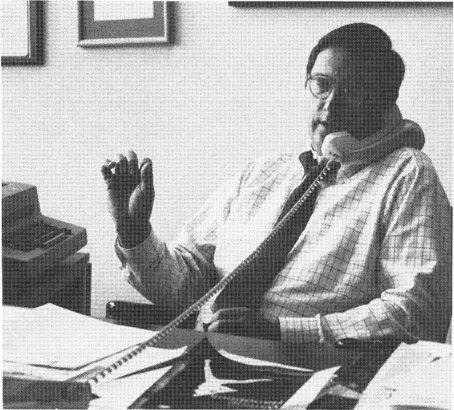
AP Dallas Bureau Chief John Lumpkin (photograph by Thomas Fensch)
The bureau quickly confirmed that a plane was down. Broadcast editor Diane Jensen confirmed KRLD’s report by calling DFW’s public information office. Without knowing anything more than a plane was down, reporter David Pego and a staff photographer headed toward the DFW airport.
And one of the reasons you do that is you better get there before they close off the (crash) scene. [David Pego got to the end of the runway, where the crash occurred, before the police closed off the area.]
I was on vacation, playing golf with Denne [pronounced Denny] Freeman and I saw a pick-up truck with a flashing light bouncing down the fairway. It screeched to a halt and the driver asked this guy I was playing with, “is there a John Lumpkin here? You need to call your office—apparently there’s been a plane crash.” So we raced back in and made a phone call and left the golf course immediately and got back to the office here about 9:40 a.m. Freeman, who is our Texas sports editor for the AP was playing with me. He had the day off because he is always working weekends covering Texas football.
So he headed home to change and come down here. I was driving in and heard on radio KLIF someone say that “he didn’t know what it meant, but someone who had one of those big vans—that haul a lot of people like a rent-a-car van—seemed to be headed out of DFW by the north entrance.”
There’s a small hospital there—about 5 miles from DFW. Harris H.E.B. hospital [Hurst, Euliss Bedford, all Dallas—Fort Worth suburbs] is a good hospital, but it’s not a big trauma hospital like Parkland, in Dallas.
As soon as I got here (to the bureau), I called Denne and told him to go to that hospital. As he drove up, in the parking lot, they were releasing the first of the survivors. As it turned out, they took 50 or 60 people there. These were the ones that were scratched or barely hurt or whatever. And they kept releasing them all day long. So that as each one was released, you had yet another “story.”
As s...
Table of contents
- Cover
- Half Title
- Title
- Copyright
- Original Title
- Original Copyright
- Dedication
- Contents
- Preface
- Acknowledgments
- Foreword
- PART I The First Day
- PART II The Second Day
- PART III The Third Day
- Appendix A SOPs—Standard Operating Procedures for Reporters
- Appendix B Filing the Wire
- Appendix C Wire and Computer Terms
- Appendix D How Texas Newspapers Covered the Delta 1141 Story
- Appendix E FAA Transcript of the Crash
- Appendix F National Transportation Safety Board Transcripts, Crew Interviews
- Appendix G Associated Press Broadcast Wire Stories
- Appendix H WMAQ—TV and the Crash of Flight 249
- Appendix I How USA Today Handled the Delta Crash
- References
- Index
Trusted by 375,005 students
Access to over 1.5 million titles for a fair monthly price.
Study more efficiently using our study tools.
Frequently asked questions
Yes, you can cancel anytime from the Subscription tab in your account settings on the Perlego website. Your subscription will stay active until the end of your current billing period. Learn how to cancel your subscription
No, books cannot be downloaded as external files, such as PDFs, for use outside of Perlego. However, you can download books within the Perlego app for offline reading on mobile or tablet. Learn how to download books offline
Perlego offers two plans: Essential and Complete
- Essential is ideal for learners and professionals who enjoy exploring a wide range of subjects. Access the Essential Library with 800,000+ trusted titles and best-sellers across business, personal growth, and the humanities. Includes unlimited reading time and Standard Read Aloud voice.
- Complete: Perfect for advanced learners and researchers needing full, unrestricted access. Unlock 1.5M+ books across hundreds of subjects, including academic and specialized titles. The Complete Plan also includes advanced features like Premium Read Aloud and Research Assistant.
We are an online textbook subscription service, where you can get access to an entire online library for less than the price of a single book per month. With over 1.5 million books across 990+ topics, we’ve got you covered! Learn about our mission
Look out for the read-aloud symbol on your next book to see if you can listen to it. The read-aloud tool reads text aloud for you, highlighting the text as it is being read. You can pause it, speed it up and slow it down. Learn more about Read Aloud
Yes! You can use the Perlego app on both iOS and Android devices to read anytime, anywhere — even offline. Perfect for commutes or when you’re on the go.
Please note we cannot support devices running on iOS 13 and Android 7 or earlier. Learn more about using the app
Please note we cannot support devices running on iOS 13 and Android 7 or earlier. Learn more about using the app
Yes, you can access Associated Press Coverage of a Major Disaster by Thomas Fensch in PDF and/or ePUB format, as well as other popular books in Social Sciences & Media Studies. We have over 1.5 million books available in our catalogue for you to explore.