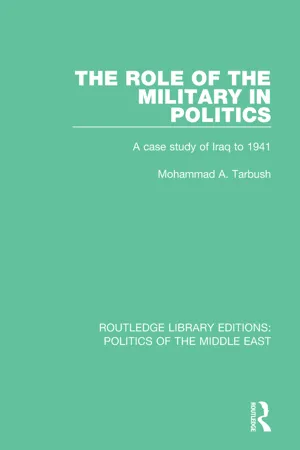
This book, first published in 1982, attempts to explain how and why Iraqi military intervened in the affairs of state between 1936 and 1941. The intention is not to describe the various coups of this period, but to explain the gradual assumption of a political role by the Iraqi army and the contributing factors at play, for example the fragmented nature of Iraqi society and the presence of the British. In addition, an understanding of the political role of the Iraqi army requires a thorough investigation of the development of the Iraqi state itself.
- 305 pages
- English
- ePUB (mobile friendly)
- Available on iOS & Android
eBook - ePub
About this book
Information
Notes
Notes to Acknowledgments
1 'Abd al-Razzaq al-Hasani, Tarikh al-Wizarat al-Iraqiya (History of the Iraqi Cabinets), 10 vols, Beirut, 1974.
2 Hanna Batatu, The Old Social Classes and the Revolutionary Movements of Iraq, Princeton, NJ, 1978.
3 A. S. Klieman, Foundations of British Policy in the Arab World, The Cairo Conference of 1921, Baltimore, 1970.
4 H. Mejcher, The Imperial Quest for Oil, Iraq 1910-1928, London, 1976.
5 P. Sluglett, Britain in Iraq 1914-1932, London, 1976.
Notes to Introduction
1 May Brodbeck, Models, in Readings in the Philosophy of Science, ed. H. Feigl and M. Brodbeck, New York, 1953. See also Abraham Kaplan, The Conduct of Enquiry, Michigan, 1963, and Thomas Kuhn, The Structure of Scientific Revolution, Chicago, 1970.
2 Morris Janowitz, The Military in the Political Development of New Nations, Chicago, 1964, p. 111.
3 Ibid., p. 5, where he refers to five types of civil military relations. See also his Table I, on p. 10.
4 See for example John J. Johnson (ed.) The Role of the Military in Underdeveloped Countries, Princeton, 1962, and also Samuel P. Huntington, The Soldier and the State, Cambridge, Mass., 1957.
5 See J. C. Hurewitz, 'Soldiers and social change in plural societies: the contemporary Middle East', in V. J. Parry and M. E. Yapp (eds), War, Technology and Society in the Middle East, London, 1975.
6 See also Janowitz, 'Some Observations on the Comparative Analysis of Middle Eastern Institutions', in op. cit.
7 Hurewitz, op. cit., p. 401.
8 This is the notion put forward by S. E. Finer as being negatively related to the level of military intervention in the relevant nation. See S. E. Finer, The Man on Horseback, The Role of the Military in Politics, London, 1969.
Notes to Chapter 1
1 According to a report by Major N.N. Bray, then Special Intelligence Officer attached to Political Department, India, there were 300 Mesopotamian members of al-'Ahd in Amir Faisal's service. 'They were nearly all in Turkish military employment. They are the leading personalities in the Arab state, and hold all the military posts.' FO 371/5230, 14.9.1920.
2 Gertrude Bell, Review of the Civil Administration of Mesopotamia, London, 1920, p. 132.
3 Already in 1910, a German expert reported 'the oil-bearing district of Mosul and Baghdad to be amongst the richest in the world'. (As quoted in A. G. Boycott, The Elements of Imperial Defence, London, 1938, p. 294). British officials were in any case aware of the potential wealth of Mesopotamia. This is how a typical Memorandum by the General Staff of Mesopotamia referred to this issue: 'The future motive power of the world is "oil". The oil fields of southern Persia, now under British control, are the most inexhaustible "proved" fields in the world. The Mosul province, and the banks of the mid-Euphrates, promise to afford oil in great quantities, although the extent of the fields is not yet proved.' FO 371/5073, 12.11.1919. Apart from oil, even before the First World War, Britain occupied a paramount position in the trade of what later became Iraq. Of the total import trade of the country, Britain's share was between 45 and 50 per cent, and that of India about 25 per cent; while Britain was also the principal customer, taking some 35 per cent of the exports. FO 371/17858, E 3526/ 190/93, 20.5.1934.
4 For example, in the Memorandum by the General Staff of Mesopotamia referred to above, it was noted that, 'with a railway and pipe line in the Mediterranean, which is forecasted within the next ten years, the position of England as a naval power in the Mediterranean could be doubly assured, and our dependence on the Suez canal, which is a vulnerable point in our line of communication with the East would be considerably lessened.' FO 371/5073, 12.11.1919.
5 For the full text, see P. W. Ireland, Iraq, London, 1937, p. 160.
6 Bell, op. cit., p. 128.
7 Ibid., p. 127.
8 Ibid., p. 140.
9 For a study of this rebellion, see W. O. Nadmi], 'The Iraqi Revolt of 1920', PhD thesis, University of Durham, 1974.
10 CO 730/1/15895, C 6247/2740/18, 23.3.1921.
11 Apart from the Arab nationalists and the British striving to further their respective political interests, it was 'reliably reported that letters were received by the 'ulama . . . from 'Ajaimi Pasha acting as agent to Mustafa Karnal Pasha. He talks of a Turk and Arab union against the heretics.' LP & s, 31.12.1920.
12 FO 371/5231, 26.10.1920.
13 LP & S, 48, Intelligence Report no. 4, 31.12.1920.
14 Ibid.
15 Special Report by H.B.M.G. to the Council of the League of Nations on the Progress of Iraq during the period 1920-31, Colonial no. 58, p. 14.
16 Air 23/432/BD/39, 21.7.1930.
17 See for example, Air 23/104, SSO, Basra, CD/1/251, 22.5.1926.
18 CO 730/40, Intelligence Report no. 14, 5.7.1923.
Notes to Chapter 2
1 All population figures for 1920 are based on the census conducted by the British military authorities. Details of this census are given in FO 371/5074, and in Statistical Abstract for the Several British Overseas Dominions and Protectorates, from 1907-21, no. 56, London,1924.
2 FO 371/18945, 21.3.1935.
3 G. Bell, Review of the Civil Administration of Mesopotamia, London,1920,p.129.
4 Ibid., p. 129.
5 All population figures for 1930 are based on the census made by Sir Ernest Dowson, An Inquiry into Land Tenure and Related Questions, Iraq Government Report, 1931. These figures are also used as official estimates in The Iraq Directory, 1936, Times Press Ltd, Baghdad, 1936, and in the Statistical Handbook of Middle Eastern Countries, Economic Research Institute, Jewish Agency for Palestine, 1945.
6 Infant mortality rates for 1929, for example, show that the average rate in the three major cities ran at 334 per 1,000, a rate four to five times higher than that of most Western nations at that time. Also, if we take the annual incidence of malaria, for example, we find that, whereas the total number of reported cases was 36,552 in 1923, it increased to 175,476 in 1926, and although it dropped to 87,476 in 1928 it went up again to 1 58,902 in 1929 and 151,063 in 1930: Public Health Directorate, Vital Statistics of Iraq, 1935, p. 20.
7 Figures on health are based on Colonial Office, Reports on Iraq Administration, starting with the year 1922 and continui...
Table of contents
- Cover Page
- Half Title page
- Title Page
- Copyright Page
- Orignal Title Page
- Orignal Copyright Page
- Contents
- Illustrations
- Foreword
- Note on transliteration
- Abbreviations
- Acknowledgments
- Introduction: The army in politics: questions and problems
- 1 The beginning of the state
- 2 Structural instability
- 3 The creation of the state
- 4 The army
- 5 First ventures of the army into politics
- 6 The Bakir Sidqi coup d'état of October 1936
- 7 Coups and counter-coups
- 8 The Rashid' Ali coup and British intervention
- 9 Conclusions
- Appendix I: The Programme of the Popular Reform League
- Appendix II Translation of 'Programme of Policy' issued by the cabinet of Saiyid Hikmat Sulaiman
- Appendix III Kurdish Petition
- Appendix IV Anglo-Iraqi Treaty of Alliance, June 30 1930, and notes exchanged embodying a separate financial agreement, 19 August 1930, with various explanatory notes, both published and unpublished
- Notes
- Bibliography
- Index
Trusted by 375,005 students
Access to over 1.5 million titles for a fair monthly price.
Study more efficiently using our study tools.
Frequently asked questions
Yes, you can cancel anytime from the Subscription tab in your account settings on the Perlego website. Your subscription will stay active until the end of your current billing period. Learn how to cancel your subscription
No, books cannot be downloaded as external files, such as PDFs, for use outside of Perlego. However, you can download books within the Perlego app for offline reading on mobile or tablet. Learn how to download books offline
Perlego offers two plans: Essential and Complete
- Essential is ideal for learners and professionals who enjoy exploring a wide range of subjects. Access the Essential Library with 800,000+ trusted titles and best-sellers across business, personal growth, and the humanities. Includes unlimited reading time and Standard Read Aloud voice.
- Complete: Perfect for advanced learners and researchers needing full, unrestricted access. Unlock 1.5M+ books across hundreds of subjects, including academic and specialized titles. The Complete Plan also includes advanced features like Premium Read Aloud and Research Assistant.
We are an online textbook subscription service, where you can get access to an entire online library for less than the price of a single book per month. With over 1.5 million books across 990+ topics, we’ve got you covered! Learn about our mission
Look out for the read-aloud symbol on your next book to see if you can listen to it. The read-aloud tool reads text aloud for you, highlighting the text as it is being read. You can pause it, speed it up and slow it down. Learn more about Read Aloud
Yes! You can use the Perlego app on both iOS and Android devices to read anytime, anywhere — even offline. Perfect for commutes or when you’re on the go.
Please note we cannot support devices running on iOS 13 and Android 7 or earlier. Learn more about using the app
Please note we cannot support devices running on iOS 13 and Android 7 or earlier. Learn more about using the app
Yes, you can access The Role of the Military in Politics by Mohammad A. Tarbush in PDF and/or ePUB format, as well as other popular books in Social Sciences & Regional Studies. We have over 1.5 million books available in our catalogue for you to explore.