Egypt was the first Arabic-speaking country to throw off the yoke of Turkish rule, with an attendant growth in European influence. The impact of the West was most obvious in the political-constitutional field, with the gradual adoption of Western patterns of government and political life. This book, first published in 1953, is the first work to trace the development of parliamentary institutions and political parties in Egypt and to consider the extent of Western influence on their inception, evolution and disruption. Based on both Arabic and European sources, it is a comprehensive examination of the subject, and is key to the understanding of the development of the modern Middle East.
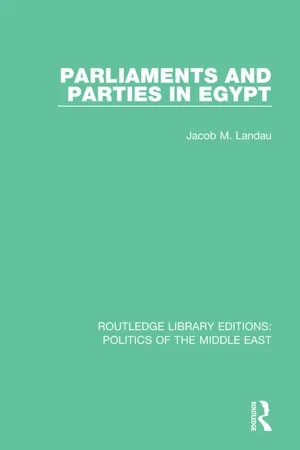
- 220 pages
- English
- ePUB (mobile friendly)
- Available on iOS & Android
eBook - ePub
Parliaments and Parties in Egypt
About this book
Information
Political Parties
Ch. I — The Secret Societies
The scarcity of published material renders a true estimate of the development of political ideas in Egypt during the nineteenth century difficult. Nor is it any easier to trace the origins of the first political parties.
As in other lands and other periods, the rise of political groups in Egypt was due to three main, closely inter-related, factors: the spread of education, the knowledge that a better state of things was possible, and the suspicion towards foreigners.
The various educational missions sent to Europe, starting from the time of Muhammad 'Ali, the activities of Christian missionaries, and the influence of French scientists, doctors, officers and. engineers, could not but leave their imprint on the people. They thus came to feel that a better state of affairs could exist, a belief which was strengthened by the creation of the Assembly of Delegates in 1866. Semi-Europeanized Egyptiang ceased to consider the personal rule of the Khedive Isma'iîl as the ideal one. Naturally enough, the first vague rumblings of political consciousness expressed themselves in suspicion, or even animosity, towards foreigners who were regarded as interfering with Egyptian affairs.
If one may credit the conclusions which the British Consuls in Egypt derived in 1873, this attitude towards foreigners was echoed by the uneducated classes, mainly for two reasons religion and economics. Firstly, the large orthodox population attributed the growing religious laxity of the richer class of Muslims to European influence168. Secondly, though aware that certain benefits had accrued from the impact of the West, many poorer-class Egyptians were inclined to blame the Europeans for their own private losses, for the rise in the cost of living, and for the heavy taxation of the Khedive's Government, which were commonly imputed to the pressure of the European creditors169.
Another sign of the unrest prevalent in Egypt under Ismâ'îl was the development of the Press. Though hampered by technical difficulties - typesetting and printing were both done by hand and telegraphic facilities were scarce - the number of newspapers and periodicals increased. The severely censored newspapers, despite restricted sale, were passed from hand to hand and their readers soon learnt to read between the lines170. Syrians, who took an active part in the progress of literature in Ismâ'îl's days, contributed greatly to the development of the Press in Egypt by gradually educating the masses and offering them glimpses of Western culturel71.
Besides this, certain discontented elements published a few anonymous newspapers and distributed them clandestinely. Thus, in 1869, the Government of Egypt was trying in vain to prevent the printing and circulation of a newspaper named "Le nouvel Argus", the editors of which could not be found172. A year later the Government of the Khedive was enraged by the secret publication of a humorous French-language newspaper called "Le Crocodile"173. Though not much evidence of the contents or character of these journals is available, they were in a way the predecessors of papers like "Abuû Naddâra" or "Al-qâhirî" of the seventies.
When Valentine Chirol visited Cairo in 1876-77, his Arabic teacher introduced him to some young local intellectuals. He noticed an obvious spirit of discontent with foreign influence in Egypt about them174. The same dissatisfaction permeated the anti-European incidents during the years 1877-1879 in the towns, in the villages of Upper Egypt, and in the army, as observed and repeated more than once by British Consuls175.
This discontent was only partly open. It centred in those secret organizations, which were to be the forerunners of political parties in Egypt. Until the time of Ismâ'îl there were no political parties; at the most there were groups loosely connected with one personality or another at Court, and serving its interests. The latter form of political association was to last, moreover, throughout the British Occupation and, to a lesser extent, right up to the present.
The secret societies were able to provide the basis for the growth of political parties, by virtue of the fact that they had some sort of organization, ideals aiming at the common weal, and no close connection with any Court personality.
Secret societies were by no means a new phenomenon in the Muslim world176. Like elsewhere in the Near East, however, these Egyptian societies either kept no written records at all or destroyed what little they had committed to paper, when danger Seemed incumbent. Therefore first-hand sources of information on these societies are almost negligible; second-hand sources are often confused, contradictory and unreliable.
Models for clandestine organization were not lacking. Besides what educated Egyptians might have read on the subject in the literatures of Europe, they had the example of the Dervish orders177 and Muslim guilds178, with their particular signs of recognition and peculiar jargon, before them. We have some evidence that secret societies of a religious nature existed in Egypt during Sa'îd's rule. They might have been influenced by Muslims from India, studying at al-Azhar, and by Muhammad al-Sanûsî, who had also studied there in his youth179. The movement in general was inspired from certain circles in al-Azhar, so that its character and expression remained chiefly religious180.
The secret society of army officers, which was to be the nucleus of the future "National Party", reflected discontent with religious laxity, economic depression and social discrimination. Though the date of its formation is unknown - the assumption that its origins go back to Sa'îid's days181 has yet to be proved - it may have been in the early or middle seventies of the nineteenth century; our information about its existence is certain from the year 1876.
The society was founded by 'Alî al-Rûbî. Ahmad 'Urâbî182 Joined it afterwards, together with 'Alî Fahmî and 'Abd al-'Âl. It is not certain who revealed the society's existence and the names of its leaders to 'Alî Mubârak Pasha (Minister and author of "Al-khitat al-taufîqiyya"). Some sources imply that overtures were made to induce him to join the society. At any rate, he disclosed its existence to the Khedive Ismâ'îl, who well understood the value of such an ally and tried to exploit it to his own ends. He was generally suspected of employing the society towards the overthrow of the European Ministry in 1879183. A further point worth noting is that even after that date, when the secret society of army officers had been changed into a political party with a programme of its own, it jealously maintained its secret character, continuing to meet clandestinely, often at nightl84.
It is reasonable to suppose that the movement which led from the officers' secret society to the "National Party" must have been directed, or even sponsored, by some highly-placed, well-educated person. It is indeed almost impossible to explain otherwise its genesis and development. The archives of the Public Record Office in London, hitherto little explored for this purpose, offer a clue to this personality.
His name was Halîm Pasha. He was the last surviving son of Muhammad 'Alî. A clever man, with the advantage of a French education, he was a likely successor to the Khedivate after Ismâ'îl, until the latter obtained the Sultan's sanction to a radical change in the law of succession: instead of the oldest living member of Muhammad 'Alî's family succeeding to the Khedivate, direct succession was established.
Naturally Halîm was not ready to consent to having his claims to the Khedivate waived so glibly. He was well acquainted both with the intellectual nobility of Egypt - Sharîf Pasha had been his secretary in 1852-53185 — and with the general characteristics of the country's inhabitants. His Saint-Cyr education186 won him the respect of the army.
It was no mere chance, therefore, that, soon after the firman's changing of the line of succession in Egypt, Col. Stanton, the British Consul-General, reported confidentially that Halîm was accused of affixing his seal to a document of revolutionary character187. Of course, Halîm denied the whole affair, and complained then and on future occasions of being groundlessly persecuted by Ismâ'îl188. At the end of 1868, Halîm was accused of plotting an insurrection and, despite his stout denials of the charge, was banished from Egypt189.
The pertinent document is extremely interesting. It is a letter discovered among the papers of Col. O'Reilly (Hasan Pasha), addressed by that adventurer to Halîm and detailing a list of weapons and ammunition necessary for a projected armed revolt against Ismâ'îl190. Though the authenticity of this document cannot be definitely ascertained, its guarded style might indicate that some secret revolution was indeed being planned; for it is very likely that if the document were a forgery, it would have shown Halîm's complicity more clearly than it actually did, the more fully to compromise him. Halîm's previous activities of this nature would, on the other hand, lead one to believe that he was not quite as guileless or outragedly innocent as he professed to be.
The impression one receives is that Ismâ'îl's intrigues were the reaction to Halim's machinations. Besides, the very fact that Ismâ'îl tried hard to drive Halîm into exile, instead of keeping him under observation in Egypt, is also an indication that his presence in the country was regar...
Table of contents
- Cover Page
- Half Title page
- Title Page
- Copyright Page
- Original Title Page
- Original Copyright Page
- Acknowledgements
- Table of Contents
- Foreword by Professor Bernard Lewis
- Introduction
- First Part — Parliamentary Institutions
- Second Part — Political Parties
- Conclusion — The Recent Years
- Abbreviations
- Bibliography
- Index
Trusted by 375,005 students
Access to over 1.5 million titles for a fair monthly price.
Study more efficiently using our study tools.
Frequently asked questions
Yes, you can cancel anytime from the Subscription tab in your account settings on the Perlego website. Your subscription will stay active until the end of your current billing period. Learn how to cancel your subscription
No, books cannot be downloaded as external files, such as PDFs, for use outside of Perlego. However, you can download books within the Perlego app for offline reading on mobile or tablet. Learn how to download books offline
Perlego offers two plans: Essential and Complete
- Essential is ideal for learners and professionals who enjoy exploring a wide range of subjects. Access the Essential Library with 800,000+ trusted titles and best-sellers across business, personal growth, and the humanities. Includes unlimited reading time and Standard Read Aloud voice.
- Complete: Perfect for advanced learners and researchers needing full, unrestricted access. Unlock 1.5M+ books across hundreds of subjects, including academic and specialized titles. The Complete Plan also includes advanced features like Premium Read Aloud and Research Assistant.
We are an online textbook subscription service, where you can get access to an entire online library for less than the price of a single book per month. With over 1.5 million books across 990+ topics, we’ve got you covered! Learn about our mission
Look out for the read-aloud symbol on your next book to see if you can listen to it. The read-aloud tool reads text aloud for you, highlighting the text as it is being read. You can pause it, speed it up and slow it down. Learn more about Read Aloud
Yes! You can use the Perlego app on both iOS and Android devices to read anytime, anywhere — even offline. Perfect for commutes or when you’re on the go.
Please note we cannot support devices running on iOS 13 and Android 7 or earlier. Learn more about using the app
Please note we cannot support devices running on iOS 13 and Android 7 or earlier. Learn more about using the app
Yes, you can access Parliaments and Parties in Egypt by Jacob M. Landau in PDF and/or ePUB format, as well as other popular books in Social Sciences & Regional Studies. We have over 1.5 million books available in our catalogue for you to explore.