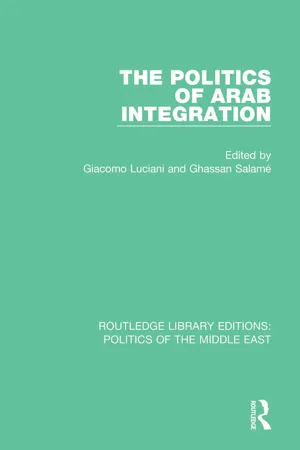
This volume, first published in 1988, is the result of a major research project, the most important inquiry into the fundamental political structure of the Arab world. It is often argued that Arab states are arbitrary political creations that lack historical or present legitimacy and are unable to relate to each other in a productive way. It is further suggested that the demise of pan-Arabism merely underlines the inability of individual Arab states to integrate either domestically or internationally. This book, Volume Four in the Nation, State and Integration in the Arab World research project carried out by the Istituto Affari Internazionali, sets out to answer the questions of Arab integration, with articles from a wide range of contributors from around the world.
- 340 pages
- English
- ePUB (mobile friendly)
- Available on iOS & Android
eBook - ePub
The Politics of Arab Integration
About this book
Information
The Cultural Dimension
1
Speech Diversity and Language Unity: Arabic as an Integrating Factor
Zakaria Abuhamdia
When I took the first survey of my undertaking, I found our speech copious without order, and energetic without rules: wherever I turned my view, there was perplexity to be disentangled and confusion to be regulated . . . (Samuel Johnson: 1655, Preface to A Dictionary of the English Language)
It would not merely be a misfortune but a crime to perpetuate differences in language in this country. (President Theodore Roosevelt; 1877 in Lewis, 1980: 246)
This chapter deals with linguistic diversity and integration in the Arab world. The focus is on Arabic, though some Arab states have substantial non-Arab communities speaking languages other than Arabic as native/home languages, e.g. Algeria, Iraq, Lebanon, Morocco, Sudan. A detailed analysis of the status and role of the languages of those communities in the (dis)integration of their respective states merits a separate study in its own right; nevertheless, the section on the language of sub-national groups attempts a brief analysis of the language issue pertinent to those communities.
Much has been written about the language question in the Arab region, by both Arab and non-Arab linguists and Arabists. Disagreement among Arab writers over linguistic issues has developed, at times, into heated controversies leading to polarisation of opinion as a result, on the one hand, of a lack of understanding regarding the nature of human language, the changes it undergoes and subsequent variations or planned homogeneity; and, on the other hand, of forcing invalid conclusions based on analogies with ancient languages, such as Latin and Greek. The latter point applies also to non-Arab linguists and Arabists. Many Western scholars have adopted a monolithic (socio-) linguistic theory, dismissing the consequences of societal values and forces that could, and in the case of Arabic do, influence the course of language change. Although some of the generalisations have been proven obsolete, wrong or ideology-laden (Fishman, 1983), they have been quoted and cited time and again in the literature. For these reasons, I have deemed it necessary to devote the first part of this chapter to a theoretical perspective for my thesis.
I will argue that while natively acquired (spoken) varieties of Arabic differ in structural aspects, such features of variation as well as the acquisition of the home variety of any language are universal. This is particularly the case in all languages used over extended territories. The controversy engendered over the dichotomy between regional varieties and the standard variety of Arabic (allegedly unique to Arabic and a handful of other languages) was a symptom of social and intellectual division in the Arab world earlier in this century, not a source of disintegration. Nonetheless, standard Arabic has its distinctive ideologically faith-based integrative and unifying role among the Arabs to an extent unmatched by any other living language to its native speakers. This status of Arabic is not weakened by the domination of English and French as media for science and development.
Theoretical Framework
Terminology
Dialect, vernacular, colloquial, accent vs variety
In this chapter, I have avoided the use of the first four terms (except in quotes) in reference to natively acquired linguistic systems, thus departing from a common practice in the literature. Those terms, like patois in French, carry pejorative and derogatory connotations in English. As one old uneducated informant (in a linguistic survey carried out under the supervision of the American dialectologist Raven McDavid, Jr) responded to a question about his dialect, he underscored his attitude to the term: 'We don speak no dalect hyur', he said, and added, 'if you wan rale dalect, you gotta go dan into Hellhole Swamp' (McDavid, 1971: 55). Most native speakers of English use the term 'accent' where 'dialect' fits more appropriate, but avoid the use of the latter because of its association with the lack of education (Bloomfield, 1964; see also Haugen, 1966; Chambers and Trudgill, 1980). In contrast, the term 'variety' has come to be used in sociolinguistics as a neutral label.
Standard Arabic
Although one can substantiate hair-splitting distinctions between types of standard Arabic over the ages, such differences can be viewed as reflections of different levels of usage within the same variety. Henceforth, the term refers to the common core features of this variety's styles or levels of usage. Indeed, this common core makes standard Arabic since the foundation of Islam highly accessible to the literature of the present age.
Language and linguistic variation
Notions of language
Although the Arabs and Muslims developed and established a tradition and theory of linguistic investigation in the few centuries following the rise of Islam, their achievements are hardly known, let alone recognised or duly credited in modern (Western) linguistic literature and scholarship. Consequently, debate about Arabic linguistic issues revolves around precepts, concepts and theories developed by non-Arabs. Issues of investigation about Arabic are generally identified and defined within the framework of Western linguistic theory and tradition. In this tradition, several conceptualisations of language can be discerned and, depending on which conceptualisation an investigator adopts, different conclusions and theories emerge. Below is a summary of three such conceptualisations which have influenced linguistic debate about language. They provide the basis for evaluating positions of parties to the controversies on language in the Arab countries.
(a) In the Saussurean theory, la langue forms the basis of linguistic investigation and description. In la langue, the investigator can find more uniformity and stability than in la parole. The latter is heterogeneous, varied from group to group and from one individual to another; it gives the investigator a distorted imagerealisation of la langue. Unity of speakers appears more clearly in la langue than in la parole, in which more diversity is common.
(b) In the theory and practice of the American structural descriptive linguistic school, speech became the prime object of investigation and description. But the actual practice was less than consistent; for in dealing with English, only the writing and formal speech forms of the college-educated qualified as data sources. For other languages, informal speech and/or that of the average individual (largely uneducated in the regions now known as the Third World) was taken as the sole source of data and analysis.
(c) Transformational-generative grammar theory revived and formalised another view about language. In accordance with this orientation to language, data for linguistic analysis comes from an ideal native speaker-listener. Since no individual in any society meets such a requirement, a fact conceded by the founder of this theory — Noam Chomsky — the intuition of the investigating linguist substitutes for the idealised person.
From the above, it should be obvious that despite the mundaneness of language, specialists continue to propose different theories about its nature and how to study it. Of course, an investigator is usually guided by a particular orientation and a particular objective; and these inevitably make him selective of data, data collection procedures, data analysis and data interpretation. Consequently, regardless of which theory one adopts, one cannot be entirely wrong nor entirely right; it all depends, so to speak, on a multiplicity of factors.
Heterogeneity of speech
Speech patterns in any language show intra-group variation (Berdan, 1975). Differences are recognised even by the layman. For example, other Britons call the speech of Liverpool 'scouse' and the speech of Newcastle and Tyneside 'geordie' (Lyon, 1981: 269). Despite the presumed counter-efforts of education, speech variations constantly grow and increase. In the English-speaking countries, Quirk (1982) reports that the differences among groups of all kinds are wide and still growing. Italy, for example, is characterised as the forest of varieties — 'la selva dei dialetti' (Mioni and Arnuzzo-Lansweert, 1979). Multiple samples can be cited from all languages used over large areas. The details of such differences have been amply investigated and mapped in linguistic atlasses, e.g. Atlas Linguistique de la France, Deutsche sprachatlas, and the seven projects with the same objective in the UK (Cassidy, 1977; Chambers and Trudgill, 1980). Inter-group variation of this nature goes along a continuum from the quite limited to the extensive, culminating in inter-comprehensibility. 'All languages are fragmented into dialects, but not to an equal degree' (Ray, 1968; 756). The attitudes of groups towards each other may either facilitate, reduce or block mutual intelligibility. For instance, it is known to many that Danes understand Norwegians better than Norwegians understand Danes (Chambers and Rudgill, 1980). Inter-group conflicts have, in fact, caused the separation of otherwise linguistically similar varieties into different languages, e.g. Norwegian, Swedish, Danish, Croatian, Hindi, Urdu, etc.
Written/standard varieties
Prevalent societal norms and values assign preferential ranking to varieties of languages. Accordingly, one variety becomes the object of societal valuation, intervention, institutionalisation and consequently the source and symbol of prestige. The intervention in the course of such a variety takes the form of codification, standardisation, elaboration and cultivation for the purpose of its preservation. As education functions as a major institution of change and socialisation in states and nations, the standardised variety invariably serves as the primary medium in this respect (Trudgill, 1979; Spolsky, 1980; Edwards, 1984). The structural distance of the standard from other varieties notwithstanding, governments and other institutions enforce the use of the standard variety. When shared among several polities/states as the medium of school education, this variety ensures a continuation of a bond among the communities of the states, securing unity/integration among otherwise divergent linguistic varieties (Gallardo, 1980). Fishman links such use of the standard across states to loyalty, stating, 'Modern loyalties are centered on political units whose boundaries are defined by the language of an educational system' (1972: 163). This is exactly what happens in the Arab world.
Due to the process of codification it undergoes, the standard becomes resistant to change, that is it does not change to the same extent or as fast as the other varieties do. With the passage of time, the differential rates of change between the standard and the other varieties, and of variances between them, increase. Consequently, a tension may build up between the centrifugal effects of regional varieties and the centripetal objectives of the standard variety. (See also Wolfram and Fasold, 1974 and Robertson, 1970: 43 on a comparison of views regarding English and Arabic, respectively.)
Furthermore, the prestigious functions that the standard serves and the subsequent prestigious status it thus acquires do not negate the continuation of the use of regional varieties. Communities do not give up their local varieties, for they fulfil essential community-internal functions, without necessarily competing with the standard. (However, the standard variety could be replaced by one of the local varieties.) While the standard variety serves certain functions, local varieties serve complementary ones — rarely overlapping. Group solidarity and membership depend on maintaining certain forms that are observed by members, among which are verbal behaviour norms. 'You speak like Glaswegians,' said an informant in Britain, 'though knowing southern educated English is better and more correct, because you don't want to be accused of standoffishness.' Ryan finds (1978) that in-group value systems reinforce the use of low-prestige language varieties for in-group communication purposes.
Arabic in the Arab World: The Sociolinguistic Setting
Heterogeneity of regional varieties: potentially divisive and disintegrative
Current regional varieties of Arabic have developed from those Arabic varieties that emerged in the urban centres of the Muslim state in its early centuries — seventh to tenth century AD. The linguistic substrata that distinguished them from each other in the past have been supplemented in modern history by borrowings and superstrata from languages of the powers that ruled and/or colonised the region. (Further details about hypotheses posited for the origin of Arabic regional varieties appear in Faysal, 1952; Ferguson, 1959c; Cowan, 1960; Cadora, 1966 and in other studies.)
The numerous studies analysing the varieties either individually and/or collectively or in regional groups, and those which draw contrast-comparison conclusions with the standard variety reveal two major points, which must be taken as assumptions or premises in the study of Arabic sociolinguistics. First, universals of linguistic change in both type and process are obvious in the development of the varieties. In this respect, the linguistic settings of the regional varieties of Arabic do not diverge from those of the universal pattern of language variation, especially that of languages spoken over large areas. Secondly, unlike other languages of universal states, linguistic change in Arabic regional varieties has not cumulatively led to their development into different languages; in addition, and again unlike the languages of universal states, the disintegration of the Muslim state has not resulted in the rise of different languages in the Arab region. Apart from the special case of the Maltese, no Arab community or state has either considered or claimed its regional variety to be a language of its own. This stands in contrast to the consequences of the break-up of European empires into nation states, each claiming linguistic independence along with political independence; the number of languages in Europe increased from 16 in the 1800s to 53 in 1937, subsequent to the increase in the number of states (Deutsch, 1968: 599-600).
In their structural aspects, Arabic regional varieties have common core features and elements, and they differ in certain other features and elements. First, a large body of vocabulary is shared in all varieties. Cadora (1966) deals with the compatibility of lexical items from the varieties of the Maghreb, Levant and Egypt. The rate of intercomprehensibility along this dimension reached as high as 96 per cent. Except for differences of borrowed items related to the difference of the source languages, the seeming differences in vocabulary actually reflect selectivity among sets of synonyms. Where one item is more common in one region than one of its synonyms, the latter is more common in another region. Ben'Abdallah (1964a), studying vocabulary sharing between varieties of the Maghreb and the Levant and (1965) comparing the lexes of the varie...
Table of contents
- Cover Page
- Half Title page
- Title Page
- Copyright Page
- Original Title Page
- Original Copyright Page
- Contents
- Foreword
- Introduction
- Part One The Cultural Dimension
- Part Two The Economic and Social Dimension
- Part Three The Political and Institutional Dimensions
- References
- Index
- Combined Index
Trusted by 375,005 students
Access to over 1.5 million titles for a fair monthly price.
Study more efficiently using our study tools.
Frequently asked questions
Yes, you can cancel anytime from the Subscription tab in your account settings on the Perlego website. Your subscription will stay active until the end of your current billing period. Learn how to cancel your subscription
No, books cannot be downloaded as external files, such as PDFs, for use outside of Perlego. However, you can download books within the Perlego app for offline reading on mobile or tablet. Learn how to download books offline
Perlego offers two plans: Essential and Complete
- Essential is ideal for learners and professionals who enjoy exploring a wide range of subjects. Access the Essential Library with 800,000+ trusted titles and best-sellers across business, personal growth, and the humanities. Includes unlimited reading time and Standard Read Aloud voice.
- Complete: Perfect for advanced learners and researchers needing full, unrestricted access. Unlock 1.5M+ books across hundreds of subjects, including academic and specialized titles. The Complete Plan also includes advanced features like Premium Read Aloud and Research Assistant.
We are an online textbook subscription service, where you can get access to an entire online library for less than the price of a single book per month. With over 1.5 million books across 990+ topics, we’ve got you covered! Learn about our mission
Look out for the read-aloud symbol on your next book to see if you can listen to it. The read-aloud tool reads text aloud for you, highlighting the text as it is being read. You can pause it, speed it up and slow it down. Learn more about Read Aloud
Yes! You can use the Perlego app on both iOS and Android devices to read anytime, anywhere — even offline. Perfect for commutes or when you’re on the go.
Please note we cannot support devices running on iOS 13 and Android 7 or earlier. Learn more about using the app
Please note we cannot support devices running on iOS 13 and Android 7 or earlier. Learn more about using the app
Yes, you can access The Politics of Arab Integration by Giacomo Luciani,Ghassan Salamé in PDF and/or ePUB format, as well as other popular books in Social Sciences & Regional Studies. We have over 1.5 million books available in our catalogue for you to explore.