This book presents a range of new research on British-Chinese relations in the period from Britain's first imperial intervention in China up to the 1960s. Topics covered include economic issues such as fi nance, investment and Chinese labour in British territories, questions of perceptions on both sides, such as British worries about, and exaggeration of, the 'China threat', including to India, and British aggression towards, and eventual withdrawal from, China.
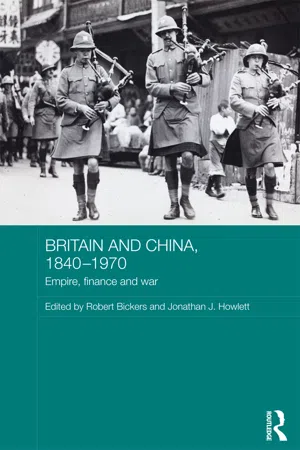
eBook - ePub
Britain and China, 1840-1970
Empire, Finance and War
- 250 pages
- English
- ePUB (mobile friendly)
- Available on iOS & Android
eBook - ePub
Britain and China, 1840-1970
Empire, Finance and War
About this book
Information
1 ‘The usual intercourse of nations' The British in pre-Opium War Canton
DOI: 10.4324/9781315687735-1
In December 1833, James Goddard, a British merchant in Macao, lamented in the Chinese Repository how British relations with China had resulted in the ‘reverse of what takes place in the usual intercourse of nations’. Identifying himself simply as ‘A British Merchant, Formerly of Canton’, Goddard scoffed at the notion that sending a superintendent of trade would improve Britain’s trading position in China, and doubted that ‘any honorary appointment could be comprehended by the Chinese’. If the Chinese continued to rebuff their demands for greater trading concessions, the British might ‘establish an embargo on their shipping about Canton, or extend it to the whole coast, or cut off their communications by the Great canal, or land an army of fifteen or twenty thousand men in the Yellow sea, and obtain a substantial commercial treaty under the walls of Peking’. With the Qing empire in ‘so crumbling a state’, the presence of British ships would be ‘received with joy and satisfaction by the great mass of the Chinese population’, even if it were ‘opposed and repulsed by the mandarins or officers of government with a more dominant power’. The embargo would ‘intercept their supplies of fish, rice and salt, destroy a large portion of their tribute and revenue, and carry distress to the inmost recesses of the empire’. The country would be liberated from the ‘barbarous’ Manchus, who ‘despising treaties and the Great wall’, had ‘seized the destinies of China, and ruled it with an iron hand’ and ‘thrown back ignominy upon ourselves, and disgraced our nation’s character’.1
What Goddard hoped to end was, of course, the Canton System, which had confined China’s trade with the West to a tiny section of Canton since the mid-1700s. The calls for a more aggressive policy towards China would become even more strident after the end of the East India Company’s monopoly in 1833, especially by private merchants such as William Jardine and his partner James Matheson and the former East India Company director Hugh Hamilton Lindsay, who tried to push British opinion in Canton and London towards a more aggressive policy in China.2 Even if the influence of Jardine and Matheson on British policy has often been exaggerated, the English-language press in Canton frequently featured editorials and letters demanding a punitive mission against China, sometimes even while arguing against outright war.3 These calls became especially loud after the failure of Lord Napier’s mission in the summer of 1834 and his death that October.
These were not, however, the only suggestions for resolving Britain’s commercial arrangements with China. In February 1834, the Chinese Repository published a response from ‘Another British Merchant’, who insisted that the British had little to offer the Chinese apart from opium. Were the Chinese not a ‘happy, thriving, and contented people’, even without English products? Although he agreed with Goddard that ‘a single gun-boat would make the whole Chinese navy quail’, he cautioned against going ‘beyond just and honorable measures’, reminding him that the Chinese government was powerful internally because ‘it pleases and cherishes the mass of the people, and oppresses only the rich, who are always objects of envy to the poor’. The government of China had ‘a firmer hold over the people and more power of effectual control, than either Great Britain, France, or any other nation; and there is every reason to believe that happiness is more generally diffused through its population’. The Qing empire was ‘greater than that of the whole of Europe’, enjoyed the ‘varied productions of every soil and climate’, and needed little from other countries. ‘The Chinese nation’, he argued, ‘can far better do without us, than we without them’.4
British greed, belligerence, arrogance, and determination to open China; Chinese corruption, xenophobia, lack of official interest in international trade, and refusal to adapt to the demands of a changing world: these are the themes that have generally characterized the Canton System, the first sustained encounter between China and the modern West.5 Several interrelated issues have clouded our understanding of this first great encounter between Britain and China. The teleology of the Opium War has made the period one primarily of conflict and cultural clash, leading inevitably to war – so much so that the Canton System and the Opium War have often been lumped together in a single unit of analysis.6 Ulrike Hillemann has recently observed how most studies see the early nineteenth century as ‘little more than a prequel to the Opium War and British–Chinese relations afterwards’.7 Nor does the usual terminology help matters: neither ‘imperialism’ nor ‘informal empire’ adequately explains the British presence in Canton before the Opium War.8 As Hillemann notes, this presence was hardly imperial, not even a trading post protected by the British military.9 Perhaps as much a cause of the problem as a result, there is a lack of a serious study of the British community in Canton as exists for the Americans, who by the early 1800s had become the second-largest Western community in Canton but still remained far fewer in number.10 Most studies of Britons in China have focused instead on the period after the establishment of the treaty ports.11
Britons who visited or resided in prewar Canton wrote widely and extensively about China, offering a range of explanations for the sorry state of Anglo-Chinese affairs and an array of solutions for the problem. Although they rarely doubted the superiority of British civilization or the righteousness of the British presence in China, some, nevertheless, hoped that China could be opened without force. The debates about the opium trade, both in Britain and in China, are familiar.12 Less familiar, however, are the many debates in Canton about how to improve Britain’s commercial and diplomatic footing in China. The local English press helped shape a British maritime public sphere that stretched from Canton to India and all the way back to Britain, hoping to convince politicians, merchants, and industrialists at home that Britain’s position in China was in dire need of improvement.13 But the press was also a place where Britons in Canton debated and argued about how to effect these changes. By seeing the post-Opium War period as a break from the Canton System, we have often overlooked some of the ways in which the complexities and contradictions of the British presence (and indeed the Western presence in general) in nineteenth- and twentieth-century China were shaped during this critical period. The British presence in China was as complex before the war as it was afterwards. Here in Canton would many Britons come to believe that the Middle Kingdom must be opened by force. But here too would some, including those who favoured war, begin a programme of missionary, educational, and philanthropic works that would equally characterize the British presence in China for another century.
Explaining the restrictions
Britons in Canton complained loudly and frequently about the ‘crying abuses’ (in the words of the Canton Register, controlled by James Matheson) of the Canton System, both to the Chinese authorities and to the British government.14 In December 1830, more than forty British merchants presented their grievances in a petition to the House of Commons, claiming that they were subjected to ‘privations and treatment to which it would be difficult to find a parallel in any part of the world’.15 In August 1831, a contributor to the Canton Register insisted that it was useless to ‘sit down quietly and hope for better times’. Nor was it only the Chinese who needed to be convinced of the need for change: ‘the more fully acquainted those at home become with the real state of things in this country – the oftener and the stronger this is forced on their attention – the greater is our rational hope of redress’.16
Even as Britons hoped that the restrictions on foreign trade would be lifted, they sought to understand how they had come into existence in the first place. Some attributed the restrictions of the Canton System to the perversion and corruption of the Chinese character. More often than not, however, they offered more thoughtful and reasoned – if not necessarily accurate – explanations. As C. Toogood Downing, a surgeon who spent two years in Canton (though mostly downriver in Whampoa, where the foreign ships were moored) and wrote three volumes based on his experience there, saw it, the Qing policy of confining foreigners to a tiny section of Canton was aimed at preventing them from settling in China while treating Canton as ‘a kind of counting-house, where the merchants may transact all their business, and then retire to their own country’. This was why the Qing authorities kept so close a watch on the foreigners and forbade them to bring their families to Canton, ‘so that their thoughts may be constantly directed to the time when they shall leave in order to join them’.17 John Francis Davis, who had worked in Canton for twenty years as a writer for the East India Company and accompanied Lord Amherst’s expedition to Peking in 1816–17, argued that the Manchus confined foreign trade to Canton ‘with such obstinacy to a point so unsuited to its extension’ for two reasons: ‘to remove the danger of external involvements from the vicinity of the capital’ and ‘to derive the largest possible revenue from internal transit’.18
In February 1838 the Canton Press, financed by Dent’s, Jardine’s main rival, explained how the ‘extreme reluctance’ of the Chinese to allow foreigners into China arose partly from their ‘peculiar manners and the pride which a long course of prosperity has engendered’, and partly from their government, ‘which being in the hands, not of the children of soil, but of foreign conquerors … dread every collision with foreign nations as threatening the subversion of their power’. The Chinese realized that with more contact with foreigners, ‘many of their most cherished institutions left them by their forefathers through a hundred generations, would be shaken’. Their tradition of isolation had made them ‘incapable of appreciating any but their own laws, institutions, and manners’. Even if the Chinese could be made to appreciate the progress the West had made in ‘all arts of civilized life’ and in ‘the science of politics’, they might not be ready for ‘western improvements’ to be ‘thrust upon them’: they would be like the famous prisoner in the Bastille, who having been incarcerated for so long, returned to prison voluntarily after the French Revolution. ‘Thus will it be with the Chinese, unless they are brought to associate with other nations by imperceptible degrees, so as not too grossly to shock the prejudices and habits which thousands of years have rendered dear to them.’19
For most observers, the restrictions of the Canton System were a historical anomaly, which although an argument against the restrictions also offered the possibility that they might be ended. The missionary Robert Morrison, who also worked for the East India Company as a writer and interpreter, explained that although for more than a century ‘almost the whole of the European trade’ had been restricted to Canton and Macao, ‘it was not always so’. At various times during the Ming dynasty, the ports of Ningbo, Zhoushan, and Xiamen were opened to European trade and became ‘large ports for their commerce’.20 John Davis argued that Chinese historical records provided ‘abundant evidence’ that ‘a much more liberal as well as enterprising disposition once existed, in respect to foreign intercourse, than prevails at present’. Before Europeans arrived, the Chinese government had ‘given every encouragement to foreign commerce’. Even before the seventh century, neighbouring countries had sent missions to China ‘with a view to inviting mutual intercourse’. Chinese junks had made their way to the Indian peninsula: the fourteenth-century Moroccan scholar and traveller Ibn Battuta had mentioned the presence of Chinese junks as far west as the coast of Malabar. Only after the Manchu conquest was European trade limited to Canton. Since then, wrote Davis, the ‘jealous and watchful Tartar dominion, established by this handful of barbarians’, ...
Table of contents
- Cover Page
- Half Title Page
- Series
- Title Page
- Copyright Page
- Contents
- Notes on contributors
- Acknowledgements
- Introduction: Britain and China
- 1 ‘The usual intercourse of nations’: the British in pre-Opium War Canton
- 2 British intervention in the Taiping Rebellion
- 3 Britain and China, and India, 1830s–1947
- 4 The interest of our colonies seems to have been largely overlooked: colonial Australia and Anglo-Chinese relations
- 5 ‘Coolies’ or Huagong? Conflicting British and Chinese attitudes towards Chinese contract workers in World War One France
- 6 Sino-British relations in railway construction: state, imperialism and local elites, 1905–1911
- 7 Foreign investment in modern China: an analysis with a focus on British interests
- 8 Curative finance: Francis Aglen, bond markets, and the early Republic, 1911–1928
- 9 Expansion and defence in the International Settlement at Shanghai
- 10 Nationalistic enthusiasm versus imperialist sophistication: Britain from Chiang Kai-shek’s perspective
- 11 ‘Decolonisation’ in China, 1949–1959
- Index
Trusted by 375,005 students
Access to over 1.5 million titles for a fair monthly price.
Study more efficiently using our study tools.
Frequently asked questions
Yes, you can cancel anytime from the Subscription tab in your account settings on the Perlego website. Your subscription will stay active until the end of your current billing period. Learn how to cancel your subscription
No, books cannot be downloaded as external files, such as PDFs, for use outside of Perlego. However, you can download books within the Perlego app for offline reading on mobile or tablet. Learn how to download books offline
Perlego offers two plans: Essential and Complete
- Essential is ideal for learners and professionals who enjoy exploring a wide range of subjects. Access the Essential Library with 800,000+ trusted titles and best-sellers across business, personal growth, and the humanities. Includes unlimited reading time and Standard Read Aloud voice.
- Complete: Perfect for advanced learners and researchers needing full, unrestricted access. Unlock 1.5M+ books across hundreds of subjects, including academic and specialized titles. The Complete Plan also includes advanced features like Premium Read Aloud and Research Assistant.
We are an online textbook subscription service, where you can get access to an entire online library for less than the price of a single book per month. With over 1.5 million books across 990+ topics, we’ve got you covered! Learn about our mission
Look out for the read-aloud symbol on your next book to see if you can listen to it. The read-aloud tool reads text aloud for you, highlighting the text as it is being read. You can pause it, speed it up and slow it down. Learn more about Read Aloud
Yes! You can use the Perlego app on both iOS and Android devices to read anytime, anywhere — even offline. Perfect for commutes or when you’re on the go.
Please note we cannot support devices running on iOS 13 and Android 7 or earlier. Learn more about using the app
Please note we cannot support devices running on iOS 13 and Android 7 or earlier. Learn more about using the app
Yes, you can access Britain and China, 1840-1970 by Robert Bickers, Jonathan Howlett, Robert Bickers,Jonathan J. Howlett,Jonathan Howlett, Robert Bickers, Jonathan J. Howlett in PDF and/or ePUB format, as well as other popular books in Scienze sociali & Studi sull'etnia. We have over 1.5 million books available in our catalogue for you to explore.