Despite the efforts of Southeast Asian governments and of ASEAN, transboundary haze continues to be a major environmental problem in Southeast Asia. This book demonstrates that the issue is complex, and explains why efforts to solve the problem in purely political terms are ineffective, and likely to continue to be ineffective. The book shows how state-led, state-incentivised agribusiness development lies at the heart of the problem, leading to a large rise in palm oil production, with extensive clearing of forests, leading to deliberate or accidental fires and the resulting haze. Moreover, although the forest clearing is occurring in Indonesia, many of the companies involved are Malaysian and Singaporean; and, further, many of these companies have close relationships with the politicians and officials responsible for addressing the problem and who thereby have a conflict of interest. The author concludes by discussing the huge difficulties involved in overturning this system of 'patronage politics'.
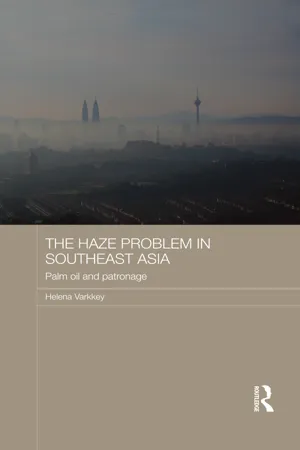
- 228 pages
- English
- ePUB (mobile friendly)
- Available on iOS & Android
eBook - ePub
About this book
Information
1 Introduction
DOI: 10.4324/9781315717814-1
Transboundary haze is the Southeast Asian region’s first and most publicly identifiable regional environmental crisis (Elliott, 2003). This haze has been an annual recurring problem in Southeast Asia since the 1980s (Mayer, 2006: 202–203), and is still a serious problem in the region today.
Haze originates from peat and forest fires, mostly in Indonesia. Research has shown that most of these fires are manmade. While previous scholars have identified poverty and developmental issues as driving haze (arguing that slash-and-burn agriculture by lesser-educated swidden farmers is a major cause of these uncontrolled fires), more recent research has established a clear link between haze-producing fires and commercial oil palm plantations in Indonesia. These commercial plantations have been found to contribute up to 80 per cent of the haze in the region (Caroko et al., 2011: 21; Casson, 2002: 234–239; Colfer, 2002: 316; Fairhurst and McLaughlin, 2009: 7–34; Tan et al., 2009: 422). As a result, haze continues to plague Southeast Asia on an almost annual basis, with Indonesia, Malaysia and Singapore suffering the worst of its effects, both in terms of socioeconomic well-being and public health. Haze mitigation activities in turn largely originate at the Association of Southeast Asian Nations (ASEAN) level, however these initiatives continuously fail to effectively mitigate haze (Chang and Rajan, 2001: 666; Nguitragool, 2011: 357; Tan, 2005: 3–4; Tay, 2002: 74; Yahaya, 2000: 49).
This is the puzzle that this book will engage with: why have the governments of Indonesia, Malaysia and Singapore thus far failed to effectively address the regional haze problem despite clear evidence of the culpability of the oil palm plantation sector in Indonesia?
Research such as this is timely and important. This research deals with a real-world problem that is continuing to bring severe socioeconomic harm to a significant number of the Southeast Asian people. While there seems to be much visible activity at the ASEAN level to address the issue, the proof of the futility of these efforts is visible every year when haze returns to blanket the region during the dry season. New academic insight is needed to explain the persistence of this issue despite these mitigation efforts, especially in the light of recent increased evidence of the link between haze-producing fires and commercial oil palm plantations (Sawit Watch, 2007: 1; WALHI et al., 2009). This has brought new issues to the surface, especially those of linkages between business and political elites at the local, national and regional levels.
Background
The term ‘haze’ normally denotes a naturally occurring climatic condition in which visibility is affected, for example ‘heat haze’ (McLellan, 2001: 254). However the term has been used in the Southeast Asian region to refer to ‘sufficient smoke, dust, moisture, and vapour suspended in air to impair visibility’ (ASEAN Secretariat, 2008). Haze pollution is transboundary when ‘its density and extent is so great at the source that it remains at measurable levels after crossing into another country’s airspace’ (ASEAN Secretariat, 2008). Since 1982, this ‘haze’ pollution developed into an almost annual occurrence in the region, with the worst episodes being in the period of 1997 to 1998, 2006 to 2007 (ASEAN Secretariat, 2008; Suwarsono et al., 2007: 1) and most recently in mid-2013. The negative effects of haze pollution can be observed at the global level, with increased carbon emissions exacerbating climate change, and at the regional level, with serious socioeconomic effects in Indonesia and its neighbouring countries.
At the global level, these haze-causing fires contribute to climate change by releasing large amounts of carbon into the atmosphere. It was estimated that during the 1997–1998 fires, 2.5 million metric tonnes of carbon dioxide was released into the air (Koh, 2008: 225). Largely as a result of these annual fires, Indonesia in 2011 was ranked as the world’s third largest emitter of carbon dioxide, after industrial giants like the United States and China (Greenpeace, 2007: 13; Hameiri and Jones, 2013: 468; Hunt, 2010: 187–190). Forests and land fires contribute up to 85 per cent of Indonesia’s emissions (Hameiri and Jones, 2013: 468–469). Research has shown that the recapturing of this lost carbon would take 692 years (Danielsen et al., 2008: 6). This is a serious concern for the region. An Asian Development Bank (ADB)-United Kingdom study found that the Southeast Asian region will be the worst effected region in the world as a result of climate change, as the region possesses unique natural ecosystems and resources such as fisheries and rainforests that feed the world and help sustain the global environment (Antara Magazine, 2009).
The more visible effects of haze pollution can be observed at the regional level. The haze affects the health of some 75 million people and the economies of six Southeast Asian nations: Indonesia, Malaysia, Singapore, Thailand, Brunei and the Philippines (Mayer, 2006: 202–203). The haze was also reported to have visibly affected areas as far off as the United States-administered Northern Mariana Islands and Guam in the Pacific Ocean. The 1997–1998 episode cost the region US$2.8 billion in forest and agricultural losses and $272 million in carbon releases. It reduced industrial production by $157 million, fisheries by $16 million and tourism revenue by $280 million (Severino, 1999). It also cost $941 million in short-term health damage and $25 million in fire-fighting efforts (Severino, 1999). While the haze can affect up to six Southeast Asian countries, the states that are the most severely affected in the region, due to their position as either a source or in close proximity to the fires, are Indonesia, Malaysia, and Singapore. These states are the focus of this book.
Densely forested Indonesia has been identified as the source of most of the haze-producing fires in the region, and has thus been one of the states suffering the worse effects of haze pollution. The fires and haze of 1997 was the worst in history for Indonesia. The Indonesian government declared the situation a ‘natural calamity’ that year when air pollution levels reached 1,890 micrograms per cubic meter (Djuweng and Petebang, 1997), many times above the tolerable level set by the World Health Organization and the Indonesian government, which is 130 and 150 micrograms per cubic meter respectively (Jakarta Post, 2004). The status of the fires and haze was elevated to a ‘disaster’ in 1999 (Dennis, 1999: 52), and a state of emergency was declared in the Sumatran province of Riau that year when the Pollutant Standards Index (PSI) there reached 978. A PSI of above 400 is considered extremely hazardous and life-threatening to the elderly and frail1 (Jakarta Post, 1999b). In the following years, almost annual haze occurrences have become a routine for Indonesians living in fire-prone areas (Jakarta Post, 1999a), especially during the dry months of August to October (Suwarsono et al., 2007).
Those closest to the source of the fires, mostly in the large island of Sumatra and the Indonesian side of the Borneo Island, Kalimantan, suffered the worst of the effects of the haze (Keraf [I35], 2010). At its most severe, the haze no longer looked like smoke but contained noticeable white particles (Jakarta Post, 1999b) and visibility was reduced to a mere 50 metres (Gunawan, 2002b). Schools in affected areas were closed down for extended periods (Jakarta Post, 2006a) or had their lessons shortened so that the students were not subjected to prolonged exposure to haze (Jakarta Post, 2004). Areas close to the flames experienced extraordinary heat (Hafild, 1997), while locations further away reported that the haze blocked out the warmth of the sun (Jakarta Post, 1999b). The locals complained that the smoke was hurting their eyes and also of increased respiratory problems (Jakarta Post, 1997a). It was estimated that in 1997, up to 20 million Indonesians sustained health troubles because of the haze (Hafild, 1997), while some hospitals reported that patient numbers exceeded the capacity levels (Djuweng and Petebang, 1997). At least 12 elderly people died in Jambi, reportedly of respiratory infections blamed on the thick haze (Jakarta Post, 1997c). The severe haze in 2006 saw 81 per cent of the days between September and November rated as ‘unhealthy/very unhealthy/dangerous’, with 30 days in October rated ‘dangerous’ (Harrison et al., 2009: 159). Major cities such as Jambi, Pekanbaru, Surabaya, Medan and Bandung experienced only on average 22 to 62 days of good air quality that year (Widianarko, 2009: 5).
The fires and haze also took a toll on local infrastructure and economies. Bad visibility due to smoke hampered land, sea and air transportation (Jakarta Post, 1997a). Thick smoke prevented flights from landing in provincial airports for weeks (Jakarta Post, 1987). The haze also delayed air operations to relieve drought-stricken villages (Jakarta Post, 1997b). The 1997 haze was blamed for the fatal crash of a Garuda Indonesia airplane (Djuweng and Petebang, 1997), and the 1999 haze was blamed for a fatal tanker accident in Siak River, Sumatra (Saharjo, 1999: 142). A bus crash in Medan in 2002, killing five passengers, was also blamed on low visibility due to haze (Gunawan, 2002a). As a result, airlines, travel agencies and bus companies saw their revenues and profits predictably plummet during each haze season (Djuweng and Petebang, 1997). Transportation disruptions also caused price hikes of daily needs and food scarcity in some areas (Jakarta Post, 1997a). The 1997 fires and haze cost Indonesia between $9 and $10 billion according to ADB estimates (Jones, 2006: 436), equivalent to 4.5 per cent of Indonesia’s gross domestic product (GDP) for the year (Ruitenbeek, 1999: 110–111). Out of this, short-term damage during the three-month haze period amounted to $1 billion in lost revenue and healthcare expenditure. The rest was attributed to lost tourist revenue, cancelled flights and airport closures (Jakarta Post, 1997d), which was estimated to be $111 million (Applegate et al., 2002: 296–297).
Much of this haze travelled across national boundaries to Indonesia’s closest neighbours, Malaysia and Singapore. Malaysia suffered ‘the most serious haze occurrence in Malaysian history’ in September 1997 (Law [M29], 2010). On 19 September 1997, the Malaysian government declared a state of emergency for the state of Sarawak when the Malaysia Air Quality Index2 reached 600. The emergency lasted for ten days, closing schools and offices. At one point, the index of Sarawak’s capital city, Kuching, went beyond 800, upon which the government even considered evacuation (Dauvergne, 1998: 13–14). Sarawak reported economic losses amounting to RM1 billion ($325 million) during the ten-day shutdown (Tawie, 1997). The August 2005 haze episode saw yet another state of emergency in several areas in the Peninsula (Bernama, 2005), and severe haze conditions continued into 2006.
Damage to local Malaysian sectors as a result of the 1997 haze cost a total of $321 million. This amounted to a damage of some $15 per capita for Malaysia (Othman, 2003: 244–245). According to these estimates, the most seriously affected local economic sectors were tourism (40 per cent of total national damage or losses due to haze) and fisheries (5 per cent) (Mohd Shahwahid and Othman, 1999). The months following the 1997 haze saw tourism arrivals fall by 13 per cent compared to the year befor...
Table of contents
- Cover Page
- Halftitle Page
- Series Page
- Title Page
- Copyright Page
- Dedication
- Table Of Contents
- List Of Figures And Table
- List Of Acronyms And Abbreviations
- Acknowledgements
- Preface
- 1 Introduction
- 2 The Indonesian oil palm sector and haze
- 3 The state as facilitator of regionalization
- 4 Regionalization and patronage politics
- 5 The regionalism of haze mitigation at the ASEAN level
- 6 Conclusion
- Index
Trusted by 375,005 students
Access to over 1.5 million titles for a fair monthly price.
Study more efficiently using our study tools.
Frequently asked questions
Yes, you can cancel anytime from the Subscription tab in your account settings on the Perlego website. Your subscription will stay active until the end of your current billing period. Learn how to cancel your subscription
No, books cannot be downloaded as external files, such as PDFs, for use outside of Perlego. However, you can download books within the Perlego app for offline reading on mobile or tablet. Learn how to download books offline
Perlego offers two plans: Essential and Complete
- Essential is ideal for learners and professionals who enjoy exploring a wide range of subjects. Access the Essential Library with 800,000+ trusted titles and best-sellers across business, personal growth, and the humanities. Includes unlimited reading time and Standard Read Aloud voice.
- Complete: Perfect for advanced learners and researchers needing full, unrestricted access. Unlock 1.5M+ books across hundreds of subjects, including academic and specialized titles. The Complete Plan also includes advanced features like Premium Read Aloud and Research Assistant.
We are an online textbook subscription service, where you can get access to an entire online library for less than the price of a single book per month. With over 1.5 million books across 990+ topics, we’ve got you covered! Learn about our mission
Look out for the read-aloud symbol on your next book to see if you can listen to it. The read-aloud tool reads text aloud for you, highlighting the text as it is being read. You can pause it, speed it up and slow it down. Learn more about Read Aloud
Yes! You can use the Perlego app on both iOS and Android devices to read anytime, anywhere — even offline. Perfect for commutes or when you’re on the go.
Please note we cannot support devices running on iOS 13 and Android 7 or earlier. Learn more about using the app
Please note we cannot support devices running on iOS 13 and Android 7 or earlier. Learn more about using the app
Yes, you can access The Haze Problem in Southeast Asia by Helena Varkkey in PDF and/or ePUB format, as well as other popular books in Politics & International Relations & Environment & Energy Policy. We have over 1.5 million books available in our catalogue for you to explore.