eBook - ePub
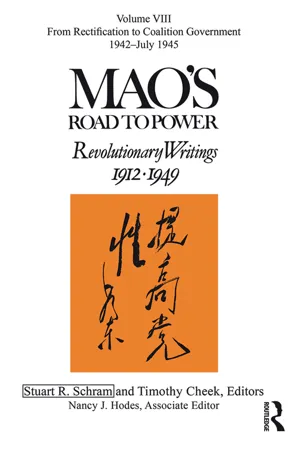
Mao's Road to Power
Revolutionary Writings: Volume VIII
- 1,072 pages
- English
- ePUB (mobile friendly)
- Available on iOS & Android
eBook - ePub
Mao's Road to Power
Revolutionary Writings: Volume VIII
About this book
This eighth volume covers the period 1942 to 1945 when Mao asserted his status as the incarnation and symbol of the Chinese Revolution and the sinification of Marxism-Leninism.
Preface to Textbook for Literacy
(January 17, 1942)
A revolutionary cadre must be able to read and write and also have rich general knowledge of social life and of nature, as the basis for doing work and as the basis for studying theory. Only thus can he hope to do his work well and to study theory well. Without this basis—that is, someone who does not recognize characters is not able to read and write, and someone whose general knowledge of society and nature is limited to the category of what one directly sees and hears—such people, though able to do some work, will not be able to do it well, even if they wish to. Although they can study some revolutionary principles, they will not be able to study them well. We now have a great number of cadres who are bright and faithful but lack a cultural basis. In the future we will inevitably still have a great number of such cadres. They urgently need to resolve the problems of a cultural basis, but the problem of textbooks has still not been resolved. Now, the publication of the Textbook for Literacy is a great victory. It is the contribution of comrades [He] Kaifeng, Xu Teli, and Fan Wenlan.1 Although the contents of the textbook will necessarily have to have its faults corrected from time to time, weeding through the old to bring forth the new, having this textbook still opens the gates to the study of culture. The publication of the Textbook for Literacy is good news for many cadres, and I believe the great mass of our cadres will warmly welcome this textbook.
Notes
Our source for this text is Mao Zedong wenji, Vol. 2, p. 387. It is taken from the 1948 edition of Wenhua keben, published by the second branch of Xinhua shudian.
1. He Kaifeng (1906–1955) was at this time the vice director of the Central Propaganda Department of the Chinese Communist Party; see Vol. V, p. lviii. Xu Teli (1877–1968) had been Mao’s teacher at the First Normal School in Changsha from 1913 to 1918; he joined the Party in 1927 and at the time of this publication was director of Yan’an’s Natural Science Academy; see Vol. I, p. 372, and Vol. V, p. 601. Fan Wenlan (1893–1969), the noted Marxian historian was at this time vice director of Yan’an’s Central Research Institute and director of the History Research Office.
Instructions for Troops in All Border Regions to Study the “Resolution of the Ninth Party Congress of the Fourth Red Army”
(January 23, 1942)
Comrades Tan Zheng and Mo Wenhua:1
Print several thousand more copies of the Resolution of the Ninth Congress of the Fourth Army and distribute them to the troops at headquarters and the troops in northwestern Shanxi. Deliver them down to the level of company commander, one copy to each person. Also, issue a notice telling them to treat it as study material which they must read well. (Cadres of all levels must read it well.)2
Mao Zedong
Notes
This note by Mao was published in Jiefang ribao on April 15, 1942, under the title that appears above. Our source is Zhonggong zhongyang wenxian yanjiushi, ed., Mao Zedong shuxin xuanji (Beijing: Renmin chubanshe, 1983), p. 192; the text is also reproduced in Mao Zedong ji. Bujuan, Vol. 7, p. 69.
1. Tan Zheng (1906–1988) was at this time deputy commissar and head of the Political Department of the Shaanxi-Gansu-Ningxia-Shanxi-Suiyuan Coalition Defense Army. Mo Wenhua (1910–2000) was deputy director of the Political Department of the Eighth Route Army.
2. It is worth noting that Mao himself was the author of this resolution; he was thus instructing the army to study his own writings.
To Zhou Enlai, Dong Biwu
(January 23, 1942)
Zhou, Dong,
1. Temporarily subscribe to two copies of every newspaper in the country. Send one copy to [Hu] Qiaomu1 and one to Chen Boda, all of which will be transferred through the New China Bookstore in Yan’an.
2. Please buy three copies of various types of books and published materials (regardless of whether they are general or specialized) and send them to the New China Bookstore to be forwarded to Qiaomu or [Li] Fuchun2 and to be received by [Wang] Shoudao.3 After they are received [we will] plan distribution.
3. In all cases, any other special books that are required should be reported through the General Office of the Secretariat via telegram.
4. As for expenses, please calculate the costs. Even if they exceed 100 yuan a year, there will be no stinting.
Mao [Zedong], Ren [Bishi],4
Li [Fuchen]
Li [Fuchen]
Notes
Our copy of this text is from Dangde wenxian, No. 2, 2012, p. 6, where it is reproduced from a copy.
1. Hu Qiaomu (1912–1992) was a sociologist by training and by 1942 was the main secretary to Mao Zedong and secretary of the Chinese Communist Party Politburo. Chen Boda (1904–1989) served as secretary and research assistant to Mao from 1937 and was valued by Mao for his work on ideology.
2. At the time Li Fuchun (1900–1975) was deputy secretary of the Central Committee and head of its General Office.
3. At the time Wang Shoudao (1906–1996) was head of the Chinese Communist Party Secretariat. Wang was Mao’s student at the Guangzhou Peasant Training Institute in 1925 and thereafter became Mao’s longtime follower, working closely with Mao beginning from 1933, particularly in the security services.
4. Ren Bishi (1904–1950) was a top military and political leader in the Party, serving on the Politburo; in 1942 Ren took charge of Yan’an’s schools and training institutes and played a leading role in the Rectification Campaign. In 1943 Ren joined Mao and Liu Shaoqi as part of the top leadership group.
Inscription for the Third Anniversary of the Publication of the Military and Political Journal of the Eighth Route Army
(January 25, 1942)
“Be prepared to counterattack.”
Note
Our source for this text is Takeuchi, Minoru, ed., Mao Zedong ji. Bujuan (Tokyo: Sososha, 1983–1986), Vol. 10, p. 174, citing Balujun junzheng zazhi, 4:1 (1942).
The Main Points of Propaganda of the Propaganda Department of the Central Committee
(January 26, 1942)
1. The main points of propaganda of this department used to lay primary emphasis on propaganda outside the Party. From this period onward, we have decided to add propaganda within the Party. We hope that comrades from all regions will pay attention.
2. In view of the fact that, before the Zunyi Conference, the losses caused to the Party and to the revolution by errors of subjectivism and sectarianism were enormous; and given that although after the Zunyi Conference the line of the Party has been correct, the remnants of subjectivism and sectarianism have by no means been eliminated and still exist to a very substantial extent within the entire Party, especially in certain special regions and certain special departments. The Politburo of the Central Committee has discussed this problem repeatedly and emphatically during the past year. It has issued a Decision on Enhancing Party Spirit, a Decision on Developing Investigations and Research, a Decision on Cadre Schools, and a Decision on High-Level Study Groups. In addition, Comrade Mao Zedong, in accordance with a decision of the Central Committee, delivered a speech at the Consultative Congress of the Shaanxi-Gansu-Ningxia Border Region opposing sectarianism. These decisions and this speech have already played a guiding role throughout the Party, have attracted the attention of many comrades, and have been concretely correcting the remnants of subjectivism and sectarianism that still exist to this day. This is a good thing, but it is only one side of the phenomenon. On the one hand, the decisions of the Central Committee and the speeches by comrades of the Central Committee have not made a deep impression on many comrades. The reasons for this may be that some comrades who committed rather serious errors of subjectivism and sectarianism still refuse for the moment genuinely to recognize their errors, are unwilling to conduct genuine self-criticisms, and refuse to correct their errors quickly. On the other hand, it may be that some comrades think that they have by no means committed any subjectivist and sectarian errors of line, and therefore they consider that this matter does not concern them and they are above it all, failing to recognize the subjectivist and sectarian elements in their own thoughts and actions both in the past and in the present and the fact that they have also been guilty of mistakes. For example, they may be easily aroused, substituting their personal feelings for policy, understanding very little about the circumstances of the three sides—enemy, friends, and ourselves. They may lack the spirit of scientifically and carefully investigating and researching objective things, but have the spirit of always considering themselves in the right. All these are precisely the sources of subjectivist errors. Furthermore, such errors may consist, for example, of asserting one’s independence inside the Party and confusing correct things, such as developing the ability to work independently and developing Marxist creativity, with erroneous things, such as disobeying one’s superior, disobeying the majority, disobeying the Central Committee, setting oneself against the Party, and putting the individual above the Party (giving prominence to the individual), and individual heroism (as opposed to national heroism and the heroism of the masses). In relations between cadres from outside and cadres from local areas, in relations between military cadres and cadres of the localities, in relations between cadres of the same forces and cadres of friendly forces, and in relations between veteran cadres and new cadres, they do not pay attention to helping one another and uniting with one another, but they look down on one another or even bully one another. Here, we did not increase the responsibilities of cadres from the outside, military cadres, cadres of the same force, and old cadres; neither did we do more to forgive and assist cadres from the local areas, cadres from the localities, cadres of friendly forces, and new cadres in the expectation of uniting them and promoting them so that they will overcome various weaknesses in the course of struggle. Because in many places there still exist various abnormal internal relations, these are but manifestations of remnants of sectarianism within the Party. As far as relations between Party members and non-Party members and between Party cadres and non-Party cadres are concerned, there further exist enormous estrangement, misunderstanding, lack of concern, and looking down on one another. For this, Party members and Party cadres should be held primarily responsible. That the “Three-Thirds” system1 has by no means been carried out completely, thoroughly, and earnestly is a manifestation of the existence of this sectarianism. It is a fact that this type of serious sectarian error in relations between those inside and outside the Party has not attracted serious attention of all or of the majority of our comrades. All these subjectivist and sectarian thoughts and actions cannot be overcome if we do not initiate a thorough, earnest, and deep struggle against them, and as a result we cannot win victory for the revolution. Moreover, if we want to carry forward the struggle and overcome these thoughts and actions, it will not have much effect if we do not mobilize the entire Party. For this reason, we hope that all the leading organs and all the leading comrades of the whole Party and the whole army will pay attention to this problem, carry out propaganda, and carry on the work. Regarding this problem, our department will successively provide the materials stated as references for our comrades’ work.
Notes
Our source for this text is Mao Zedong wenji, Vol. 2, pp. 389–91, where it is reproduced from Mao’s handwritten manuscript.
1. The “Three-Thirds” system (san san zhi), publicized in a March 6, 1940, Central Committee directive, required all public political offices to be shared equally by three groups: Communists, non-Party Leftists, and middle-of-the-road anti-Japanese patriots. See the account of this development in Vol. VII, pp. 432–34.
Decision of the Central Committee of the Chinese Communist Party Regarding Agrarian Policy in the Anti-Japanese Base Areas
(Passed by the Politburo of the Central Committee, January 28, 1942)
Since the beginning of the War of Resistance, the agrarian policy that has been carried out by our Party in all the anti-Japanese resistance areas is the agrarian policy of the Anti-Japanese United National Front: that is, the agrarian policy of reducing rent and interest, on the one hand, and delivering rent and interest, on the other. This policy, after having been carried out in all the base areas, has gained the support of the broad masses, united people of all strata, and won support for the War of Resistance in the enemy’s rear areas. In every base area where the reduction of rent and interest has been carried out fairly universally, fairly earnestly, and fairly thoroughly and where the payment of rent and interest on loans at the same time has been guaranteed, the zeal of the local masses to participate in the resistance struggle and in the establishment of democracy is relatively high. Moreover, they are able to maintain day-to-day work and to stabilize the order of social life, and there the base areas are re...
Table of contents
- Cover
- Title
- Copyright
- Contents
- Acknowledgments
- General Introduction: Mao Zedong and the Chinese Revolution, 1912–1949
- Introduction: The Writings of Mao Zedong, 1942–July 1945
- Note on Sources and Conventions
- 1942
- 1943
- 1944
- 1945
- Bibliography
- Index
- About the Editors
Trusted by 375,005 students
Access to over 1.5 million titles for a fair monthly price.
Study more efficiently using our study tools.
Frequently asked questions
Yes, you can cancel anytime from the Subscription tab in your account settings on the Perlego website. Your subscription will stay active until the end of your current billing period. Learn how to cancel your subscription
No, books cannot be downloaded as external files, such as PDFs, for use outside of Perlego. However, you can download books within the Perlego app for offline reading on mobile or tablet. Learn how to download books offline
Perlego offers two plans: Essential and Complete
- Essential is ideal for learners and professionals who enjoy exploring a wide range of subjects. Access the Essential Library with 800,000+ trusted titles and best-sellers across business, personal growth, and the humanities. Includes unlimited reading time and Standard Read Aloud voice.
- Complete: Perfect for advanced learners and researchers needing full, unrestricted access. Unlock 1.5M+ books across hundreds of subjects, including academic and specialized titles. The Complete Plan also includes advanced features like Premium Read Aloud and Research Assistant.
We are an online textbook subscription service, where you can get access to an entire online library for less than the price of a single book per month. With over 1.5 million books across 990+ topics, we’ve got you covered! Learn about our mission
Look out for the read-aloud symbol on your next book to see if you can listen to it. The read-aloud tool reads text aloud for you, highlighting the text as it is being read. You can pause it, speed it up and slow it down. Learn more about Read Aloud
Yes! You can use the Perlego app on both iOS and Android devices to read anytime, anywhere — even offline. Perfect for commutes or when you’re on the go.
Please note we cannot support devices running on iOS 13 and Android 7 or earlier. Learn more about using the app
Please note we cannot support devices running on iOS 13 and Android 7 or earlier. Learn more about using the app
Yes, you can access Mao's Road to Power by Stuart Schram, Timothy Cheek, Roderick MacFarquhar, Stuart Schram,Timothy Cheek,Roderick MacFarquhar in PDF and/or ePUB format, as well as other popular books in History & 20th Century History. We have over 1.5 million books available in our catalogue for you to explore.