eBook - ePub
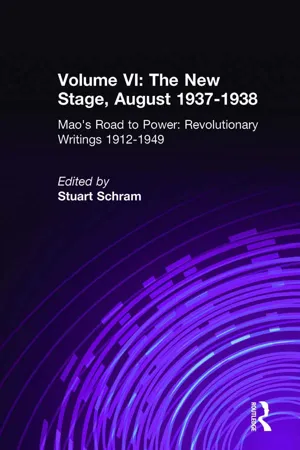
Mao's Road to Power: Revolutionary Writings, 1912-49: v. 6: New Stage (August 1937-1938)
Revolutionary Writings, 1912-49
- 928 pages
- English
- ePUB (mobile friendly)
- Available on iOS & Android
eBook - ePub
Mao's Road to Power: Revolutionary Writings, 1912-49: v. 6: New Stage (August 1937-1938)
Revolutionary Writings, 1912-49
About this book
By 1936, after a decade of Civil War and even before the Xi'an Incident, Mao Zedong had begun talking about a "New Stage" of cooperation between the Guomindang and the Communist Party. With the establishment of a framework for cooperation between the two parties, and as Japan began its brutal war against China, Mao began to develop this theme more systematically in both the political and military spheres. This volume documents the evolution of Mao's thinking in this area that found its culmination in his long report to the Sixth Enlarged Plenum of the Central Committee in October, 1938, explicitly entitled "On the New Stage" and presented here in its entirety. It was also during this period that Mao delivered a course of lectures on dialectical materialism after reading and annotating a number of works on Marxist theory by Soviet and Chinese authors. These lectures, from which "On Practice" and "On Contradiction" were later extracted, are also translated here in their entirety.
——————Part I Texts——————
——————1937——————
Speech at the “August 1” Rally of the Campaign
to Mobilize for the War of Resistance
(August 1, 1937)
Comrades, the Japanese imperialists are extending the war to North China! Beiping and Tianjin have fallen! If we fail to mobilize for the War of Resistance, the Japanese imperialists will soon be attacking us right here! Do not imagine that Beiping and Tianjin are far, far away from here. Out there lies Shanxi, bordering on our area, and beyond Shanxi are Beiping and Tianjin, which are being bombarded at this moment by Japanese airplanes and big guns. Therefore, the people of the whole country, wherever they are, must be mobilized urgently. The soviet areas are the model areas for the whole nation in fighting Japan, so it is of the highest significance that we are holding this rally of the campaign to mobilize for the War of Resistance here, at this critical moment, when North China is threatened, and the Chinese nation has arrived at a decisive pass. We want to set ourselves up as an example and hereby express our determination to prosecute the War of Resistance. A long while ago, we talked to them1 over and over again, expressing our hope that they would commit themselves to resolute participation in the War of Resistance, but they did not listen to us. From beginning to end they wavered and never made up their minds to fight the War of Resistance resolutely. The fall of Beiping and Tianjin this time was actually caused by their vacillation and lack of determination in fighting the War of Resistance. The authorities of North China from the very start resorted to the tortuous pursuit of compromise, without making sufficient preparations militarily. Unnecessarily wary of the popular masses, they made no effort to arouse the popular masses or to expand the patriotic movements of the popular masses. On the contrary, they put up public notices enforcing martial law and told the popular masses to remain “calm,” thus making it impossible for the popular masses, who were patriotic and seething with enthusiasm, to take any action. The result of this behavior was that they lost Beiping and Tianjin! I hope that the officers and men throughout the country who are fighting to safeguard our territory and resisting aggression will heed this tragic lesson! We now have only one policy orientation, and it is to fight Japan resolutely! Immediately mobilize the popular masses of the whole country—workers, peasants, merchants, students, and soldiers—people of all parties, all factions, and all social strata. Let them all unite and wage a life-and-death struggle against the Japanese imperialists! That is the one and only policy for our national independence and liberation!
The rally of the campaign to mobilize for the War of Resistance we are holding today is a step toward this orientation. This rally is not simply for the purpose of competition in the campaign; we want to mobilize the people for the War of Resistance. We want to mobilize the popular masses of the whole country for the defense of the country and its territory. Comrades, get ready to go to Hebei. Get ready to go to the front lines in the battle of resistance to Japan. Take the policy orientation and methods which we are applying here to the other parts of the country! Take our resolve to the front lines in the battle of resistance to Japan!
Let us loudly shout:
Down with Japanese imperialism!
Recover Beiping and Tianjin!
Safeguard North China!
Recover the Four Eastern Provinces!2
Long live the August 1 Campaign Rally!
Long live the liberation of the Chinese nation!
This speech was first published on August 2, 1937, in a special supplementary issue of Xin Zhonghua bao. We have translated it from Mao Zedong ji. Bujuan, Vol. 5, pp. 93–94, which reproduces this text.
1. The deliberately vague term “they’’/“them, ” with no antecedent, clearly refers to Chiang Kaishek, the Guomindang in general, and other powerful military commanders, whom Mao chose not to denounce by name at this time.
2. By “the Four Eastern Provinces” Mao was referring to Liaoning, Jilin (formerly Kirin), Rehe (formerly Jehol), and Heilongjiang, that is, to what was formerly known as Manchuria. When, in the numerous references to this area to be found in this volume, he sometimes spoke of the “Three Eastern Provinces, ” he was probably lumping together Liaoning and Jilin. In editing Mao’s writings for the Selected Works, both in Chinese and in English, those responsible changed “eastern provinces” to “northeastern provinces, ” no doubt because they assumed that some readers might think “eastern” referred to the coast, from Beijing to Shanghai. This change was made, however, only in a relatively small proportion of Mao’s total output, and in any case, our practice in this edition is to translate Mao’s writings in the form he originally gave them.
On the Operational Principles of the
Red Army
(August 1, 1937)1
Zhou [Enlai], Bo [Gu],2 Lin [Boqu]3:
As regards the operations of the Red Army, on the basis of the present situation on the enemy’s side as well as on our own, we think that we should resolutely adhere to the following two principles:
1. In accordance with our overall strategic orientation, we should carry out independent, self-reliant, and dispersed guerrilla warfare, and not positional warfare, nor should we concentrate our forces for a campaign. Consequently, we cannot allow ourselves to be restricted in campaigns and tactics. Only in this way can we bring into full play the professional skills of the Red Army and strike appropriate blows against the Japanese invaders.
2. According to the above principle, during the initial stage it is appropriate for the Red Army to use one-third of its forces. If too large a force is used, it will not be able to fight a guerrilla war and can, on the contrary, easily suffer a concentrated attack by the enemy. As for the rest of the forces, they should be brought into play gradually as the war develops.
Please discuss the above principles with the various comrades, and be prepared to inform the Guomindang.
| Luo [Fu]4 | Mao [Zedong] |
Our source for this text is Mao Zedong junshi wenji, Vol. 2, pp. 20–21, where it is reproduced from a copy in the Central Archives.
1. It is indicated at the end of this document by a conventional character that this telegram was sent between 5:00 and 7:00 p.m.
2. Qin Bangxian (1907–1946), whose pseudonym was Bo Gu, had been the dominant figure in the Party during the period of the Jiangxi Soviet Republic. Although he lost that position at the time of the Zunyi conference in January 1935, he continued to play a significant role. For details, see the numerous references to him in Volume V. At this time, he had recently been sent to Nanjing to serve as a liaison officer with the Guomindang.
3. Lin Boqu (1886–1960), also known as Lin Zuhan, a native of Hunan, had been commander of the First Army Corps during the Jiangxi Soviet period. At the beginning of the Anti-Japanese War, he became commander of the 115th division of the Eighth Route Army.
4. Luo Fu was the pseudonym of Zhang Wentian (1900–1976), a native of Nanhui, Shanghai. Zhang had joined the Chinese Communist Party in 1925, and thereafter spent four years studying in the Soviet Union. Returning to China at the end of 1930, he became one of the leading members of the “International Faction” in the Party. In 1934, he supplanted Mao as Chairman of the Council of People’s Commissars of the Chinese Soviet Republic. In January 1935 at Zunyi, he threw his support behind Mao, and as a result became “the person with overall responsibility” for the leadership of the Party, although he did not assume the formal title of Secretary General. At this time he was head of the Propaganda Department of the Chinese Communist Party.
Concerning the Submission in Person to
Nanjing of the Plan for National Defense and
Other Matters
(August 3, 1937)1
Zhou, Bo (and to be transmitted to Ye)2:
1. It would be appropriate for Zhou, Zhu [De], and Ye to go and submit the plan for national defense in person. It is not appropriate to send it by telegram.
2. We are just now considering the plan. Please inform us today by telegram of your agreed views on this matter, as well as on the operational guidelines for the Red Army and the measures to be taken.
3. Telegrams have been sent separately to the soldiers3 and the Secretariat about the danger of the westward advance by the Japanese invaders, Sino-Soviet relations, and the need of the Red Army for Soviet coordination in the fight against Japan.4
4. In your present trip to Nanjing, seek to solve the following problems in one package:
a. Publication of the declaration;
b. Formulation of the political program;
c. Ratification of the plan for national defense;
d. Announcement of the command system of the Red Army and the number of the initial reinforcements for the Red Army;
e. Guidelines for the operations of the Red Army.
| Luo [Fu] | Mao [Zedong] |
Our source for this text is Wenxian heyanjiu, 1985, no. 4 (pp. 220–21 of the annual volume).
1. It is indicated at the end of this document by a conventional character that this telegram was sent between 7:00 and 9:00 p.m.
2. The reference is to Zhou Enlai, Bo Gu (i.e., Qin Bangxian), and Ye Jianying.
3. A note to the available Chinese text states that the reference here is not clear.
4. Regarding Mao Zedong’s emphasis during and after the Long March on the importance of obtaining material support from the Soviet Union, see in particular the resolution of December 23, 1935, on problems of military strategy, in which Mao wrote: “‘Fighting a way through to the Soviet Union’ should be taken as the central [strategic] task” (Volume V, pp. 77–83), and various references to this theme in the Introduction to Volume V.
Our Views Regarding the Problem of
National Defense1
(August 4, 1937)
To Zhou [Enlai], Zhu [De], and Ye [Jianying], and also for the information of Bo [Gu], Lin [Boqu], Peng [Dehuai], Ren [Bishi], Liu [Bocheng], Zhang [Hao]2, He [Long], Guan [Xiangying], Chen [Guang], Nie [Rongzhen], Xu [Haidong], Cheng [Zihua], Chen [Zaidao], Wang [Hongkun], Xiao [Ke], and Guo [Shushen]:
Regarding the question of national defense, our opinions are as follows:
1. The first defensive front should run through places such as Zhangjiakou, Zuozhou, Jinghai, and Qingdao. The emphasis should be on Zhangjiakou, and we should concentrate enough military forces for the first decisive campaign.
2. The second defensive front should run through places such as Datong, Baoding, Machang, and Weixian. We should concentrate an advantageous number of troops, to reinforce the first defensive front at the appropriate time while at the same time preparing for the decisive campaign along the second front.
3. As far as Taiyuan, Shijiazhuang, Cangzhou, and other places are concerned, they can only be used as the third defensive front. We must absolutely not pay attention only to this front and not concentrate our forces on the first and second fronts.
4. The key at present is the first front.
5. For the time being, the general strategic orientation should be offensive defense. We must launch a destructive counteroffensive against the advancing enemy and must absolutely not conduct a pure defense. In the future we should prepare to switch to the strategic offensive and to recover lost territory.
6. In combining regular warfare with guerrilla warfare, the Red Army and the other appropriate armed forces and people’s armed forces may participate in guerrilla warfare. Under the general strategic dispositions, they should be allowed to exercise the power of command independently and with the initiative in their own hands.
7. Those units which are responsible for guerrilla warfare should use their troops properly in accordance with the topography and the situation on the battlefield. In accordance with the nature of guerrilla warfare, the troops should in principle be used separately instead of collectively.
8. According to the present situation, the Red Army should contribute one-third of its forces, use the area where the four provinces of Hebei, Chahar, Shanxi, and Suiyuan come together as the center, aim at the enemy troops which are moving westward along the Ping-Sui railway line and southward along the Ping-Han railway line, and carry on guerrilla warfare from the flanks. Apart from that, send another unit to be active in the Rehe-Hebei-Chahar Border Region and threaten the enemy’s rear (this force should not exceed one regiment). The Red Army should provid...
Table of contents
- Cover
- Half Title
- Dedication
- Title Page
- Copyright Page
- Table of Contents
- Acknowledgments
- General Introduction: Mao Zedong and the Chinese Revolution, 1912-1949
- Introduction: The Writings of Mao Zedong, August 1937-1938
- Note on Sources and Conventions
- Part I. Texts
- Part IIA. Lectures
- Part IIB. Commentaries
- Part III. Brief Sayings and Inscriptions
- Bibliography
- Index
Trusted by 375,005 students
Access to over 1.5 million titles for a fair monthly price.
Study more efficiently using our study tools.
Frequently asked questions
Yes, you can cancel anytime from the Subscription tab in your account settings on the Perlego website. Your subscription will stay active until the end of your current billing period. Learn how to cancel your subscription
No, books cannot be downloaded as external files, such as PDFs, for use outside of Perlego. However, you can download books within the Perlego app for offline reading on mobile or tablet. Learn how to download books offline
Perlego offers two plans: Essential and Complete
- Essential is ideal for learners and professionals who enjoy exploring a wide range of subjects. Access the Essential Library with 800,000+ trusted titles and best-sellers across business, personal growth, and the humanities. Includes unlimited reading time and Standard Read Aloud voice.
- Complete: Perfect for advanced learners and researchers needing full, unrestricted access. Unlock 1.5M+ books across hundreds of subjects, including academic and specialized titles. The Complete Plan also includes advanced features like Premium Read Aloud and Research Assistant.
We are an online textbook subscription service, where you can get access to an entire online library for less than the price of a single book per month. With over 1.5 million books across 990+ topics, we’ve got you covered! Learn about our mission
Look out for the read-aloud symbol on your next book to see if you can listen to it. The read-aloud tool reads text aloud for you, highlighting the text as it is being read. You can pause it, speed it up and slow it down. Learn more about Read Aloud
Yes! You can use the Perlego app on both iOS and Android devices to read anytime, anywhere — even offline. Perfect for commutes or when you’re on the go.
Please note we cannot support devices running on iOS 13 and Android 7 or earlier. Learn more about using the app
Please note we cannot support devices running on iOS 13 and Android 7 or earlier. Learn more about using the app
Yes, you can access Mao's Road to Power: Revolutionary Writings, 1912-49: v. 6: New Stage (August 1937-1938) by Zedong Mao,Stuart Schram in PDF and/or ePUB format, as well as other popular books in Business & Business General. We have over 1.5 million books available in our catalogue for you to explore.