- 272 pages
- English
- ePUB (mobile friendly)
- Available on iOS & Android
eBook - ePub
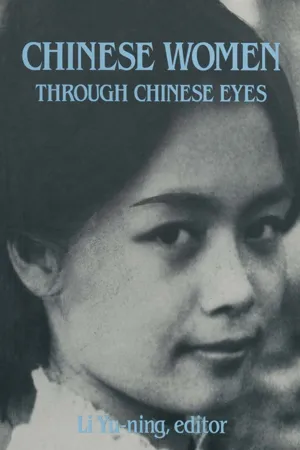
Chinese Women Through Chinese Eyes
About this book
The special focus of this book is the lives and experiences of women in China in the first half of the 20th century. Part One - Historical Interpretations - presents essays by Western-educated Chinese women and men, on the historical role of women in a time of great social and economic upheaval. Part Two - Self-Portraits of Women in Modern China - presents the views of women who experienced life in this period through essays and autobiographies that range from women as concubines to women as factory workers, from women suffering footbinding to women serving as nurses, from women in traditional role in a traditional family to women as scientists and teachers.
Information
I Historical Interpretations
1 Women's Place in Chinese History
DOI: 10.4324/9781315705729-2
Hu Shih (1891–1962) is familiar to students of modern Chinese history. Scholar, writer, educator, and diplomat, he had broad interests and made a lasting impact in many areas, from the adoption of colloquial Chinese as the standard written language to establishing a Chinese tradition of liberalism. As a liberal, he promoted equal rights for humankind, while as a historian, he praised aspects of China’s cultural traditions alongside his advocacy of Westernization.
The following essay reflects Hu’s liberal stand on women. His arguments are based on his historical research into the role of Chinese women in politics, literature, and education. This paper was first read in 1931 before the American Association of University Women in Tientsin and was published by the Transpacific News Service of New York City a decade later.
There is a general impression that the Chinese woman has always occupied a very low place in Chinese society. The object of this paper, however, is to try to tell a different story, to show that, in spite of the traditional oppression, the Chinese woman has been able to establish for herself a position that we must regard as a fairly exalted one. If there is a moral to this story, it is that it is simply impossible to suppress women—even in China.
I shall begin with these interesting lines from the Book of Odes, which is the richest and most authentic source of materials for our study of the social life of ancient China before the eighth century B.C.:
When a daughter is born,
Let her sleep on the ground,
Wrap her in common wrappings,
And give her broken tiles for her playthings.
May she have no faults, nor merits of her own;
May she well attend to food and wine,
And bring no discredit to her parents!
When a son is born,
Let him sleep in the bed,
Clothe him with fine dress,
And give him jades to play with.
How lordly his cry is!
May he grow up to wear crimson
And be the lord of the clan and the tribe!
This frank partiality to sons and neglect of daughters does not require any apology or comment. It is simply a sociological and anthropological fact that womankind has always had to face in every part of the world. It is against such a hostile background that woman has had to struggle and slowly win her position in the family and in the larger world.
Even in ancient China, women were playing an important part in political life. Confucius told us that, of the ten builders of the Chou empire, one was a woman. He did not mention who she was, nor what she did. But in those ancient odes, which sang the early history of the Chou people before its eastward migration and conquest, we read high tributes paid to the great women who helped to make their race great. Indeed the poet-historians traced the origin of this race to a virgin woman who, through an immaculate conception, gave birth to Hou Chi, who taught his people the art of agriculture and became the founder of a great race and a great dynasty. Probably women enjoyed a peculiarly high position among this western people. For, in their quasi-historical poems, their great rulers were almost always mentioned together with their wives: the T'ai Wang migrated with his wife; Wang Chi's marriage with T'ai Jen was celebrated in one of the odes; and T'ai Szu, Wen Wang's consort, was praised more than once in these poems. T'ai Szu gave birth to ten remarkable sons of whom one conquered the Yin empire and founded the Chou dynasty, which lasted almost eight hundred years, and another was the duke of Chou, a great general and statesman.
But in the later history of the Chou dynasty, the part played by the women did not seem to be always beneficial. The Western empire fell to the hands of the Barbarians in 721 B.C., and history attributed its downfall to the work of a woman, Pao Szu, Thus the poets sang:
Glorious was the Chou House,
It was Pao Szu who ruined it.
Authentic history did not tell us how she did it, but she must have been a truly wonderful woman to be able to ruin a great dynasty. For the poets said in another ode:
The wise man founded the city,
But the wise woman destroys it.
Alas! this wise woman,
A bird of evil omen is she!
A woman with a long tongue
Is surely a stepping stone to ruin.
Disaster does not descend from Heaven,
It comes from Woman.
This is a condemnation of women but at the same time a clear indication of the important role played by women in those days. Woman must occupy a very important position before she can ruin a city or a nation.
Throughout Chinese history, there were many great women whose political achievement was not merely due to their status as empresses or empress dowagers. An ordinary person with no marked talents can achieve nothing even though she is placed in the most exalted positions of the empire. But these Chinese women did honor to the positions they occupied in history. Such was the queen-regent of Ch'i who reigned for almost forty years and whose sagacity in internal government and diplomacy kept the Kingdom of Ch'i out of the devastating wars that ruined the nations in the third century B.C. She was once asked to solve the puzzle of unchaining a chain of jade rings. She took a hammer and broke the chain with the exclamation: “I have solved it!”
In the founding of the Han empire, which lasted four hundred years, two women played very important parts. The Empress Lü (died 180 B.C.), wife of the founder of the dynasty, came from the common people and had no education. But she was a woman of great shrewdness and capable of most decisive and brutal action. It was she who murdered Han Hsin and P'eng Yüeh, the two great generals whose power could threaten the safety of the empire. The other woman was the Empress Tou (died 135 B.C.), who also came from the people and was in power for forty-five years. She was a believer in Lao Tzu's political philosophy of noninterference and required all her children and grandchildren and her own clansmen to study the works of Lao Tzu and other Taoist philosophers. Throughout the long reigns of her husband and her son, the imperial policy was one of laissez-faire and strict economy, which allowed the people to recuperate from the effects of long wars and to develop their own resources. At the end of her reign, the empire had attained the height of general prosperity and the government had endeared itself to the people, so that it was possible for her grandson, Wu Ti, to carry out his policy of construction and expansion and to build up an empire of greater China.
In the most glorious days of the T'ang dynasty, a great woman, the Empress Wu Chao, ruled over the empire for forty-five years (660–705), during a part of which period she actually declared herself not merely empress-regent but emperor of her newly founded dynasty of Chou and reigned of her own right for sixteen years. She was a woman of great literary talent and political genius, and her long reign was marked by territorial expansion and cultural advancement.
I shall not go on enumerating the empresses who ruled vast empires, nor the imperial favorites who ruined great dynasties. I think I have said enough to show that the Chinese woman was not excluded from political life and that she has played no mean role in the long history of the country.
In the nonpolitical spheres of life, the Chinese woman, too, has achieved positions of honor and distinction. The greatest honor goes to T'i Ying, of the family of Ch'un-yü, who was responsible for the abolition of corporal tortures under the Han empire. Her father, who was one of the greatest physicians of the age, had been unjustly accused and was to be subjected to bodily tortures. As he had five daughters and no son, the old doctor, on his way to prison, turned to the girls and said: “It has been my misfortune to have only daughters and no son, and I have no one to help me in time of need.” T'i Ying, the youngest of his five daughters, resolved to help her father and went to the capital where she petitioned to the emperor offering herself as a slave in the imperial court to redeem her father from the deadly tortures. Her petition touched the heart of the benevolent Emperor Wen Ti, who issued in 167 B.C. his most famous edict ordering the abolition of all the worst forms of corporal punishment.
In the world of scholarship and literature, Chinese women have always made important contributions. In the early decades of the Han dynasty, when the ancient classics were transmitted through verbal teaching, a woman was responsible for the preservation and transmission of the text of one of the classics, the Book of History. Three hundred years later, when the great historian Pan Ku died in imprisonment (A.D. 92) and his monumental History of the Former Han Dynasty was left unfinished, it was a woman, his sister Pan Chao, who was requested by the imperial government to continue the work and bring it to completion. It was she who taught the great scholar Ma Yung to read the History of the Former Han Dynasty, thereby publishing it to the world. Pan Chao was invited to become the teacher of the empress and the other ladies of the court. When the Empress Teng became regent (105–121), she was a kind of political adviser to her. Of her preserved works, the Lessons for Women in seven chapters is best known. In these chapters, she taught the virtue of humility, but she also advocated the education of women. “The gentlemen of today,” said she, “who educate their sons only and ignore the instruction of their daughters, have failed to understand the proper relationship between the sexes. According to tradition, the boys are taught to read books at the age of eight and will have acquired some knowledge by the age of fifteen. May we not do the same thing for the girls?” These words sound very mild today, but it must have required much moral courage to utter them in the year A.D. 100.
Of all the literary women in Chinese history, the most famous one was Li Ch'ing-chao, a native of Tsinan and wife of the scholar Chao Ming-ch'eng. She was born in 1081 and died about 1140. Both her father and mother being talented writers, she grew up in an atmosphere of culture and refinement. She wrote well both in prose and in verse, but she was particularly noted for her tz'u or songs written to popular airs. Hers was an age of songs; but she was very severe in her criticism of the greatest poets of the time. Her own songs, of which only a few score have been preserved, were highly praised by her contemporaries; Hsin Chia-hsien, the greatest master of the tz'u, openly admitted that he was sometimes imitating the style of Li Ch'ing-chao.
Li Ch'ing-chao was probably one of the most striking personalities among the Chinese women of historical fame. She was always frank and never hesitated to write of her real life with all its love, joy, and sorrows. As an example of her frankness, I quote these sentences from her preface to her book on a game of chance that was then in vogue:
I love gambling. I am so fond of all forms of gambling that I can easily forego sleep or forget my food. And I always win, be the stake large or small. Why? Because I know the games well. Ever since the war and our migration to the South, frequent traveling under most trying circumstances has scattered all our gambling sets, and I have rarely played. But I have never ceased to think of the games.
With the same candor she wrote her “Second Preface” to the “Catalogue of Bronze and Stone Inscriptions” compiled by her scholarly husband. As this preface gives us a most charming picture of the intimate life of a happily married couple, I quote a few paragraphs to show the place of an educated wife in a scholarly family:
When we were married in 1101, my husband was twenty-one and was still a student at the National University. Both our families being poor, we lived a very frugal life. On the 1st and 15th of every month, my husband had leave of absence from the university to come home. He would very often pawn his belongings to get 500 cash, with which he would walk to the market at Hsiang-kuo Monastery and pick up rubbings of ancient stone inscriptions. These, together with some fresh fruits and nuts, he would carry home and we would enjoy together the edibles and the ancient rubbings, forgetful of all our troubles in this world.In later years when my father-in-law became prime minister, and a number of influential friends were in a position to loan us rare books to copy, our interest in these antiquarian objects was greatly deepened and we often took great trouble and sometimes suffered privation in order to buy a rare manuscript, a fine painting, or an ancient bronze vessel. I remember once during the Ch'ung-ning era (c. 1105) we were offered a painting by Hsu Hsi for sale at the price of 200,000 cash. Although a son of a prime minister, my husband found it difficult to pay such a high price. We kept the painting for two days and had to return it to the owner. For several days we could not overcome our sense of regret and disappointment.When my husband became prefect of two prefectures, he spent practically all his income on books and antiques. When a book was bought, he and I would always read it together, mending the text, repairing the manuscript, and writing the captions. And when a painting or a bronze vessel was brought home, we would also together open it, play with it, study its merits, and criticize its defects. Every evening we studied together till one candle was burned up. In this way our collection of books surpassed all other collections in the country because of this loving care which my husband and I were able to give to it.It was my good fortune to be endowed with a very good memory. Every evening after supper, we would sit together in the Kuei-lai Hall and make our own tea. We would wager against each other that such and such a quotation was to be found on a certain page in a certain chapter of a certain book. We must number the exact line, page, chapter, and volume, and then check them from the bookshelves. The winner was rewarded by drinking the first cup of tea. But when one of us did win, one was so happy that one's hand trembled with laughter and the tea would spill all over the floor. So the first cup was rarely drunk.We were resolved to grow old and die in such a little world of our own.
Here in this beautiful picture of domestic life in the early years of the twelfth century, we see absolute equality, intellectual companionship and cooperation, and a little world of contented happiness. The picture is too good to be true of most Chinese families; indeed, it is too good to be true of most families anywhere, in the East or in the West. But it is a most interesting human document that tells us that at least some Chinese women once occupied a place that may make some of us modern people feel not a little envious.
The question is often asked, How many women in old China may be said to have received an education? What proportion of the women had access to this literary education?
This question cannot be satisfactorily answered. It varies with the educational opportunities of the different families and with the different localities. A family with a literary tradition usually gave to its women some rudiments of a literary education, while it takes some strikingly exceptional genius to pick up a knowledge of reading and writing in a poor and unlettered...
Table of contents
- Cover Page
- Half-Title Page
- Title Page
- Copyright Page
- Dedication
- Table of Contents
- Preface and Acknowledgments
- Introduction
- Part I: Historical Interpretations
- Part II: Self-Portraits of Women in Modern China
- Biography
Trusted by 375,005 students
Access to over 1.5 million titles for a fair monthly price.
Study more efficiently using our study tools.
Frequently asked questions
Yes, you can cancel anytime from the Subscription tab in your account settings on the Perlego website. Your subscription will stay active until the end of your current billing period. Learn how to cancel your subscription
No, books cannot be downloaded as external files, such as PDFs, for use outside of Perlego. However, you can download books within the Perlego app for offline reading on mobile or tablet. Learn how to download books offline
We are an online textbook subscription service, where you can get access to an entire online library for less than the price of a single book per month. With over 1.5 million books across 990+ topics, we’ve got you covered! Learn about our mission
Look out for the read-aloud symbol on your next book to see if you can listen to it. The read-aloud tool reads text aloud for you, highlighting the text as it is being read. You can pause it, speed it up and slow it down. Learn more about Read Aloud
Yes! You can use the Perlego app on both iOS and Android devices to read anytime, anywhere — even offline. Perfect for commutes or when you’re on the go.
Please note we cannot support devices running on iOS 13 and Android 7 or earlier. Learn more about using the app
Please note we cannot support devices running on iOS 13 and Android 7 or earlier. Learn more about using the app
Yes, you can access Chinese Women Through Chinese Eyes by Li Yu-ning in PDF and/or ePUB format, as well as other popular books in Ciencias sociales & Criminología. We have over 1.5 million books available in our catalogue for you to explore.