eBook - ePub
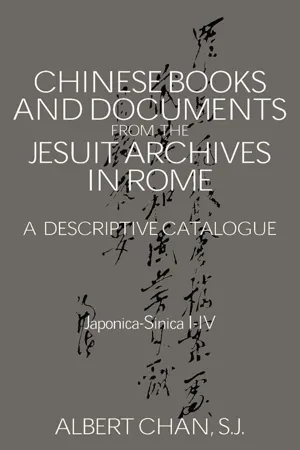
Chinese Materials in the Jesuit Archives in Rome, 14th-20th Centuries
A Descriptive Catalogue
- 600 pages
- English
- ePUB (mobile friendly)
- Available on iOS & Android
eBook - ePub
Chinese Materials in the Jesuit Archives in Rome, 14th-20th Centuries
A Descriptive Catalogue
About this book
The Jesuit Archives in Rome (Archium Romanum Societatus Iesu) contains books and manuscripts from the Ming (1369-1644) and Ching (1644-1911) dynasties on Chinese history, Chinese and Western philosophy, astronomy and other sciences; volumes by Westerners introducing Christian thought to the Chinese; and works by Chinese Christians comparing what they were taught by the Jesuits with the Buddhist, Taoist, and Confucian traditions. Many works deal with the famous Chinese rites controversy. There are also volumes that treat other religious groups such as the Muslims and the Jews. The archive has a collection of some of the first Chinese-Western dictionaries. Some of the works include marginal annotations by the emperors of China, famous Chinese scholars, and Jesuit missionaries and much, much more. This catalogue consists of careful descriptions of all these archival items with bibliographical sources pertaining to them. English is the main language, but Latin, other European languages, and Chinese (with characters) are also abundant.
Japonica-Sinica I (1–224)
Japonica-Sinica I
| I, 1.a | |
| 小學集註大全 | Hsiao-hsüeh chi-chu ta-ch’ürn. |
| By Chu Hsi 朱熹 (1130–1200). Bamboo paper, Ch’ing edition. | |
| Only three volumes are left. They are all stuck together and cannot be opened. | |
| I, 1.b | |
| 書經集傳 | Shu-ching chi-chuan. |
| By Ts’ai Shen 蔡沈 (1167–1230). Bamboo paper, Ch’ing edition. | |
| Only chüan 3–6 are left and in very bad condition. | |
| Cf. Courant 2591–2592. | |
| I, 2 | |
| 孔子家語 | K’ung-tzu chia-yü. |
| Annotated by Wang Su 王肅 (195–256). Revised by Ch’en Chi-ju 陳繼儒 (1558–1639), 陳眉公先生重訂; edited by Yang Ching-ch’üan 楊敬泉. | |
| Ten chüan in four volumes. Bamboo paper; in good condition. |
The first folio is stamped with a red seal in seal characters: Chi-ku chai 稽古齋. The last folio of chüan 10 has two lines which give the date of publication(chia-yin 甲寅 refers to 1554, Chia-ching 33) and the names of the calligrapher (Wu Shih-yung) and the carver of the wooden blocks (Huang Chou-hsien): 終歲甲寅端陽望吳時用書黃周覽金賢刻.There are nine columns on each half folio and sixteen characters in each column.
The Naikaku Bunko owns a Ch’ing reprint of a Ming edition (10 ch’üan, 4 ts’e), collated by the Chi-ku ko of Mao Chin (NBC, p. 163). Cf. Wylie, p. 82. Dominique Parennin, S.J., Le Code de la Nature, Poème de Confucius, Paris/Londres, 1788 (127 pp.). For partial translations of the K’ung-tzu chia-yü, see R. P. Kramers, K’ung Tzu Chia Yü, The School Sayings of Confucius (Section 1–10), Leiden, 1949, and R. Wilhelm, Kungfutse—Schul-gespräche (Gia Yü), Düsseldorf-Köln, 1961 (posthumous edition by H. Wilhelm).
| I, 3 | |
| 新刻張侗初先生永思齋四書演 | Hsin-k’o Chang T’ung-ch’u hsien-sheng yung-ssu chai Ssu-shu yen. |
| By Chang Nai 張鼐 (tzu 世調, chin-shih of 1604). Proofread by Ts’eng | |
| Ch’u-ch’ing 曾楚卿 (tzu 元贊), Chang’s disciple. | |
| Cf. Jap-Sin I, 12. | |
| I, 4 | |
| 西漢名文旁訓孔子家語 | Hsi-Han ming-wen p’ang-hsün K’ung-tzu chia-yü |
| Texts approved by Chang Ming-pi 張明弼 (1563–1651). Reprinted by the Chin-ch’ang shu-lin 金閶書林 (Kiangsu). | |
| One volume in bamboo paper, written letter type. Eighty-eight folios. Late Ming or early Ch’ing edition. |
On the first folio there is a red seal in seal characters: 活撥亭主 (Huo-p’o t’ing-chu).
On the first folio of the table of contents under the title Hsi-Han wen 西漢文 there are two inscriptions: 金沙張明弼琴張豫章黃國琦五湖鑒定 ([texts] approved by Chang Ming-pi, [tzu] Chin-chang, of Chin-sha [Kiangsu] and Huang Kuo-ch’i, [tzu] Wu-hu, of Yü-chang [Kiangsi]) and 古潭張運泰來倩余元熹延稚彙評 (commentaries collected by Chang Yün-t’ai, [tzu] Lai-ch’ien, and Yü Yüan-hsi, [tzu] Yen-chih, of Ku-t’an [Hunan]). Both Chang Ming-pi and Huang Kuo-ch’i were chin-shih of 1637 (for Chang’s biography see Wang 1983, p. 677). There is a preface by Wang Ao 王鏊 (1450–1524, DMB 2: 1343–1347) of Ch’ang-shu 常熟 (Kiangsu).
| I, 5 | |
| 三訂孔子家語直解 | San-ting K’ung-tzu chia-yü chih-chieh. |
| By Hsia Yün-i of Yün-chien (Kiangsu) 雲間夏允彝 (1596–1645). |
Hsia Yün-i(tzu 彝仲, hao 緩公) was a native of Sung-chiang 松江. He obtained the chin-shih degree in 1637. As a learned man he was known for his prose writings. The second half of the Wan-li reign (1573–1620) saw the rise of Academic parties: Ku Hsien-ch’eng 顧憲成 (1550–1612) founded the Tung-lin Party 東林黨 in Wu-hsi 無錫 (Kiangsu) and Chang P’u 張溥 (1602–1641) the Fu-she 復社 in Su-chou 蘇州. Hsia and several of his friends founded the Chi-she 幾社 accordingly. After the fall of Peking, Hsia still cherished the idea of recovering the lost empire from the Manchus, but when he learned the ill fate of some of his friends he committed suicide (cf. MJCC 1: 404; DMB 1: 279).
For a description of the K’ung-tzu chia-yü (two chüan, two ts’e) with commentaries by Hsia Yün-i, published during the Ch’ung-chen period (1628–1644), see Wang 1983, p. 219.
| I, 6 | |
| 孟子 | Meng-tzu. |
| By Meng K’o 孟軻 (Mencius, b.c. 372–289) with an introduction and commentary by Chu Hsi 朱熹集註序說. Incomplete. Bamboo paper, one ts’e. |
The cover bears an inscription in Latin: “Mency, 2di philosophi — pars1acf [Jap-Sin I] 10.”
Each half folio has nine columns with seventeen characters in each column. The commentary is given in double lines and in smaller type. Romanizations are written on each of the folios together with the meanings of the characters written in Latin. There is no indication as to the author of this.
Only the first three chapters of Mencius are preserved: 1. King Hui of Liang 梁惠王; 2. Kung-sun Ch’ou 公孫丑; 3. T’eng wen kung 滕文公. Since the title page is missing, there is no way to tell the place or the date of its publication; the format, however, seems to indicate that of the late Ming period.
| I, 7 | |
| 閔家三訂易經正文 | Min-chia san-ting I-ching cheng-wen. |
| (the character, 經 is missing from the title page). Collated by Huang Ju-heng 黃汝亨 (1558–1629) and Li Chih-tsao 李之藻 (d. 1630). | |
| Four chüan, bamboo paper in one ts’e. Published by [Mr.] Yü of the Yüan-sheng t’ang bookstore 書林源盛堂余氏刊行. |
The title page bears a seal with the name of the publisher in cursive characters. The first folio gives the title: 新刻京本正爲音譯分章周易上經正文下經繫辭說卦共四卷 (A new Peking edition of the Chou-I shang-ching in a division of paragraphs, the hsia-ching, Hsi-tz’u and Shuo-kua, all together in four chüan)and the names of the collators, both high placed chin-shih (of 1598): 會魁黃汝亨貞甫李之藻振之甫仝校.
The book is printed in large characters, but is not elegant. Folios 2 and 3 are misplaced. The text is furnished with pronunciations after the fan-ch’ieh 反切 system (i.e., to indicate the pronunciation of a character by the quick enunciation of two other characters).
| I, 8 | |
| 古周禮 | Ku Chou-li. |
| Manuscript, twenty-two folios, written in the standard script in fairly good calligraphy. Bamboo paper in one ts’e. 21 × 15 cm. | |
| The Latin inscription on the title page reads: “Textus originalis libri cheu-li seu Rituum Imperii cheu.” |
The text is divided into five sections: 天官冢宰第一地官司徒第二春官宗伯第三夏官司馬第四秋官司寇第五. These five sections are given as the work of Liu Hsiang (77–76 b.c.): 漢劉向條目. The sixth, the 冬官考工記第六, is attributed to Liu Hsiang’s son Liu Hsin (52–23 b.c.), who supplemented the original part which is said to have been missing: 漢劉歆補闕. Pronunciations and explanations of meaning are given on the margins and side by side to the text. The marginal notes frequently bear the name Ming-ch’ing 明卿 as their author. This, as we know, is the hao 號 of Ch, en Jen-hsi 陳仁錫 (1579–1634), a government official and scholar of the late Ming period.
The Chou Li, known also as Chou Kuan 周官 “Offices of Chou” or Chou Kuan Ching “Canonical offices of Chou,” was actually a description of the constitution of the Chou dynastic government. It has practically nothing to do with rites, as the title suggests. It was composed of six neatly organized sections, each dealing with a major component of the Chou dynastic government: the Office of Heaven 天官, or the Prime Ministry; the Office of Earth 地官, or the Office of Education and Social Welfare; the Office of Spring 春官, or Office of Rites and Ceremonies and Protocol; the Office of Summer 夏官, or the Department of Defense and Security; the Office of Autumn 秋官, or the Department of Justice and Punishment; and the Office of Winter 冬官, or the Department of Public Works and Economic Production. In its present form, the last chapter is missing and replaced by a curious document e...
Table of contents
- Cover
- Half Title
- Title Page
- Copyright Page
- Dedication
- Table of Contents
- List of Illustrations
- Acknowlegments
- Preface
- List of Books and Documents
- Bibliographical References and Abbreviations
- Japonica-Sinica I (1-224)
- Japonica-Sinica II (1-173)
- Japonica-Sinica III (1-24)
- Japonica-Sinica IV (1-30)
- Indices
- List of Popes and Jesuit Superiors (1541-1773)
Trusted by 375,005 students
Access to over 1.5 million titles for a fair monthly price.
Study more efficiently using our study tools.
Frequently asked questions
Yes, you can cancel anytime from the Subscription tab in your account settings on the Perlego website. Your subscription will stay active until the end of your current billing period. Learn how to cancel your subscription
No, books cannot be downloaded as external files, such as PDFs, for use outside of Perlego. However, you can download books within the Perlego app for offline reading on mobile or tablet. Learn how to download books offline
Perlego offers two plans: Essential and Complete
- Essential is ideal for learners and professionals who enjoy exploring a wide range of subjects. Access the Essential Library with 800,000+ trusted titles and best-sellers across business, personal growth, and the humanities. Includes unlimited reading time and Standard Read Aloud voice.
- Complete: Perfect for advanced learners and researchers needing full, unrestricted access. Unlock 1.5M+ books across hundreds of subjects, including academic and specialized titles. The Complete Plan also includes advanced features like Premium Read Aloud and Research Assistant.
We are an online textbook subscription service, where you can get access to an entire online library for less than the price of a single book per month. With over 1.5 million books across 990+ topics, we’ve got you covered! Learn about our mission
Look out for the read-aloud symbol on your next book to see if you can listen to it. The read-aloud tool reads text aloud for you, highlighting the text as it is being read. You can pause it, speed it up and slow it down. Learn more about Read Aloud
Yes! You can use the Perlego app on both iOS and Android devices to read anytime, anywhere — even offline. Perfect for commutes or when you’re on the go.
Please note we cannot support devices running on iOS 13 and Android 7 or earlier. Learn more about using the app
Please note we cannot support devices running on iOS 13 and Android 7 or earlier. Learn more about using the app
Yes, you can access Chinese Materials in the Jesuit Archives in Rome, 14th-20th Centuries by Albert Chan in PDF and/or ePUB format, as well as other popular books in History & North American History. We have over 1.5 million books available in our catalogue for you to explore.