- 256 pages
- English
- ePUB (mobile friendly)
- Available on iOS & Android
eBook - ePub
About this book
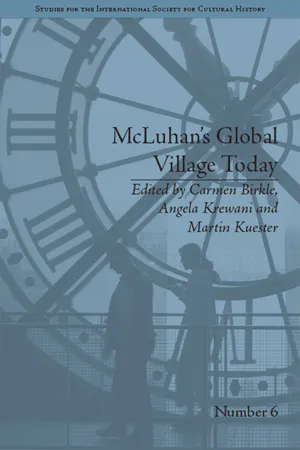
Marshall McLuhan was one of the leading media theorists of the twentieth century. This collection of essays explores the many facets of McLuhan's work from a transatlantic perspective, balancing applied case studies with theoretical discussions.
1 IN-CORPORATING THE GLOBAL VILLAGE
One of the signal questions that emerges as we look back, on this occasion of his centennial, at the trajectory of Marshall McLuhan’s career, is why he turned to the idea of the corporate in the second half of his career, that is, in the period after the 1964 publication of Understanding Media.1 Not only did he publish two major works in this area – Culture is Our Business (1970),2 which examines corporate advertising, and Take Today: The Executive as Dropout (1972),3 which investigates corporate structures – but he was also involved with publishing the Dew Line Newsletters, which were directed at business corporations and published between 1968 and 1970. On one level, these publications offered McLuhan an opportunity to revisit works that he had previously published: Culture is Our Business is largely an updating of The Mechanical Bride,4 published twenty years earlier, and Take Today is a rewriting of The Gutenberg Galaxy,5 published in 1962. On another level, the works are counter-intuitive in the classic McLuhanesque style: Take Today has more to do with cultural analysis than business management, and the Dew Line Newsletters are more an expression of McLuhan’s interest in ‘typographic man’ than in corporate affairs.
This brings me back to my opening question: how can we understand these works from the later part of McLuhan’s career in the context of his total body of writing? What I propose is that our opening onto these works can be made along three avenues that characterize McLuhan’s writing after the 1964 publication of Understanding Media: his turn toward the concept of the environment; his increasing interest in the dynamics of the global village; and the emerging importance that bio-mediation took on in this stage of his career.
Environment
‘Environment’ was one of the key terms McLuhan employed after the 1962 publication of The Gutenberg Galaxy, although the notion that media functioned environmentally was crucial to McLuhan’s work from his first book, The Mechanical Bride (1951). The ‘ecology’ or ‘environment’ that is the focus of that book was a new ‘nature’, or a ‘second nature’, comprised by the technological extension of the human body itself through a libidinal, affective economy established in response to the gender dysphoria unleashed by World War II. This embodied environment was theorized by McLuhan to be inherent in utterance, or outerance.6 As Bruce R. Smith has noted, speech is ‘an environmental gesture’ through which ‘I extend my person into the “about-me”’. ‘Both the Italian and the German equivalents of “environment”’, he goes on to state,
carry, perhaps, a stronger sense of this unmarked spatiality than the English word now does: ambiente waves a hand toward … the air around the speaker, while Umgebung invokes the ‘givens’ that surround the speaker. The environment certainly includes plants and animals, but it also includes air, ink, fiber-optic cable – and other people.7
In this scenario, the distance between environment and body is nullified because the body is the environment – the vastly distended body of our technological extensions. This concept of the environment is cognate with Maurice Merleau-Ponty’s notion of ‘the flesh of the world’8 as articulating ‘corporeity’,9 the interconnection of the body and the environment.10 The notion of the extended body also resonates with Martin Heidegger’s late meditations on sculpture; as Stephen Mitchell writes, in these works Heidegger thinks of ‘the body as no longer distinct or separable from space … as mediated, an inhabitant of the between’.11 The environment, thus, is an effect of mediation.
McLuhan’s notion of the media environment was global in the sense that it represented the epistemic totality of a given historical moment. A major implication of this position was that ‘nature’ was itself in history, and therefore that there was no going back to nature as a transhistorical concept. As Greg Garrard remarks in his book on ecocriticism, ‘[t]he local communities beloved of anti-modern ecocritics are being supplanted by “virtual” communities brought together by shared interests, including environmental concerns’.12 It is precisely through globalized technologies such as meteorological and hydrological satellites that we have not simply become aware of issues such as ozone thinning and soil erosion, but have been able to measure them in ways that are politically effective. Whether this represents an argument in favour of or against globalization is perhaps beside the point; what remains undeniable is that the natural ‘environment’ is now ‘contained’ within a network of ‘“human managerial oversight”’13 whereby ‘the Earth is … inflected as an errant subject requiring techno-scientific correction, or “environmentalization”’.14 Garrard relates this position to that of Baudrillard’s ‘simulacra’, whereby ‘a world of simulation … now functions to supplant the real world’,15 and while this notion reflects McLuhan’s notion of the media environment as a ‘second nature’, it should be noted that, for McLuhan, it was not that mediated culture is ‘simulating’ nature; for McLuhan mediation is nature itself. As W. J. T. Mitchell and Bruce Hansen put it in Critical Terms for Media Studies, whereas for critics such as Friedrich Kittler, media ‘determine’ our situation, for McLuhan media are our situation.16
McLuhan argues in his 1972 book Take Today: The Executive as Dropout that the launching of the satellite Sputnik in 1957 definitively turned nature into culture, the earth becoming at that point an artefact of technology, contained by technology rather than being its container. This new cultural environment proposes an ‘ecology’ of ‘echo recognition’, writes McLuhan, whereby we confront a ‘nature’ which is constituted by the biotechnology of our extended selves: ‘Today’s ecological awareness’, McLuhan states, ‘is echo recognition’17 because, ‘[i]n today’s electric world, man becomes aware that … “Nature” … is an extension of himself’.18 The media theorist becomes an ‘echo’ critic in this scenario, insofar as mediation, as the new ‘nature’, is an ‘echo’ of the old nature which it has replaced. The media theorist must now understand mediation not as determining our situation from outside but as constituting the very idea of our being.
Global Village
McLuhan’s earliest notion of what he would later famously call the global village made its debut in his 1954 broadside Counterblast19 (not to be confused with the 1969 book of the same title), where McLuhan argues that a new sense of the urban has emerged as one of the effects of electronic media:
The new media are not ways of relating us to the old ‘real’ world; they are the real world and they reshape what remains of the old world at will … Technological art takes the whole earth and its population as its material, not as its form.20
This ‘Earth City’, as McLuhan then called it, constitutes a new articulation of space; indeed, it is one of the ‘new spaces created by the new media’.21 The first point McLuhan wishes to make about this new articulation of space is to suggest that it provides a revised way of understanding what it means to be cosmopolitan (an important consideration for an author writing within a colonialist context). Hence McLuhan’s comment that ‘any highway eatery with its TV set, newspaper, and magazine is as cosmopolitan as New York or Paris’.22
In this articulation, cities acquire a mediated simulacrum, since the traditional role and functions of a metropolis were now reproducible outside the metropolis. McLuhan theorized this relationship dynamically as one between the local (referred to in terms of a ‘village’ in order to bring out the social complexities of the relationship) and the global, the site of the dynamic relationality of the local: ‘Globes make my head spin’, McLuhan wrote at the beginning of War and Peace in the Global Village; ‘[b]y the time I locate the place, they’ve changed the boundaries’.23 For McLuhan, the global village is here and there at one and the same time. As an interface, or flashpoint, it was the site of enormous creative vibrancy as well as of ‘trauma and tension’, as he put it at the end of The Gutenberg Galaxy.24
The notion of the global village emerged out of McLuhan’s experience as a Canadian, which is to say within a colonized nation whose history was at once local and imperial. McLuhan supplemented this experience by bringing together a number of his interests and influences, particularly those he derived from the work of Siegfried Giedion, the author of Space, Time and Architecture (1941), a book which McLuhan called ‘one of the great events of my lifetime’.25 As McLuhan notes, ‘Giedion began to study the environment as a structural, artistic work’.26 McLuhan was particularly influenced by Giedion’s insistence on organic interconnections among cultural phenomena, one aspect of which was the relational space of the global village.
McLuhan was furnished with the opportunity to connect Giedion’s notions about organic space to McLuhan’s own ideas about bio-mediation through the unanticipated intervention of a Greek architect named Constantin Doxiadis, who in 1963 invited a number of key cultural thinkers to join him on an Aegean cruise in order to discuss major issues having to do with town planning that were facing the world. As Mark Wigley has written, what captured the attention of those attending the seminar was McLuhan’s notion that media were bio-technological:
McLuhan’s argument was that electronics is actually biological, an organic system with particular effects. The evolution of technology is the evolution of the human body. Networks of communication, like any technology, are prosthetic extensions of the body. They are new body parts and constitute a new organism, a new spatial system, and a new architecture.27
Media are, in this sense, corporate – that is, embodied. This notion took the meeting by storm, and the remainder of the cruise was devoted to unpacking its implications, especially McLuhan’s idea that ‘electronics presents new challenges to city planners because this latest prosthetic extension of the body defines an entirely new form of space’.28 Here, in essence, we have McLuhan’s notion of the global village: that it is at once a prosthetic extension, bio-technologically, and, in direct dynamic relationship, a shrinking-down of experience into the sort of confluences associated with village life. As McLuhan wrote to urban planner Jacqueline Tyrwhitt on 23 December 1960,
Prior to electricity, the city was the sensus communis for such specialized and externalized senses as technology had developed. From Aristotle onward, the traditional function of the sensus communis is to translate each sense into the other senses, so that a unified, integral image is offered at all times to the mind. The city performs that function for the scattered and distracted senses, and spaces and times, of agrarian cultures. Today with electronics we have discovered that we live in a global village … With electronics, any marginal area can become centre, and marginal experiences can be had at any centre [emphasis added] … Whatever we may wish in the matter, we can no longer live in Euclidean space under electronic conditions, and this means that the divisions between inner and outer, private and communal, whatever they may have been for a literate culture, are simply not there for an electric one.29
In this scenario, the global village is not a place, nor is it what is commonly referred to today as ‘globalization’. Rather, the global village is a dynamic relationship between a mediated sense of the ‘local’ and an equally mediated sense of the ‘global’, with neither term a stable demarcator for the other. As McLuhan puts it at the end of Take Today, ‘EVERY-WHERE IS NOW-HERE’.30
Bio-Mediation
It was McLuhan’s profound realization that, with the end of World War II, the era of Mars had given way to that of Venus.31 This was not, however, simply a prophetic insight into the age of sex and consumerism that would characterize the 1960s, when, not so coincidentally, McLuhan achieved the height of his fame, becoming the most quoted person on earth through the power of a mediated network he had theorized. Rather, McLuhan was proposing that the world’s economic engine had exhausted itself in the war effort and had been reconfigured as a libidinal economy, a vast desiring machine, in which consumption was at once the product and the goal in a feedback loop of endless consumerism, whose ultimate configuration was advertising. McLuhan articulated this notion in his 1951 book The Mechanical Bride, where the ‘bride’ is the automobile that embodies the displaced libido of a culture whose sexual identity had been deeply disrupted by the war.32 When he revisited The Mechanical Bride twenty years later in Culture is Our Business,33 McLuhan made these connections specific:
Advertising is the institution of abundance. It is a service environment of information that exceeds in cost the products that are advertised … The making of ads is not a private but a corporate activity … The great corporations are new tribal families.34
This libidinal model of economic and cultural configuration was founded upon a notion of mediation as bio-technological. According to McLuhan, all ‘media’ – and by this he meant cities and cars as well as the more traditional understanding of the term as referring to newspapers and television – were embodied, such that the massive increase in power afforded by our prosthetic extensions was likewise the source of a profound alienation – ‘extension’ and ‘amputation’. The electronic globe was now one vastly distended body, but that body was outside us. As McLuhan writes in a key passage of Understanding Media:
Physiologically, man in the normal use of technology (or his variously extended body) is perpetually modified by it and in turn finds ever new ways of modifying his technology. Man becomes, as it were, the sex organs of the machine world, as the bee of the plant world, enabling it to fecundate and to evolve ever new forms. The machine world reciprocates man’s love by expediting his wishes and desires, namely in providing him with wealth.35
In order to understand how McLuhan came to this radical understanding of biomediation as both extension of and amputation of our bodies, it is necessary to examine hi...
Table of contents
- Cover Page
- Half Title page
- Series page
- Title Page
- Copyright Page
- Contents
- List of Contributors
- List of Figures
- Part I: McLuhan's Global Village Today: An introduction
- Part II: McLuhan and Literature
- Part III: McLuhan and Technical Media
- Notes
- Index
Trusted by 375,005 students
Access to over 1.5 million titles for a fair monthly price.
Study more efficiently using our study tools.
Frequently asked questions
Yes, you can cancel anytime from the Subscription tab in your account settings on the Perlego website. Your subscription will stay active until the end of your current billing period. Learn how to cancel your subscription
No, books cannot be downloaded as external files, such as PDFs, for use outside of Perlego. However, you can download books within the Perlego app for offline reading on mobile or tablet. Learn how to download books offline
Perlego offers two plans: Essential and Complete
- Essential is ideal for learners and professionals who enjoy exploring a wide range of subjects. Access the Essential Library with 800,000+ trusted titles and best-sellers across business, personal growth, and the humanities. Includes unlimited reading time and Standard Read Aloud voice.
- Complete: Perfect for advanced learners and researchers needing full, unrestricted access. Unlock 1.5M+ books across hundreds of subjects, including academic and specialized titles. The Complete Plan also includes advanced features like Premium Read Aloud and Research Assistant.
We are an online textbook subscription service, where you can get access to an entire online library for less than the price of a single book per month. With over 1.5 million books across 990+ topics, we’ve got you covered! Learn about our mission
Look out for the read-aloud symbol on your next book to see if you can listen to it. The read-aloud tool reads text aloud for you, highlighting the text as it is being read. You can pause it, speed it up and slow it down. Learn more about Read Aloud
Yes! You can use the Perlego app on both iOS and Android devices to read anytime, anywhere — even offline. Perfect for commutes or when you’re on the go.
Please note we cannot support devices running on iOS 13 and Android 7 or earlier. Learn more about using the app
Please note we cannot support devices running on iOS 13 and Android 7 or earlier. Learn more about using the app
Yes, you can access McLuhan's Global Village Today by Angela Krewani in PDF and/or ePUB format, as well as other popular books in History & World History. We have over 1.5 million books available in our catalogue for you to explore.