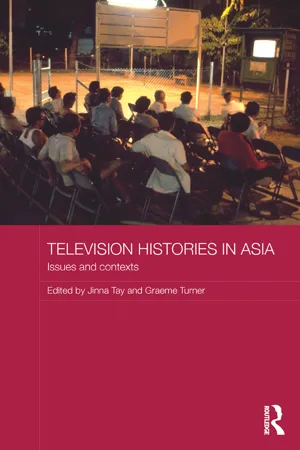
This book presents an analysis of television histories across India, China, Taiwan, Singapore, Indonesia, Japan, Hong Kong, the Philippines, Malaysia and Bhutan. It offers a set of standard data on the history of television's cultural, industrial and political structures in each specific national context, allowing for cross-regional comparative analysis. Each chapter presents a case study on a salient aspect of contemporary television culture of the nation in question, such as analyses of ideology in television content in Japan and Singapore, and transformations of industry structure vis-à-vis state versus market control in China and Taiwan. The book provides a comprehensive overview of TV histories in Asia as well as a survey of current issues and concerns in Asian television cultures and their social and political impact.
- 232 pages
- English
- ePUB (mobile friendly)
- Available on iOS & Android
eBook - ePub
About this book
Information
1 Introduction
Television histories in Asia: nation-building, modernization and marketization
In Asia, as in so many other locations outside the US, television was global before it became local. Commencing as it did in the West, and in the Global North, the period of technological advancement that continued with ever-accelerating pace from the mid-1950s onwards often ran slightly ahead of the emergence of politically independent nation-states in Asia. That is especially true for postcolonial countries such as Hong Kong, Singapore, Malaysia and the Philippines – even, as Divya McMillin argues in this collection, for India – as well as for a nation-state such as Taiwan as it has struggled to construct a distinctly Taiwanese national identity. In Singapore, Jinna Tay watched the same programmes as she was growing up as did her contemporaries in Australia where she now works: Little House on the Prairie and Hawaii Five-O. The generation before her watched Doctor Who, I Dream of Jeannie, and so on. These Western texts would have made their rounds across many Asian television screens as national television systems began the cultural, political and industrial process of establishing their relation to their national audiences. As Umi Khattab’s chapter on Malaysia in this volume argues, even the definition of these audiences as ‘national’ has often proven to be a long, highly contested and difficult process. This is evident at the most fundamental levels: for instance, before the creation of an independent nation-state, or in some cases before the establishment of an official ‘national language’ in multiethnic societies such Singapore, local dialects were often used in early broadcasting – and in some cases now (India, for example), they still are. As we shall see time and again in the national case studies collected in this book, the particular relation between the local and the national, the regional and the global, the indigenous and the imported, is the highly specific product of particular historical conditions and contingencies. The investigation of these conditions and contingencies in each of our locations is what this book sets out to provide – a nuanced and complicated understanding of the histories of television in Asia, across localities, states and the region.
As we have argued elsewhere (Turner and Tay, 2009) to speak of television now without recognition of the specificities of its operation across geographic, linguistic, social, cultural and political differences is to work against the grain of contemporary directions in television studies. The project of de-Westernizing media studies, and television studies in particular, has been in train since at least the early 2000s (Curran and Park 2000). As a consequence, even in the mainstream of Anglo-American television studies, the default normatization of the British or US context is much less common now than would have been the case 20 years ago. There is now a substantial body of work that turns its attention towards the specificities of the locations of television beyond the Anglo-American centre (for example Keane et al. 2007; Kraidy 2010; Pertierra and Turner 2013) and that is concerned with understanding the roots and provenance of such specificities. Even though much of the discussion about the industrial and technological changes that have swept through television industries in what is so often described as the post-broadcast era has tended to emphasize the common elements linking the various national systems, there is an increasing recognition of the scale and the importance of the differences between these systems, their functions and their histories. Among the shifts such a recognition entails has been the problematization of the longstanding tendency towards a national focus for television studies, with the exploration of other possibilities for conceptualizing what Pertierra and Turner (2013) describe as ‘zones of consumption’. Asian television, however, remains an underexamined area. While there has been much written about certain aspects of the media’s development in the region – the role of the Korean wave in the formation of a transnational East Asian popular culture, the rise of new regional and local production hubs establishing alternative new trading patterns for Asian media content, the marketizing transformation of the Chinese media as political conditions change, and so on – there is still room for many more attempts to enquire into, and to understand, what has gone into making up these distinctive histories.
This book, then, addresses a gap in the international literature on television: first, by focusing solely on Asia, rather than reducing it to the status of one more regional component within a larger international survey; and, second, by directing its attention to the histories of television in that region. The reason for the focus on history reflects the exceptionally close connection between the specific industrial formations and the politico-cultural function of television systems in Asia and their local, national and regional histories. In a region that has been particularly engaged, each state in its own way, in an historic, vigorous and highly diverse programme of modernization over precisely the period during which television established itself as the primary medium of mass communication for the nation-state, Asian television has played an exceptionally prominent role in expressing, managing and representing the cultures of modernity as they have been shaped by political and historical forces.
Among the outcomes of the modernizing and industrializing process of development within the Asia region, and its more recent alignment with a shift away from the manufacture of material commodities towards the development of services and cultural industries, has been the growth of the local/national audience for television and, relatedly, the capacity for local production. In Asia, as elsewhere, the strong preference for local or national programming has proven significant in generating markets of sufficient size to support local production industries. In the past few years, some of this localized programming has capitalized on the existence of strong regional demand that is driven by linguistic and cultural factors; the circulation of Tamil programming across Sri Lanka, India and Singapore is an instance of this (Sankaran and Pillai, 2011). Regional markets for Asian television content have developed, structurally as well as geographically separated from the Western content providers. Western content providers continue to sell their wares in the region, highly successfully, but there are now some important contrasts to the simple colonialist model referred to at the beginning of this chapter. The expanding trade in global formats over the past decade or so has benefited these emerging industries in a new way: global brands that are identified with the modern and fashionable West have become more accessible to Asian audiences through adaptation and franchising. Where the manner in which Western fashions are taken up often carries negative political consequences – in those countries suspicious of cultural Westernization, for instance – the flexibility of formats such as Idol has allowed the tailoring of particular local or national versions to the tastes and values of the targeted market. As numerous studies have demonstrated in relation to China in particular (Keane et al. 2007; Sun and Zhao 2009) such tailoring is not only able to accommodate the local value systems but can also adjust to current political priorities.
While it has been relatively common (but not uncontested) within Anglo-American discussions of the post-digital and post-broadcast environment to downplay the continuing relevance of the nation-state, the situation in Asia certainly demands revision of these assumptions. Not only has the nation-state persisted, with more or less the same levels of authority and power it has always enjoyed, but it continues to play a highly interventionist and fundamental role in many of the locations we examine in this book. The chapters on Thailand, Taiwan, Singapore, China, Bhutan and Malaysia all provide examples of this. In general, although the specifics can get quite complicated, it would be true to say that television in Asia remains more closely tied to the construction of national identity than is currently the case in Western Europe, for instance. Indeed, as this collection will demonstrate, there are numerous countries in Asia where this relationship is directly and openly managed by the state. Given the circumstances, this is not surprising. Many Asian states are currently engaged in a significant historical process of transition towards a variety of political, economic or developmental ends: towards a more democratic polity, towards a market economy, towards a postcolonial or modernized and unified national identity, or towards new forms of governance and political control. Television, particularly in states where the levels of literacy and educational access vary widely, is a crucial instrument for those charged with managing such transitions. In fact, it has always played such a role, as Jinna Tay’s contribution to this collection argues, television, and in particular television’s representation of national histories, has been crucial to the construction of an independent postcolonial national identity in Singapore, and the chapters on Malaysia, Taiwan and Thailand also have their stories to tell about the way such a role has been managed in each location. In the case of the Philippines, where the media is strong but the state is weak, as Jonathan Corpus Ong argues in his chapter, television has actually appropriated some of the nation- and community-building roles more customarily performed by the state.
As so many accounts of television over the past decade or so have been preoccupied with technological change and, perhaps as a consequence of an informal Western tendency to regard American television as the eventual evolutionary destination for systems around the world, much of our sense of the particularity of the functions television performs for its audiences has been dominated by an American perspective. Such a perspective does not help us to understand television histories in Asia. Asian nations have had a diverse and varied relationship to the West, and television has emerged out of equally diverse policy configurations, philosophies and agendas within different Asian countries. While it has had to borrow and adapt from the West, the region has also generated its own more compatible models for production and exchange, as demonstrated by the manner in which Hong Kong, Korea and Japan have developed their own local industries. As we shall see throughout this book, while the project of modernization is in train everywhere, it is not always executed the same way. This is demonstrated in Sun Jung’s chapter on the rise of K-pop music and the development of the South Korean media industries.
Television histories are not just about the production of institutional and structural accounts of the history of television; they are also about capturing how television programming has participated in generating and circulating particular understandings of national identities. In their respective chapters, Alisa Freedman (Japan), Brett Farmer (Thailand), Fang-Chih Irene Yang (Taiwan) and Jinna Tay (Singapore) all examine the part played by particular forms of serial drama in the process of nation formation. The genres employed – historical drama and soap opera – may be familiar across cultures but, as these chapters demonstrate, the work they do in each instance is highly specific. It is a reminder to Western media studies that while television may not be always qualitatively different (that is, we may not always notice much variation in the kinds of texts produced), the conditions under which television is produced, distributed and consumed can vary markedly – and therefore so can the meanings it generates. Television can be both local and global all at once.
While there is a currently dominant tendency within media studies in general towards global accounts and global explanations, examining the histories of television within a region that is so linguistically, culturally, socially, ethnically and politically diverse as Asia unearths a wealth of countervailing stories. Among them are the more detailed accounts of the experience of television that come from the audiences – from their personal memories of their own reception of the programmes. In their Remembering Television (2012), Darian-Smith and Turnbull acknowledge that while the accounts produced by such memories are imperfect and informal accounts of personal practices, they are nonetheless important; they help us recover the popular culture experiences that are displaced by the privileging of the more formal accounts of national histories. The retrieval of these memories of television foregrounds the social role of television in interesting and useful ways: it links these broader historical formations to what is an intrinsically domestic experience of identity formation, where ‘the theorisation of memory and its engagement with politics and questions of identity, belonging, affect and temporality position the media as both a repository and creator of memories’ (Darian-Smith and Turnbull 2012: 2). The media is thus seen as a site of cultural production rather than merely a site of consumption. These memories also return us to the closer consideration of more specific arenas of consumption – such as television’s participation in defining the domestic space of the home. Relevant here is the material culture surrounding the television set – the choice and arrangement of furniture, and accessories such as TV lamps, trays, chairs and so on. Frances Bonner (2012) has examined television product ‘spin-offs’ such as these material objects, seeing them as triggers for memories but also as ‘technologies of attachment’ that frame the individual’s relationship with television through their imbrication within a larger network of everyday practices. In this collection, Liew Kai Khiun’s chapter deals with the theme music for Hong Kong television drama as, in a sense, another ‘technology of attachment’, by highlighting the ways in which this music circulates as memory, both locally and globally. Such approaches locate television as extending beyond its most immediate categorizations as programmes, objects or a set of meanings; the cultural practices that gather around television also provide us with ways of accessing the past and retrieving the historicity of everyday life.
This collection of essays explores a wide range of the ways in which Asian television histories have played out, and it examines them from many perspectives and in many locations. Its coverage is not comprehensive, in that not every nation from the region is represented; we are particularly disappointed that a chapter on Indonesia has not eventuated, for instance. However, the collection does include chapters on China, India, Malaysia, Singapore, Hong Kong, the Philippines, Thailand, Taiwan, Bhutan and Japan; as such, it constitutes a substantial beginning to the process of helping media studies to pay closer attention to the histories of television in Asia. In the remainder of this introduction, we wish to briefly review some themes that run through all of the contributions to this collection and that may inform further studies in the future. Over the next three sections we will summarize three major historical processes we wish to highlight in order to frame the project of this book: the processes are those of nation-building, modernization and marketization.
Nation-building
The history of broadcast television has its foundations in the project of nation-building. In his book on BBC programming in radio and television, Thomas Hajkowski (2010) charts the relations between one of the world’s earliest broadcasters’ programming and its participation in a process of nation-building; his research demonstrates that, from the beginning, state broadcasters have been recruited to the service of developing the nation. In Asia, the big institutional state broadcasters such as CCTV (China), NHK (Hong Kong), Doordarshan (India) and Mediacorp (Singapore) have functioned as central mass communication apparatuses for their nation-states even though they each serve different political agendas – ranging from the authoritarian to the liberal democratic. Their agendas are broader than the strictly political, of course; state broadcasters have an informational, cultural and, at times, a pedagogical function. Television has been particularly effective as a national informational infrastructure; as a technology it can cut across demographic lines to speak to a mass audience that includes not only the educated elites but also the illiterate segments of the population. As a result, broadcast state-funded television remains the most flexible and powerful medium for mass communication and national identity formation, circulating ideas, images, values and, at times, propaganda with sufficient success to embed it within the processes of government. Even dominant non-state commercial broadcasters, such as TVB in Hong Kong, have performed similar socio-cultural functions (Ma 1999), serving as the key communication, pedagogical and narrative platform for its national audience. As Eric Ma points out, television’s critical importance to the historical process of identity formation in Hong Kong does not ‘mean that other media are irrelevant to identity formation’; however, where television excels is through its capacity ‘reach the public on a regular basis and in a domestic setting’ (1999: 33).
In many of the countries we examine in this collection, the timing of the arrival of television in each location was often closely concurrent with the establishment or development of the nation-state itself; this is the case with Singapore, Malaysia and, in more complicated ways, China and India. The strategic and political value of television in such a context cannot be overestimated; it had the unique capacity to mediate between the interests of the national audience, government, advertisers and other institutions. The national audience in the broadcasting era was, of course, a captive audience, choosing from the same limited menu of content and addressed as a homogenous citizenry with common concerns (Hartley 2004: 9). As a consequence, national viewing patterns supported the idea that this national audience was interested in the affairs of the state and identified with concerns about the nation’s development. The creation of the modern audience/citizenry is built on such assumptions, transforming the domestic space into multiple components of a larger nationalized public sphere.
Yet as Sun and Gorfinkel point out in their chapter on the history of Chinese television, the role of the state, and the manner of its participation in nation-building via television, is becoming increasingly blurred and complex. As a general observation, this has some force: Divya McMillin’s chapter for instanc...
Table of contents
- Cover
- Half Title
- Title Page
- Copyright Page
- Table of Contents
- List of figures
- List of tables
- Notes on contributors
- Acknowledgements
- 1 Introduction: television histories in Asia: nation-building, modernization and marketization
- 2 Television, scale and place-identity in the PRC: provincial, national and global infl uences from 1958 to 2013
- 3 Trust and television in globalizing India
- 4 Watching television in Bhutan
- 5 Battling angels and golden orange blossoms: Thai television and/as the popular public sphere
- 6 Dramatizing the nation: television, history and the construction of Singaporean identity
- 7 Working women and romance on Japanese television dramas: changes since Tokyo Love Story
- 8 Unpacking multiculturalism and Islam in Malaysia: state–corporate television celebrations of Bangsa Malaysia
- 9 The television of intervention: mediating patron–client ties in the Philippines
- 10 Taiyu serial dramas in Taiwan: a history of problem-making
- 11 Shifts in Korean television music programmes: democratization, transnationalization, digitalization
- 12 Cultural polysemy and vernacular cosmopolitanism in the theme songs of Hong Kong television dramas
- Appendix: television data across countries
- Index
Trusted by 375,005 students
Access to over 1.5 million titles for a fair monthly price.
Study more efficiently using our study tools.
Frequently asked questions
Yes, you can cancel anytime from the Subscription tab in your account settings on the Perlego website. Your subscription will stay active until the end of your current billing period. Learn how to cancel your subscription
No, books cannot be downloaded as external files, such as PDFs, for use outside of Perlego. However, you can download books within the Perlego app for offline reading on mobile or tablet. Learn how to download books offline
Perlego offers two plans: Essential and Complete
- Essential is ideal for learners and professionals who enjoy exploring a wide range of subjects. Access the Essential Library with 800,000+ trusted titles and best-sellers across business, personal growth, and the humanities. Includes unlimited reading time and Standard Read Aloud voice.
- Complete: Perfect for advanced learners and researchers needing full, unrestricted access. Unlock 1.5M+ books across hundreds of subjects, including academic and specialized titles. The Complete Plan also includes advanced features like Premium Read Aloud and Research Assistant.
We are an online textbook subscription service, where you can get access to an entire online library for less than the price of a single book per month. With over 1.5 million books across 990+ topics, we’ve got you covered! Learn about our mission
Look out for the read-aloud symbol on your next book to see if you can listen to it. The read-aloud tool reads text aloud for you, highlighting the text as it is being read. You can pause it, speed it up and slow it down. Learn more about Read Aloud
Yes! You can use the Perlego app on both iOS and Android devices to read anytime, anywhere — even offline. Perfect for commutes or when you’re on the go.
Please note we cannot support devices running on iOS 13 and Android 7 or earlier. Learn more about using the app
Please note we cannot support devices running on iOS 13 and Android 7 or earlier. Learn more about using the app
Yes, you can access Television Histories in Asia by Jinna Tay,Graeme Turner in PDF and/or ePUB format, as well as other popular books in Social Sciences & Ethnic Studies. We have over 1.5 million books available in our catalogue for you to explore.