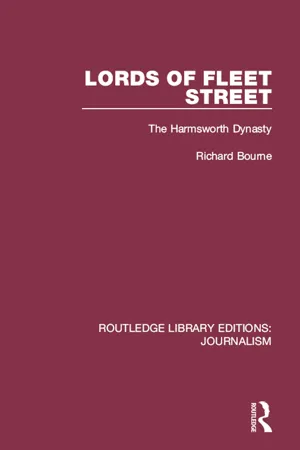
Originally published in 1990. The Harmsworth family, starting with Lord Northcliffe (1865-1922) is the greatest and most influential press dynasty Britain has known. The dynasty has had by far the greatest impact on the shape of the press today of all the great press families. The Harmsworths were big, bold characters, enormously rich and with a gift for flamboyant use of their wealth. Much more important though is the way they used their influence on public opinion to steer the country's political and social life. 'Public opinion' was a force that the Harmsworths harnessed before anyone else, and they quickly understood how to use it as a political tool. This book is constructed as four biographies which together make up the central story of the popular press in Britain. Their story continues to have relevance.
- 284 pages
- English
- ePUB (mobile friendly)
- Available on iOS & Android
eBook - ePub
About this book
Information
PART I
Alfred Northcliffe
The Founder
1
Origins and Answers
The future Viscount Northcliffe was born close to two creative fault-lines in the social geology of Britain: he had an Anglo-Irish background, and his parents felt they ought to be middle class but in fact were rather hard up. He was delivered by the family doctor on 15 July 1865 at the family home, ‘Sunnybank’, in Chapelizod close to Dublin where his father, also Alfred, was then a schoolmaster at the Royal Hibernian Military School. His mother, Geraldine Mary née Maffett, came from Scottish Presbyterian stock in County Down; her father, William, had moved down to Dublin and become a tough rich land agent.
The two parents were quite different in character. Alfred Harmsworth, whose family came from Hampshire, was the son of a shopkeeper and a small builder living in what is now St John’s Wood, north London. He trained as a teacher at St Mark’s College, Chelsea. In temperament he was easy going, self-indulgent and a good conversationalist, with a weakness for the bottle. His wife, however, whom he met when teaching at the Military School in Dublin, was a determined lady who wanted to see her husband become a barrister. Her will power kept what became a large family going in spite of the ineffectualness and limited income of Alfred senior. The wedding had been disapproved of by many of the Maffetts who felt that Geraldine was throwing herself away on a poor schoolmaster. Fortunately, her Alfred had succeeded in charming William Maffett, who insisted that his relations should turn up at the ceremony on pain of being cut out of his will.
Nearly two years after young Alfred was born the family moved to London. There were both push and pull factors at work. The situation in Ireland was not good either politically or in a more personal sense. There was considerable alarm among respectable Unionists at the growth of a revolutionary and nationalist movement, the Fenians. Geraldine Harmsworth heard a rumour in the village that her husband, as an Englishman teaching at the military school, had been targeted by the Dublin Fenians. He commented in his diary, ‘Reading law with my sword on my knee. Dieu nous garde.’
For the two parents the death of William Maffett in the year young Alfred was born had been unfortunate. It had exposed them to the unfriendliness of Maffett relatives, and a complicated will which lawyers would fight over had not relieved their financial difficulties. A move to England, where Alfred senior had obtained a salary for nine months as an assistant secretary in the London office of a commission inquiring into the revenues of the established church in Ireland, could also expedite his entry to the Bar.
Baby Alfred, nicknamed Sunny, was sickly, suffering from ‘congestion of the brain’ and ‘fits’, with a head that seemed too big for his body. By the time he was taken to London – initially to stay in the house of his paternal grandmother in St John’s Wood – he had a baby sister, born in 1866 and called Geraldine after her mother. On 26 April 1868 a third child was born, Harold Sidney, nicknamed Bunny, who was to grow up to be the first Lord Rothermere. The following year, by now with four children, Alfred senior passed his exams and was called to the Bar. But the reality which stretched before him was melancholy: an expanding family, a career of ‘devilling’ for seniors rather than of forensic triumphs of his own, house moves forced on him for financial reasons, and a corrosive feeling of personal dissatisfaction. He consoled himself with alcohol, his pipe, and the company of friends in the Sylvan Debating Club which he helped to found.
If the father was a bit of a dreamer, and one of nature’s losers, the mother was a fighter. Geraldine Harmsworth was tough, with a big physique which permitted her to bear fourteen babies – of whom only three died in infancy – and still to run up and downstairs. With babies coming on average at eighteen-month intervals much of her own existence for twenty years was taken up with child-rearing, and every one but the latest may have been somewhat short on affection. A woman who had been brought up with plenty of money, and able to dress expensively, now had to borrow clothes from friends and relatives; she could not sew or knit. Sometimes her ignorance of the Beetonian skills of household management showed through, as when her husband brought home a three-guinea fee and asked her to buy salmon as a treat for the family – she bought a whole salmon, not knowing it could be purchased by the pound.
The family’s difficulties did not, however, upset Geraldine’s devotion to her husband or her children’s regard for him, even though he did not conceal his disappointments. The children tended to take after him in appearance, but from her they inherited a determination to succeed and a respect for truthfulness. Until her death in 1925, in her late eighties, she exercised a moral authority over children and grandchildren which was classically Victorian. It was not just that she knew right from wrong: she had earned their respect as a mother to so many, often making her own sacrifices in the hard times.
Probably the lowest period occurred when Alfred senior twice lost his voice and was compelled to give up his legal practice. On the second occasion he lost his livelihood for several months. Harold, Lord Rothermere, recalled later that there was often only bread for breakfast and sometimes no Sunday lunch; the younger children were wrapped in newspapers at night for lack of blankets. Young Alfred resolved that he would never let himself be placed in a situation where he had to worry so much about money, and family legend suggested that the mental backwardness of Charles (born in 1874) may have had something to do with the lack of basic nutrition in the household at that time.
How did they survive? The father’s Masonic membership – he was for five years a member of the Honor and Generosity Lodge of St John’s Wood – may have helped. He sold a Dutch still life at Christie’s for £9 15s, and wrote to the butcher postponing payment. He tried to find homes at a cheaper rent – as when he moved from Alexandra Terrace to Rose Cottage in the Vale of Health, Hampstead in 1870, where they stayed for three years before moving again to the terraces of St John’s Wood. He made do with a bowl of soup for his lunch. Meanwhile, Geraldine got some support from two of their relations – his talented and attractive sister, Sarah (known in her early twenties as ‘the belle of St John’s Wood’), and her own niece, Florence Hamilton.
To late twentieth-century eyes, used to the brick expanses of north London, it is not easy to remember that in the last quarter of the nineteenth century houses in St John’s Wood had substantial gardens, Hampstead was still thought of as out in the country, and cow-parsley stood shoulder-high on the country road from West Hampstead to Barnet. In spite of other privations, the Harmsworth children had the fun of the great wilderness of Hampstead Heath on their doorstep, and the stimulus of living in a zone where the attitudes of a thrusting city rubbed along with the slower traditions of rural Hertfordshire.
More particularly, for youngsters who were to invent much of popular journalism as it was to be practised in Britain, there was plenty of precept and example near at hand. Their own father was constantly trying to get articles published with indifferent success, and had a respect for words and a gift of wit. Charles Dickens, whom Alfred senior had heard at his last reading, died in the year they moved to the Vale of Health; he noted in his diary that only the previous day a manuscript of his had been rejected by Dickens for Household Words, and he and his wife joined the crowd to pay their respects to the dead writer at his funeral in Westminster Abbey.
Nearby then there lived George Jealous, a printer and journalist who had set up his own weekly, the Hampstead & Highgate Express, in 1860. He seems to have befriended the young Sunny Harmsworth, giving him a toy printing set with which he taught himself to read, inviting him round to the printing works on press days, and giving him space to escape from the noise of so many brothers and sisters; his wife recalls the boy sitting in their parlour, in a world of his own, sole possessor of a kingdom of books and newspapers.
It is possible, too, that Aunt Sarah, who gave readings from Dickens and talked well, was another inspiration. In 1886 – by which time young Alfred would be 21 – she set up a weekly paper of her own, the Kensington Advertiser, which ran for three years. This was a most unusual enterprise for a woman in this period, and may have been at the back of young Alfred’s mind when much later he sought to launch the Daily Mirror as a daily paper for women.
Finally, although the education of the young Harmsworths was to be rather ragged until young Alfred was in a position to subsidise it, there was some genuine scholarship in the family. Two of Geraldine’s Maffett sisters had married Germans. One of them was Albert Maximilian Selss of Westphalia, professor of German at Dublin University, and a man of presence and learning. He usually called on the London Harmsworths en route from Dublin to Germany, when he quarrelled with cabmen and delighted the children by giving them sweets and inviting them to join him and their father at the Bull and Bush, where they could drink all the ginger beer they wanted. (In the Franco-Prussian War the Harmsworths, like much middle-class opinion, had been firmly pro-Prussian.)
Meanwhile, the family remorselessly expanded and young Alfred, who hated too much noise, tried to keep control; young Geraldine ordered and thumped the smaller ones around. There were a lot of energetic youngsters in relatively small spaces; toys were smashed and gardens ravaged. After Harold and Cecil had been born in Alexandra Terrace (Cecil in September 1869), three more were born in the Vale of Health (Robert Leicester in November 1870, Hildebrand in March 1872 and Violet in April 1873); Charles and St John were born in Grove End Road, St John’s Wood (successively in December 1874 and May 1876). By 1877 the family had moved to a larger house, ‘Burghfield’ in Boundary Road, St John’s Wood, which was next door to a school run by the Misses Budd which the children attended. There five more were born of whom only two (Christabel, who arrived in April 1880 and Vyvyan, who appeared exactly twelve months later) survived infancy.
As they grew the children became big and assertive. Many had nicknames. Harold, who was good at arithmetic, was Bunny; Cecil was Bouffles; St John, who was athletic, was known as Bonch. The milieu encouraged a certain quick-wittedness and ruthlessness. Young Alfred, warned by his mother that those who ask shan’t have, and those who don’t ask won’t get, said that it was all right – he just took. (Later on, Northcliffe would say that those who did not speak up and ask for things would never get them.) A next-door neighbour in Boundary Road, fed up with the older Harmsworths scrumping his apples, called out one morning to them, ‘Why don’t you come right in and take what you want? I know you’ll have it anyhow – you might as well have it honestly!’
In the Vale of Health days the family inspired a cartoon in Punch. Alfred and Harold were having tea with a neighbour. Harold fell silent. His elder brother, perhaps mindful that food at home was not always plentiful, remarked, ‘I know what he’s thinking about. He’s thinking about cake – he’s always thinking about cake.’ The story came to the ears of George du Maurier, a local inhabitant, who changed the sex of the protagonists to provide an instantly recognisable vignette for Punch’s middle-class readers.1
Whether for financial reasons, or really as his father claimed because he was against starting formal education too soon, young Alfred did not begin at school until he was 8. At the boys only Academy run by the Misses Budd he began every day with a hymn, learnt some Latin and French, impressed his teachers with his English compositions, and as a new boy himself fought off an older boy who was attacking a small Jewish new boy, Henry Arnholz, who went on to become his solicitor and confidant.
When he was 11, Alfred was sent away as a boarder to Stamford Grammar School in Lincolnshire, then known as Browne’s School after a founder. According to his later reminiscences he spent a thoroughly unhappy two years there, being caned three times a week by the clergyman headmaster, Edward Coulson Musson. Life in Victorian boarding schools was notoriously tough, but this was not the spirit he conveyed in a typically inconsequential schoolboy letter dated 15 September 1877 and sent to his mother:2
My dear Mama,
I got your letter telling me of Mr Bacon’s death. When did Mrs Bacon come over? Give my love to Mrs Bacon, Sonny and all the others. Shall I wear my school ribbon? You need not wear one if you are in mourning. I went to Mr Stapleton’s to dinner and tea. I will get my slippers as soon as I can get the price of them. Papa sent me one shilling. We had a football match. On Wednesday I have a new piece of music called La Petite Fleur by C. Voss. Love to Papa and all the brothers and sisters.
God Bye
I am
Your affectionate Son
A. Harmsworth
At Stamford he was known as ‘Dodger’; there was a fashion among the boys for Dickensian nicknames. What was clearly a bad time for him came to an end when one of his thumbs was split by a caning and he had to spend a term at home. His father decided not to send him back – whether because of the incessant beatings or because the family fortunes were finding it hard to stretch beyond the costs of a day school – and at 13 he was sent to Henley House School, St John’s Wood.
Henley House, to which a lot of the children from the Misses Budd had graduated, was much more congenial. The headmaster was J. V. Milne, father of A. A. Milne who created Winnie the Pooh, and a man who had an enlightened and encouraging attitude to youngsters. The young Harmsworth, there known as ‘Billy’, was made captain of the school cricket and football teams on the grounds that he was a natural leader. With his fair hair, blue eyes and forelock falling over his left eye he stood out as good looking and full of vitality.
He was not a good student, particularly in arithmetic and subjects which bored him, but he was good at spelling and composition and surprisingly well read. He not only knew his Dickens, as his father would have hoped, but he also enjoyed Defoe, Smollett, Oliver Goldsmith and Thackeray. The Henley House experience was to be creative for him not in any strictly scholastic sense, but more broadly. It gave him the confidence to initiate; it set him on the path of journalism; it introduced him to the joys of bicycling; and it launched him on a process that would involve his whole family in attempts to make money.
At 15 he founded the school magazine. It was firmly labelled ‘Edited by Alfred C. Harmsworth’ on the masthead, professionally printed and laid out by a printer in Kilburn, and was sold for the relatively high price of three pence. (Fifteen years later, when the Daily Mail was born, it would only cost a halfpenny). He had badgered Milne to start a magazine for the school; when the head said he was too busy, he offered to do it himself.
Thousands of journalists since have begun by writing for their school magazines. But some of the touches in the Henley House School Magazine did prefigure the editor’s efforts on a larger stage. One of the nicest, at the head of a kind of editorial gossip column entitled Entre Nous, was in the first number: ‘I have it on the best authority that the HHS Magazine is to be a marked success.’ By the second he commented, ‘I am glad to say that my prediction as to the success of this magazine proved correct.’ The idea of flattering readers on their discrimination and of blowing one’s own editorial trumpet would have wider application: even if they are only schoolboys, people like to feel that they are joining a success story, which then becomes self-fulfilling.
In other ways, too, the magazine gave him ideas and practice for the future. He learnt the value of short, snappy sentences and paragraphs. He harried his printer, who did not regard the production of a school magazine as his top priority, until he got the job done. He drew on his own observations and experience, thus discovering that a good journalist can turn almost anything into copy. And in the magazine’s first issue he had a section called, ‘Answers to Correspondents’ – thus giving him the title and idea for what would be his first outstanding success, and demonstrating that an inventive editor can always provide readable answers even before a journal can legitimately expect to have received any correspondence.
Even though Henley House was stimulating, and for the first time provided him with a society in which he was admired, life was not all school. For a start there were bicycles. At school he got his fag to look after a 48-inch Coventry ‘ordinary’, with a high front wheel and a smaller one behind, in which he had a half share. Out of school he joined a bicycling club which had a smart uniform and went on club runs round London and down to the south coast. Young Harmsworth prided himself on cycling uphill without dismounting – not altogether easy in the absence of modern gears – and made a number of new friends, including Max Pemberton who would become a journalistic associate. Cycling represented personal freedom: it also inspired in him an abiding thrill for the technological revolution in travel, which in merely a couple of decades would embrace cycles, motor cycles, cars and aircraft.
At home, however, the eldest son could not avoid being aware of the continuing shortage of funds. His father was often depressed, and was kept going partly by his own reputation for good fellowship and the help of his friends; his son, Robert Leicester, had been named for a family friend, George Robinson, a gas company engineer in Leicester who helped with money; later on Robinson would pay the fees of Cecil at Trinity College, Dublin.
It was in this atmosphere that the entrepreneurial instincts of the teenaged Alfred began to burgeon. He played with various schemes to create his own and restore his family’s fortune. He tried photographic reproduction and a liquid for reviving silk hats. His most grandiose plan, using a Christmas present of £5 from a rich friend of his father’s, was to sell a patent medicine pill largely made out of ...
Table of contents
- Cover
- Half Title
- Title Page
- Copyright Page
- Original Copyright Page
- Dedication
- Table of Contents
- List of Illustrations
- Acknowledgements
- The Harmsworth Family
- Part I Alfred Northcliffe: The Founder
- Part II Harold Rothermere: The Brother
- Part III Esmond Rothermere: The Son
- Part IV Vere Rothermere: The Grandson
- Notes
- Select Bibliography
- Index
Trusted by 375,005 students
Access to over 1.5 million titles for a fair monthly price.
Study more efficiently using our study tools.
Frequently asked questions
Yes, you can cancel anytime from the Subscription tab in your account settings on the Perlego website. Your subscription will stay active until the end of your current billing period. Learn how to cancel your subscription
No, books cannot be downloaded as external files, such as PDFs, for use outside of Perlego. However, you can download books within the Perlego app for offline reading on mobile or tablet. Learn how to download books offline
Perlego offers two plans: Essential and Complete
- Essential is ideal for learners and professionals who enjoy exploring a wide range of subjects. Access the Essential Library with 800,000+ trusted titles and best-sellers across business, personal growth, and the humanities. Includes unlimited reading time and Standard Read Aloud voice.
- Complete: Perfect for advanced learners and researchers needing full, unrestricted access. Unlock 1.5M+ books across hundreds of subjects, including academic and specialized titles. The Complete Plan also includes advanced features like Premium Read Aloud and Research Assistant.
We are an online textbook subscription service, where you can get access to an entire online library for less than the price of a single book per month. With over 1.5 million books across 990+ topics, we’ve got you covered! Learn about our mission
Look out for the read-aloud symbol on your next book to see if you can listen to it. The read-aloud tool reads text aloud for you, highlighting the text as it is being read. You can pause it, speed it up and slow it down. Learn more about Read Aloud
Yes! You can use the Perlego app on both iOS and Android devices to read anytime, anywhere — even offline. Perfect for commutes or when you’re on the go.
Please note we cannot support devices running on iOS 13 and Android 7 or earlier. Learn more about using the app
Please note we cannot support devices running on iOS 13 and Android 7 or earlier. Learn more about using the app
Yes, you can access Lords of Fleet Street by Richard Bourne in PDF and/or ePUB format, as well as other popular books in Sciences sociales & Étude des média. We have over 1.5 million books available in our catalogue for you to explore.