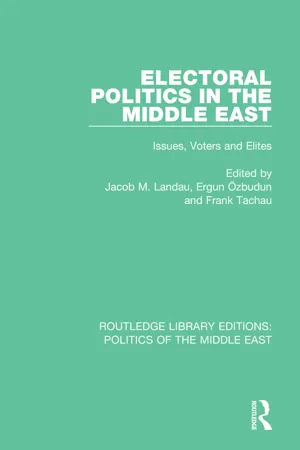
Comparative political study of the Middle East got off to a late start. Unlike any previous studies in comparative politics, this book, first published in 1980, represents an important methodological advance in that it proceeds by themes rather than by countries, and uniquely focuses on three major aspects of electoral politics in three contemporary Middle Eastern states. The three countries – Turkey, Lebanon and Israel – are chosen because they are the only Middle Eastern countries with a tradition of free elections. On the other hand, they also display certain characteristics found in other, non-competitive Middle Eastern political systems, such as the role and prominence of religion. The study is based on extensive original research and presents the first comparative treatment of electoral issues, voting behaviour and parliamentary elites, emphasising the context of rapid socio-economic change – a theme particularly pertinent to those countries with their tradition of free elections. The variety of political behaviour within the countries concerned, coupled with the prevailing complexities resulting from disparities in language and cultural inheritance, makes the comparative approach particularly revealing. The attitudes and behaviour of the voters can be seen to be at least as important as the laws and mechanisms involved.
eBook - ePub
Electoral Politics in the Middle East
Issues, Voters and Elites
- 339 pages
- English
- ePUB (mobile friendly)
- Available on iOS & Android
eBook - ePub
Electoral Politics in the Middle East
Issues, Voters and Elites
About this book
Information
Electoral Issues
1. Turkey
Doǧu Ergil
Elections in Turkey date back to the First Constitutional Assembly of 1877-8. However, until 1946 the electoral system had many limitations that denied free participation in the political process. There were limitations of age, sex and literacy in the electoral system that went into effect in 1877 and prevailed during the second constitutional period and in the first decade of the republican era. Those under 30, females and those illiterate in Turkish were barred from the Assembly. The result of these provisions was to deny candidacy to approximately 90 per cent of the population. The electorate was required to be male, over 25 years of age and to pay property tax. One year's local residence was also mandatory.
Until 1946 the electoral system was indirect. The registered voters chose secondary electors who, in turn, selected the actual deputies. The candidates had to be male, over 30 years of age and own property.
Law No. 320 which was passed in 1923 extended the franchise to all males over 18 years of age. The taxpaying requirement for first and second electors was lifted. In 1934 the word 'male' was dropped from the necessary qualifications of both electors and deputies (Law No. 2598). As a consequence the Fifth Assembly, elected in 1935, included 18 female deputies.
In 1946 Law No. 4918 changed the electoral system from a two-stage process to a single-stage process. But, perhaps more important than that, formation of political parties other than the Republican People's Party was legalised.
These changes paved the way for competitive and free elections which, in turn, brought plurality of ideas, expression of different interests and organisation of interest groups into the Grand National Assembly.
What are the main electoral issues that were voiced by the political parties since 1920? I believe that electoral issues can be analysed in the context of ideologies. In fact, they are expressed in the framework of ideological tendencies.
Ideologies can briefly be described as (i) forms of perception of the world, and (ii) socio-political responses of various social groups to the conditions that they experience in specific historical periods. According to this characterisation, ideologies can and do change over time (they are time-specific) and they appear in different forms due to diverse socio-structural circumstances.
The national liberation struggle following the surrender and partitioning of Ottoman Turkey was strongly supported by the ideology of liberation characterised by nationalism, anti-imperialism and national-bourgeois revolutionism. The latter component embodied the missions of replacing the theocratic Ottoman monarchy with a secular modern republic and the predominantly pre-capitalist economy with transforming contemporary capitalism. This, of course, meant the elimination of several classes and social institutions which upheld them and the elimination of direct foreign influence in the economy such as the Ottoman Public Debt Administration and the Capitulations.
The 1924 Constitution laid down the foundation of legal institutions that aimed at centralising power by which social change could be engineered. Followed by the adoption of the Swiss Civil Code and other bodies of law of Western origin such as the penal and commercial codes, the 1924 Constitution provided the legal framework for creating a modern secular state. The military-civilian bureaucracy which controlled the state apparatus took on the inevitable mission of nation-building which meant reinforcing central control over local authorities and diverting all loyalties to the state. This endeavour culminated in a single party, the Republican People's Party, the programme of which was symbolised by six arrows representing: republicanism, nationalism, populism, statism, secularism and reformism.
Nationalism was the uniting force among all social groups and the governing elite. Secularism was the instrument of rebuilding a traditional society based on rational and contemporary principles which would allow scientific evaluation of worldly affairs and dynamic policymaking. Republicanism served two purposes: (i) to dismantle the old traditional authority and replace it with a new secular elite, and (ii) change of governing cadres through popular election. Populism meant the support of the ruling elite by the majority of the people. The bureaucracy established the material basis of populism by using the state apparatus. It created the necessary infrastructure, found jobs and provided consumer goods, and at the same time supported the private sector.
Needless to say, this mission gave the bureaucracy a central role in every aspect of daily life. This included planning for the future and directing social change. It was no coincidence that the sixth principle of the RPP was reformism. In more contemporary terms, the ruling Kemalist elite symbolised revolutionary change 'from above'. It was a directed change and the ruling cadres were to be the 'managers' of change (modernisation). The direction of change is evident from the reforms they introduced. Starting with the traditional attire, they changed many things including the script used for centuries. Eastern traditions, values and institutions were dropped in favour of Western ones. This was Westernisation, and Westernisation meant modernisation.
The state or the Kemalist cadre who controlled the state apparatus was the driving force behind this scheme of modernisation. In the absence of a modernising bourgeoisie, the bureaucracy had shouldered the task of nation-building, that is, creating a new nation state out of a traditional monarchy. The programme of the state party (RPP) embodied all aspects of national solidarity, centralisation of power, and directed change, in short, the ideology of nation-building. The ingredients of this ideology were reflected in the party's documents until 1950. That year was a turning point in Turkish political history in that multiparty politics became an integral part of political life.
The Democrat Party's accession to power and the laissez-faire economic policy it advocated and supported opened the phase of competition of development ideologies. This competition was further exacerbated by the failure of the laissez-jaire policy towards the end of the 1950s.
The 1961 Constitution, approved by popular vote, contained new principles aimed at obtaining social welfare and policy-making for developmental purposes. First of all, it was established that 'Economic, social and cultural development is based on a plan. Development is carried out in accordance with this plan' (Article 129). Considering that the Turkish economy is a 'mixed' one comprising both state and private sectors, the plan would be binding on the state sector and regulatory for the private.
A Central Planning Organisation was created directly attached to the Prime Minister's office. The first Five-Year Development Plan issued by this organisation bears the date of 1963 to cover the period from this year until 1967. The plan initiated debates over the issue of whether a state-directed economy was better suited to Turkey's conditions or development through supporting the private sector was a better solution. The RPP, still representing the central authority's predominance in public and economic affairs, was inclined to support the first thesis. The Justice Party and other liberal parties all of which claimed that they had inherited the defunct Democrat Party's platform were firm believers in the virtues of the private sector. For them, private enterprise was the very foundation of human liberties.
On the other hand, the democratic nature of the new Constitution provided the legal basis for the formation of new political parties giving voice to different social groups in the society. The Turkish Labour Party was the most prominent among them.
It is appropriate to say that formation of a socialist party such as the Turkish Labour Party and free discussion of socialist ideas in Turkey were not primarily due to the more permissive nature of the 1961 Constitution. General economic growth since 1950 and accelerated industrialisation since 1960 brought qualitative changes one of which was the growth of a working class. This class was continuously fed by migrating masses from the mechanising countryside. On the other hand, it was legally shielded by new laws and regulations providing new opportunities such as collective bargaining, forming trade unions, striking and full coverage by social security.
The character of political debates had drastically changed when the Turkish Labour Party brought 15 MPs to the National Assembly following the 1965 general elections. It is during this period that the RPP, in spite of the later danger of losing its right-wing supporters, adopted a left-of-centre programme. The RPP's social-democratic stance was assumed at this stage. The year 1965 was a turning-point in the progress of Turkish politics towards a more crystallised political and ideological polarisation, augmented not only by limited development, but also by the incongruity between economic growth and the relatively equitable distribution of national wealth on the one hand and rapidly rising political consciousness or expectations that surpassed it on the other.
The period following the 1965 general elections was also fertile for the formation of many professional and political organisations which performed the duty of bringing together new pressure groups. This development may be deemed as the formation or organisation of the 'civilian society' outside the state apparatus. The initial proliferation of left leaning organisations was observed by both the Justice Party government and private enterprise with dismay. As a precaution, rightist youth organisations, some of which have been transformed into armed groups, began to be formed and trained in special paramilitary camps.
The ensuing economic difficulties and the inevitable clashes between the extreme left and the militant right left no chance for conciliation between the two sides. The military intervention of 12 March 1971 was the result of this clash which rapidly turned into a large-scale political vendetta.
The so-called 'intervening regime' under martial law ended with the general election held in 1973. Since this date two further elections have been held, namely the 1975 partial elections for the Senate and the 1977 general elections. Since there were few changes in the platforms, slogans and views advocated by the existing political parties no periodisation will be attempted between the elections held since 1973.
Electoral Issues Since the 1973 General Elections
Since 1961 Turkey's parliament has been made up of two houses, the National Assembly, with 450 seats, elected every four years; and the Senate, with 150 elected members (in addition to life Senators and those appointed by the State President), of whom a third is elected every two years for a six-year term. Representation is based on population and the elections are held by provincial constituency. Only electoral issues voiced by those parties large enough to have a group, i.e. ten members, in the National Assembly will be scrutinised. There are now only four such parties: the Republican People's Party (RPP), the Justice Party (JP), the National Salvation Party (NSP) and the Nationalist Action Party (NAP).1
Issues to be discussed can best be grouped under four headings: issues of economic development; issues of internal peace and political stability; issues of national security and foreign policy; and attitudes towards social change.
Issues of Economic Development
7he RPP Platform. The democratic left or social democratic programme of the RPP is intended to begin national development in the countryside, where the majority of the Turkish people still live. This policy is aimed both at ending the existing inequality between urban centres and the villages and also creating the necessary capital to support growing industry. If the envisaged transfer of surplus value from agriculture to industry can be accomplished through this scheme, then reliance on foreign capital will be reduced and so will Turkey's overall economic dependence, evinced by snowballing deficits in the balance of payments.
Development of the agrarian economy must be based on rural enterprises, such as modern operations engaged in animal husbandry, poultry, fisheries and mechanised farming. These newly established enterprises must be helped to support themselves and compete both in the internal and external markets. To achieve this, they should be united in co-operatives to which the state makes financial and technical contributions. This programme will hopefully put an end to the small, non-competitive and stagnant private agricultural operations and create rational enterprises with increasing production capacity and marketing facilities. For the RPP, this is the only sound way to transform the subsistence economy which characterises the Turkish agrarian sector.
There are two complementary schemes of achieving the desired transformation in the countryside: (i) formation of agro-towns; and (ii) formation of production co-operatives. The first scheme is aimed at creating central dwellings and production units out of nearly 65,000 rural settlements dispersed throughout Anatolia. For example, one central village may be chosen out of ten, and government aid, including public utilities, may be directed to this centre. This means one school, one doctor, one power plant etc., instead often. These centres are expected to grow into communities which will also be the medium for industrial investment. The industrial plants envisaged will utilise excess labour power freed from subsistence farming. Similarly, local raw materials, now cultivated in greater quantities in nearby co-operatives, will be utilised in the factories installed in such centres. Co-operatives will be voluntary unions of farmers formed to overcome problems of finance, marketing and technical aid. The rationale behind agricultural co-operatives is not collective ownership but collective production to surmount the difficulties of subsistence farming and inefficiencies of rural artisanship (manual industry). This is also the basis of a land and agricultural reform programme proposed by the RPP.
The rural community project also envisages halting the flow of population from the countryside. This flow may not be important for the increasingly mechanised rural economy, but it imposes heavy burdens on the urban economy in several respects. First of all, the infrastructural capabilities of Turkish cities are insufficient to absorb a continuously migrating rural population. The rings of squatter houses swelling around urban centres symbo...
Table of contents
- Cover Page
- Half Title page
- Title Page
- Copyright Page
- Original Title Page
- Original Copyright Page
- Contents
- Abbreviations
- Preface
- Introduction: Comparative Electoral Politics in the Middle East
- Part I: Electoral Issues
- Part II: Voting Behaviour
- Part III: Parliamentary Elites
- Index
Trusted by 375,005 students
Access to over 1.5 million titles for a fair monthly price.
Study more efficiently using our study tools.
Frequently asked questions
Yes, you can cancel anytime from the Subscription tab in your account settings on the Perlego website. Your subscription will stay active until the end of your current billing period. Learn how to cancel your subscription
No, books cannot be downloaded as external files, such as PDFs, for use outside of Perlego. However, you can download books within the Perlego app for offline reading on mobile or tablet. Learn how to download books offline
Perlego offers two plans: Essential and Complete
- Essential is ideal for learners and professionals who enjoy exploring a wide range of subjects. Access the Essential Library with 800,000+ trusted titles and best-sellers across business, personal growth, and the humanities. Includes unlimited reading time and Standard Read Aloud voice.
- Complete: Perfect for advanced learners and researchers needing full, unrestricted access. Unlock 1.5M+ books across hundreds of subjects, including academic and specialized titles. The Complete Plan also includes advanced features like Premium Read Aloud and Research Assistant.
We are an online textbook subscription service, where you can get access to an entire online library for less than the price of a single book per month. With over 1.5 million books across 990+ topics, we’ve got you covered! Learn about our mission
Look out for the read-aloud symbol on your next book to see if you can listen to it. The read-aloud tool reads text aloud for you, highlighting the text as it is being read. You can pause it, speed it up and slow it down. Learn more about Read Aloud
Yes! You can use the Perlego app on both iOS and Android devices to read anytime, anywhere — even offline. Perfect for commutes or when you’re on the go.
Please note we cannot support devices running on iOS 13 and Android 7 or earlier. Learn more about using the app
Please note we cannot support devices running on iOS 13 and Android 7 or earlier. Learn more about using the app
Yes, you can access Electoral Politics in the Middle East by Jacob M. Landau,Ergun Özbudun,Frank Tachau in PDF and/or ePUB format, as well as other popular books in Social Sciences & Regional Studies. We have over 1.5 million books available in our catalogue for you to explore.