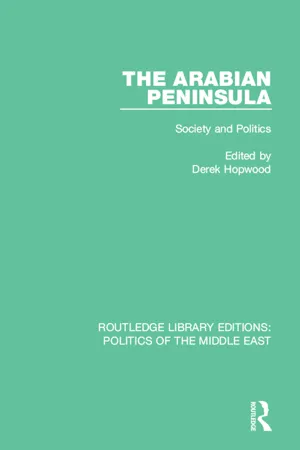
Although the Arabian Peninsula is the heartland of Islam and of the Arab world, for decades it did not receive the attention it deserves from scholars and writers. The School of Oriental and African Studies, University of London, and the Middle East Centre of St Antony's College, Oxford, jointly organized a series of seminars, culminating in a conference at which the papers in this volume (first published in 1972) were discussed. Together they constitute an authoritative statement of our present knowledge of several areas of the Peninsula, with particular emphasis on the Gulf States. Three chapters trace the history of Oman from pre-Islamic times to the recent past, and in so doing emphasize the theme of continuing conflict between sultan and imam. Other chapters examine the Gulf and the Peninsula from the standpoint of inter-Arab and of international relations. The third section of the book is devoted to a discussion of the increasing rate of social change in the area, and the final section deals with problems of oil and state and of economic development.
- 320 pages
- English
- ePUB (mobile friendly)
- Available on iOS & Android
eBook - ePub
About this book
Information
PART I
HISTORY
2
THE DEVELOPMENT OF THE GULF STATES
In writing on this subject it will be necessary to limit oneself to certain states and certain aspects of development, otherwise the subject will be too wide to tackle in the present survey. The eastern and northern shores of the Gulf, i.e. Persia and Iraq, al-Ihsa’ province of Saudi Arabia, and Oman will therefore be excluded. The countries which will be studied are: Kuwait, Bahrain, Qatar and the Trucial States, with special emphasis on the first. As far as the nature of development is concerned, the present chapter will endeavour to survey the political aspect, together with other auxiliary factors which usually lead to development.
From the first glance at those states, therefore, one can see that one is confronted with two types of political unit. The first is an independent state and the second a group of amirates or shaikhdoms which fell under British protection as a result of special treaty relations. But Kuwait, the independent state of today, was until 1961 more or less a British protectorate too. It might be worth our while to notice that these states stretch on the western shore of the Arabian Gulf from its northernmost edge to its southernmost end with only one intermission, namely that of al-Ihsa’, a territory that lies between Kuwait in the north and Qatar in the south. In spite of the fact that these states vary widely in their systems of government, it should be noted that there is a common factor among them. They are all Arabian territories, inhabited in the main by Arabian tribes who mostly belong to the cAdnani or northern division of Arabs, the southern being called Qahtani by Arab historians and traditionalists.
For the sake of convenience and because most of the shaikhdoms will be studied in other chapters, Kuwait will first be studied in detail, and the other protectorates, the shaikhdoms of Bahrain, Qatar and the seven Trucial States: Abu Dhabi, Dubai, Sharjah, cAjman, Umm al-Qaiwain, Ras al-Khaimah and Fujairah, will be dealt with at a later stage.
THE SHAIKHDOM OF KUWAIT1
To appreciate the political development of Kuwait one has to look very briefly at the early history of the place. The state of Kuwait is named after its capital Kuwait which was originally a very small fishing centre on the north-western corner of the Arabian Gulf. The name ‘Kuwait’ is a diminutive of ‘kut’, meaning a small fortress. This town was also known to the eighteenth-century European travellers as Grane (sometimes spelled ‘Grain’ or ‘Graen’) which is in turn a diminutive of the Arabic ‘qarn’ meaning a small hill.2 The town’s earliest history might date back to the mid-seventeenth century. Yet Kazimah, in the neighbourhood of Kuwait, was famous in the seventh century AD and is alluded to in various Arabic verses.3
The cUtub4
The earliest settlers of Kuwait of whom we have record in the seventeenth century are the Bani Khalid tribes, who ruled eastern Arabia in the sixteenth, seventeenth and eighteenth centuries. It was their Amir Barrak who is said to have established Kuwait. But late in the seventeenth century a number of Arabian tribes, united under the name of cUtub, travelled from the southern part of central Arabia, because of severe drought, to the coasts of the Gulf near Qatar. They dispersed along the shores of the Gulf and finally met again at Kuwait where towards the middle of the eighteenth century they gradually established their independence of the Bani Khalid.
Famous among the cUtub confederacy were Al Sabah, Al Khalifah and Al Jalahimah clans. It might be useful to note here that these cUtub (singular cUtbi) were the cousins of Al Sacud, and they all claim to be descended from Jamilah, a branch of the Great cAnazah tribe, now inhabiting northern Arabia.
Rise and Development of Kuwait in the Eighteenth Century
Al Sabah became the rulers of Kuwait in about 1750. By the end of the eighteenth century, Kuwait became an established shaikhdom as far as politics, economics and government are concerned. Its fleet was said, with Muscat’s, to have monopolized the conveyance of trade in the Persian Gulf.5 Its Arab ruler was independent of all foreign control including Ottoman. Shaikh cAbd Allah ibn Sabah was its second and most efficient ruler to whom Kuwait owed not only its independence but also its prosperity. He rose to power in about 1762 after the death of his father Shaikh Sabah ibn Jabir, who gave the present ruling family its name. Shaikh cAbd Allah ruled until his death in February 1815.6 This long reign of Shaikh cAbd Allah was destined to go through certain difficulties of a political and economic nature. But before going into the details of these difficulties, it is necessary to examine the structure of Kuwaiti society during his reign. It might be interesting to notice at this early phase of Kuwaiti society that it continued almost unchanged until the early 1950s, i.e. until the time when oil began to change the face of the land and its inhabitants.
Kuwait was the meeting point of the cUtub who, as previously mentioned, by the 1780s must have flocked together from the various islands and shores of the Gulf to Kuwait on its northwestern corner. Local traditions and the records of the time both speak of influential Arabian families among the new settlers which play an important part in forming the government in a tribal society. As a matter of fact Kuwait was from the start a tribal society, but with a difference.
cAbd Allah ibn Sabah
As the rule of Shaikh cAbd Allah was to influence government and state-manship in Kuwait for a long time to come, an examination of Kuwait under his rule would be very useful. Local tradition in Kuwait states that Shaikh cAbd Allah was chosen as a ruler from among other brothers although he was the youngest.7 The choice was made by the townspeople, who were mainly merchants, for his qualities of courage and wisdom, which an Arab usually likes to see in his chief.8 It is important to note that he was chosen by his townsmen in the manner his father was chosen before him. In other words he was given the right to rule by his people – he did not simply inherit that right.
From the start the merchants played a great role in running the daily affairs of Kuwait, so there was no danger of its ruler, in this case the Shaikh, becoming a despot. Indeed Shaikh cAbd Allah was very far from becoming one.
It is also important to remember that much of Kuwait’s internal policy has been dictated by the external situation, i.e. the state of affairs in neighbouring countries. Two factors, activity on the waters of the Gulf and the policies of the countries surrounding those waters, have always had their influence on Kuwait and the other Gulf States. The shaikhs of Kuwait knew how to handle these factors and make them work for their benefit.
During Shaikh cAbd Allah ibn Sabah’s rule in the eighteenth and early nineteenth centuries one can see how those two factors were to affect the policies of Kuwait. First there was the growing British interest in the Gulf waters, after the British had eliminated other European maritime powers, namely the Portuguese, Dutch and French; and secondly there were the other land forces, comprising the Wahhabis, on the eastern Arabian shores, the Ottomans in Iraq and the Persians on the eastern shores of the Gulf. Though it is beyond the scope of this paper to go into the details of how each of these two factors helped mould the policies of Kuwait, it can be briefly stated that Shaikh cAbd Allah managed to build a fleet which was able to defy the local fleets in the Gulf; and he followed a friendly policy towards the British from 1775, bringing them to Kuwait in 1793 to shelter their Basra factory for over two years, with the result that the factory workers took cAbd Allah’s side in repelling the Wahhabi attacks on Kuwait in 1795.9 Both Ottoman Iraq and Persia were too weak to disrupt the rapid growth of Kuwait in the eighteenth and the early nineteenth centuries. It might be worth our while to turn briefly to Kuwait’s internal political structure during this period, a structure which remained mainly unchanged until Kuwait became an independent state in 1961.
Paternal Rule
Both local traditions and contemporary European sources10 speak of an early paternal system of government in Kuwait. Al Sabah became rulers of the town by local tribal choice – that is, the cUtbi families of Kuwait chose Sabah, the ancestor of the present ruling family, to look after the administration of their town. He therefore became an Arabian sedentary amir who was a resident of an Arab town. But Kuwait was a community where merchants had the upper hand because of the wealth which they accumulated in the early days of the rise of their town, and so their influence on the political attitudes of their ruler was important. And members of the ruling family of Al Sabah might also be called merchants, in the sense that they have always had their own business.11 Though the ruler had it in his hands to settle the disputes among the town’s people, local traditions speak of a qadi or judge who used to settle matters relating to Islamic (sharicah) Law. The names of these judges are given in the books written by local historians.12 It could be therefore safely assumed that the policies of Kuwait, until quite recently, were decided by its rulers, the Shaikh, who sought advice from the merchants and from a qadi.
Shaikh Mubarak the Great and the Exclusive Agreement of 1899
As far as the running of the shaikhdom’s foreign policy is concerned no major change took place until the first few years of the rule of Shaikh Mubarak Al Sabah (1896–1915). For in 1898 Shaikh Mubarak of Kuwait, anxious to avoid any extension of Ottoman control from Iraq, turned to Great Britain and in 1899 signed a comprehensive treaty which contained most of the provisions included in the various agreements with Bahrain and the Trucial States, whereby the ruler undertook not to have direct relations with any other foreign power, and not to sell, lease or cede land to any such power.13 Great Britain thus became responsible for conducting the foreign relations of Kuwait and, incidentally, for its protection against foreign aggression. Shaikh Mubarak entered readily into this agreement because he realized that Kuwait’s continued independence could only be insured by British protection.14
After the signing of this treaty of 1899, and until 1946 when the golden oil tap was turned by Shaikh Ahmad al-Jabir Al Sabah, there were no radical changes in the policies of Kuwait. Yet the First World War and the Berlin-Baghdad Railway project at the beginning of the twentieth century were major factors in giving Anglo-Kuwaiti relations the intimacy which continued until the days of independence. The Second World War had of course its effects on Kuwait’s internal as well as external political development. The huge improvement in human communications through the media of air transport and radio accelerated social, political and economic change. Yet the role of oil was paramount.
Oil and Development
It is not possible to include in this brief survey of Kuwait the history of oil discovery, but it might be useful to mention that because of the cordial Anglo-Kuwaiti relations, and following the lines of 1899’s ‘exclusive’ agreement, Shaikh Mubarak the Great offered the British another ‘exclusive’ agreement regarding the search for oil in Kuwait in 1913.15 It is true that the oil concession to the Kuwait Oil Company came later than that date, and it is true too that oil was struck during the year 1938, but the golden tap was not turned on until 30 June 1946, during the rule of Shaikh Ahmad al-Jabir Al Sabah.16
Oil, Government and Politics
The discovery of oil in Kuwait was bound to have its effects on society. Thus the changes which were to come could be measured by the amount of oil and money earned per capita and how the ruler made use of this fabulous wealth.
Until the reign of Shaikh Ahmad al-Jabir Al Sabah (1921–50), Kuwait remained a paternal shaikhdom with the ruler at the head of the administration, running a country of about 15,000 square kilometres with only one big town of about 50,000 people and a considerable nomadic population – the boundaries of the shaikhdom were fixed at the cUqair Conference held in Saudi Arabia in 1922.17 Shaikh Ahmad al-Jabir continued to administer the shaikhdom in the traditional manner though in the 1920s he tried to form a Consultative Assembly to help him in his administration. The Assembly was doomed to die soon after its birth,18 though its death should in no way minimize the importance of the traditional role of Kuwaiti merchants, who continued to help the Shaikh run the administration of their country until the time became ripe for the recent birth of democratic rule.
It has been pointed out that although oil was found in Kuwait in 1938 production was not started until 1946. With the growth of the industry came a great human influx into Kuwait. Together with their cousins, the people of Kuwait, the new arrivals who came from the Arab countries of the Middle East and Arabia began to transform traditional Kuwaiti society. Their right arm was the newly discovered wealth drilled from under the earth which was helping not only to develop the face of the earth, but also to bring prosperity to those who formed the traditional society of Kuwait.
Shaikh Ahmad al-Jabir did not live long enough to witness the great changes; this lot fell to his successor Shaikh cAbd Allah al-Salim Al Sabah (1950–65). Thanks to cAbd Allah’s apprehension of internal and external affairs, Kuwait reached its present state of development as a modern state. But before discussing development in government and politics during cAbd Allah’s rule, it is important to give some relevant statistical information on his shaikhdom with reference to population and oil.
The census of 1958 put the population of the shaikhdom at about 300,000,19 the majority of whom lived in Kuwait town. The census carried out in 1965 put the number of the population at 467,789.20 It might be useful to state here again that more than half of the population come from neighbouring and distant Arab countries, and that among the foreign population there are a few thousand Persians, the majority of whom come from the opposite littoral of the Gulf and have Arab...
Table of contents
- Cover
- Half Title
- Title Page
- Copyright Page
- Table of Contents
- Foreword by A. H. Hourani and P. J. Vatikiotis
- Note on Transliteration
- BIBLIOGRAPHICAL SURVEY
- PART I HISTORY
- PART II POLITICAL DEVELOPMENTS AND INTERNATIONAL RELATIONS
- PART III SOCIOLOGY AND CULTURE
- PART IV ECONOMICS
- Index
Trusted by 375,005 students
Access to over 1.5 million titles for a fair monthly price.
Study more efficiently using our study tools.
Frequently asked questions
Yes, you can cancel anytime from the Subscription tab in your account settings on the Perlego website. Your subscription will stay active until the end of your current billing period. Learn how to cancel your subscription
No, books cannot be downloaded as external files, such as PDFs, for use outside of Perlego. However, you can download books within the Perlego app for offline reading on mobile or tablet. Learn how to download books offline
Perlego offers two plans: Essential and Complete
- Essential is ideal for learners and professionals who enjoy exploring a wide range of subjects. Access the Essential Library with 800,000+ trusted titles and best-sellers across business, personal growth, and the humanities. Includes unlimited reading time and Standard Read Aloud voice.
- Complete: Perfect for advanced learners and researchers needing full, unrestricted access. Unlock 1.5M+ books across hundreds of subjects, including academic and specialized titles. The Complete Plan also includes advanced features like Premium Read Aloud and Research Assistant.
We are an online textbook subscription service, where you can get access to an entire online library for less than the price of a single book per month. With over 1.5 million books across 990+ topics, we’ve got you covered! Learn about our mission
Look out for the read-aloud symbol on your next book to see if you can listen to it. The read-aloud tool reads text aloud for you, highlighting the text as it is being read. You can pause it, speed it up and slow it down. Learn more about Read Aloud
Yes! You can use the Perlego app on both iOS and Android devices to read anytime, anywhere — even offline. Perfect for commutes or when you’re on the go.
Please note we cannot support devices running on iOS 13 and Android 7 or earlier. Learn more about using the app
Please note we cannot support devices running on iOS 13 and Android 7 or earlier. Learn more about using the app
Yes, you can access The Arabian Peninsula by Derek Hopwood in PDF and/or ePUB format, as well as other popular books in Social Sciences & Regional Studies. We have over 1.5 million books available in our catalogue for you to explore.