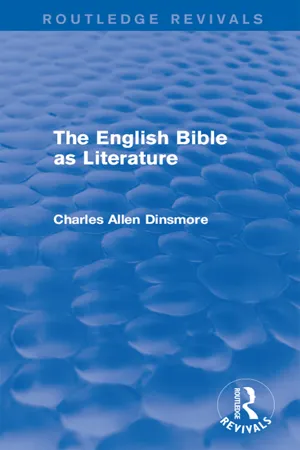
The religious associations surrounding the Bible make it difficult for the general reader to appreciate, in its full purity, the value which the Scriptures bear as literature, and as an epic in no way inferior, in cultural worth, to the greatest works of Greece and Rome. Dealing as it does with elementary passions and principles, the English Bible is, in the author's view, the greatest book of all the ages. This book, first published in 1931, will be of interest to students of literature and religious studies.
- 316 pages
- English
- ePUB (mobile friendly)
- Available on iOS & Android
eBook - ePub
The English Bible as Literature (Routledge Revivals)
About this book
Trusted by 375,005 students
Access to over 1.5 million titles for a fair monthly price.
Study more efficiently using our study tools.
Information
Subtopic
Literary CriticismIndex
LiteratureTHE ENGLISH BIBLE AS LITERATURE

PART I
THE GENIUS AND DISCIPLINE OF THE HEBREW PEOPLE
THE ENGLISH BIBLE AS LITERATURE
CHAPTER I
THE MARKS OF A SUPREME BOOK
The Authorized Version of the Bible is a piece of literature without any parallel in modern times. Other countries, of course, have their translations of the Bible, but they are not great works of art. The only other translation that can be compared with the Authorized Version is the Vulgate; and that is written in a language now foreign to everybody…. It is more than a translation, it expresses the religious thoughts and emotions of Englishmen as well as of Jews and early Christians.
A. CLUTTON-BROCK
THROUGH space we travel by many vehicles; through time we journey most easily by the magic of a good book. Of these there are many, but they differ in worth and durability, Some are for the day; others are for the ages. Some are so ephemeral that they are like ‘a snow-fall on the river, a moment white, then melts forever.’ Others shine like the stars forever and ever.
What are the marks of an immortal book? Emily Dickinson once wrote: ‘If I read a book and it makes my whole body so cold no fire can ever warm it, I know it is poetry. If I feel physically as if the top of my head were taken off, I know this is poetry.’ These vivid words are a poet’s intense way of saying that poetry, and all vital literature, affects us profoundly. How well I remember the day I finished reading Hugo’s ‘Les Misérables’! I walked on air, a golden glow suffused earth and sky, my ears were unstopped and I heard the dynamos of the world purring in the deep places. Every novel of George Eliot was a spiritual milestone in my early pilgrimage; while the very splendor of God rests upon the day I casually opened Dante’s ‘Divine Comedy.’
No book is great to us unless it affects us in a deep and permanent way. But our individual judgments may be mistaken; some trivial thing may release our emotions. If we find, however, that a volume which gives us mental and spiritual elevation has in like manner moved competent minds in many generations, and of many races, then we conclude that it is one of the world’s great books.
Now, what is there in these deathless books which causes them thus to stir the minds of multitudes in every century? We find in all of them a clear, fresh, powerful vision of human life. They tell the story of men and women in their great moments; they reveal the grandeur and the degradation of our humanity. Never do the greatest books deal with abstractions or speculations, but always with truth as it is revealed in human experience. Always their theme is man, his sins, his sufferings, his sources of comfort and redemption. The great books often deal with some one aspect of life, as ‘The Scarlet Letter,’ or ‘Romola,’ but life is always the stuff of which they are made. The immortals always see life steadily, and usually they see it whole. They have broad horizons, amazing penetration of thought, and amplitude of diction.
We find also that what makes these books powerful is their delineation of passion and their appeal to passion. Literature is measured by the quality and force of its emotional effect. ‘Mankind,’ says Goethe, ‘is always advancing, but man Is always the same.’ The elemental emotions — love, hate, revenge, thirst for God — these are permanent, and upon these unchanging feelings the enduring literature rears its stately structure.
One is also impressed with the vividness of the imagination of the immortal writers. ‘When you describe a thing,’ wrote Tchekhov to Gorky, ‘you see it, and touch it with your hands. That is real style.’ The characters in the immortal books are as living as historical figures. Achilles is as much a part of Grecian history as Pericles, Mephistopheles is as vivid a memory as Bismarck, Hamlet is as well known in England as Gladstone.
But the manner of the supreme books is as memorable as their matter. In their sentences is the rhythm of great music, the grace of a polished shaft, the glitter of a flight of silver arrows. Truth unadorned does not live in the memory of men, but truth shaped and glowing with beauty. Truth plus beauty equals immortality, is the algebraic equation of literature.
Long before we feel the power of the book as a whole, our attention is arrested by the magic word, the grace of the perfect sentence. We do not look for these on every page, but ever and anon in a good book we expect to find a word that fits as a jewel in its setting, a sentence that shines with the authentic fire of genius. In all the masterpieces there are phrases which condense a whole lifetime of experience, like that sentence Dante heard in Paradise,, ‘And his will is our peace’; or that give utterance to an emotion, in a form which cannot be improved, like
We are such stuff
As dreams are made on; and our little life
Is rounded with a sleep;
or some conviction, like ‘They also serve who only stand and wait.’ It is by these ‘winged words,’ these sentences glowing with celestial beauty, that the kings of speech reveal their royal blood.
After much searching I have found no better description of the characteristics of the pages that do not perish than that given by John Morley: ‘Literature consists of all the books — and they are not so many — where moral truth and human passion are touched with a certain largeness, sanity and attraction of form.’ Of the few books which meet the terms of this definition, there are three which hold incontestably the first rank as world classics. They are Homer’s ‘Iliad,’ Dante’s ‘Divine Comedy,’ and Shakespeare’s Dramas. Many would add to this list Plato’s Dialogues, the dramas of Æschylus, Sophocles, and Euripides, and Goethe’s ‘Faust.’ Aside from the worth of their thought, the Dialogues, considered as literature, have neither the variety of form nor the scale of emotional effect attained by the first three classics mentioned. The Greek dramatists may see life steadily, but they do not interpret an epoch like Homer or see it in as complete a compass as Shakespeare. Goethe has not yet been tested by enough centuries to be acclaimed a fourth in so great a company. The three mentioned are the highest expression in literature of the ancient, the medieval, the modern world. Each is concerned with human life in its decisive and crowded moments; each is the voice of an epoch, the picture of a civilization; each displays wide ranges of elemental emotion; all have a splendor of thought, a sweep of imagination, a superlative mastery of the resources of language, that place them upon an unapproached eminence. In them all ‘moral truth and human passion are touched with a certain largeness, sanity and attraction of form.’
My purpose now is to show to the reader how easily the English Bible — and by English Bible I mean the King James Version, and the Authorized Revisions — simply through its literary qualities takes a conspicuous position in the group of the world’s greatest classics. Of course we cannot evaluate literature as we do real estate, or with confidence assign relative rank to documents of the spirit. Yet standards of judgment are not wanting, and superlative merit is not easily concealed. I wish to bring out the greatness of the English Bible by comparing it with these classics.
If the substance of great books is the extent and importance of the moral truth taught, and the powerful portrayal of human passion, surely no book compares with the Bible in aggregation of truth and variety of passion. In the ‘Iliad,’ the events of less than fifty days are recorded. There are four days of fighting, followed by twenty-two days of funeral. Against a somber background there shine forth a few figures so resplendent that the ‘Iliad’ was used as a Bible by the Greeks to teach valor, magnanimity, hospitality. But the Scriptures hold in view the developing succession of centuries and show life under an immense diversiformity of conditions. In scope of truth and range of emotion, the ‘Iliad’ compares with the Bible as a broad-flowing river compares with the ocean.
Like the Bible, Dante goes down into the deep places of Satan; he also reads the mystery of life in the face of God. He is deep and high, but he moves in a strange world, the divine fire in him is often dimly seen under the encasement of medieval theology. His ‘Comedy’ lacks the universal appeal of the Scriptures. It is for all time, but not for all people.
The crowded stage of Shakespeare discloses a multiformity of emotions comparable with the Bible. No one surpasses him in envisaging the austere grandeur of the moral law, and in splendor of diction he is worthy of all honor. But his sight is very dim when he peers into the Supreme Mystery. He is world-wide, but there are heights which he cannot attain.
Neither Homer, nor Dante, nor Shakespeare touches so many chords of human passion, delicately and powerfully, or interprets so wide a compass of experience as does the Bible.
Or, apply another standard. It is perfectly fair to compare books of genius by the characters they create or the dramatic power of the situations involved. As the heroes ot these famous books pass before our imagination they stir us profoundly: Agamemnon, Achilles, Ulysses; Dante, Francesca, Latini, Beatrice; Othello, Lear, Miranda, Hamlet — a glorious company; but no more interesting than Jacob, David, Saul, and the great company of saints and heroes. When our thoughts turn from these to the divine portraiture of Christ, there is no question as to which way the balance turns. No literature has a character of such perfect proportions. And if the test is the powerful presentation of plot and the tragic moment, there is Calvary and the long centuries of spiritual adventure leading up to it.
Quite apart from questions of inspiration, the English Bible has the advantage of all other classics in the fact that a library of sixty-six books is gathered into one volume. While the other masterpieces are the product of one mind, or of a small group of minds, our Scriptures were written by many men, under many conditions. They were dictated by the genius of one race and then moulded by the genius of another. They present life as it appeared to successive generations and to successive strata of intelligence. The ‘Divine Comedy’ issued from the brain of one man, the ‘Iliad’ may be the minstrelsy of one poet or of a syndicate of poets, but the English Bible is the production of a multitude of minds stretching in succession over nearly three thousand years, representing many temperaments and many points of view. Like John at Patmos, we hear the voice of many waters, yet unified as the clear note of a trumpet. It is the Holy Ghost speaking in divers portions and in divers manner through many men, in many centuries, in many countries.
Or, if we make the basis of comparison the magic word, the enchanted phrase, the sentence of perfect grace, only Shakespeare would be mentioned and his treasure-house is far smaller than that of the Scriptures.
But we have not yet disclosed the deepest secret of the literary effectiveness of the Bible. In any real book, a large part of its power lies in the nature of its background — in the atmosphere in which the characters live and move and have their being. It is just this lack of background that condemns much of our modern work. The greatest writers do not neglect it. Dante makes his marvelous pilgrimage against a scene first of the terrifying gloom, and then of the ineffable glory of the eternal world. In all of Shakespeare’s tragedies the actors seem to be playing their part before the high throne of inexorable justice. Even in Homer, the issue of the battle on the plains of windy Troy is determined by the councils on Mount Olympus. In all of the sovereign books which the world will not let die, the characters live and do their deeds in the atmosphere and against the awful curtain of the Eternal.
Now in the Scriptures the Eternal is the background, even more intimate and solemnly impressive than in the other classics we have mentioned. Never for a moment is the gloom, or the glory, of the background forgotten; the shadow or splendor is on every page.
But the source of greatest power lies deeper than this. Not only are the actions performed and the words spoken as in the presence of the Most High, the Background becomes intensely personal and steps upon the stage as the chief actor in the drama. He is the absorbing center of attention from the beginning to the end. At first he is an Invisible Presence, hearing all, directing all. His authentic message comes through the mouth of his prophets, ‘Thus saith the Lord.’ Again he speaks directly: ‘Come, let us reason together: though your sins be as scarlet they shall be white as snow.’ Until finally the Word becomes flesh, and dwells among us, we behold his glory, full of grace and truth. Henceforth every thought is on him, whose glory filleth all in all. The ancient Hebrew could make God speak so directly to the hearer or reader because he held with such intensity the conviction that the voice which spoke in the depth of his soul was the veritable utterance of God. These writers could represent the Eternal as speaking and acting through man with the sincerity and simplicity of utter belief. Therefore their words have power. Both Homer and Milton use this device. The Greek poets represent the gods as speaking on human topics, but the real God — the Eternal Fate — preserves an awful silence. The speeches of Jehovah in ‘Paradise Lost’ are pompous, theological, and artificial, they are stage machinery. Tennyson may represent the Two Voices engaged in earnest debate, but he cannot speak as the mouthpiece of God. Whittier in perfect sincerity can sing:
I know not where his islands lift
Their fronded palms in air;
I only know I cannot drift
Beyond his love and care.
But these lines, confident and beautiful as they are, do not carry the convincing and comforting power of ‘I will never leave thee nor forsake thee.’ What modern writer could assert the divine forgiveness in such tremendous words as those of Israel: ‘Though your sins be as scarlet, they shall be white as snow.’
Now regarded merely as literary machinery — quite apart from religious value — the genius to see life vividly and to see it steadily against the background of the Eternal Righteousness, the ability to introduce God as an authentic voice speaking constantly through the drama, warning, directing, encouraging, and finally to make his grace and glory assume human form and bring the drama to its culmination of victorious agony in one supreme moment; considered, I say, merely as literary art, this tremendous drama, this divine human comedy, makes the plot of the ‘Iliad,’ or of ‘Hamlet,’ seem very insignificant.
If we add to this the fact that this incredible story is told with such simplicity and utter sincerity that multitudes in every generation and in every age hear through its pages the very accents of the Holy Ghost, and feel the immediate presence of the Eternal, then I think we are justified in saying that in the whole range of the literature of power this volume is unique.
If the tests of great literature are the scope and quality of the humanized truth presented, the variety of emotions vividly and truthfully delineated in a manner at once generous, sane, and attractive, then the Scriptures certainly stand with the world classics. But if we add to these its effect on its readers, its power to liberate them from the drudgery of the commonplace, to add new territories to the domain of their consciousness, to move so powerfully on all their feelings as permanently to change their character, and to do this not to a few elect minds, but to all classes and conditions of men everywhere and in every age, then I think that we may claim for the English Bible a place not inferior to that occupied by the very greatest books of the Western world.
CHAPTER II
AN EPIC OF REDEMPTION
East and West met long ago in the matchless phrases translated from Hebrew and Greek and Latin into the English Bible; and the heart of the East there answers to the heart of the West, as in water face answereth to face. That the colonizing Englishmen of the seventeenth century were Hebrews in spiritual culture, the heirs of Greece and Rome without ceasing to be Anglo-Saxon in blood, is one of the basal facts in the intellectual life of the United States to-day.
BLISS PERRY
IT is usually affirmed that the Bible is an inspired book. Properly speaking, persons, not books, are inspired. We are closer to the fact...
Table of contents
- Cover
- Half Title
- Title Page
- Copyright Page
- Original Copyright Page
- Table of Contents
- PART I THE GENIUS AND DISCIPLINE OF THE HEBREW PEOPLE
- PART II LITERARY VALUES OF THE OLD TESTAMENT BOOKS
- PART III THE LITERARY QUALITIES OF THE NEW TESTAMENT
- INDEX
Frequently asked questions
Yes, you can cancel anytime from the Subscription tab in your account settings on the Perlego website. Your subscription will stay active until the end of your current billing period. Learn how to cancel your subscription
No, books cannot be downloaded as external files, such as PDFs, for use outside of Perlego. However, you can download books within the Perlego app for offline reading on mobile or tablet. Learn how to download books offline
We are an online textbook subscription service, where you can get access to an entire online library for less than the price of a single book per month. With over 1.5 million books across 990+ topics, we’ve got you covered! Learn about our mission
Look out for the read-aloud symbol on your next book to see if you can listen to it. The read-aloud tool reads text aloud for you, highlighting the text as it is being read. You can pause it, speed it up and slow it down. Learn more about Read Aloud
Yes! You can use the Perlego app on both iOS and Android devices to read anytime, anywhere — even offline. Perfect for commutes or when you’re on the go.
Please note we cannot support devices running on iOS 13 and Android 7 or earlier. Learn more about using the app
Please note we cannot support devices running on iOS 13 and Android 7 or earlier. Learn more about using the app
Yes, you can access The English Bible as Literature (Routledge Revivals) by Charles Allen Dinsmore in PDF and/or ePUB format, as well as other popular books in Literature & Literary Criticism. We have over 1.5 million books available in our catalogue for you to explore.