This book, first published in 1903, is an account of Lafcadio Hearn's insights and experiences of Japan. Hearn, known also by the Japanese name Koizumi Yakumo, was an international writer who was best known for his books about Japan and Japanese culture. This book will be of interest to students of history and Asian Studies.
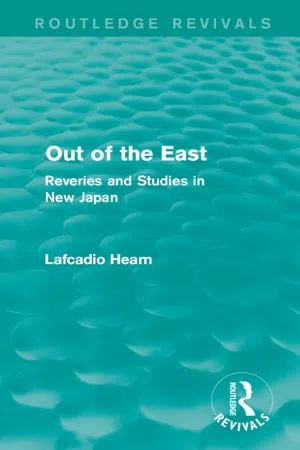
- 342 pages
- English
- ePUB (mobile friendly)
- Available on iOS & Android
eBook - ePub
“OUT OF THE EAST”
REVERIES AND STUDIES IN NEW
JAPAN
to
NISHIDA SENTARŌ
in dear remembrance of izumo days
Contents
- I. THE DREAM OF A SUMMER DAY
- II. WITH KYŪSHŪ STUDENTS
- III. AT HAKATA
- IV. OF THE ETERNAL FEMININE
- V. BITS OF LIFE AND DEATH
- VI. THE STONE BUDDHA
- VII. JIUJUTSU
- VIII. THE RED BRIDAL
- IX. A WISH FULFILLED
- X. IN YOKOHAMA
- XI. YUKO: A REMINISCENCE
“The Dream of a Summer Day” first appeared in the “Japan Daily Mail.”
I The Dream of a Summer Day
DOI: 10.4324/9781315691497-1
I
The hotel seemed to me a paradise, and the maids thereof celestial beings. This was because I had just fled away from one of the Open Ports, where I had ventured to seek comfort in a European hotel, supplied with all “modern improvements.” To find myself at ease once more in a yukata, seated upon cool, soft matting, waited upon by sweet-voiced girls, and surrounded by things of beauty, was therefore like a redemption from all the sorrows of the nineteenth century. Bamboo-shoots and lotus-bulbs were given me for breakfast, and a fan from heaven for a keep-sake. The design upon that fan represented only the white rushing burst of one great wave on a beach, and sea-birds shooting in exultation through the blue overhead. But to behold it was worth all the trouble of the journey. It was a glory of light, a thunder of motion, a triumph of sea-wind, — all in one. It made me want to shout when I looked at it.
Between the cedarn balcony pillars I could see the course of the pretty gray town following the shore-sweep, — and yellow lazy junks asleep at anchor, — and the opening of the bay between enormous green cliffs, — and beyond it the blaze of summer to the horizon. In that horizon there were mountain shapes faint as old memories. And all things but the gray town, and the yellow junks, and the green cliffs, were blue.
Then a voice softly toned as a wind-bell began to tinkle words of courtesy into my reverie, and broke it; and I perceived that the mistress of the palace had come to thank me for the chadai, 1 and I prostrated myself before her. She was very young, and more than pleasant to look upon, — like the mothmaidens, like the butterfly-women, of Kunisada. And I thought at once of death; — for the beautiful is sometimes a sorrow of anticipation.
She asked whither I honorably intended to go, that she might order a kuruma for me. And I made answer: —
“To Kumamoto. But the name of your house I much wish to know, that I may always remember it.”
“My guest-rooms,” she said, “are augustly insignificant, and my maidens honorably rude. But the house is called the House of Urashima. And now I go to order a kuruma.”
The music of her voice passed; and I felt enchantment falling all about me, — like the thrilling of a ghostly web. For the name was the name of the story of a song that bewitches men.
II
Once you hear the story, you will never be able to forget it. Every summer when I find myself on the coast, — especially of very soft, still days, — it haunts me most persistently. There are many native versions of it which have been the inspiration for countless works of art. But the most impressive and the most ancient is found in the “Manyefushifu,” a collection of poems dating from the fifth to the ninth century. From this ancient version the great scholar Aston translated it into prose, and the great scholar Chamberlain into both prose and verse. But for English readers I think the most charming form of it is Chamberlain’s version written for children, in the “Japanese Fairy-Tale Series,” — because of the delicious colored pictures by native artists. With that little book before me, I shall try to tell the legend over again in my own words.
Fourteen hundred and sixteen years ago, the fisher-boy Urashima Tarō left the shore of Suminoyé in his boat.
Summer days were then as now, — all drowsy and tender blue, with only some light, pure white clouds hanging over the mirror of the sea. Then, too, were the hills the same, — far blue soft shapes melting into the blue sky. And the winds were lazy.
And presently the boy, also lazy, let his boat drift as he fished. It was a queer boat, unpainted and rudderless, of a shape you probably never saw. But still, after fourteen hundred years, there are such boats to be seen in front of the ancient fishing-hamlets of the coast of the Sea of Japan.
After long waiting, Urashima caught something, and drew it up to him. But he found it was only a tortoise.
Now a tortoise is sacred to the Dragon God of the Sea, and the period of its natural life is a thousand — some say ten thousand — years. So that to kill it is very wrong. The boy gently unfastened the creature from his line, and set it free, with a prayer to the gods.
But he caught nothing more. And the day was very warm; and sea and air and all things were very, very silent. And a great drowsiness grew upon him, — and he slept in his drifting boat.
Then out of the dreaming of the sea rose up a beautiful girl, — just as you can see her in the picture to Professor Chamberlain’s “Urashima,” — robed in crimson and blue, with long black hair flowing down her back even to her feet, after the fashion of a prince’s daughter fourteen hundred years ago.
Gliding over the waters she came, softly as air; and she stood above the sleeping boy in the boat, and woke him with a light touch, and said: —
“Do not be surprised. My father, the Dragon King of the Sea, sent me to you, because of your kind heart. For to-day you set free a tortoise. And now we will go to my father’s palace in the island where summer never dies; and I will be your flower-wife if you wish; and we shall live there happily forever.”
And Urashima wondered more and more as he looked upon her; for she was more beautiful than any human being, and he could not but love her. Then she took one oar, and he took another, and they rowed away together, — just as you may still see, off the far western coast, wife and husband rowing together, when the fishing-boats flit into the evening gold.
They rowed away softly and swiftly over the silent blue water down into the south, — till they came to the island where summer never dies, — and to the palace of the Dragon King of the Sea.
[Here the text of the little book suddenly shrinks away as you read, and faint blue ripplings flood the page; and beyond them in a fairy horizon you can see the long low soft shore of the island, and peaked roofs rising through evergreen foliage — the roofs of the Sea God’s palace — like the palace of the Mikado Yuriaku, fourteen hundred and sixteen years ago.]
There strange servitors came to receive them in robes of ceremony — creatures of the Sea, who paid greeting to Urashima as the son-in-law of the Dragon King.
So the Sea God’s daughter became the bride of Urashima; and it was a bridal of wondrous splendor; and in the Dragon Palace there was great rejoicing.
And each day for Urashima there were new wonders and new pleasures: — wonders of the deepest deep brought up by the servants of the Ocean God; — pleasures of that enchanted land where summer never dies. And so three years passed.
But in spite of all these things, the fisherboy felt always a heaviness at his heart when he thought of his parents waiting alone. So that at last he prayed his bride to let him go home for a little while only, just to say one word to his father and mother, — after which he would hasten back to her.
At these words she began to weep; and for a long time she continued to weep silently. Then she said to him_ “Since you wish to go, of course you must go. I fear your going very much; I fear we shall never see each other again. But I will give you a little box to take with you. It will help you to come back to me if you will do what I tell you. Do not open it. Above all things, do not open it, — no matter what may happen! Because, if you open it, you will never be able to come back, and you will never see me again.”
Then she gave him a little lacquered box tied about with a silken cord. [And that box can be seen unto this day in the temple of Kanagawa, by the seashore; and the priests there also keep Urashima Tarō’s fishing line, and some strange jewels which he brought back with him from the realm of the Dragon King.]
But Urashima comforted his bride, and promised her never, never to open the box — never even to loosen the silken string. Then he passed away through the summer light over the ever-sleeping sea; — and the shape of the island where summer never dies faded behind him like a dream; — and he saw again before him the blue mountains of Japan, sharpening in the white glow of the northern horizon.
Again at last he glided into his native bay; — again he stood upon its beach. But as he looked, there came upon him a great bewilderment, — a weird doubt.
For the place was at once the same, and yet not the same. The cottage of his fathers had disappeared. There was a village; but the shapes of the houses were all strange, and the trees were strange, and the fields, and even the faces of the people. Nearly all remembered landmarks were gone; — the Shintō temple appeared to ha...
Table of contents
- Cover
- Halftitle Page
- Title Page
- Copyright Page
- Title Page 1
- Dedication Page
- Contents
- I. THE DREAM OF A SUMMER DAY
- II. WITH KYŪSHŪ STUDENTS
- III. AT HAKATA
- IV. OF THE ETERNAL FEMININE
- V. BITS OF LIFE AND DEATH
- VI. THE STONE BUDDHA
- VII. JIUJUTSU
- VIII. THE RED BRIDAL
- IX. A WISH FULFILLED
- X. IN YOKOHAMA
- XI. YUKO: A REMINISCENCE
Frequently asked questions
Yes, you can cancel anytime from the Subscription tab in your account settings on the Perlego website. Your subscription will stay active until the end of your current billing period. Learn how to cancel your subscription
No, books cannot be downloaded as external files, such as PDFs, for use outside of Perlego. However, you can download books within the Perlego app for offline reading on mobile or tablet. Learn how to download books offline
We are an online textbook subscription service, where you can get access to an entire online library for less than the price of a single book per month. With over 1.5 million books across 990+ topics, we’ve got you covered! Learn about our mission
Look out for the read-aloud symbol on your next book to see if you can listen to it. The read-aloud tool reads text aloud for you, highlighting the text as it is being read. You can pause it, speed it up and slow it down. Learn more about Read Aloud
Yes! You can use the Perlego app on both iOS and Android devices to read anytime, anywhere — even offline. Perfect for commutes or when you’re on the go.
Please note we cannot support devices running on iOS 13 and Android 7 or earlier. Learn more about using the app
Please note we cannot support devices running on iOS 13 and Android 7 or earlier. Learn more about using the app
Yes, you can access Out of the East (Routledge Revivals) by Lafcadio Hearn in PDF and/or ePUB format, as well as other popular books in History & Japanese History. We have over 1.5 million books available in our catalogue for you to explore.