eBook - ePub
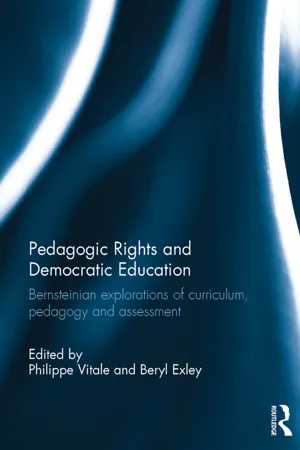
Pedagogic Rights and Democratic Education
Bernsteinian explorations of curriculum, pedagogy and assessment
- 250 pages
- English
- ePUB (mobile friendly)
- Available on iOS & Android
eBook - ePub
Pedagogic Rights and Democratic Education
Bernsteinian explorations of curriculum, pedagogy and assessment
About this book
The basis of Bernstein's sociology of education lays in is his theorisation of the different approaches to curriculum, pedagogy and assessment and the implications for pedagogic rights and social justice. This edited collection presents 15 empirical case studies and theoretical accounts from 22 international scholars who focus on the experiences of students and teachers in contexts marked by economic, social, cultural, linguistic and/or geographic diversity. Located in systems of education in Australia, France, Germany, Greece, Portugal, South Africa and the United States, each chapter contributes to a better understanding of the conditions of a democratic education across time and place.
Information
Section III
Democratising knowledge
6The body of knowledge
Introduction
Sociology of education has never had a satisfactory way of talking about knowledge. Its overriding concern has been with social action, with the social forces impinging on curriculum and pedagogy, and with their distributional consequences. A concern with the ‘stuff’ of learning was not considered germane to sociological theorisation or investigation. In many cases, including Bernsteinian circles (see Tyler, 2010), it still isn’t. As Bernstein was to put it, in relation specifically to Bourdieu, sociology of education has largely concerned itself with the relay, not with what is relayed.
This tiptoeing around the stuff of learning could be partly understood in terms of the traditional object of social analysis – action, not thought. But was some action not more thoughtful – more knowledgeable or expert – than other action? And what was it that made the difference or, rather, what was it that one had to have for there to be a difference? Sociologists did not ask this question. At least they could agree that it was not inherited intelligence, but beyond that was terra incognita. The assumption seemed to be that ‘knowledge’, insofar as it was anything at all, was some kind of tacitly acquired capability that became infused into the synapses (see Perraton and Tarrant, 2007; Kotzee, 2014, for sceptical responses). What mattered for sociology in the first instance was the social location of the learners, which governed what it was they could show they knew in the final examination, and therefore governed ongoing inequalities. This seemed to be irrespective of what it was they were learning.
Sociologists of education were thus not a great help to educators struggling with what the curriculum should comprise in the last quarter of the 20th century. But neither were philosophers and psychologists. The former seemed on all sides to be bitten by the pragmatist bug, following Wittgenstein, for whom knowing something was doing something – usually, following a rule. It was what learners did that mattered. A host of practice-based psychologies arose, to be followed by sociologists and their varied communities of practice. In the background, ‘knowing how’ preoccupied the philosophers, and ‘knowing that’ seemed to have dropped off the intellectual agenda.
This marked swing to practice, in all its sociological, psychological and philosophical varieties, has been variously diagnosed. From within Bernsteinian ranks, a critique has been mounted that (some of the) practice-centred approaches reduce all questions of knowledge to social position – in Moore’s pithy phrase, this ‘conflates what is known with who knows – knowledge with knowers’ (Moore, 2012a, p. 345). This of course does not apply to all approaches that deal with practice, but it does mark a tendency that holds the theoretical high ground in the social sciences (see Beck, 2002; Reckwitz, 2002). For writers such as Moore and Young (2001), this results in relativism, which, despite its democratic intents, undermines a powerful view of knowledge and, at the same time, undermines the social justice argument for entitlement to powerful knowledge for all. For them, it was precisely the denial that some knowledge was more powerful than other knowledge that validated the social justice demand for equality of distribution and made its inequitable distribution visible; it was precisely the denial of powerful knowledge that rendered the inequality opaque.
For another group of more classroom-focused Bernsteinians, following middle-period Bernstein, the result of the practice turn was the naturalisation of an invisible pedagogic regime. Put more prosaically, the focus on learners and what they can do licensed a swing away from what learners were entitled to learn, focusing instead on what kinds of skills they should be able to exercise, a focus which legitimated and continues to legitimate the stipulation of the curriculum in skill- and outcome-based terms. The result was invariably an understipulated curriculum and undersignalled pedagogy that directly disadvantaged those already disadvantaged, a fact brought out graphically by a series of conceptually informed empirical studies reported in the second Bernsteinian symposium and beyond (see, for example, Muller, Davies and Morais, 2004).
Bernstein had of course presciently put his finger on this issue. For him, generic ‘skills-talk’, which he called ‘generic modes’, originated in further and vocational education, but had been extended much more widely ‘partly in response to the perceived need to functionalize education for a world in which futures are held to be increasingly unpredictable’, as Beck put it (Beck, 2002, p. 89). Generic skills-talk thus denotes a weakening of classification of knowledge boundaries; a new receptiveness to instrumental concerns that aim not at specialisation but at ‘trainability’, an empty openness to future requirements as and when they occur. This ‘emptiness’ denotes empty in two senses: one, conceptually empty, that is, without content; and two, socially empty in that the decontextualisation of generic skill also cuts the skill-holder off from any common community of practice.
Most critically, as Beck goes on to point out, generic skill modes ‘insidiously suppress recognition of their own discursive base, that is, they suppress awareness of the fact that they are themselves tacitly rooted in theory, notwithstanding their claims to be based on practice… .’ (Beck, 2002, p. 90; Bernstein, 2000, p. 53). But what is that theory? And why is it so persistent? This paper aims to explore this issue beyond simply dismissing it as an ideological error.
This trend to skills-talk has if anything become more marked since Bernstein wrote in the late 1990s, propelled by the current global vogue for qualifications frameworks which, proclaiming a new ‘pedagogic right’ of ‘transferability’, require learning outcomes to be stipulated in ‘outcomes’, which invariably means generic skills rather than knowledge terms (Allais, 2012). Generic skills have been taken to task for decontextualizing context – specific know-how, for atomising what is to be learnt and hence undermining coherence, as well as for effectively disguising that which is to be learnt. Critiques range from studies on the effects of generic skill stipulations on disciplinary knowledge (Jones, 2009), on vocational qualifications (Brockmann, Clarke and Winch, 2008) and on doctoral programmes (Gewirtz, 2008). Skills-talk in the curriculum – stipulating what you should be able to do rather than what you should know – has become hegemonic.
It was against this emergent current that Bernstein, together with his critique of ‘generic modes’, launched his sociological analysis of discourses and knowledge structures in the mid-1990s with the question: what was knowledge before it became the curriculum; wherein consisted the ‘discourses subject to pedagogic transformation’ (Bernstein, 2000, p. 155)? His answer is almost too familiar now, but I shall revisit it again below from a different angle.
Before I do that, I want to turn to the idea of knowledgeable action because, for all the persistence of the skills-talk, we are no closer to understanding what kind of knowledge we have when we can, or can’t, do something. The question is present whenever we consider what it means to perform well at school or university, but it is brought into even sharper relief when we consider the professions and professional expertise; what does it mean, as a knowledgeable professional or skilled craftsman or -woman, to do something expertly, or innovatively? What is it we know when we know how to do something? Conceptual knowledge of some sort? Some or other procedural knowledge? Or something else altogether?
In the next section I will turn, necessarily schematically, to some recent debates in philosophy where, it turns out, arguments rage over the nature of ‘how to’ knowledge, which, in the light of the above, is not too surprising. I will then return to Bernstein to see whether his account stands in need of elaboration in order to cope with knowledgeable action in its socially distributed ramifications.
Know how and know that or, what must you know in order to can do?
Consider the following:
- An illiterate farmworker, Mr Hendriks, with no formal training, is able to design wagons to the specification of his farmer. When asked how he does it, he just says that he ‘visualises’ the new design. He is able to apply knowledge that he did not formally acquire, and he is able to innovate, but on the basis of what is not clear (Muller, 2000);
- ‘Industrial chicken-sexers can, I am told, reliably sort hatchlings into males and females by inspecting them, without having the least idea how they do it. With enough training, they just catch on’ (Brandom, 1998, p. 375);
- The baseball player Knoblauch was reputedly the fastest second baseman of his time. When asked to reflect on how he did it, he mysteriously lost the knack (Dreyfus, 2006).
With some variation, these examples pose the question as to what it is we know (or don’t know) when we can (or can’t) do something. The chicken-sexers claim that their accurate judgment is based on intuition, not knowledge. And the hapless Knoblauch didn’t know he knew anything at all until he was asked to think about it, at which point he lost what he didn’t know he had. Nor is it only expert performance in the craft or vocational sector of expertise that is viewed through the lens of ‘fluent action’ (Kotzee, 2014). If Gladwell (2005) is to be believed, the doctors of Cook County have mastered the art of intuitive diagnosis of heart problems. They don’t reflect upon it, they just diagnose. Gladwell advocates this approach, called ‘thin slicing’, as a general and efficacious way to save cognition time while preserving accuracy.
Philosophers of a certain persuasion use examples such as these to make the argument that in much expert action – some such as Dreyfus would say in all of it – it is fluent action or ‘know how’ that governs our actions, not ‘know that’, or conceptual knowledge. It is practice, not understanding, that makes perfect; it is skills, not knowledge, that matters. In fact, for philosophers of this persuasion, knowledge or thinking about it (or as Dreyfus contends, knowledge of an expert action and thinking about an expert action) positively gets in the way, as in the case of Knoblauch, or at least the verbalisation of it does, a phenomenon cognitive psychologists call ‘verbal overshadowing’ (Stanley, 2011, p. 159).
It is worth a brief glance to the origin of this way of thinking in Gilbert Ryle’s distinction (Ryle, 1945/6, 6). Here is how he sets up the problem, actually an ancient dilemma called the dilemma of the Hare and the Tortoise by Lewis Carroll:
A pupil fails to follow an argument. He understands the premises and he understands the conclusion. But he fails to see the conclusion follows from the premises. The teacher thinks him rather dull(!) but tries to help. So he tells him that there is an ulterior proposition, which he has not considered, namely, that if these premises are true, the conclusion is true. The pupil understands this and dutifully recites it alongside the premises… . And still the pupil fails to see. And so on forever. He accepts rules in theory but this does not force him to apply them in practice. He considers reasons, but he fails to reason.
Ryle concludes: knowing a rule means knowing how to infer, not simply being able to state the rule. ‘Rules, like birds, must live before they can be stuffed’ (Ryle, 1945/6, p. 11). A sizeable cohort of analytical philosophers has followed Ryle down this path. ‘Knowing that’ is best considered together with ‘knowing how’, without which it (‘knowing that’) is simply inert. Or as Peter Winch (1958, p. 58) was to put it a little later:
Learning to infer is not a matter of being taught about explicit logical relations between propositions; it is learning to do something.
It is useful at this point to briefly recall the two principal positions that this view was set against. Both of them put their faith in conceptual knowledge which is ‘in the head’, so to speak, something that one knows is the case. For the rationalists (sometimes called intellectualists, or Cartesians), knowledge is a set of logical relations, a set of propositions about the world. These are the outcome of reason, which can then be brought to bear on experience. For the empiricists, knowledge is something one absorbs through experience. Both sides have over the centuries traded choice insults: rationalists stand accused of the ‘myth of the mental’; empiricists, of the ‘myth of the given’. Neither are however in any doubt that knowledge in the end resides in propositional form in the beliefs of the knower or that truth is a matter of reference, that these propositions are ‘about’ something that we can check and confirm. With the Ryleans, and after Wittgenstein, we have another possibility: knowledge is a kind of skill or ability, knowledge is as knowledge can do. All ‘know that’ is a kind of ‘know how’.
Two kinds of Rylean should be distinguished. The first kind, following phenomenology, believe that philosophers have spent too much time considering the ‘conceptual upper floors’ and have ignored the embodied coping happening on the ground floor. For Dreyfus, the Knoblauch example shows not just that verbalisation ‘overshadows’ action, but that ‘thought’ is ‘the enemy of expertise’ (Dreyfus, 2007, p. 354). This branch of the ‘practical knowledge’ philosophers is in this sense anti-intellectual, having also an affinity with the proponents of ‘tacit’ knowledge like Schön and Polanyi (Kotzee, 2014). As Kotzee goes on to show, such accounts are unable to account for differences in expert performance between experts and novices, but are more crucially unable to account for differences between unspecialised forms of expertise in everyday life, such as driving a car well, and highly specialised forms of expert performance, such as complex surgery. Besides, what help can an anti-intellectualist be to scholars of curriculum? We are back here with the central problem of skills-talk.
A second kind of pragmatist is more interesting, promising far more for a sociological account. This is the inferential approach of Robert Brandom and the ‘Pittsburgh School’. Brandom’s (2001) is a complex position, owing as much to Hegel as to the analytical tradition. If the modern Dreyfusards have defined all intelligent action as fluency, Brandom, and his colleague McDowell (1996), define all action as having conceptual content: in McDowell’s phrase, all action is ‘minded’, or in Brandom’s phrase, takes place ‘in the space of reasons’.
‘Mindedness’ is rendered stable and objective by the ‘game of reasons’. Conceptual knowledge in this account is that which can be offered as, and by itself stand in need of, reasons.
Understanding or grasping such propositional content is a kind of know-how, or practical mastery of the game of giving and asking for reasons: being able to tell what is a reason, for what, distinguishes good reasons from bad
(Keeler, 2004, p. 250)
To be able to play the game is to be able to keep score on what you, and other players, are committed and entitled to. Evaluating a claim means understanding how it would change the score. This sets up a chain of inferential relations, which, if made explicit, is what Brandom would call a conceptual structure. The reliability of concepts is underwritten by scorekeeping. Rational activity is thus a ...
Table of contents
- Cover Page
- Half Title page
- Title Page
- Copyright Page
- Dedication
- Contents
- Contributors
- Acknowledgements
- Introduction
- Looking back to look forwards Expanding the sociology of education
- Pedagogic rights
- The enigma of Bernstein's ‘pedagogic rights'
- Empirical reference points for Bernstein's model of pedagogic rights Recontextualising the reconciliation agenda to Australian schooling
- Changing from within Basil Bernstein, teacher education and social justice
- The sociology of democratic potentials in social structures The case of apprenticeship in French Freemasonry
- Democratising knowledge
- The body of knowledge
- Investigating principles of curriculum knowledge progression A case study of design in a civil engineering degree programme
- Devaluing knowledge School mathematics in a context of segregation
- Changing official knowledge in economy-based societies Higher education policy, projected identities and the epistemic shift
- Describing forms of knowledge and their variations in French école maternelle The contribution of Bernstein's concepts
- Comparing discipline-based and interdisciplinary knowledge in university education
- Democratising pedagogies
- Constructing meaning from multisemiotic printed school texts The heuristic nature of Bernstein's concepts to analyse students' difficulties
- Vertical discourses and science education Analysing conceptual demands of educational texts
- Caught in the net? Innovation and performativity in an Australian university program
- Recontextualisation in in-company vocational education in the dual system in Germany
- Afterword
- Basil Bernstein and the problem of culture and power in education
- References and further readings
- Index
Trusted by 375,005 students
Access to over 1.5 million titles for a fair monthly price.
Study more efficiently using our study tools.
Frequently asked questions
Yes, you can cancel anytime from the Subscription tab in your account settings on the Perlego website. Your subscription will stay active until the end of your current billing period. Learn how to cancel your subscription
No, books cannot be downloaded as external files, such as PDFs, for use outside of Perlego. However, you can download books within the Perlego app for offline reading on mobile or tablet. Learn how to download books offline
Perlego offers two plans: Essential and Complete
- Essential is ideal for learners and professionals who enjoy exploring a wide range of subjects. Access the Essential Library with 800,000+ trusted titles and best-sellers across business, personal growth, and the humanities. Includes unlimited reading time and Standard Read Aloud voice.
- Complete: Perfect for advanced learners and researchers needing full, unrestricted access. Unlock 1.5M+ books across hundreds of subjects, including academic and specialized titles. The Complete Plan also includes advanced features like Premium Read Aloud and Research Assistant.
We are an online textbook subscription service, where you can get access to an entire online library for less than the price of a single book per month. With over 1.5 million books across 990+ topics, we’ve got you covered! Learn about our mission
Look out for the read-aloud symbol on your next book to see if you can listen to it. The read-aloud tool reads text aloud for you, highlighting the text as it is being read. You can pause it, speed it up and slow it down. Learn more about Read Aloud
Yes! You can use the Perlego app on both iOS and Android devices to read anytime, anywhere — even offline. Perfect for commutes or when you’re on the go.
Please note we cannot support devices running on iOS 13 and Android 7 or earlier. Learn more about using the app
Please note we cannot support devices running on iOS 13 and Android 7 or earlier. Learn more about using the app
Yes, you can access Pedagogic Rights and Democratic Education by Philippe Vitale,Beryl Exley in PDF and/or ePUB format, as well as other popular books in Éducation & Éducation générale. We have over 1.5 million books available in our catalogue for you to explore.