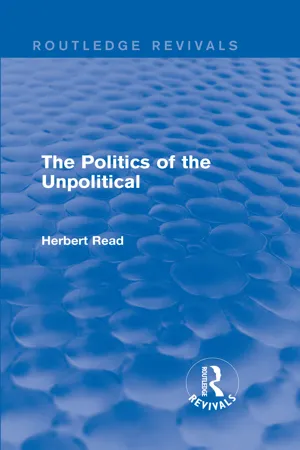
In this collection of fourteen essays, first published in 1943, Herbert Read extends and amplifies the points of view expressed in his successful pamphlet To Hell with Culture, which has been reprinted here. The 'politics of the unpolitical' are the politics of those who strive for human values and not for national or sectional interests. Herbert Read defines these values and demands their recognition as a solvent of social and cultural crises', and looks forward to the future with constructive vision. This book will be of interest to students of politics, history, and philosophy.
- 160 pages
- English
- ePUB (mobile friendly)
- Available on iOS & Android
eBook - ePub
The Politics of the Unpolitical
About this book
Information
1
The Politics of the Unpolitical
If certain writers feel emancipated enough from all that is human—they would say intellectual enough—to continue to fulfil, under any circumstances whatever, the strange functions of purely abstract thought, good luck to them. But those who can only conceive their rôle as writers to be a means of experiencing more deeply and of establishing more fully a mode of existence which they want to be human, those who only write in order to feel themselves living integrally—such people no longer have the right to be disinterested. The trend of events, and the evolution of ideas, if they run out their course, will lead straight to an unparalleled deformation of the individual human being. Whoever gazes into the future which is being forged for us, and can there perceive the monstrous and denatured brother whom one will necessarily resemble, cannot react except by a revolt into éxtreme egoism. It is this egoism which must now be rehabilitated. To-day the problem of the person effaces all others. The intelligence is placed in such circumstances that for it disinterestedness and resignation come to the same thing.
THIERRY MAULNIER, La Crise est dans l'homme (Paris, 1932).
THE politics of the unpolitical—these are the politics of those who desire to be pure in heart: the politics of men without personal ambition; of those who have not desired wealth or an unequal share of worldly possessions; of those who have always striven, whatever their race or condition, for human values and not for national or sectional interests.
For our Western world, Christ is the supreme example of this unselfish devotion to the good of humanity, and the Sermon on the Mount is the source of all the politics of the unpolitical. But others who came before Christ and who may have influenced him elaborated their political ideals in pureness of heart—Lao-Tsǔ and Zeno, for example; and among Christ's direct disciples we must include several philosophers and prophets nearer to our time, whose message is still insistent, and directly applicable to our present condition—Ruskin and Kropotkin, Morris and Tolstoy, Gandhi and Eric Gill. These modern representatives of what we might well call an ancient tradition form a closely interrelated body of thought: Gandhi, for example, has declared his debt to Ruskin and Tolstoy; Gill is a disciple of Morris, who was himself a disciple of Ruskin; Kropotkin was closely associated with Morris. Ruskin, in this succession, has a certain pre-eminence and originality: the vitality and transforming power1 of his writings seem to come straight from his deep study of the Bible and from his prolonged meditation on the words of Christ; though he had in himself that rare power which Gandhi recognized as the specifically poetic power—his power "to call forth the good latent in the human breast". We are still far from estimating the full extent of this great man's influence, but we can describe it as ethical and aesthetic rather than as religious or political. Ruskin's eloquence did not bring into being either a new sect or a new party: his power is emotive and not calculative, and in this as in other respects he is nearly related to Rousseau, having for our own revolutionary period almost exactly the same significance as Rousseau had for the French Revolutionary period. We may still come to regard Unto this Last as the Contrat Social of a new society—as the Manifesto of those communists who renounce political action in their efforts to establish a new society.
Of the six names mentioned, Morris was the only one who compromised on this political issue, but he never, to the end of his life, reconciled himself to the political methods advocated by his friends. His lecture on "The Policy of Abstention" (1887) is the best statement of the case against parliamentary action ever made in English, and it is a pity that it is so entirely forgotten by socialists to-day, and that it is only available in a limited and expensive publication.1 Towards the end of his life Gandhi also, it might be said, has made a tactical compromise of some kind with the politically minded leaders of the Congress Party. With them he has worked in close association since 1921, but always in a relationship which he himself has described as "experimental". For the whole of Gandhi's life and teaching have been directed against parliamentary action: the doctrine of ahimsa, or non-violence, rejects the violence of majority government no less decisively than the violence of military oppression. But before accusing Gandhi of political compromise, it would be necessary to know in much more detail the motives which have determined his recent activities; we must wait for the outcome of his final attempt to liberate India.
It is characteristic of these six teachers that although they would be included among the most revolutionary figures of the past hundred years, we do not spontaneously associate the word "democracy" with any of them. Democracy is a very ambiguous word, and its meanings vary from a sentimental sympathy for the poor and oppressed such as we get in Christian Socialism, to a ruthless dogma of proletarian dictatorship such as we have seen established in Russia. Our Six were all democrats in the former sense; none of them was a democrat in the latter sense. But it is an important distinction, and if in the name of democracy we are more and more inevitably compelled to commit ourselves to the political machinery of the state—to the nationalization of industry, to the bureaucratic control of all spheres of life and to the doctrine of the infallibility of the People (divinely invested in a unique Party)—then it is time to renounce the democratic label and seek a less equivocal name. My use of the word "democracy" in the pages which follow is always subject to this consideration.
A complete renunciation of the word is not easy: indeed, it has been deliberately made difficult for us, not only by the common usage of many ardent seekers after the truth, but also by the deliberate propaganda of the enemies of liberty. A common form of this Machiavellian sophistry consists in presenting your opponent with an apparently inescapable alternative—an "either/or" which you accept as covering all the known facts. In our own time, in the sphere of world politics, this either/or is either democracy or fascism. Such an alternative seems to leave communism out of account, but not in reality. If you question people about the relation of communism to democracy, the communists among them will tell you that communism is the extreme form of democracy, and the anti-communists will say that communism as it exists in Russia is merely another form of totalitarianism.
Both these views are right. Communism is an extreme form of democracy, and it is totalitarian: but equally the totalitarian state in the form of fascism is an extreme form of democracy. All forms of socialism, whether state socialism of the Russian kind, or national socialism of the German kind, or democratic socialism of the British kind, are professedly democratic: that is to say, they all obtain popular assent by the manipulation of mass psychology. All are actually majority governments. It has often been pointed out that in some ways the organization of society in Nazi Germany is much more thoroughly democratic than the organization of society in Great Britain or the United States. The German army is more democratic than the British army; the German industrial system is more democratic than the capitalist industrial system; German finance is more democratically controlled than finance in a plutocracy like ours. In Germany power and responsibility are not the prerogatives of birth or wealth, but are delegated to the holders of office in a party organization; and though such a system is strongly oppressive of individual freedom and therefore not democratic in the libertarian sense of the word, it is at least as democratic as a system which delegates the symbols of authority to a parliament and leaves the real power in the hands of those who control the financial system. National Socialism relates justice to service and group loyalty, which may not be defensible from an abstract ethical point of view; but it is at least an improvement on a system which confuses justice with the competitive struggles of the jungle. It is mere hypocrisy on the part of democratic propagandists to pretend that Great Britain or the United States enjoy some mythical happiness or freedom which is denied to the Germans, the Russians, or the Italians. We "enjoy" chaos just as they "enjoy" order; we "enjoy" licence, they "discipline"; the choice is in each case equally democratic.
I am not suggesting that the democracies of Great Britain and Germany are identical. I am only pointing out that fascism in Germany is a form of democracy, even if an arbitrary one; it is only its extremism which accounts for its intolerance. It is to be observed, however, that political democracy even in Great Britain grows more intolerant day by day, and not merely under the pressure of war. The pressure of an economic system which inevitably proceeds towards monopoly—that is to say, towards a unified control designed to maintain the security of profits and wages—brings about a form of government which, however democratic in appearance, is essentially totalitarian.
The weaknesses of democracy have been exposed by every political philosopher since Plato and Aristotle. Even Rousseau, the so-called Father of Democracy, rejected it as a system practicable for any society larger than a city state. The philosophers, being men of intelligence, have never been able to suggest anything better than a dictatorship of the intelligentsia; but knowing how unlikely it is that such a dictatorship would be long tolerated by the ignorant masses, they have tried to disguise the inevitability of some alternative form of dictatorship under a picturesque formula. Historically the most effective of these is constitutional monarchy. It has always been recognized that a king might easily degenerate into a tyrant, but his natural life is limited and can at a pinch be artificially shortened; whereas the reign of an aristocracy, which is the next best possibility, has no mensurable limit: it can only be brought to an end by a civil war with all its miseries.
The plain fact about democracy is that it is a physical impossibility. In an aggregation of millions of individuals such as we always have in modern society, we may get government of the people and even government for the people, but never for a moment government by the people. But that is the essential test, for if a people does not govern itself, it is governed by somebody else; ipso facto it is no longer a democracy. This is not merely a logical quibble: democracy never has in fact existed in modern times. In our own country, for example, the monarchical system was overthrown by an oligarchy, and since the "Great" Revolution of 1688 we have been governed by a succession of oligarchies, which might be Whig or might be Tory, might represent the landed interests or the moneyed interests, but never for a moment represented the people as a whole. In our own time a new oligarchy, the oligarchy of the trade unions, as exclusive a caste as ever aspired to power, has competed, luckily in vain, for the control of the state. It is now openly merging itself with the ascendant oligarchy of monopoly capitalism, to form what James Burnham has called "the managerial class"
All this is such an obvious interpretation of the historical facts that no one but a fool can deceive himself in the belief that democracy has ever been, or is ever likely to be, a reality in a modern industrial community. A constitutional monarchy as a cloak to competing sectional interests, as a symbol of unity in a society which would otherwise disintegrate from ruthless class warfare—that is the definition of the British constitution. The French Third Republic, the United States of America, and the Third Reich are all constitutions of the same character: they only differ in nomenclature and the trimming on their uniforms.
Nevertheless this must be said (if only in justification of the lip service which so many of us have paid to democracy at various times): the political doctrine known as democracy has implied an important principle which, if it were not systematically misinterpreted and misunderstood, would still justify us in using the word. This is the principle of equality—an ethical doctrine, even a religious dogma. The equality of man implies many things, but never its literal meaning. No one believes that all men are equal in capacity or talent: they are in fact outrageously diverse. But nevertheless, in Christian phraseology, they are all equal in the sight of God; and to affirm our common humanity is the first article of freedom. Whatever government we establish, whatever way of life we follow, all our faith is built on error unless we respect the rights of the person—that is to say, his right to be a person, a unique entity, "human left, from human free".
This is the fundamental doctrine of a Christian community and of all other types of essential communism. It is even fundamental to the communism of Marx and Engels. But the equality acknowledged by democracy has in practice been something very different. God has been eliminated from the formula and we are left with a mere equalization or levelling of man with man. The spiritual measure has been discarded, and man is left to dangle in material scales; and for centuries the counter-weight has been a piece of silver. The only way in which democracy has been able to assess equality is in the terms of money, and it is the inability of the trade union movement, especially in Great Britain and Germany, to break away from this cash valuation of humanity which has, more than any other single factor, made the democratic working-class movement a futile diversion of revolutionary effort.1
By what values a man shall be judged absolutely we will not discuss here, but socially, as a man among his fellow-men, he should be judged by his creative ability, by his power to add to the common stock of goods. The value of a man is the value of the art he practises—whether it is the art of healing or the art of making music, the art of road-mending or the art of cooking. We might place first of all the art of making children, because on that the continuance of the human race depends. Procreation is perhaps the only art which is literally creative: the rest of the arts are merely inventive.
For this and for reasons more strictly sociological, our social philosophy must begin with the family. The Pope is right, the Archbishop of Canterbury is right, Pétain is right; the psychoanalysts and the anthropologists are right. The Stalinists are wrong, the Nazis are wrong, our own democratic socialists and public school fascists are wrong, for they all exalt the state above the family. From whatever realistic angle we approach the problems of human life, the family is seen as the integral unit, without which there is no social organization, no social progress, no social order or human happiness. But we must insist that this is a sociological problem, and we must dissociate ourselves from those who think it can be solved by moral persuasion. Families are encouraged and sustained by security of life and property, decent housing, and an environment in which nurture and education can be natural and serene. Morality and religion may give their sanction to the social unit thus established: it is the fascist way of thinking to imagine that such sanctions are a substitute for economic action.
The next essential group is the guild—the association of men and women according to their calling or practical function. (I obstinately retain the word "guild", in spite of its medieval and sentimental associations, because it is more human, and euphonious, than such expressions as "collective", "co-operative", "soviet", etc.). The guild is a vertical and not a horizontal organization: it includes all persons associated together in the production of a particular commodity. The agricultural guild, for example, would include the drivers and mechanics who run the tractors: the engineers' guild would include the men who make the tractors. But the vertical organization will be divided into regional and district units, and the main business of the guilds will always take place in the district units; decisions will arise out of personal contacts and not from the abstract and legalistic conclaves of a central bureau.
Decentralization is thus also of the essence of this alternative to democracy. "Real politics are local politics", and power and authority should be devolved and segmented to the utmost limit of practicability. Only in such a way can the person—every person in society—be assured of an adequate sense of responsibility and human dignity. These qualities for the average person only emerge in his actual sphere of work and in his regional environment.
The trend to centralization is a disease of democracy, and not, as is so often assumed, of the machine. It arises inevitably from the concentration of power in parliament, from the separation made between responsibility and creative activity, from the massing of production for greater profits and higher wages. The evolution of democracy is parallel to the growth of centralization, and centralization is in no sense an inevitable process. The present war has revealed its extraordinary inefficiency. Have not the guerillas of Jugoslavia shown more initiative than the bureaucrats of Whitehall? The centralization of control in a democratic state is clumsy, inhuman and inert. Incapable of thought, originality or enterprise, it can only act under the dictatorship of a Hitler or a Churchill—even the shrill voices of an exasperated Press have no effect on it.
The health and happiness of society depend on the labour and science of its members; but neither health nor happiness is possible unless that work and science are directed and controlled by the workers themselves. A guild is by definition autonomous and self-governing. Every man who is a master of his craft acquires thereby the right to a voice in the direction of his workshop. He also acquires security of tenure and of income. Indeed, his income and his tenure should depend on his qualifications rather than on the tally of his labours. He should begin to receive an income from...
Table of contents
- Cover
- Title
- Copyright
- Original Title
- Original Copyright
- Contents
- 1. THE POLITICS OF THE UNPOLITICAL
- 2. THE CULT OF LEADERSHIP
- 3. CULTURE AND LIBERTY
- 4. TO HELL WITH CULTURE
- 5. ART IN AN ELECTRIC ATMOSPHERE
- 6. THE VULGARITY AND IMPOTENCE OF CONTEMPORARY ART
- 7. MODERN ART AND FRENCH DECADENCE
- 8. A QUESTION OF LIFE OR DEATH
- 9. THE COLLECTIVE PATRON
- 10. THE FREEDOM OF THE ARTIST
- 11. THE NATURE OF REVOLUTIONARY ART
- 12. A CIVILIZATION FROM UNDER
- 13. CIVILIZATION AND THE SENSE OF QUALITY
- 14. A SOLEMN CONCLUSION
Trusted by 375,005 students
Access to over 1.5 million titles for a fair monthly price.
Study more efficiently using our study tools.
Frequently asked questions
Yes, you can cancel anytime from the Subscription tab in your account settings on the Perlego website. Your subscription will stay active until the end of your current billing period. Learn how to cancel your subscription
No, books cannot be downloaded as external files, such as PDFs, for use outside of Perlego. However, you can download books within the Perlego app for offline reading on mobile or tablet. Learn how to download books offline
Perlego offers two plans: Essential and Complete
- Essential is ideal for learners and professionals who enjoy exploring a wide range of subjects. Access the Essential Library with 800,000+ trusted titles and best-sellers across business, personal growth, and the humanities. Includes unlimited reading time and Standard Read Aloud voice.
- Complete: Perfect for advanced learners and researchers needing full, unrestricted access. Unlock 1.5M+ books across hundreds of subjects, including academic and specialized titles. The Complete Plan also includes advanced features like Premium Read Aloud and Research Assistant.
We are an online textbook subscription service, where you can get access to an entire online library for less than the price of a single book per month. With over 1.5 million books across 990+ topics, we’ve got you covered! Learn about our mission
Look out for the read-aloud symbol on your next book to see if you can listen to it. The read-aloud tool reads text aloud for you, highlighting the text as it is being read. You can pause it, speed it up and slow it down. Learn more about Read Aloud
Yes! You can use the Perlego app on both iOS and Android devices to read anytime, anywhere — even offline. Perfect for commutes or when you’re on the go.
Please note we cannot support devices running on iOS 13 and Android 7 or earlier. Learn more about using the app
Please note we cannot support devices running on iOS 13 and Android 7 or earlier. Learn more about using the app
Yes, you can access The Politics of the Unpolitical by Herbert Read in PDF and/or ePUB format, as well as other popular books in Philosophy & Philosophy History & Theory. We have over 1.5 million books available in our catalogue for you to explore.