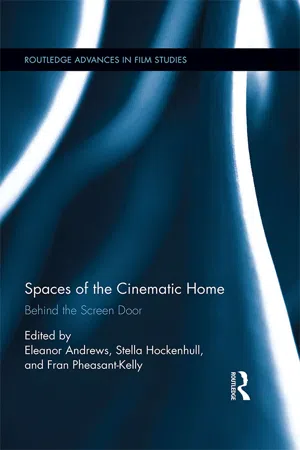
This book examines the ways in which the house appears in films and the modes by which it moves beyond being merely a backdrop for action. Specifically, it explores the ways that domestic spaces carry inherent connotations that filmmakers exploit to enhance meanings and pleasures within film. Rather than simply examining the representation of the house as national symbol, auteur trait, or in terms of genre, contributors study various rooms in the domestic sphere from an assortment of time periods and from a diversity of national cinemas—from interior spaces in ancient Rome to the Chinese kitchen, from the animated house to the metaphor of the armchair in film noir.
eBook - ePub
Spaces of the Cinematic Home
Behind the Screen Door
- 244 pages
- English
- ePUB (mobile friendly)
- Available on iOS & Android
eBook - ePub
Spaces of the Cinematic Home
Behind the Screen Door
About this book
Information
1 Carl's Moving Castle “Animated” Houses and the Renovation of Play in Up (2009)
Christopher Holliday
DOI: 10.4324/9781315762616-2
Long did I build you, oh house!With each memory I carried stonesFrom the bank to your topmost wallAnd I saw your roof mellowed by timeChanging as the seaDancing against a background of cloudsWith which it mingled its smoke(Louis Guillaume, Noir comme la mer, Paris: Librairie Les Lettres, 1949: 14)
Animated abodes are often more than mere homes, and frequently anything but just houses. This essay examines the representation of the home in a variety of cartoons and animated feature films, culminating with an investigation into Up (Docter, 2009), the tenth computer-animated film produced by the Pixar Animation Studio. Beyond its signature image of a floating house affixed to hundreds of helium balloons, Up’s iconic dwelling invites a (re)thinking of the traditions of the animated home according to two interrelated areas. The first is the connection between the house and animation’s established heritage of anthropomorphism, an artistic and interpretive process that refers to the endowment of various creatures or inanimate objects with human ability, proportion, purpose, and volition. Up tacitly reverses many of the founding assumptions of anthropomorphism in studies of animation, privileging the morphē, meaning “shape” or “form” component, rather than the ánthrōpos or “human” element. The home in Up does not “live” as a sentient creature with its windows and doors transforming into recognizable humanoid features. Rather, the film exploits the home’s architectural integrity and stability (that is, preserving its “homeness” or morphē). This formal maintenance is fundamental to the way in which Up floats the house into life (literally) as a tribute to owner Carl Fredericksen’s (Edward Asner) deceased wife Ellie (Elie Docter) as he seeks to relocate their shared home atop the mesas-filled landscape of the fabled Paradise Falls.
The second area of focus pursues how the respect paid to the architectural honesty of Carl’s home corroborates the dwelling’s status as an anti-depressant fantasy for the elderly, recently widowed protagonist. While one line of enquiry might locate American frontier elements in Up’s juxtaposition of the resettled home with impossible and desirable prospects and the fulfilment of an adventure quest, this essay focuses on the construction of the animated home as a means of dealing with loss. Drawing on key research into child behavior and development, I examine how the suburban home is movingly coerced into a childlike object of pleasure by the mournful Carl as a way of coping with his grief. In valuing the home’s architectural logic as a form of reassurance for its owner, Up rejects the Surrealist, mutative qualities that conventionally mark animated abodes, and has Carl’s response to his wife’s death instead subject to Donald Woods Winnicott’s notion of the “manic defence” (1988: 86). Indeed, Carl demonstrates a striking capacity to distract his conscious mind, declining inactivity for a flurry of programmed and purposeful action to prevent (any acceptance of) his own feelings of despair. For Winnicott, this form of “denied depression” that is obfuscated by outwardly restless activity is “associated in our minds with the idea of early childhood.” It is frequently harbored beneath a kind of “acute joy” typically found within children’s exaggerated liveliness (1988: 87). In his own “childlike” phase of repudiated hopelessness, Carl imaginatively remakes the functionality of his own home space, and in doing so actually animates an activity of infant play which child psychologists define as the early “substitution” stage of intellectual object manipulation. This is a developed type of play activity in which certain objects are replaced with others. Involving games of object role reversal and replacement, such acts of pretense generate playful symbolism that stretches the connection between signifier (object) and signified (meaning). While Up repeatedly subscribes to the motto that “adventure is out there” (uttered in the film as the motto of explorer Charles Muntz [Christopher Plummer]), by remaking the home space through acts of pretend play, Carl ultimately revels in the intimate interiority of his adventure, animating the home into life in innovative and compelling ways.
Anthropomorphism and the Animated Abode
Since the earliest animated cartoons, the visual currencies and graphic capabilities of animation as a creative medium have enabled a particularly fluid and flexible treatment of the home. Animators are able to place under strain, and, at any moment, even abolish, the architectural honesty and material substance associated with its structure. The circumstances, viewed as proper to its original design or purpose, provide little resistance to the animator’s inventiveness and imagination, with few limits as to what animated abodes can ultimately become. Fantasmagorie (Cohl, 1908) includes perhaps the first example of this kind of unstable animated house. Émile Cohl’s picaresque adventure comprises a series of rapid mutations and illogical “quick-change” metamorphoses, pinned to a loose narrative involving the tribulations of a stick-figure clown named Fantoche. Among the morphing objects, shifting lines and continuous transitions that occur in Fantasmagorie outside of any regimented spatio-temporal logic, the shape of a house suddenly materializes before the spectator’s eyes. The dwelling emerges from the white outline of an elephant: its ears becoming windows, and the curl of its trunk reconfigured as a door. Fantoche enters the house, only to plunge immediately out of the window, losing his head in the process (though Cohl’s hands soon enter into the film frame to reattach the floating cranium). The house then simply vanishes from view.
With its unremitting modulations and changing swirls of white lines against a stark black background, the transmuting potential and non sequitur logic of Fantasmagorie has been situated by both animation and early cinema scholars within the visual dynamism of the Surrealist movement that held strong artistic sway during the 1920s.1 While Cohl’s ties to the short-lived French intellectuals, “Les Arts Incohérents,” certainly influenced the chaotic activity of his animated line, the artistic attitudes of Fantasmagorie have been enthusiastically positioned within this historical moment as an early precursor to Surrealist representation (Crafton 1990: 258–266). Alison McMahan has drawn comparisons between Cohl’s stylized film and the “grotesque, distorted images” and obsessions with the “random phrase” in Surrealist philosophy (2005: 6), while Esther Leslie identifies how Cohl’s “derangement of narrative” endeared the animator to the “anarcho-surrealist sensibility” of Surrealist filmmaker Jean Vigo (2002: 20). The Surrealist procedure of “automatic writing” (l’écriture automatique), in which subconscious utterances emerge free of any degree of rational control, is also channeled by the aesthetic style of Fantasmagorie (Aspley 2010: 50).2 Parallels to “automatic writing” can be located not just in its immediacy to the skilled craft of animation as performed by artisans (cause), but also through the indeterminate activity and “vector” of the animated line (effect) that, as Sean Cubitt argues, hold license to continually draw and redraw itself in spontaneous motion (2004: 74–75).3
A striking allusion made towards the house within the subsequent Surrealist manifesto serves not only to enforce the connection between Fantasmagorie and a Surrealist sensibility, but also to launch some of the ways the animated house has subsequently been treated within the history of graphical film. Among the declarations of intent stated in the Surrealist policy drawn up by poet André Breton in January 1925, which outlined the fundamental tenets of Surrealism as a pure state of “psychic automatism,” the manifesto announced that Surrealists “make no claim to change the mores of mankind, but we intend to show the fragility of thought, and on what shifting foundations, what caverns we have built our trembling houses” (quoted in Edwards 1999: 211). The playful transmutations and random (re)phrasings centered in the transformative imagery of Fantasmagorie, and the fluid and flexible portrayal of the home, are a lighthearted inscription of the notion of “trembling houses.” For the Surrealists, the home was not a fixed and immovable concrete structure, but could “tremble” with creative instability. The series of startling paintings and sketches produced by French-American artist and sculptor Louise Bourgeois between 1945 and 1947 under the title Femme Maison rewrites the sanctuary of the home as an ensnaring cage. In deploying compositions of the female nude, with a house replacing the abdomen and torso, Femme Maison’s semantic allusion to “house-wife” places domesticity as the overwhelming definition of female form. The reconfiguration of the home also naturally extended to Surrealist architecture. The “strange reversals of public and private space” that Krzysztof Fijalkowski describes as an ideological staple of Surrealist spatiality find a clear analogue within the looped exchange of inside/outside domains in Cohl’s animated film (2005: 13). In Fantasmagorie, there is little distinction made between interior and exterior spaces within the planar surface, and thus no visible clues exist as to the precise cartography of this animated screen world.
Within animation history, the Surrealist qualities of Fantasmagorie can be organized as a blueprint, patterning the representational contours of the animated house. Indeed, Cohl’s film draws up an expressive visual template from which the animated home has seldom deviated. Cohl himself would immediately return to the “trembling” architectural uncertainty of the home in The House Becomes a Chinese (1911), in which a house seamlessly transforms into the visage of a Chinese man (Barba and Savarese 2006: 60). In Little Red Riding Hood (Disney, 1922), an early short that was part of Walt Disney’s Laugh-O-Grams series, the confrontation between the villainous Wolf and heroine Red at Grandma’s house takes place away from the spectators’ gaze. It is the whole house that impossibly stretches, jumping from its foundations and tilting from side-to-side, exuberantly signifying the otherwise unseen conflict occurring inside. When the homes and apartment blocks in Otto Messmer’s Felix the Cat cartoon Woos Whoopee (1928) similarly lurch back and forth, their swaying movement visually connotes the feline’s inebriated state, while simultaneously allegorizing how threatening the modern era has become. In two stop-motion films, Czech surrealist animator Jan Švankmajer’s Jabberwocky (1971) and Street of Crocodiles (1986) by the Quay Brothers, the home-space is enlivened by the disquieting activity of the objects and artifacts that reside there. These sinister playrooms reverberate with activity, their worlds on perpetual assignment as inanimate objects become effortlessly resurrected from stasis into unsettling status. The animated house in its entirety is, of course, free to shed its function and become another thing entirely. The Japanese science-fiction anime series, tondera hausu no daibōken/Time Classroom: Adventures of the Flying House (Higuchi and Fuji, 1982–1983), tells the story of three children, Justin, Angela, and Corkey, who, during a game of hide-and-seek, discover a magical time-traveling house owned by Professor Humphrey Bumble. Feature-length Japanese animations Tenkū no shiro rapyuta/Laputa: Castle in the Sky (Miyazaki, 1986) and Hauru no ugoku shiro/Howl’s Moving Castle (Miyazaki, 2004), produced by Studio Ghibli, are equally invested in the expressive potential of the animated house, while in Who Framed Roger Rabbit (Zemeckis, 1988), Toon Town is a city comprised of singing and dancing apartment blocks that scoff at the arrival of the non-animated, human private detective, Eddie Valiant (Bob Hoskins).
As well as a strong tradition across Gothic literature and horror cinema, the house-come-alive narrative has therefore held a clear purchase within the histories and traditions of the animated cartoon (Bailey 1999).4 What marks a large proportion of the “trembling houses” of animation is their cohesion around dominant personality traits and predictable humanlike behavior. At the root of the animated house and its humanity sits the well-established practice of anthropomorphism, which commonly works to index recognition and identification through a familiar human vocabulary. With etymological origins reaching as far back as sixth-century Greece—combining ἄνθρωπος (ánthrōpos) defined as “human” and μορφή (morphē) meaning “shape” or “form”—the endowment of creatures, inanimate objects, or abstractions with human attributes has, according to Paul Wells, remained the “consistent locus” of animation (1998: 15). Indeed, the “animated” liveliness of the houses in animated film is often (re)conceived and (re)conjured according to an aliveness that emerges from the sudden inscription of a perceivable humanity. In his explanation of Street of Crocodiles (Quay Brothers, 1986), Norman Klein describes the groans emitted from the “limbs of the house [which] suggest a building about to have a heart attack” (2000: 34). The anthropomorphism of animated houses is, on occasion, also placed within a discourse of extreme technological innovation. The Chuck Jones cartoon Dog-Gone Modern (1939), Tex Avery’s The House of Tomorrow (1949), Design for Leaving (McKimson, 1953) starring Daffy Duck and Elmer Fudd, and Mickey’s Mechanical House (Gannaway, 1999) all animate the sentient home through its collection of labor-saving, but ultimately reductive, gadgetry. The erratic behavior of the appliances imposes a particular kind of antagonistic consciousness upon the home, one which conflicts with the progressively exasperated conduct of the user/homeowner.
Adapted from Virginia Lee Burton’s 1942 book, the Disney cartoon The Little House (Jackson, 1952) is altogether more explicit in its depiction of a sentient house, with a clear physiognomy imposed upon the design of the home itself. During the course of the film’s narrative, the female house flutters its eyelashes and inexplicably blushes at the conduct of her new owners (an amorous newlywed couple). But while the house enjoys the playful activity of the couple’s offspring, it ultimately harbors a desire for “other houses to talk to.” Such visions are soon realized with the gradual onset of urban sprawl (described by the film’s narrator Sterling Holloway as the Modernist “age of progress”). Dwarfed by the encroaching development, the idyllic country life of the Little House is submitted to an increasing social alienation. In typical Disney fashion, however, The Little House concludes with cheerful and uplifting scenes of revival. Its dilapidated state now reclaimed through renovation, the house gains new owners and emotional equilibrium is restored. As the narrator puts it, “that’s the things about progress, it always progresses.” A recurring segment on the US animated television program Liquid Television (Beyer, 1989–1991) animates the house in similarly anthropomorphic terms. The anthology created by Mark Beyer titled “The Adventures of Thomas and Nardo” involves the tribulations of Nardo and his anthropomorphic companion, a sentient dwelling that in its design evokes the hybrid form of Bourgeois’ Surrealist sketches. More recent feature-length animated films, including the computer-animated Monster House (Kenan, 2006) and the stop-motion fantasy Coraline (Selick, 2009), articulate more sinister regimes of anthropomorphic characterization. The humanity of the home is explained as a magical embodiment and reincarnation of its villainous owners. The sentient homes therefore function as the narrative’s primary antagonist, and, as nightmarish personifications, they are able to fluidly shift the perceived certainty of their structural design. The twisting contortionism and mutable substance of these animated houses mark a (re)turn to the ideology of Surrealist architecture. Chilean Surrealist Roberto Sebastian Antonio Matta Echaurren notes that “A house must function like a heart, with a systole and a diastole, outside and inside” (in Fijalkowski 2005: 21). While the conscious, “lively” animated houses go some way in fulfilling this Surrealist desire, they also follow the work of those twentieth-century artists who conjure anthropomorphic representations of houses, such as Lawren Harris (in his 1926 painting Red House, Winter) and Charles Burchfield. In his book Contrasts, Harris deploys anthropomorphic similes when describing one particular dilapidated home, writing that “in a part of the city that is ever shrouded in sooty smoke, and amid huge, hard buildings, hides a gloomy house of broken grey rough-cast, like a sickly skin in a callous soul” (in Larisey 1993: 185).
The anthropomorphic houses of animated film uniformly speak to what Béla Balázs identifies as the hard-wired assumption of human consciousness named as an inevitable “anthropomorphous world-vision.” This is the unavoidable psychological state which forces men to “see a human physiognomy in every phenomenon” (Balázs 1970: 92). The often irrational, but nevertheless intuitive, attribution of human behavior and rationale to a variety of social and cultural agents (known in psychology as pareidolia) is especially common in the formative subjectivity of childhood. It explains why young children are frightened by “the grinning...
Table of contents
- Cover Page
- Half Title Page
- Title Page
- Copyright Page
- Contents
- List of Figures
- Acknowledgements
- Introduction
- 1 Carl's Moving Castle “Animated” Houses and the Renovation of Play in Up (2009)
- 2 Peas, Parsnips, and Patriotism Images of the Garden in the Second World War
- 3 “King for a Day” Performance and Expression in the Cinematic Space of the Basement
- 4 Kim in the Sitting Room The Function of Domestic Space in the Construction of Star Image
- 5 At Home with the Caesars The Emperor Tiberius and the Ambiguity of Place in Historical and Epic Films
- 6 The Dining Room Authenticity, Immersion, and Reproduction?
- 7 A Drama of Solitude The Library as Cocoon in Luchino Visconti's Conversation Piece
- 8 Reframing the Material and Imaginative Geographies of the Home Chinese Filmmaker Liu Jiayin's [刘伽茵] Oxhide II [牛皮二] (2009)
- 9 Furnishing the Living Room in Film Noir Disillusion and the Armchair
- 10 Whither Shall I Wander? Up and Down the Staircase in Film
- 11 Intimate Spaces, Extimate Subjects The Bedroom in Horror Films
- 12 A Room Going Spare Lodgers, Nannies, and Strangers in the House
- 13 Monstrous Men and Bathroom Mirrors The Bathroom as Revelatory Space in American Cinema
- 14 Secrets, Memory, and Imagination Psychic Space and the Cinematic Attic
- Bibliography
- List of Contributors
- Index
Trusted by 375,005 students
Access to over 1.5 million titles for a fair monthly price.
Study more efficiently using our study tools.
Frequently asked questions
Yes, you can cancel anytime from the Subscription tab in your account settings on the Perlego website. Your subscription will stay active until the end of your current billing period. Learn how to cancel your subscription
No, books cannot be downloaded as external files, such as PDFs, for use outside of Perlego. However, you can download books within the Perlego app for offline reading on mobile or tablet. Learn how to download books offline
Perlego offers two plans: Essential and Complete
- Essential is ideal for learners and professionals who enjoy exploring a wide range of subjects. Access the Essential Library with 800,000+ trusted titles and best-sellers across business, personal growth, and the humanities. Includes unlimited reading time and Standard Read Aloud voice.
- Complete: Perfect for advanced learners and researchers needing full, unrestricted access. Unlock 1.5M+ books across hundreds of subjects, including academic and specialized titles. The Complete Plan also includes advanced features like Premium Read Aloud and Research Assistant.
We are an online textbook subscription service, where you can get access to an entire online library for less than the price of a single book per month. With over 1.5 million books across 990+ topics, we’ve got you covered! Learn about our mission
Look out for the read-aloud symbol on your next book to see if you can listen to it. The read-aloud tool reads text aloud for you, highlighting the text as it is being read. You can pause it, speed it up and slow it down. Learn more about Read Aloud
Yes! You can use the Perlego app on both iOS and Android devices to read anytime, anywhere — even offline. Perfect for commutes or when you’re on the go.
Please note we cannot support devices running on iOS 13 and Android 7 or earlier. Learn more about using the app
Please note we cannot support devices running on iOS 13 and Android 7 or earlier. Learn more about using the app
Yes, you can access Spaces of the Cinematic Home by Eleanor Andrews, Stella Hockenhull, Fran Pheasant-Kelly, Eleanor Andrews,Stella Hockenhull,Fran Pheasant-Kelly in PDF and/or ePUB format, as well as other popular books in Mezzi di comunicazione e arti performative & Design d'interni. We have over 1.5 million books available in our catalogue for you to explore.