- 176 pages
- English
- ePUB (mobile friendly)
- Available on iOS & Android
eBook - ePub
About this book
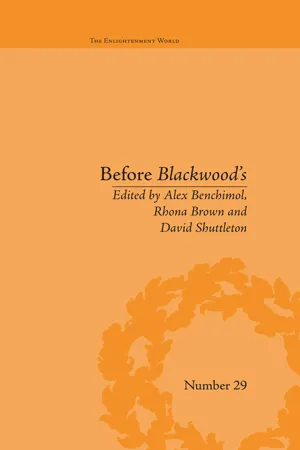
This collection of essays is the result of a major conference focusing specifically on the role of Scotland's print culture in shaping the literature and politics of the long eighteenth century. In contrast to previous studies, this work treats Blackwood's Magazine as the culmination of a long tradition rather than a starting point.
1
Newspapers, the Early Modern Public Sphere and the 1704–5 Worcester Affair
In recent decades, historians have shown great interest in the means by which growing numbers of people were able to engage with politics in the early modern era. Since 1989, many have employed the term ‘public sphere’ to provide an interpretive framework for the examination of this expansion in the public nature of politics. As Brian Cowan has observed, the 1989 translation of Jürgen Habermas’s work on the bürgerliche Öffentlichkeit arrived in the English-speaking historical world at a post-Namierite moment when historians needed a way to integrate old work on elite politics with new work on popular and extra-institutional political activities. With the rapid rise of the ‘public sphere’ as an analytical term, however, came criticism of Habermas’s account of the ‘bourgeois public sphere’ and empiricist fears that pervasive associations of the ‘public sphere’ with rationality, progress and liberal democracy would encourage teleological analysis.1 In what Cowan has called a ‘post-Habermasian’ phase, some scholars have suggested that the ‘public sphere’ be jettisoned in favour of more historicized terminology. Joad Raymond has called for ‘a new model of something like a public sphere, built upon the categories of the actors who participated in it’ and Alasdair Raffe has chosen to write of a ‘culture of controversy’ rather than the public sphere in relation to religious debates in early modern Scotland.2 For some political historians, however, the term remains useful as a shorthand for public modes of interaction between governors and the governed in particular times and places. Thus Peter Lake and Steven Pincus have outlined phases of development in the English early modern public sphere and Bjorn Weiler has used the term to encompass political communications in thirteenth-century England and Germany.3
Concerns over the usefulness of the ‘public sphere’ as an analytical category have particular relevance to the study of early modern Scotland. Though it has become common to investigate the public sphere in early modern England, orthodox associations of the term with modernity have tended to discourage similar investigations in Scotland where modernity has been seen as slow to arrive.4 Some scholars have applied the term in a Habermasian sense to the clubs, periodicals and public lectures of Enlightenment Scotland, while Bob Harris has suggested that rising print and lobbying activity oriented to Westminster transformed the Scottish public sphere in the century after the Union of 1707.5 Yet in the century before the Union, Scotland – like England – experienced increasing political participation at multiple crisis points in conjunction with rising print outputs and other forms of public protest, from organized crowds to mass petitioning. The concept of the ‘public sphere’ can offer a framework for exploring these activities as long as modern or Habermasian contours are not presumed.6 Moreover, parallel studies of the early modern public sphere in Scotland and England can facilitate comparative and British-level analysis in the era of the Stuart composite monarchy.7
The regular publication of domestic newspapers in Scotland from 1699 invites investigation of the impact of this particular development on the Scottish public sphere. Scholars of the public sphere have highlighted the significance of newspapers and periodicals in creating greater public awareness of politics and enabling direct participation in events as they unfolded. Scottish newspapers appeared at a tumultuous moment in Anglo-Scottish relations and this chapter will show how the papers facilitated widespread engagement in what became an acute crisis in the British composite monarchy from late 1704 to the summer of 1705. The crisis centred on accusations of piracy and murder alleged to have been committed by the crew of an English trading ship, the Worcester, against a Scottish ship. By augmenting existing modes of communications, the Edinburgh Gazette and Edinburgh Courant helped to prime an explosive expression of popular discontent by well-informed crowds in April 1705. This can be seen as a significant moment of expansion in the Scottish public sphere facilitated by periodical publications. In this moment, the sentiments expressed by angry crowds were understood by government ministers to reflect national opinion that they could not afford to ignore. This may appear to provide an ideal case study for a Habermasian notion of progressive political engagement facilitated by printed news, but the episode had tragic consequences in the execution of three members of the Worcester crew in the face of countervailing evidence and pleas by the crown for a judicial review. The episode confirms that developments in the public sphere cannot be seen in a teleological sense as inherently progressive and that the study of the public sphere needs to distinguish historical practice and outcomes from modern ideals.
Early in April 1705, three members of the crew of the Worcester, an English ship that had stopped in Leith on its return from a trading voyage to the East Indies, were executed for piracy and robbery on the sands of Leith in the presence of an enormous number of onlookers. Scottish officials had seen evidence which cast doubt on the death sentence imposed on the crew by the Scottish High Court of Admiralty, but public pressure forced them not to delay the scheduled executions. The queen’s chancellor was attacked by a crowd in the streets of Edinburgh on the morning of the executions when a rumour suggested that he might prevent the executions. Why was there such an extreme level of public interest in this case? Over the preceding five months, Scottish newspapers had declared the crew guilty and linked the circumstances of the trial to ongoing constitutional conflict between Scotland and England. Periodical news informed and shaped public opinion, turning many Scots against the Worcester’s crew and stimulating many thousands to come to Edinburgh to witness the executions. This made it impossible for the government to reprieve the crew without risking serious public unrest and an anticipated loss of support in the upcoming parliamentary session of 1705.
In Scotland, as in other early modern societies, political opinions could be expressed by crowds. Mobilized by word of mouth at the local level, purposeful crowds sought to protest against the provocative actions of authorities.8 After 1660, for example, Presbyterian crowds tried to prevent the installation of unwanted clergymen in some parishes, and Episcopalian crowds in turn resisted the placing of Presbyterian clerics after 1690.9 often these actions had the support of local landowners or magistrates, but a network of supporters was needed to generate collective movements stretching beyond one locality. This can be seen in the winter of 1688–9, when members of nonconformist praying societies succeeded in forcing dozens of Episcopalian ministers out of their parishes in response to news of the landing in England of William of Orange on 5 November.10 From 1699, domestic newspapers offered an alternative to interpersonal networks for the provision of political news and the facilitation of protest activity. Newspapers could be efficient carriers of information and opinions within contemporary constraints of censorship, cost and illiteracy. Reaching down the social hierarchy and out to provincial locations, the regular and rapid delivery of printed newspapers allowed recipients to feel that they were participating in national affairs as they happened, rather than hearing about them afterwards.11 This encouraged readers and listeners to form purposeful opinions and to express these in debate or protest. Periodical news helped to mobilize autonomous expressions of public opinion outside of elite organizing networks. In turn, large-scale statements of opinion, through gatherings, uprisings or petitioning, could affect political events by influencing members of parliament, party leaders or government ministers.12
Prior to 1699, censorship exercised by the Privy Council and the burgh councils of Edinburgh, Glasgow and Aberdeen limited the appearance of indigenous newspapers.13 News circulated in Scotland through written newsletters from London and Edinburgh, English newspapers, private correspondence and word of mouth. The occasional printing of news in Edinburgh tended to reflect moments when more news was printed in London. Edinburgh reprints of English newsbooks in 1642 were followed in the 1650s by short-lived publications catering to Cromwellian forces. In the Restoration period, the Mercurius Caledonius appeared in 1661 and the Edinburgh Gazette in 1680. In 1688, the Catholic printer to James VII and II reprinted a handful of London publications but ceased operations after an anti-Catholic crowd attacked his Holyrood press in December. Serial reports of parliamentary affairs began in 1689 with the short-lived Account of the Proceedings of the Meeting of the Estates in Scotland, printed in London. From 1693, Minuts of the Scottish Parliament were published in Edinburgh. London papers circulated regularly in Scotland after the lapsing of the English Licensing Act in 1695. In 1700, for example, the burgh council of Montrose paid an under-clerk of the Edinburgh post office to send them each week copies of the London Gazette, Flying Post and any postscripts with ‘extraordinary occurances’.14
The Montrose council also ordered two copies of the Edinburgh Gazette, which began to be published in March of 1699 when James Donaldson, a former army officer and occasional pamphleteer with connections to the earl of March-mont, secured a license from the Privy Council.15 Under the eye of the council, Donaldson produced a digest of London and continental newspaper reports with Scottish news and advertisements. The content was aimed at a middling to elite readership of merchants, lairds and substantial farmers. The Edinburgh Gazette appeared on Mondays and Thursdays, or later if the London post was delayed. Donaldson’s paper had the endorsement of the Convention of Royal Burghs, whose members welcomed the provision of a relatively cheap digest of news. The Gazette’s price of one Scots penny compared favourably to the cost of London papers, as their penny sterling price translated to one Scots shilling plus postage.16 The scale of the Gazette’s print runs are not known, but the paper was hawked by the Edinburgh caddies, could be found in coffee-houses and taverns and was sent to post towns by subscription.17 It is likely that it was distributed by provincial booksellers and itinerant packmen, like newspapers in the Netherlands.18 By 1699, booksellers were established in most of Scotland’s substantial market towns, including Stirling, Perth, St Andrews, Dundee, Ayr, Haddington, Inverness and Banff.19 Incidental evidence suggests that travellers brought newspapers home from trips to Edinburgh.20
From February 1705, the periodical market became more competitive with the launch of another licensed newspaper, the Edinburgh Courant. Compiled by Adam Boig, the Courant was published on Mondays, Wednesdays and Fridays. Boig sold his paper to the caddies at a discount to the Edinburgh Gazette per quire, which seems to have led them to switch to sole distribution of the Courant.21 Boig also competed on content by including more detailed news on Privy Council affairs and more Scottish news from outside Edinburgh. At the launch of the Courant, Donaldson sought to maintain the loyalty of his readers by reminding them that his Gazette would ‘keep a continued Threed of News … so that by a Colection of the Gazettes, you will have a Compleat History of all the Considerable Transactions of Europe’.22 By May, having lost his caddy distribution, Donaldson began to advertise individual coffee-houses and shops where the Gazette could be purchased. After a strong start, however, the Courant faltered when it lost its licence in late June 1705. The paper had printed a notice protesting against the suppression by the Privy Council of a cheap reprint of a London pamphlet on Anglo-Scottish relations. This affront led the council to shut the paper down. It reappeared with a new printer in October 1705.23 During the Courant’s hiatus, Donaldson announced that disputes with the caddies had been resolved and ‘the Gazettes are now to be sold by the said Paper-Cryers, and by none...
Table of contents
- Cover
- Half Title
- Title
- Copyright
- CONTENTS
- List of Contributors
- Introduction
- 1 Newspapers, the Early Modern Public Sphere and the 1704–5 Worcester Affair
- 2 Advertising and the Edinburgh Evening Courant
- 3 ‘A Very Proper Specimen of Great Improvement’: The Edinburgh Review and the Moderate Literati
- 4 Wilkes and Scottish Liberty: The Reception of John Wilkes in the Weekly Magazine, or Edinburgh Amusement
- 5 The Buzz about the Bee: Policing the Conversation of Culture in the 1790s
- 6 ‘The Pith o’ Sense, and Pride o’ Worth’: Robert Burns and the Glasgow Magazine (1795)
- 7 Edinburgh Periodical Writing and James Hogg’s the Spy
- 8 Medical Discourse and Ideology in the Edinburgh Review: A Chaldean Exemplar
- 9 The Death of Maggie Scott: Blackwood’s, the Scots Magazine and Periodical Eras
- Afterword
- Notes
- Index
Trusted by 375,005 students
Access to over 1.5 million titles for a fair monthly price.
Study more efficiently using our study tools.
Frequently asked questions
Yes, you can cancel anytime from the Subscription tab in your account settings on the Perlego website. Your subscription will stay active until the end of your current billing period. Learn how to cancel your subscription
No, books cannot be downloaded as external files, such as PDFs, for use outside of Perlego. However, you can download books within the Perlego app for offline reading on mobile or tablet. Learn how to download books offline
Perlego offers two plans: Essential and Complete
- Essential is ideal for learners and professionals who enjoy exploring a wide range of subjects. Access the Essential Library with 800,000+ trusted titles and best-sellers across business, personal growth, and the humanities. Includes unlimited reading time and Standard Read Aloud voice.
- Complete: Perfect for advanced learners and researchers needing full, unrestricted access. Unlock 1.5M+ books across hundreds of subjects, including academic and specialized titles. The Complete Plan also includes advanced features like Premium Read Aloud and Research Assistant.
We are an online textbook subscription service, where you can get access to an entire online library for less than the price of a single book per month. With over 1.5 million books across 990+ topics, we’ve got you covered! Learn about our mission
Look out for the read-aloud symbol on your next book to see if you can listen to it. The read-aloud tool reads text aloud for you, highlighting the text as it is being read. You can pause it, speed it up and slow it down. Learn more about Read Aloud
Yes! You can use the Perlego app on both iOS and Android devices to read anytime, anywhere — even offline. Perfect for commutes or when you’re on the go.
Please note we cannot support devices running on iOS 13 and Android 7 or earlier. Learn more about using the app
Please note we cannot support devices running on iOS 13 and Android 7 or earlier. Learn more about using the app
Yes, you can access Before Blackwood's by Alex Benchimol in PDF and/or ePUB format, as well as other popular books in History & World History. We have over 1.5 million books available in our catalogue for you to explore.