- 240 pages
- English
- ePUB (mobile friendly)
- Available on iOS & Android
eBook - ePub
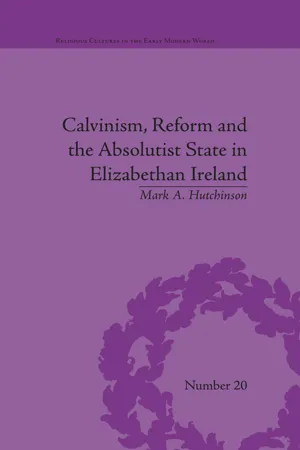
Calvinism, Reform and the Absolutist State in Elizabethan Ireland
About this book
Despite the best efforts of the English government, Elizabethan Ireland remained resolutely Catholic. Hutchinson examines this 'failure' of the Protestant Reformation. He argues that the emerging political concept of the absolutist state forms a crucial link between English policy in Ireland and the aims of the Calvinist reformers.
1
Building a Godly Polity in Ireland
The tone of early policy discussion in Ireland tended to suggest that the norms of civil society were so evidently true, that in the face of such civility the shackles of Irish barbarism would simply fall away. Various political treatises written in the 1520s and ’30s emphasized how the introduction of settled arable farming, primogeniture, English medieval religious practice, and the due process of law would naturally alter the behaviour of Ireland’s disobedient lords and allow government to establish friendly and stable political relationships within the polity or kingdom.1 Brendan Bradshaw, in the Irish Constitutional Revolution, saw this renewed vigour as coinciding with the introduction or use of the term ‘commonwealth’. This invoked the category of the moral good, which in turn required government to look to the reform of the whole island, to analysis the ‘inadequacies of the system of political organization’ and to seek to alter such circumstances.2 What happened, however, when these self-evident truths failed to materialize?
It is the failure to further societal reform in Ireland, whereby current political conditions remained unaltered, that the first two chapters of this book take as their point of departure. What these chapters ask is how a group of reformed protestants involved in Irish government, from the mid-1560s onwards, understood the widespread civil disorder they confronted and what this might tell us about a wider reformed protestant or Calvinist re-conception of notions of civil obedience, the common good and political relationships within a polity or kingdom. How did Calvinists respond when their theology suggested that man’s ability to act well was dependent on grace, when grace was thought to act separately on each individual? Gone was the assumption that redemption depended on participation in the rituals of the medieval church, where the simple fact of the community’s involvement in the life of the church meant no awkward questions needed to be asked concerning the presence of grace in political life.3 How did Ireland’s political condition, where the question of the island’s reform to a long-term civil obedience dominated discussion, affect how reformed protestants read and applied their theology?
In exploring these questions, this chapter begins by assessing the optimism of commonwealth thought and the challenges posed by an Irish context. It examines how notions of civil obedience, as found in protestant resistance theory of the period, informed Irish policy. ‘True obedience’ was equated with good conscience, which in turn was argued to be dependent on the action of God’s grace. Here Ireland inverts the paradigm for resistance, because those Calvinists involved in government did not ask when they might justifiably disobey an ungodly ruler, but how they might bring a kingdom to obey a godly prince. The rest of the chapter addresses initial attempts to implement such a model, where emphasis was placed on the need to disseminate God’s word. It was as a consequence of a continued failure to make any marked progress that an underlying definition of godly civil obedience was outlined in open political debate.
Commonwealth Thought
If Ireland was to expose a godly view of political life to scrutiny, an earlier ‘commonwealth’ position had already been tested. In Bradshaw’s Constitutional Revolution, it was the combination of English Christian humanism of the 1520s and ’30s, with its Irish counterpart, that drove an attempt to restructure Henry VIII’s lordship of Ireland. A central plank of this policy was the 1541 act of kingly title and the now ubiquitous policy of surrender and regrant, which had its basis in a renewed interest in statute law and government’s ability to tackle social and political ills through prescribed solutions. Here Bradshaw moved beyond the commonplace observation that the act of kingly title simply tackled an awkward point arising from Henry’s break with Rome.4 Instead, it was argued that the act was meant to do far more, because it provided the constitutional mechanism by which Irish lords could become subjects of the crown in Ireland.5
The act of kingly title established the basis upon which those lords who held land with no legal right under English law could surrender their estates and retake them from the prince. This was meant to establish the basis upon which civil society, ‘the good life’, could be furthered in the Irish kingdom. The analysis as applied consisted of two components. The first part was structural, where Brehon law (that used amongst the Gaelic Irish) was seen as fostering retributive justice, where it was material loss as opposed to the morality of the act that underlay decisions, whilst customary Gaelic exactions encouraged the maintenance of private armies and exploitation. Secondly, such structural analysis lay on top of an optimistic assessment of the nature of man, who, made in the image of God, it was suggested, would naturally act for the common and greater good if given the opportunity.6 Thus changing the structure of society would naturally draw out man’s good character, where a more equitable justice would encourage honesty and reasoned discussion, negotium, which would become the basis for political relationships. This was very much in line with the optimism of the Northern European Renaissance, where man was assumed capable of self-fashioning.7
From this perspective, as with much Irish historical scholarship, events in Ireland remain conditioned by a larger English or European narrative. The Irish Constitutional Revolution drew directly upon Geoffrey Elton’s Reform and Renewal which had identified a concurrent statute based movement for reform in England. For Elton ‘Tudor writers were troubled by the state of the world, by its lack of honest spirituality and by social differences, and they brought [to bear] … some … basic ideas concerning the political perfectibility of man’s condition and a naively sanguine trust in the power of edicts to better man’.8 There is, however, a different way in which Bradshaw’s account might be read. Irish government attempted to establish a kingdom for the first time through a series of mechanisms as set out in statute. In particular, through the act of kingly title and other bills, government sought to establish the basis for civil and functional political relationships through force of statute alone. In this respect, there was an immediate potential for events in Ireland to shape a wider English conception of civil society, because the ability of statute or prescribed solutions to bring about change came to be tested in an extreme environment; so too were the wider assumptions about man and civilized society.
By the late 1560s a definition of civil obedience had emerged, where in specifically political or civil terms it was assumed that government could only hope to hold the Irish kingdom in a basic level of external obedience, which relied on the threat of force or ‘the sword’. In 1572 Lord Deputy William Fitzwilliam commented that he feared ‘the state of the country will grow rather to the continuance of 15,000 or 16,000 men’, in responding to Elizabeth’s decision to significantly shrink the size of the army.9 In reference to the province of Connacht, where widespread rebellion was once again a concern, it was argued that ‘without force continually … [the Irish] will never leave … sensual barbarism to the knowledge of any civility and obedience to law’.10 The charms of an English model of society were not so evidently true to the extent that man, corrupt by nature, would accept reform without the presence of punitive measures. Unless the queen would ‘resolve … [to] lay by her weeding hook and put in her sickle’ no real change would be brought about.11
Here the way in which Irish civil structures came to function was very much the opposite of the original intent of commonwealth thought. The Gaelic Irish and many Old English lords came to be shut out of the political sphere and the pursuit of ‘the good life’, either because it was believed they would not act for the common good, or because of the open manipulation of civil structures by the English colonizer. However, I think we need to recognize that in Ireland, it is not simply the case that Elizabeth’s Irish subjects were judged difficult to reform. Instead, it was the wider humanist episteme, with its optimistic assessment concerning man’s capabilities and the civilizing process, which came to be challenged.12
The eschewing of the idea of an interlinked polity is reflected in the proliferation of martial law commissions, through the 1570s and ’80s, which David Edwards identifies.13 This entailed the rejection of English customary law, where the community, through trial by jury, should have been involved in determining the guilt of a member of that community. The role of county seneschals and provincial presidents altered quite significantly. The seneschal and provincial president should have fostered the civil and legal norms of English society. Instead, they increasingly used their executive authority to enforce martial law, where fear and force remained the operative mode.14
A similar departure from, or disintegration in, commonwealth values is also evident in the way in which surrender and regrant arrangements operated from the late 1550s onwards. As Christopher Maginn recently identified, a staged shift in the use of surrender and regrant can be traced. The remit of the initial policy, which was to introduce English political norms by utilizing the relationship between a lord as loyal servitor and the prince was slowly forgotten. Instead, after an initial optimistic turn, surrender and regrant was deployed in many instances as a means of formalizing aspects of the existing political status quo.15 This is effectively the argument of Lord Deputy Henry Sidney’s memoir of service, which was written in 1583 and gave an account of both his periods in office in the 1560s and 70s.
Acting in the midst of the first Desmond rebellion of 1568–9, for Sidney what mattered was the construction of an alternative body of crown supports who would act against oppositional forces. Thus the indentures drawn up between these lords and the prince (or deputy) paid less attention to the deconstruction of the various conditions usually perceived as limiting or preventing a more civil culture. The construction of political alliances was all that really mattered at this point.16
Nevertheless, government did wish to curtail bastard feudal practices, where another key motif of policy discussion was the need to end the use of coyne and livery as practised by the great noble houses and factional groups in Ireland. The great factional networks were usually identified as the Fitzgeralds or Geraldines (headed by the earls of Kildare and Desmond) and the Butlers (headed by the earl of Ormond). The basic analysis was that major lords collected their rents in kind (namely in meat and drink). This encouraged the maintenance of a large military retinue and so furthered endemic violence. However, by encouraging lords to collect fixed rents, it was suggested that the need to maintain large military forces would end, whilst the financial benefits, which would arise when lords no longer maintained large military forces, might convince Ireland’s lords of the benefits of a more settled arable lifestyle.17
There is some ambiguity in such a position, where a sense of the self-evident quality of English civility does re-emerge. I would argue, however, that such a policy came to be thought of as operating upon the basis of self-interest as opposed to the notions of honesty, duty and fidelity. In effect, the critical factor remained the need to maintain a basic civil obedience, which would become easier if a lord’s military forces had been removed; whilst the analysis relied on the lord agreeing to an alteration in current conditions because he would understand that he could not compete with crown forces. The lord would also realize he would be materially better off if he did not have to maintain a private army.18
A still better comparison might be the shift in how colonial projects were thought to operate. Taking Thomas More’s Utopia as our starting point, a notion of a hoped-for unitary commonwealth provides More with the moral justification for colonial projects, because the extension of the civil and rational processes of government to colonies is seen as drawing out the better qualities of man. Access to an edifying, as opposed to a coercive, justice would be provided.19 But in an Irish context there quickly emerged a series of stark departures from such an ideal. As the work of Nicholas Canny suggests, there is an immediate tension between such an altruistic ideal and the self-interest of the colonizer seeking to dispossess the native of land.20
The initial plan for a colony in the mid-lands in Ireland quickly fell short of the commonwealth model. In 1556, plans for plantation in Laois and Offaly had assumed that pockets of English civility would encourage the O’Connors and O’Mores to adopt a settled, arable and English manner of life. Like their English colonial counterparts, they should be ‘freeholders’ and they should ‘answer the laws of the realm as the English’. In 1560, however, after the O’Connors and O’Mores had gone into rebellion, force of arms and not exemplary civility became the critical qualification for a planter, who needed to ‘bring over force to defend that allowed’.21
A more important example is Sir Thomas Smith’s own description of his proposed colonial project in Ulster in 1572, which involved the colonization of the Ards in Ulster. His promotional pamphlet A Letter Sent by I. B. Gentleman unto his Very Friend Master R. C. Esquire (1572) emphasizes the benefits of shire government, whereby access to English justice, and a settled arable life style, would draw man into civil conversation by eschewing a factional and militarized society based upon self-interest (and often violent) behaviour. Smith’s proposal drew on an awareness of ancient Rome, and Smith’s own classic view of the Elizabethan mixed polity as set out in De Republica Anglorum (1583). De Republica was originally written in 1565 and detailed the functionality of the Elizabethan polity, where the role played by the nobility, gentry and yeoman was extolled.22 In Smith’s promotional pamphlet, as Hiram Morgan has noted, explicit reference is made to More’s earlier work. Smith asks, ‘How say you now, have I not set forth to you another Utopia’? In particular, Smith argues that the younger sons of the gentry, due to overpopulation in England, should form the backbone of his scheme thus echoing More.23
Nevertheless, within the pamphlet a sense of punitive justice remains dominant, where the degeneracy of the original English colony in Ireland arises out of a latent self-interest, where English subjects ‘perceiving their immunit...
Table of contents
- Cover
- Half Title
- Title
- Copyright
- CONTENTS
- Dedication
- Acknowledgements
- List of Figures
- Note on the Text
- Introduction
- 1 Building a Godly Polity in Ireland
- 2 The Failure of Reformed Protestant Plans
- 3 Irish Constitutional Peculiarity
- 4 The End of an Irish Mixed Polity
- 5 Ireland’s Lordships and an Absolutist State
- 6 An Irish State Theory
- Epilogue: Beyond the 1590s
- Works Cited
- Notes
- Index
Trusted by 375,005 students
Access to over 1.5 million titles for a fair monthly price.
Study more efficiently using our study tools.
Frequently asked questions
Yes, you can cancel anytime from the Subscription tab in your account settings on the Perlego website. Your subscription will stay active until the end of your current billing period. Learn how to cancel your subscription
No, books cannot be downloaded as external files, such as PDFs, for use outside of Perlego. However, you can download books within the Perlego app for offline reading on mobile or tablet. Learn how to download books offline
Perlego offers two plans: Essential and Complete
- Essential is ideal for learners and professionals who enjoy exploring a wide range of subjects. Access the Essential Library with 800,000+ trusted titles and best-sellers across business, personal growth, and the humanities. Includes unlimited reading time and Standard Read Aloud voice.
- Complete: Perfect for advanced learners and researchers needing full, unrestricted access. Unlock 1.5M+ books across hundreds of subjects, including academic and specialized titles. The Complete Plan also includes advanced features like Premium Read Aloud and Research Assistant.
We are an online textbook subscription service, where you can get access to an entire online library for less than the price of a single book per month. With over 1.5 million books across 990+ topics, we’ve got you covered! Learn about our mission
Look out for the read-aloud symbol on your next book to see if you can listen to it. The read-aloud tool reads text aloud for you, highlighting the text as it is being read. You can pause it, speed it up and slow it down. Learn more about Read Aloud
Yes! You can use the Perlego app on both iOS and Android devices to read anytime, anywhere — even offline. Perfect for commutes or when you’re on the go.
Please note we cannot support devices running on iOS 13 and Android 7 or earlier. Learn more about using the app
Please note we cannot support devices running on iOS 13 and Android 7 or earlier. Learn more about using the app
Yes, you can access Calvinism, Reform and the Absolutist State in Elizabethan Ireland by Mark A Hutchinson in PDF and/or ePUB format, as well as other popular books in History & Early Modern History. We have over 1.5 million books available in our catalogue for you to explore.