- 224 pages
- English
- ePUB (mobile friendly)
- Available on iOS & Android
eBook - ePub
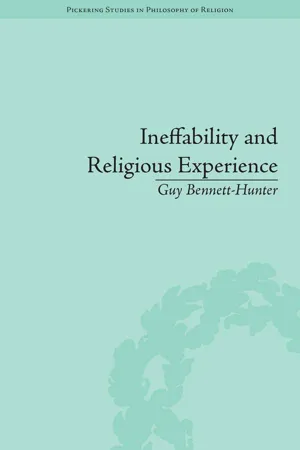
Ineffability and Religious Experience
About this book
Ineffability – that which cannot be explained in words – lies at the heart of the Christian mystical tradition. This is the first book to engage with the concept of ineffability within contemporary philosophy of religion and provides a starting point for further scholarly debate.
Information
1 INEFFABILITY AND RELIGION
The central concept to be addressed in this book is that of ‘ineffability’. The specific way in which I understand the term will, I hope, become clear in the next chapter but, by way of initial orientation, it seems appropriate to make some initial remarks. By the term ‘ineffable’, I mean to refer not just to the concept of that which is inexpressible or in practice unknown but to the notion of what is in principle resistant to conceptual grasp and (therefore) literal linguistic articulation. ‘Ineffability’, in my sense, should therefore be taken also to include a non-disparaging sense of ‘mystery’. It may seem obvious that this concept has long been at work in Christianity, indeed this fact is part of what motivates me to write a book about it. But I first want to distinguish between two lines of religious thought, both of which look, at first glance, like promising sources for the notion of ineffability in Christianity. I label these the ‘theological conception’ of ‘mystery’ and the ‘apophatic premise’. The initial interest in the theological conception is provoked by its attempt to explore the connection between mystery and religious practice (especially ritual), which is one of my eventual aims. Although the mystical writing produced by those committed to the apophatic premise has inspired most of the (very little) existing philosophical treatment of the notion of ineffability in the period of interest, both lines of thought have received twentieth-century and contemporary philosophical defence. The main aim of this first chapter is therefore to review, and critically to engage with, representative examples of that philosophical treatment.
The Theological Conception of Mystery
There is a line of thought, originating in early twentieth-century theology, whose focus is on ‘mystery’. Albert Plé, for instance, starts from the conception of mystery as it is found in New Testament, especially Pauline, texts. He defines it, curiously, as something revealed in Christ and in the teaching of the Apostles, as something manifest and spoken of, though perhaps previously hidden.1 He locates one major piece of biblical evidence for this definition at Colossians 1:25–7 but thoroughly supports each part of it with further biblical evidence.2 In this conception of mystery there is a Christological focus, since Christ is thought of as the medium for the hidden, invisible, inaccessible God and is believed to manifest God in his own physical and sensible being.3 But Christ, as much now as he was for Paul, is inaccessible to the senses because he is believed to be ‘at the right hand of God’.4 Thus, until the parousia, the Church (as Christ’s mystical body) and its Eucharistic liturgy constitute ‘for us’ the necessary media of faith.5 In this same volume, under Plé’s editorship, Louis Bouyer contrasts the notion of ‘mysterion’ as it is understood in Greek paganism (where mysteries were secret rites, rather than doctrines, and which were revealed only to initiates)6 with the Pauline usage, which he thinks the first in Christian literature, where it refers to God’s plan of salvation to be fully revealed at the end of time, already revealed in Christ, especially in his parables and in the events of his life.7 It is on the basis of this contrast, Bouyer thinks, that the difference between pagan secrecy in connection with ‘mysterion’ and, to take one example, St Ignatius of Alexandria’s description of ‘mysteries to be cried aloud’ can best be understood.8 Following on where Plé’s essay left off, Bouyer takes up the line of thought reflected in the translation from the Greek ‘mysterion’ to the Latin ‘sacramentum’,9 where the notion of mystery takes on a liturgical significance as many writers, especially in the Constantinian era, apply terms that were applied to the pagan rites to the Christian liturgy and to the actions, objects and rites associated with it.10 These new allusions, Bouyer claims, were added to the Pauline sense of ‘mystery’ without suppressing it and it was in this context that the word ‘mystery’ and its cognates came to be applied to the Christian sacraments in general and to the Eucharist in particular.11
Whatever we may make of the historical arguments made by Plé and Bouyer, arguments of this kind certainly lie behind and inform the not uncontroversially influential12 work of Odo Casel.13 Casel states his point of departure in his initial answer to his own central question, ‘What is the essence of the mystery?’, namely, revelation whose primary source he believes is holy scripture.14 With Plé and Bouyer, Casel suggests that, although the Church rejected the ancient mystery religions, it has always used their language in relation to its own liturgy and to clarify the meaning of its rituals.15 He accepts St Paul’s identification of the religious mystery with the reality of Christ and his life and defines ‘the mystery of worship’ as the presentation and renewal of that first mystery (‘the mystery of Christ’) by means of which access to it and participation in it are possible.16 Casel’s view that ‘mystery’ and ‘liturgy’ mean the same thing considered from two viewpoints is summarized as follows:
Mystery means the heart of the action, that is to say, the redeeming work of the risen Lord, through the sacred actions he has appointed: liturgy, corresponding to its original sense of ‘people’s work’ … means rather the action of the Church in conjunction with this saving action of Christ’s.17
George Guiver provides an interesting gloss on Casel’s interpretation of the New Testament’s sense of ‘mystery’ operative in the work of Plé and Bouyer:
(a) it is the divine presence, (b) it is Christ, (c) Christ is God’s hidden plan for his creation, (d) now no longer hidden but made manifest in the saving events, (e) this manifesting of the Mystery at the time of those events now lives on in the sacramental life of Christ’s body the Church.18
Aside from his annoyance at Casel’s error of translation,19 Gordon-Taylor’s reason for paying relatively little attention to his work is its neglect of the apophatic dimension which, Gordon-Taylor feels, cannot but be acknowledged in any decent discussion of divine activity.20 He observes that Casel does not anywhere in his work deal with the apophatic implications of the concept of mystery and their bearing on a theology of divine presence in the liturgy. On the contrary, Casel seems to assume Christ’s objective presence in the Eucharist.21 The fact that, in the secondary literature, Casel’s ‘mystery’ (which appears to be, if not the apotheosis of the theological conception, then at least its most influential statement) is taken to refer to no fewer than two distinct realities cursorily indicates a substantial distance between this theological conception of mystery and my notion of ineffability.
This is not the only reason that I do not take my cue, in this book, from the theological conception. To my mind, even given their not unproblematic dependence on scriptural authority, there is something odd about the arguments provided by Plé, Bouyer and Casel in support of the theological conception. That is that similar biblical texts and in some cases the very same texts, here used to support the idea, were used a little less than three centuries earlier to support arguments against the idea of a Christian mystery. In his famous Christianity Not Mysterious,22 John Toland covers some of the same Pauline ground as Plé, notably the basis of Plé’s definition at Colossians 1:25–7, and many similar New Testament texts.23 Toland’s interpretation of the relevant kind of biblical passage displays a deep affinity with that of Plé: ‘the Mysteries of the Gospel were certain things in their own Nature intelligible enough, but call’d Mysteries by reason of the Vail under which they were formerly hid’.24
However, there follows for Toland a very different ‘promis’d Conclusion’; rhetorically, and with biting sarcasm, he asks:
Now in what Sense could this Mystery be said to be reveal’d, this Secret to be made manifest, to be made known to all Nations by the Preaching of the Apostles, if it remain’d still incomprehensible? A mighty Favour indeed! to bless the world with a parcel of unintelligible Notions or Expressions, when it was already overstock’d.25
Thus it appears that the difference between Toland and Casel is over the meaning of words, or rather the key word ‘mystery’. Whereas, for Plé, the religious mystery is defined as something revealed, Toland does not appear to see how it could possibly be both revealed and a mystery. That such a major disagreement is possible suggests that, in each case, different concepts lie behind the same word. The way in which I understand the term (in sympathy with Toland) leads me to the conclusion that what Casel calls ‘mystery’ is not the same concept as that which I denote with the term ‘ineffability’ and which is of interest to me here. It is not necessarily that the arguments for the theological conception fail but rather that they defend a different concept to that of ineffability. My preference, in this book, for using of the word ‘ineffability’ and its cognates, rather than, say, ‘mystery’ owes partly to my wish to distinguish my own arguments from those in support of, and otherwise connected with, the theological conception. The word is also adopted partly for strategic reasons since, frustratingly, in common parlance the word ‘mystery’ is often taken to mean something opaque, like the dénouement of a detective story, unknown merely in practice. The argument I advance turns on the understanding of ‘mystery’ as what is in principle unknowable — I therefore generally avoid the term.26 So my main reason for going no further with the theological conception is that its articulation does not involve the concept that is of interest to me. There is, however, some more recent philosophical work that articulates the logic of this conception and attempts to defend it.
In a recent paper, Steven D. Boyer attempts to provide a logical analysis of the senses of mystery.27 He draws a distinction between the above New Testament sense of mystery, which he labels a ‘revelational’ mystery, and mysteries of what he calls the ‘investigative’ kind. Whereas the former, revelational kind of mystery, likely inherited from the ancient Greek mystery religions, somehow remains mysterious in its revelation, the latter, investigative kind is like those found in detective fiction, where investigation and revelation dispel the mystery.28 He articulates the logic of the New Testament’s ‘revelational’, theological conception of mystery, in contrast to this, as follows:
It remains incomprehensible even to those who know it.29This kind of mystery involves real knowledge, and yet a knowledge that is always reflexively aware of its own incompleteness or inadequacy. The reality known is always known as enigmatically larger or deeper than our knowledge of it. In other words, revelational mystery is revealed precisely as mystery. The defining feature of mystery in this sense is that its mysterious character is not undercut by being made known.30
The defence of the revelational kind of mystery (the explanation of ‘why a revelational mystery is a mystery … [i]f it has been revealed or made known, then how can it continue to “defy reason”, in some sense?’) which Boyer appears to think the most promising proceeds with the aid of a mathematical analogy. The precise extent to which this analogy is inspired by Edwin A. Abbott’s famous novel, Flatland,31 is unclear, though Boyer does refer to it and admits, in a footnote, that he cannot help being reminded of it in the context of the present argument.32 He asks us to consider a circle, an example of a two-dimensional shape, and the way in which geometry allows us to reason about it.33 If the figure were in fact a three-dimensional cylinder being investigated by a mathematician limited to two dimensions, the mathematician could reason geometrically and thus know everything that is two-dimensional about the cylinder. She would reach the same conclusions about the circular end of the cylinder, and with the same accuracy, as in the case of the two-dimensional circle. But, for this mathematician, there is always more of the cylinder to be discovered: a ‘more’ which transcends what geometry can understand and describe of the figure but which does not cease to be geometrical in character.34 Such a mystery transcends the normal workings of human reason ‘dimensionally’: even when the object is known (as a two-dime...
Table of contents
- Cover Page
- Half Title page
- Series Page
- Title Page
- Copyright Page
- Contents
- Acknowledgements
- Introduction: Philosophy of Religion in the New Style
- 1 Ineffability and Religion
- 2 Philosophical Defence of the Concept of Ineffability
- 3 Two Attempts at Theological Appropriation
- 4 Karl Jaspers's Philosophical Position
- 5 The Nature of Philosophical Evocation of the Ineffable
- 6 The Aesthetic and Ritual Embodiment of the Ineffable
- Notes
- Works Cited
- Index
Trusted by 375,005 students
Access to over 1.5 million titles for a fair monthly price.
Study more efficiently using our study tools.
Frequently asked questions
Yes, you can cancel anytime from the Subscription tab in your account settings on the Perlego website. Your subscription will stay active until the end of your current billing period. Learn how to cancel your subscription
No, books cannot be downloaded as external files, such as PDFs, for use outside of Perlego. However, you can download books within the Perlego app for offline reading on mobile or tablet. Learn how to download books offline
Perlego offers two plans: Essential and Complete
- Essential is ideal for learners and professionals who enjoy exploring a wide range of subjects. Access the Essential Library with 800,000+ trusted titles and best-sellers across business, personal growth, and the humanities. Includes unlimited reading time and Standard Read Aloud voice.
- Complete: Perfect for advanced learners and researchers needing full, unrestricted access. Unlock 1.5M+ books across hundreds of subjects, including academic and specialized titles. The Complete Plan also includes advanced features like Premium Read Aloud and Research Assistant.
We are an online textbook subscription service, where you can get access to an entire online library for less than the price of a single book per month. With over 1.5 million books across 990+ topics, we’ve got you covered! Learn about our mission
Look out for the read-aloud symbol on your next book to see if you can listen to it. The read-aloud tool reads text aloud for you, highlighting the text as it is being read. You can pause it, speed it up and slow it down. Learn more about Read Aloud
Yes! You can use the Perlego app on both iOS and Android devices to read anytime, anywhere — even offline. Perfect for commutes or when you’re on the go.
Please note we cannot support devices running on iOS 13 and Android 7 or earlier. Learn more about using the app
Please note we cannot support devices running on iOS 13 and Android 7 or earlier. Learn more about using the app
Yes, you can access Ineffability and Religious Experience by Guy Bennett-Hunter in PDF and/or ePUB format, as well as other popular books in Philosophy & Philosophy History & Theory. We have over 1.5 million books available in our catalogue for you to explore.