eBook - ePub
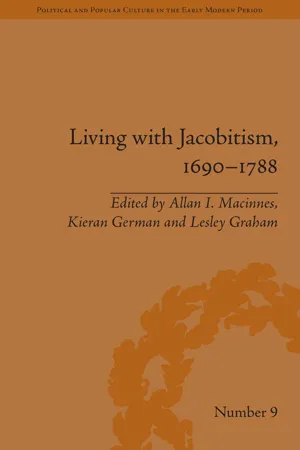
Living with Jacobitism, 1690�1788
The Three Kingdoms and Beyond
- 288 pages
- English
- ePUB (mobile friendly)
- Available on iOS & Android
eBook - ePub
Living with Jacobitism, 1690�1788
The Three Kingdoms and Beyond
About this book
For over seventy years after the 'Glorious Revolution' of 1688–90, Jacobitism survived in the face of Whig propaganda. These essays seek to challenge current views of Jacobite historiography. They focus on migrant communities, networking, smuggling, shipping, religious and intellectual support mechanisms, art, architecture and identity.
1 THE FIRST JACOBITE AND THE SCOTTISH PARLIAMENT
Alastair J. Mann
James II and VII is one of those historical figures who has a contested reputation, one that brings forth exaggeration and polarization. For contemporaries this is seen in contrasting reflections on the political aptitude of the last monarch of the British Isles to be removed by revolution. James was, according to the Benedictine Joseph Johnston, ‘the Greatest Politician … mighty, carfull and laborious in all his affaires’ – ‘never was there such a prince in England these hundred years to be compared to him’.1 Meanwhile in ‘The Snare’, an anonymous rhymed verse from the late 1680s that emphasizes political weakness, James and the ghost of his elder brother are imagined to be in conversation, when Charles warns:
Brother, when I your name and place did bear
I sought the peoples love before their fear
And by that means both fear and love I gott
From the rich ermin to the ruffel coat
And now you find what I have oft declar’d
The vulgar must be loved or they’ll be feared
They’ll suffer long and much, but once enraged
Devouring flames more easy are asuag’d
…
I know it suits not with your haughty mind
To stoop to any thing of humane kind
But patience upon force has oft been known
To be endured, tho coveted by none
You see, while others run you prepare
Your self in headlong fall into the snare2
In historiography the passage to that snare has had many strands or narratives. The four most important of these are the assessments of James as soldier, tolerant Christian, constitutional innovator and, in traditional and Whig-inspired simplicity, success or failure. Indeed, in spite of some concerted efforts by Anglo-Scottish ‘Jacobite’ apologists, from Scottish contemporaries like Colin Lindsay, third Earl of Balcarres to the English priest and historian John Lingard in the nineteenth century, there is a considerable consensus that James was a weak and unsuccessful political strategist.3 More recent historiography has continued the success versus failure dialectic, drawing broadly negative conclusions after deploying apparently overwhelming supporting evidence.4
Another controversy concerns whether or not James really sought to further religious toleration or whether this was but a front for his pro-Catholic agenda. Kirsty McAlister sums up the views of the majority – from 1685 James ‘obstinately pressed for toleration for his fellow Roman Catholics’, making it his central and defining policy objective. Recent re-evaluations of James and the Revolution of 1688, in a Scottish context, have certainly led to the unearthing of more evidence of his manipulation of Scottish local and central government from 1686, but to a relatively limited degree.5 Moreover, the toleration camp has strong support, encouraged by a revisionist approach expressed since the late 1970s, which argues that administrative incompetence and misunderstanding should replace some of James’s claimed political aggression used in pursuit of catholicizing and arbitrary power. Blame is attached to his ministers, such as James’s Scottish secretary John Drummond, Earl of Melfort, rather than the policies themselves. As Miller describes it, James wished only for Catholics ‘to worship freely and to hold public office’, not to force, unrealistically, minority Catholicism on the majority Protestantism of Scotland and England. And so the Presbyterian and Anglican reaction was in some respects disproportionate. In addition, Edward Corp’s work on the years of exile makes a strong case for James as a misunderstood liberal, who genuinely believed in toleration. In the 1690s, in and around his court at St-Germain-en-Laye near Paris, he did what he could to support Jacobite Protestants, in spite of the disapproval of Louis XIV and the court at Versailles.6 The career in exile of Charles, Earl of Middleton, James’s Protestant secretary of state from 1693, suggests the master did what he could to accommodate Protestant servants within his inner circle.7
While in Scottish terms James’s association of Presbyterianism with republicanism, in which he cast his mind back to the events of the 1640s and 1650s, made him no more than a qualified tolerationist, Steve Pincus’s history of the Revolution recreates the stark picture of James as an intolerant papist with a plan. James attempted to build the monarchy in the image of Louis XIV, with a religious settlement like France’s, not wedded to Rome but to independent Catholicism. He propelled a policy of ‘Catholic modernity’, looking to undermine traditional religious and secular structures and to introduce French-like bureaucratic institutions and crown authority. In other words, it seems, James was a revolutionary rather than a conservative looking back to medieval Catholicism. Jacqueline Rose’s emphasis, however, on the conservative and traditional Tudor/Stuart foundations of James’s policies makes the case for continuity – kings holding sway over parliaments but also over churches being the familiar ground trod by James I and VI. It harks back in Catholic terms to James V of Scotland and Mary I of England, and even to her father Henry VIII. Thus the clash between these philosophical beliefs, as rendered in the mind of a Catholic king, and the Anglo-Scottish political communities with their ‘reflexive distrust of popery’, doomed James’s religious policies. It seems therefore that it was the very idea of a general toleration, more than the means of asserting royal power, which was revolutionary.8 Moreover, the reluctance of historians to see James’s attitude to toleration as fluctuating has not fostered clarity. For Scotland and James VII additional judgements must be taken over war, faith, parliament and ‘success’. In a Scottish context, though, remarkably little has been written.9 James was part of the great ‘Stewart’ family of the northern kingdom, the longest continuous royal dynasty in European history, though questions remain as to his significance as a king of Scots. For 300 years Whig historiography has told that James, a Catholic despot, attacked the independence of his parliaments in Edinburgh and London. He was an absolutist following in the wake of Louis XIV’s France who naturally recoiled from the ‘new order’, which set in after the Cromwellian and Covenanting period, where a constitutional balance was struck between parliaments and monarchy.10 Yet how much store can we put in these generalizations and how did James view his northern kingdom?
James’s view of Scotland and its parliament can be detected in his own writings and especially his ‘Advice to his Son’ of 1692, first published in unabridged form with James Stanier Clarke’s edited Life of James II (1816), the nearest thing we have to a memoir. An earlier printed edition appeared in London in 1703 under the title The Late King James, His Advice to His Son, but was heavily edited with references removed related to James’s immorality and mistresses, awkward revelations for an aspiring saint whose posthumous status was being promoted by a pious widow. The original ‘Advice’ was private and ‘circulated’ only in manuscript. The 1703 Advice, as indeed the Life itself, must be understood as a work of propaganda. Thus a king’s need to prosecute war ‘with the help of his parliament’ was in 1703 replaced with ‘the assistance of the people’, and all mentions of the parliament of Scotland and the promotion of Catholicism were removed. This was an English edition appealing to Anglican, Jacobite sensibilities and the prospects of the rehabilitation and succession of James III.11
The original text of the ‘Advice’ was probably completed in April 1692 just before the second failed attempt at James’s restoration by invasion, this time with a large French fleet, which in May ended at the decisive sea battle of La Hogue when it was defeated by the Anglo-Dutch. The text, written no doubt in case James was captured or killed, was then filed away before being published for propaganda purposes by James’s widow. In his ‘Advice’ James traces the notion of fatherly instruction back to the fourteenth century and the wise deathbed words given to a son King Juan by a father King Henry II of Castile. All such mirrors of princes or Fürstenspiegel promoted a monarchical agenda and James’s writings were no different.
The ‘Advice’ contains four themes: the dangers of sin, the correct behaviour of a prince, the governing of the three kingdoms of the British Isles and an incomplete passage on the make-up of government.12 In the last of these James counsels his son on selecting the best ministers and servants, in a tone that seems balanced. Thus ‘for the English Secretarys of State, one [should be] Catholick, the other Protestant, [the] Secretary War Catholick, Secretary of the Navy Protestant’, but, the ‘Army, Household, Bed Chamber, [should be] Most[ly] Catholicks’. Judging by this evidence the case for James’s tolerant attitudes, as claimed by Corp and others, is both strengthened and undermined.13
In section three of the ‘Advice’ James provides his prescription for governing Scotland: ‘take all care to let no alterations be made in the government of that kingdom, they will stand by the crown’ and, in spite of past rebellions, ‘the nobility and gentry, and the generality of the commons are very loyal’; trust none but the ‘antient loyal familys that have had no taint of presbyterianism’, and be kind to the clans for, ‘except the Cambells [sic]’, they have and will fight for you, as they had already for James himself and would do so for his son and grandson.14 As for the Scottish Parliament, James could offer his son unique advice being the only monarch to preside over the estates in person as royal commissioner in 1681, and then subsequently as reigning monarch planning the agenda for the sessions of 1685 and 1686. Not since James VI had a monarch such experience of Scottish parliamentary procedures. James’s approach echoes the controversy over the management committee, the lords of the articles, which had been set aside in the 1640s by the covenanters and then, as a grievance related to the Claim of Right which made it clear to William and Mary that the crown was offered conditionally, removed completely after the Revolution in 1689:
The constitutions of the parliament there are very good, and ought not to be altered, especially that of the Lords of the Articles, for by that means a Parliament can do no great harme, and I have observed, that those who had a mind to be troublesome and to have it in their power to be so, endeavoured to take that great prerogative from the Crown.
Ironically, William made vain efforts to keep the committee but had to concede its demise.15
Given James’s philosophical attitudes to the Scottish Parliament, and his desire to govern via a small ruling elite of cavaliers, the ‘antient loyal familys’, how in practice did this affect his handling of parliamentary affairs? His relationship with the institution, and indeed with Scottish politics in general, can be seen to have fallen into three phases – the cavalier of the immediate Restoration period; the managerial from his time of close engagement with Scottish politics; and the counter-revolutionary, where all policies were aided at a restoration, firstly for himself and then in the name of his son.
The beginning of the counter-revolutionary phase was clearly the Revolution itself. James’s Scottish administration imploded in December 1688 as privy councillors defected or scattered and Presbyterian rioters ransacked James’s chapel at Holyrood Abbey and its Catholic press.16 In order to reinforce James’s army, in the expected key battle with the forces of the Prince of Orange, the entire Scottish standing army, some 3,000 men, had in late September marched to the south of England, and so left a security void where local militias could no longer be trusted to hold back anti-Catholic protest. Some who tried to flee, such as James’s chancellor James Drummond, fourth Earl of Perth, were arrested in the act of embarking for the Continent. Meanwhile, in November the Scottish forces in England found themselves part of the debacle that was the rendezvous of James’s army at Salisbury. Defections to William deprived James of officers and created chaos, a collapse in morale, James’s own crisis of confidence, and a muddled order to disband conveyed via his commander in the field the Earl of Feversham. Rather than see it disband in confusion, Prince William agreed that the Scots army, under the command of George Livingstone, later fourth Earl of Linlithgow, could march in good order back to Scotland.17 So when it returned in January 1689 law and order was re-established, although the Scottish political classes paused nervously pondering what would happen next. Word reached Edinburgh that James had fled to France, landing there on Christmas Day, his wife and new son having gone before him.
In the disorder of November and December James contemplated calling a meeting of the English Parliament, so neutralizing a major grievance, and was given advice to do so in a meeting of peers in late November. On 28 November he began issuing writs for a general election for a parliament to meet in January, and also sent his ministers Lords Halifax, Gololphin and Nottingham to negotiate with William, still in the west, and assure him that such a parliament would meet freely and, hopefully, without molestation by either army. There is no evidence that any thought was given by James to a Scottish parliament at this stage, matters turning on the immediate crisis. However, once it was agreed that James could leave London he abandoned the election plan, dropped the English great seal in the Thames, making it impossible to issue such writs, and left as soon as he was able for France and St Germain.18
Once in the relative calm of exile James focused his mind on the significance of meetings of his parliaments in his three kingdoms. Following meetings between William and over one hundred Scottish lords and lairds then in London a convention of estates was called to meet in Edinburgh on 14 March 1689. Two days after it convened James’s infamous letter to the estates, stating his terms, was read to the chamber. This was considered immediately after a similar letter from William. William’s was more conciliatory, confirming the legality of the convention and, noting that he made reassurances about ‘securing the Protestant religion, the ancient laws and liberties of that kingdom’, the estates swiftly passed the ‘Act declaring this to be a free and lawfull meeting of the estates’. James’s letter, drafted by his zealous, Catholic secretary Melfort, who accompanied James to Ireland from St Germain, was viewed by most of those present as at worst threatening and, in the circumstances, at best inconsequential. Having met on the ‘usurped authority of the prince of Orange’ James demanded they ‘condemn the base example of disloyal men’. He was obsessed with the importance of loyalty. He declared he would ‘pardon all such as will return to their duty before the last day of this month [but] punish with the rigour of our laws all such as shall stand out in rebellion against us and our authority’. The letter did nothing to reduce that sense of demoralization which afflicted Jacobites and waverers in the first months of the Revolution. Loyalists like John Graham, Viscount Dundee and the Earl of Balcarres, who had themselves drafted a more generous letter which was blocked by Melfort, abandoned the convention and returned to their estates to plot counter-revolution. In January and February 1689 these men had led a considerable Jacobite effort in the shire and burgh elections to the Revolution convention, and now ‘constitutional Jacobitism’ in parliament was virtually leaderless.19 The Revolution party’s tactic of abandoning the restrictive Test Act of 1681, and allowing all Protestant burgesses to vote, had in any case diluted the electoral prospects of loyalists, as did early initiatives at grass roots. In Linlithgowshire, for example, a Michaelmas election for shire commissioners took place in early October 1688; an annual process not adhered to without royal warrant since the Restoration. Two stalwart revolution men were elected, Thomas Drummond of Riccarton and Patrick Murray of Livingstone, in a clear sign of political organization and pre-planning.20
Nevertheless, although James’s appeal fell on deaf ears, he remained commi...
Table of contents
- Cover
- Half Title
- Title Page
- Copyright Page
- Table of Contents
- List of Contributors
- List of Figures
- Abbreviations
- Preface: Breandán Ó Buachalla, A Tribute
- Introduction: Living with Jacobitism
- 1 The First Jacobite and the Scottish Parliament
- 2 The Scottish Jacobite Community at Saint-Germain after the Departure of the Stuart Court
- 3 Liturgy: The Sacramental Soul of Jacobitism
- 4 ‘Zealous in the Defence of the Protestant Religion and Liberty’: The Making of Whig Scotland, c. 1688–c. 1746
- 5 Jonathan Swift’s Memoirs of a Jacobite
- 6 ‘Female Rebels’: The Female Figure in Anti-Jacobite Propaganda
- 7 Commerce and the Jacobite Court: Scottish Migrants in France, 1688–1718
- 8 Ultramontane Ultras: The Intellectual Character of Irish Students at the University of Paris
- 9 To a Fair Meeting on the Green: The Order of Toboso and Jacobite Fraternalism, 1726–c. 1739
- 10 English and Scottish Jacobite Painters in Eighteenth-Century Rome
- 11 Polite War: Material Culture of the Jacobite Era, 1688–1760
- 12 Robert Adam: ‘My Mother’s Dear British Boy’
- 13 From Jacobite to Jacobin: Robert Watson’s Life in Opposition
- 14 Robert Louis Stevenson’s ‘The Young Chevalier’: Unimagined Space
- Notes
- Index
Trusted by 375,005 students
Access to over 1.5 million titles for a fair monthly price.
Study more efficiently using our study tools.
Frequently asked questions
Yes, you can cancel anytime from the Subscription tab in your account settings on the Perlego website. Your subscription will stay active until the end of your current billing period. Learn how to cancel your subscription
No, books cannot be downloaded as external files, such as PDFs, for use outside of Perlego. However, you can download books within the Perlego app for offline reading on mobile or tablet. Learn how to download books offline
Perlego offers two plans: Essential and Complete
- Essential is ideal for learners and professionals who enjoy exploring a wide range of subjects. Access the Essential Library with 800,000+ trusted titles and best-sellers across business, personal growth, and the humanities. Includes unlimited reading time and Standard Read Aloud voice.
- Complete: Perfect for advanced learners and researchers needing full, unrestricted access. Unlock 1.5M+ books across hundreds of subjects, including academic and specialized titles. The Complete Plan also includes advanced features like Premium Read Aloud and Research Assistant.
We are an online textbook subscription service, where you can get access to an entire online library for less than the price of a single book per month. With over 1.5 million books across 990+ topics, we’ve got you covered! Learn about our mission
Look out for the read-aloud symbol on your next book to see if you can listen to it. The read-aloud tool reads text aloud for you, highlighting the text as it is being read. You can pause it, speed it up and slow it down. Learn more about Read Aloud
Yes! You can use the Perlego app on both iOS and Android devices to read anytime, anywhere — even offline. Perfect for commutes or when you’re on the go.
Please note we cannot support devices running on iOS 13 and Android 7 or earlier. Learn more about using the app
Please note we cannot support devices running on iOS 13 and Android 7 or earlier. Learn more about using the app
Yes, you can access Living with Jacobitism, 1690�1788 by Allan I. MacInnes,Kieran German,Lesley Graham in PDF and/or ePUB format, as well as other popular books in History & British History. We have over 1.5 million books available in our catalogue for you to explore.