- 224 pages
- English
- ePUB (mobile friendly)
- Available on iOS & Android
eBook - ePub
About this book
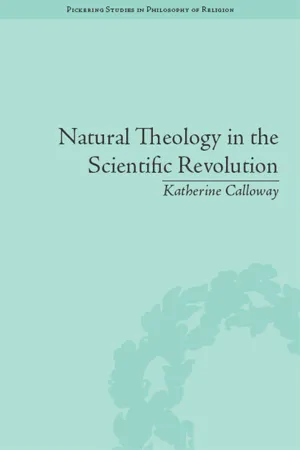
In the seventeenth century scientific discoveries called into question established Christian theology. It has been claimed that contemporary thinkers contributed to this conflict model by using the discoveries of the natural world to prove the existence of God. Calloway challenges this view by close examination of five key texts of the period.
Information
1 RATIONAL THEOLOGY: HENRY MORE’S AN ANTIDOTE AGAINST ATHEISM (1653)
Henry More called his An Antidote against Atheism ‘rational theology’, not natural theology. Celebration of rationality – and a polemic against the irrational – persists through the text, which is otherwise remarkably elusive. More draws evidence from the external natural world as well as deducing from innate first principles, asserts the truth of supernatural events as well as urging the wondrousness of natural law itself, and purports to prove conclusively the existence of God while acknowledging that some readers will nonetheless not conclude that God exists. Although More’s greatest stated aim is to combat atheism, he spends much of An Antidote combating atheism’s pernicious bedfellow, enthusiasm, the mistaken claim of an individual to have access to divine knowledge without the means of reason. Relative to other natural theologies of the period, An Antidote therefore assigns to the human mind a high degree of agency and responsibility, and paints in a positive light the products of human industry, including written texts. More venerates ancient philosophers while protesting that he draws on an innate reason that he and they share. He succeeds better than other natural theologians of the period in keeping revealed doctrine out of his work, nor does he urge readers to supplement his account with what is known more directly about God’s existence and nature. God’s act of revelation, if it may be called that, was for More effected by his imprinting divine knowledge onto the human mind in ‘actual knowledge’ or ‘divine sagacity’.1
Or at least, from More’s assertions and emphases in An Antidote, these are the things that should distinguish his natural theology. From the point of view of posterity, however, More is remarkable for levelling the first modern design argument, considering the world in detail as discovered by naturalists and pointing out how fitted that world is to its present purpose, and thence inferring the existence of a providential creator. Here I explore the paradoxical disjunction between More’s stated purpose and his most historically influential achievement, asking what characteristics of his philosophy and temper might have led to that achievement.
Reconciling Contraries
More published An Antidote in 1653, his first major prose work. He had already begun to set out his philosophy in verse, in the four-part Platonick Song of the Soul (Psychodia Platonica, 1642), a metrical Essay upon the Infinity of Worlds out of Platonick Principles (1646) and a collected Philosophical Poems (1647) with an appended essay espousing the existence of the soul before birth. In the late 1640s More corresponded briefly with Descartes about particulars of his philosophical system, and in 1650 and 1651, respectively, he published his Observations and Reply on the Anthroposophia Theomagica of Thomas Vaughan (1650) in an effort to distinguish his own views of the human soul from Vaughan’s. The preface of An Antidote recalls these polemical texts and announces that More intends now to take a different tack, purging his prose of sarcasm and including nothing but plain reason in his first organized prose exposition of his developing philosophical system, which is not accidentally a work of rational theology. An Antidote is organized into three books: book 1 deals with his doctrine of innate ideas; book 2, with design in the natural world; book 3, with supernatural phenomena. He had yet to articulate fully his peculiar philosophy of a ‘Spirit of Nature’ and his system of ethics; these would come later, in The Immortality of the Soul (1659) and Enchiridion ethicum (1667). Those texts buttress, expand on and complicate the dualistic philosophy More began to set out in prose in An Antidote. Expanding on theological claims made in An Antidote is More’s influential work The Mystery of Godlinesse (1660), in which he reiterates not only his dualism but also his claims about the demonstrability of the truth of Christianity. An Antidote, however, is More’s only work of natural theology proper, and it is this text that would exert a direct influence on English natural theology for decades, and – in constituting the first sustained work of physico-theology – an indirect influence until the present day.2
More’s emphasis on reason in An Antidote will not surprise those who are familiar with his life and thought. The most notable feature of his young life was his departure from the Calvinism of his parents: he narrates decades later that, even from his youth, their ‘hard doctrine concerning Fate’ in his view assigned too little agency to human will.3 After attending Eton College and Christ’s College, Cambridge, More was made a fellow at Christ’s in 1641 and there became a central, if idiosyncratic, figure in the movements that came to be known as Cambridge Platonism and Latitudinarianism. Among the Cambridge Platonists, More and his friend Ralph Cudworth were primarily philosophers rather than theologians, in contrast with their Emmanuel predecessors such as Benjamin Whichcote, Nathaniel Culverwell and John Smith.4 All of the Cambridge Platonists, however, emphasized common ground and the unity of truth and professed to avoid subtle or sectarian controversies. The ‘Latitude-men’ were likewise so called – at first pejoratively – because of their efforts to comprehend Christians of a variety of stripes within the church. They emphasized adherence to a few central doctrines that they held to be easily seen and believed by all who were in their right mind, and they believed that the best course was to discover and live by these common rational principles, rather than wasting energy debating lesser points of doctrine. Because of the close affiliation between such broad-minded ecclesiastical views and the monarchy, these men fell out of public favour at the deposition of Charles I in 1649 and then enjoyed an explosion in popularity after the restoration in 1660. Through all these developments More showed himself a true believer, preaching his own version of reason to an intellectual public that successively judged him too liberal and too eccentrically dogmatic.
For those seeking to paint a coherent picture of More’s thought have always faced the challenge of reconciling contraries. Alongside his prosaic rationalism stand his poetic mysticism and espousal of doctrines no other Latitude-man would consider necessary, such as the pre-existence of individual human souls before birth and an unconscious spirit of nature mediating between God and material creation. There is still no clear consensus on the question of whether he developed a cohesive philosophy sui generis or is simply inconsistent.5 To answer this question in terms of More’s entire oeuvre is a formidable challenge: it is not always clear, for example, when various works of poetry and prose should be read as strict philosophy and when they are rhetorically driving at a more synthetic or narrative truth. This very question of form is metonymic for the tension in More between reason and dogmatism: More divorces rhetoric from reason at the outset of An Antidote, but even as he does so, he admits that he has used rhetoric in the past. An Antidote itself, on the other hand, is one of the most rationalistic works of natural theology of the period,6 and it is certainly the most thoroughly rational physico-theology, a phenomenon that deserves more attention than has been given it by historians of science and intellectual biographers of More alike.
Relative to his Cambridge Platonist contemporaries, then, More stands out as fanciful, though his fancy is most evident outside of An Antidote. His Platonic poems are characterized by an ‘enthusiasm’ very like what he sought to squelch in reformed Christians, he was known to enter meditative trances for days on end,7 and in later life he became interested in the Hebrew Cabbala at the encouragement of his former pupil and dear friend Anne Conway.8 But, for all his whimsical style of writing and his receptivity to things supernatural, More’s fancy can often be explained philosophically. A charge levelled against his Platonick Song of the Soul, for example, is that of subordinating his poetry to his philosophy, instead of keeping poetry primary as Spenser had done.9 In the third book of An Antidote, too, More’s emphasis on the wondrous amounts to a rational, god-of-the-gaps argument, considered in the final section of the chapter. It may seem counterintuitive to attribute to the fanciful More a relatively high degree of rationalism, but there is no logical contradiction between his interest in supernatural subject matter and his desire never to attribute whimsy to God.
In placing More in his intellectual context, twentieth-century critics have noticed both his rationality and his fancy, with varying degrees of approbation. In 1969 C. A. Patrides measured the various Cambridge Platonists by the rule of reason: at the top he places Benjamin Whichcote and Ralph Cudworth, who were by no means experimental scientists but who shared Plato’s unrelenting commitment to the rational pursuit of the true, the good and the beautiful. The Emmanuel men Culverwell and Peter Sterry he omits entirely, on the grounds that ‘Culverwell’s loyalty to Calvinism and Sterry’s denial of free will are sufficient of themselves to set both men in diametric opposition to Whichcote, [John] Smith, Cudworth and More’.10 Regarding More, Patrides claims to have faced some taxonomical problems, eventually opting to downplay his ‘frequent lapses into absurdities’ and ‘present him in as favourable a light as might be possible’, by which Patrides means (among other things) that he will consider only books 1 and 2 of An Antidote.
Although recent critics show more patience with More’s whimsy than did the previous generation,11 Patrides was not the last reader to see More’s scientific thought as a redemptive counterbalance to his rapturous metaphysics. A. Rupert Hall grants that if More contributed to the advance of empirical science, it was against his will; but, he argues, More still deserves the designation of founder of natural religion – primarily on the grounds that he was a ‘more original thinker’ than was Cudworth.12 More influenced subsequent scientists as well as natural theologians, Hall points out, including Isaac Newton himself, whom More probably taught.13 Although More was admittedly preoccupied with theological matters, Hall argues, ‘his opposition [to mechanical philosophy] was not theologically argued. He said: this notion of the natural philosophers … can be proved to be false, for it is absurd, therefore its potential danger to religion is nullified’.14 Hall’s argument for More’s importance goes on to highlight More’s empiricism specifically: in An Antidote he makes ‘carefully detailed natural-philosophical arguments’ resting on the Copernican solar system, the ‘intricate system of heart and blood vessels’, and on the eye, a favourite object of contemplation by subsequent natural theologians.15 Like Patrides, Hall omits to discuss the third book, in which More takes up witchcraft and supernatural apparitions.
A look at More’s own apology in the preface of An Antidote leads to a conclusion that the book warrants neither such praise nor such censure. Judging his beliefs about the supernatural as absurd or backward is Whig history: critics since Patrides have pointed out that many respectable people (including More’s friend Joseph Glanvill) believed in and asserted the reality of supernatural phenomena. Nor, however, does the text reflect a perspicuous awareness that empirical science would carry the day and render physico-theology the dominant form of natural theology for the next two centuries.
To be sure, from a twenty-first-century point of view, the most striking innovation of An Antidote was More’s consideration in detail of various physical phenomena and processes in order to establish that the cosmos was designed with a specific purpose in mind.16 More’s successors recognized the utility of such an argument, and over the succeeding decades it was refined, expanded upon and iterated countless times – despite the blows it received at the hands of Hume and, later, Darwin. According to More, however, the great strength of An Antidote was not its appeal to empirical observation. Instead, he makes a case for rational consistency, purporting to include nothing that he cannot ‘make good by reason’. Taking away the ‘winning Rhetorick and pleasant Philology’ that make for the ‘copious variety of Arguments that others have done’, More means to use ‘plain Reason, and an easy and cleare Method’, keeping only such older arguments as are absolutely compelling as he endeavours ‘not to impose upon the Atheist, but really to convince him’. More adds, ‘I think I may here without vanity or boasting, freely profess that I have no lesse then demonstrated that there is a God’.17 In the effort to avoid boasting, More claims that he ‘doe[s] not bestowe the ostentative term Demonstration’ on his arguments, but immediately he undercuts this claim by adding that an objection to his argument ‘is no more possible, then that the clearest Mathematicall evidence may be false (which is impossible if our facultyes be true)’.18 In so professing, More hopes to counter the similar claim made by Hobbes, who purported to set forth his materialistic system with geometrical certainty.19
Although An Antidote is unusually ‘scientific’ for a work of More, then, there is nothing uncharacteristic about his strong appeal to reason, and nothing unreasonable about the incorporation of wondrous phenomena into his system. Nor was there anything noble about the appeal to nature in book 2, in his view: More saw empirical argument not as a necessary component of his compelling proof of Christianity, but rather as a concession to the ‘weake and sunk minds of sensuall mortalls’. His strategy in book 2, he goes on to say, is to appear
in the shape of a meere Naturalist … For hee that will lend his hand to help another fallen into a ditch, must himself though not fall, yet stoop and incline his body: And hee that converses with a Barbarian, must discourse to him in his own language … to accommodate himself to their capacity, who like the Bat and Owle can see no where so well as in the shady glimmerings of their own Twilight.20
A ‘naturalist’, More explains later, is a person who rejects Logic ‘out of Dotage upon outward grosse sense’21 and must therefore have the gap between sense and logic bridged in order to see reason. So More, in praising reason so highly, does not mean empirical reason, even though he is the first to spend so much energy on theological arguments drawn from the structure and functions of the natural world.
Two questions arise from this difference between posterity’s perception of More’s contribution to intellectual history and his own account of that contribution. First, why did More deny and obscure his own influential innovation? And second, why More? Of all the scientists and philosophers writing during this fecund phase in English intellectual history, why did More write the first work of physico-theology? The a...
Table of contents
- Cover
- Half Title
- Title Page
- Copyright Page
- Table of Contents
- Acknowledgements
- List of Figures and Tables
- Introduction
- 1 Rational Theology: Henry More’s An Antidote against Atheism (1653)
- 2 ‘Prudent Charity’: Richard Baxter’s The Reasons of the Christian Religion (1667)
- 3 A Settled Mind? John Wilkins’s Of the Principles and Duties of Natural Religion (1675)
- 4 God’s Naturalist: John Ray’s The Wisdom of God (1691)
- 5 God’s Philologist: Richard Bentley’s The Folly and Unreasonableness of Atheism (1692)
- Conclusion
- Notes
- Works Cited
- Index
Trusted by 375,005 students
Access to over 1.5 million titles for a fair monthly price.
Study more efficiently using our study tools.
Frequently asked questions
Yes, you can cancel anytime from the Subscription tab in your account settings on the Perlego website. Your subscription will stay active until the end of your current billing period. Learn how to cancel your subscription
No, books cannot be downloaded as external files, such as PDFs, for use outside of Perlego. However, you can download books within the Perlego app for offline reading on mobile or tablet. Learn how to download books offline
Perlego offers two plans: Essential and Complete
- Essential is ideal for learners and professionals who enjoy exploring a wide range of subjects. Access the Essential Library with 800,000+ trusted titles and best-sellers across business, personal growth, and the humanities. Includes unlimited reading time and Standard Read Aloud voice.
- Complete: Perfect for advanced learners and researchers needing full, unrestricted access. Unlock 1.5M+ books across hundreds of subjects, including academic and specialized titles. The Complete Plan also includes advanced features like Premium Read Aloud and Research Assistant.
We are an online textbook subscription service, where you can get access to an entire online library for less than the price of a single book per month. With over 1.5 million books across 990+ topics, we’ve got you covered! Learn about our mission
Look out for the read-aloud symbol on your next book to see if you can listen to it. The read-aloud tool reads text aloud for you, highlighting the text as it is being read. You can pause it, speed it up and slow it down. Learn more about Read Aloud
Yes! You can use the Perlego app on both iOS and Android devices to read anytime, anywhere — even offline. Perfect for commutes or when you’re on the go.
Please note we cannot support devices running on iOS 13 and Android 7 or earlier. Learn more about using the app
Please note we cannot support devices running on iOS 13 and Android 7 or earlier. Learn more about using the app
Yes, you can access Natural Theology in the Scientific Revolution by Katherine Calloway in PDF and/or ePUB format, as well as other popular books in Philosophy & Philosophy History & Theory. We have over 1.5 million books available in our catalogue for you to explore.