William Shakespeare's The Taming of the Shrew has succeeded in surviving in contemporary culture, and has even managed to penetrate to the most modern media of mass communications. This book, first published in 1991, examines some of the different literary and oral versions of The Taming of the Shrew. This book is ideal for students of literature, drama, and theatre studies.
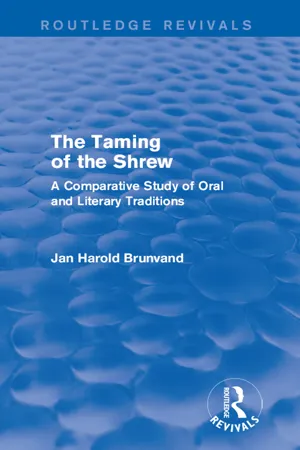
eBook - ePub
The Taming of the Shrew (Routledge Revivals)
A Comparative Study of Oral and Literary Versions
- 272 pages
- English
- ePUB (mobile friendly)
- Available on iOS & Android
eBook - ePub
The Taming of the Shrew (Routledge Revivals)
A Comparative Study of Oral and Literary Versions
About this book
Information
The Taming of the Shrew
CHAPTER 1
Introduction
The Taming of the Shrew Complex
The title “Taming of the Shrew,” apart from Shakespeare’s comedy, is often loosely applied to various folktales, literary works, and subliterary works in which a bad wife is improved. However, by folklorists the designation has been chiefly reserved for Tale Type 901 in the Aarne-Thompson Types of the Folk-tale,1 summarized there as follows: “The youngest of three sisters is a shrew. For their disobedience the husband shoots his dog and his horse. Brings his wife to submission. Wager: whose wife is the most obedient.” This plot, or part of it, is recognizable in several early European literary sources, such as the Middle High German poem Der vrouwen zuht, an Old French fabliau De la Dame Escolliée, a chapter in the fourteenth-century Spanish El Conde Lucanor of Don Juan Manuel, one of Straparola’s stories from the sixteenth century, and others. There is also an anonymous English play from 1594, The Taming of a Shrew, the relationship of which to Shakespeare has long been a subject of disputes. In addition, there are many folktale analogues of the tale, mostly unpublished, from Europe and the East.
A few scholars have pointed out, though none has studied, the similarity in a wife-taming method described in another folktale, Type 1370*, The Lazy Cat, which is reduced in the Type-Index Index to two statements: “The cat beaten for not working. The wife must hold the cat and is scratched.” (This tale is henceforth referred to without the star, as in Thompson’s forthcoming revised edition of the Type Index.) The plots of Types 901 and 1370 both center on a husband who cures his bad wife by pretending to administer irrational punishment to a recalcitrant animal. The types differ, basically, not only in the species of animals usually involved, but also in that, while the wife is not really harmed in most versions of Type 901, she suffers rather severe physical punishment in version of Type 1370. These distinctions, however, tend to merge in many folktales; also combinations of both types in single narratives are not unknown. The scattered and brief discussions by scholars of the similarities in these tale types has had no effect on folktale classification. The Type-Index itself, with Type 901 classified as a novella about shrewishness reformed and Type 1370 in a category for miscellaneous stories about married couples, creates an artificial breach between the tales. Some annotators and archivists have not apparently found the description of Type 1370 under the starred numbers in the Type-Index, and so they have simply listed versions of The Lazy Cat with Type 901. (Both types were sent to me by archivists when I originally wrote asking only for Type 901.) The time is long overdue to reassert the relationships between these two folktales and to study them, along with other related tales and their literary parallels, as a tale complex.
In both Types 901 and 1370 there is considerable variation in exact details of the pretended punishment which is used to tame the wife. In Type 901 the species of animal that is killed may vary, and often several animals appear. Similarly, in about one-half of the versions of Type 1370, not a cat but some inanimate thing is beaten on the wife’s back, ostensibly for being lazy and not doing the housework as the husband commanded. Sometimes the husband, who may not punish his wife directly because of her higher social status, pretends to punish something by beating it while his wife holds it. The object beaten may be an animal hide, a bag, or some other object. It seems legitimate to designate versions containing hides or other objects merely as subtypes of Type 1370.
Various other devices to tame a wife, some ingenious and some merely cruel, are sometimes combined with Type 901 or Type 1370. Occurrences of these miscellaneous devices as separate tales have also been gathered for this study, though they are treated rather briefly. Epilogues that may be attached to the tales, such as an unsuccessful attempt to tame another wife, or the subsequent taming of the Shrew’s mother (i.e., Type 901B), have been included as part of the complex. Similarly, special introductions or elaborations in the tales, when not obviously borrowed from other folktale types, have been taken into account.
In this study, therefore, “Taming of the Shrew” refers to a complex of tales and narrative elements from oral and literary tradition which cluster about Type 901 and its psychological and historical partner, Type 1370. Versions were admitted to the study if they involved taming a bad wife by pretending to punish an animal or object, or if they contained other taming methods which have repeatedly been combined with either of the two types based on this motif.
Previous Studies
The absence of a full-scale study of any part of the Taming of the Shrew Complex, and the lack (prior to the revised Type-Index) of even a fairly complete list of references to this popular theme of oral and printed tradition, would be difficult to understand were it not for two crucial gaps in the printed history of the tale. First, the Taming of the Shrew story was not in the Grimm brothers’ collection, and second, the majority of recently collected versions lie unpublished in folklore archives. The result of the first condition is that not only are we without Bolte and Polívka’s Anmerkungen for the Taming of the Shrew, but also the tale has not benefited from wide circulation in the Grimm canon and has thus not been called to the attention of folktale collectors as an item to be sought and preserved. (As a matter of fact, the Taming of the Shrew did not appear in any early collection which could be described as a “popular classic,” except perhaps for Svend Grundtvig’s books.) As a result of infrequent publication of oral versions, the scholars who are most interested in the tale, Shakespeareans, have not realized that a large number of folktale analogues are extant. Studies dealing with Shakespeare’s relationship to the oral tradition of the tale are discussed in Chapter IV; here we will only consider briefly writings concerned mainly with folktales.
The history of scholarly attention to the Taming of the Shrew Complex is no more than the history of annotations by the editors of some literary versions and by the collectors and publishers of some oral versions. The annotators of literary versions began earlier than the folklorists, but disappeared from the scene at about the period when folktale research was emerging as a recognized discipline. The folklorists who have dealt with the tale have been collectors and indexers who, in general, were interested in providing materials for research, rather than in producing studies of individual tales.
There is no value in summarizing in detail the annotations of literary analogues of the Taming of the Shrew, most of which date from the nineteenth century. Not only did succeeding editors often simply repeat notes from previously published lists, but theoretical o...
Table of contents
- Cover
- Half Title
- Title Page
- Copyright Page
- Original Copyright Page
- Table of Contents
- Introduction to This Edition
- Preface
- CHAPTER I Introduction
- CHAPTER II Summary of the Combinations of Narrative Elements in the Versions
- CHAPTER III Type 901: Historic-Geographic Study
- CHAPTER IV Type 901: The Northern-European Elaborated Subtype and Shakespeare’s The Taming of the Shrew
- CHAPTER V Type 901: “That’s Once,” The American Subtype
- CHAPTER VI Type 1370 and the Combination of 1370 and 901
- CHAPTER VII Other Tales in the Complex
- CHAPTER VIII Summary of Conclusions
- Appendix
Trusted by 375,005 students
Access to over 1.5 million titles for a fair monthly price.
Study more efficiently using our study tools.
Frequently asked questions
Yes, you can cancel anytime from the Subscription tab in your account settings on the Perlego website. Your subscription will stay active until the end of your current billing period. Learn how to cancel your subscription
No, books cannot be downloaded as external files, such as PDFs, for use outside of Perlego. However, you can download books within the Perlego app for offline reading on mobile or tablet. Learn how to download books offline
Perlego offers two plans: Essential and Complete
- Essential is ideal for learners and professionals who enjoy exploring a wide range of subjects. Access the Essential Library with 800,000+ trusted titles and best-sellers across business, personal growth, and the humanities. Includes unlimited reading time and Standard Read Aloud voice.
- Complete: Perfect for advanced learners and researchers needing full, unrestricted access. Unlock 1.5M+ books across hundreds of subjects, including academic and specialized titles. The Complete Plan also includes advanced features like Premium Read Aloud and Research Assistant.
We are an online textbook subscription service, where you can get access to an entire online library for less than the price of a single book per month. With over 1.5 million books across 990+ topics, we’ve got you covered! Learn about our mission
Look out for the read-aloud symbol on your next book to see if you can listen to it. The read-aloud tool reads text aloud for you, highlighting the text as it is being read. You can pause it, speed it up and slow it down. Learn more about Read Aloud
Yes! You can use the Perlego app on both iOS and Android devices to read anytime, anywhere — even offline. Perfect for commutes or when you’re on the go.
Please note we cannot support devices running on iOS 13 and Android 7 or earlier. Learn more about using the app
Please note we cannot support devices running on iOS 13 and Android 7 or earlier. Learn more about using the app
Yes, you can access The Taming of the Shrew (Routledge Revivals) by Jan Harold Brunvand in PDF and/or ePUB format, as well as other popular books in Media & Performing Arts & Performing Arts. We have over 1.5 million books available in our catalogue for you to explore.