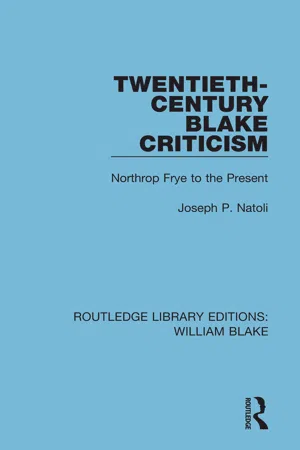
First published in 1982 this book provides a bibliography of commentary, criticism, and scholarship on the works of William Blake. It covers the period from Northrop Frye's Fearful Symmetry in 1947 to 1980. The criticism is organised according to eleven classifications in order to help direct the research of students and scholars and each chapter is preceded by an introductory essay in order to guide the reader.
eBook - ePub
Twentieth-Century Blake Criticism
Northrop Frye to the Present
- 352 pages
- English
- ePUB (mobile friendly)
- Available on iOS & Android
eBook - ePub
About this book
Information
Chapter One
Reference Works and Bibliographies
G.E. Bentley's Blake Books (item 5) covers Blake criticism and scholarship from Blake's own time to 1975. A supplement published in Blake: An Illustrated Quarterly, XI, 2 (1977), 137–177, extends that coverage to 1977. Blake Books is an expansion and revision of Bentley and Nurmi's A Blake Bibliography (item 2). More than half of Blake Books is descriptive bibliography, covering not only editions of Blake's writings but reproductions of drawings and paintings and commercial engravings. Thomas L. Minnick, bibliographer for Blake: An Illustrated Quarterly (BIQ), compiles an annual bibliographic update of Blake studies entitled "Blake and His Circle: A Checklist of Recent Scholarship." BIQ has published some interesting bibliographies, including Mary Lynn Johnson's "Choosing Textbooks for Blake Courses: A Survey & Checklist." This checklist includes sections on "Guidebooks, Introductions & Study Aids" as well as "Facsimiles & Reproductions Inexpensive Enough for Classroom Use."
As to complete editions of Blake, a student can choose between Erdman's edition (item 38) and Keynes's (item 54). Bentley's William Blake's Writings (item 18) is in two volumes; the first volume includes numerous plate designs. Erdman's The Illuminated Blake (item 41) includes "all of William Blake's illuminated works with a plate-by-plate commentary." The plates are black and white, but the edition is relatively inexpensive. This Illuminated Blake should be for the student a companion volume to the Erdman, Bentley or Keynes editions of the writings. David Bindman's The Complete Graphic Works of William Blake (item 19) includes all of Blake's designs but does not include Blake's engravings after other artists. Essick and Easson's William Blake: Book Illustrator (item 32) is concerned with this aspect of Blake's engraving. Bindman's book contains the illustrations to Job, the Grave, Virgil and Dante as well as Blake's own illuminated works. Martin Butlin is preparing a catalogue raisonné of Blake's drawings and paintings which, according to Robert Essick, who has read the proofs of the work, "should be the most important work on Blake as an artist ever."
Since commentary restricted to Blake's writing is becoming more and more frowned upon, a student of Blake must make an effort to incorporate a "reading" of Blake's designs together with a reading of his poetry. Fairly inexpensive facsimiles are being offered by the William Blake Trust and the American Blake Foundation. Blake Books contains facsimile items in the descriptive bibliography sections.
Erdman's Concordance (item 35) should be referred to upon all occasions when a student feels drawn to Damon's A Blake Dictionary (item 24). Damon's Dictionary is indeed his dictionary and should be read as an exegetical rather than as a reference work. The Letters (item 52) and both Gilchrist's biography (item 309) and Wilson's biography (item 351) must be considered essential reference material. Other biographical studies will be discussed in Chapter Three. G.E. Bentley's Blake Records (item 10) is a sourcebook of biographical data and most definitively fills gaps found in narrative accounts of Blake's life.
1. Bentley, G.E., Jr. "William Blake 1757–1827." New Cambridge Bibliography of English Literature, II. Edited by George Watson. Cambridge, 1971, 615–636.
2. Bentley, G.E., Jr., and Martin K. Nurmi. A Blake Bibliography; Annotated Lists of Works, Studies, and Blakeana. Minneapolis: Minnesota University Press; London: Oxford University Press, 1964. 393pp.
Bibliography superseded by Bentley's Blake Books (item 5). Everything in this early bibliography is incorporated in Blake Books and extended, especially the descriptive bibliography of Blake's works.
2a. Erdman, David V. (rev., A Blake Bibliography). Journal of English and Germanic Philology, LXIV (1965), 744.
"As mines of information go, this new compendium is exceptionally copious, efficiently organized, and certain to establish itself as an indispensable companion to the study of Blake once the initial unfamiliarity and oddness have been overcome."
3. Keynes, Geoffrey, (rev., A Blake Bibliography). Book Collector, XIV (1965), 250, 253.
Considers the arrangement, the bibliographic excellencies, etc., and finally concludes that the book is an asset.
4. Bentley, G.E., Jr. "A Supplement to G.E. Bentley, Jr. and Martin K. Nurmi, A Blake Bibliography (1964)." Blake Newsletter, II (1968), 1–29.
5. Bentley, G.E., Jr. Blake Books. Oxford: Clarendon Press, 1977. 1079pp.
Terminus for this work is about April 1975. The descriptive bibliography of Blake's writings, Part I, is much more elaborate than the earlier A Blake Bibliography (item 2). Brief annotations accompany more than 75 percent of the enumerative bibliography items.
6. Eeles, Adrian, (rev., Blake Books). Times Literary Supplement, Jan. 27, 1978n, 100.
"Here [the Biography and Criticism section] the result is dispiriting rather than impressive, so immense is the literature, so computerized and uncritical the presentation."
7. Essick, Robert N. (rev., Blake Books). Blake Newsletter, XI (1977–1978), 178–199.
"Blake Books will be accepted as the standard bibliography in its field and will remain so for many years."
8. Bentley, G.E., Jr. "A Supplement to Blake Books." Blake Newsletter, XI (1977–1978), 137–177.
This supplement takes Blake Books up to March 31, 1977.
9. See item 2a.
10. Bentley, G.E., Jr. Blake Records. Oxford: Clarendon Press, 1969. 678pp.
Attempts to list all references to Blake made by his contemporaries. This minutely particularized calendar of Blake's life lacks the narrative continuity necessary in a biographical work. It is, however, a prodigious example of what it intends to be: a foundation for a future biography.
11. Brennan, Norman, (rev., Blake Records). Blake Studies, IV (1971), 103–107.
Bentley's volume took fifteen years to compile. "... a truly major contribution to Blake scholarship."
12. Erdman, David V. (rev., Blake Records). English Language Notes, IX (1971), 27.
It's very difficult to disparage a work which is the result of Herculean scholarly labors.
13. Gilbert, Thomas, (rev., Blake Records; Blake and the Nineteenth Century [item 363]; Blake's Visionary Universe [item 83]). English, XIX (1970), 66–67.
Bentley's work is considered prodigious; Dorfman has presented a few comments on some interesting areas and Beer's effort is decent.
14. Peter, John, (rev., Blake Records'). Malahat Review, XV (1970), 121–122.
Why does Bentley leave scandal about Blake? All readable for the general out all the rumors and that makes the thing public.
15. Schulz, Max F. (rev., Blake Records). Eighteenth Century Studies, IV (1971), 490–492.
"... an accessible, verified documentation of the known facts of Blake's life and of the financial and legal data of his art dealings."
16. Bentley, G.E., Jr. "Blake Scholars and Critics: Commentators and Exhibitions." University of Toronto Quarterly, XL (1970), 86–101.
Surveys some recent critical works and lists various Blake exhibitions.
17. Bentley, G.E., Jr. "Blake Scholars and Critics: The Texts." University of Toronto Quarterly, XL (1970), 274–287.
Reviews a number of Keynes's texts: The Letters of William Blake, The Gates of Paradise, Europe and Songs of Innocence and Experience.
18. Bentley, G.E., Jr. William Blake's Writings. Oxford: Clarendon Press, 1978.
Volume I: "Engraved and Etched Writings"; Volume II: "Writings in Typography and in Manuscript."
18a. Bentley, G.E., Jr. "Geoffrey Keynes's Work on Blake: Fons et Origo, and a Checklist of Writings on Blake by Geoffrey Keynes, 1910–1972." William Blake: Essays in Honour of Sir Geoffrey Keynes (item 240).
19. Bindman, David. The Complete Graphic Works of William Blake. London: Thames and Hudson, 1978.
"I have set out to reproduce every printed design by Blake as well as their major variants. I have included virtually all the prints which Blake designed but did not engrave himself but have omitted almost all of Blake's engravings after other artists."
20. Butlin, Martin. "Cataloguing William Blake." Blake in His Time (item 149), 77–90.
Discusses his problems in putting together a catalogue raisonné of Blake's works.
21. Candela, Gregory. "A Checklist of Recent Blake Scholarship." Blake Newsletter, VI (1973), 11–15.
22. Connolly, Thomas E. "Songs of Innocence, Keynes (1921) Copy U, Keynes-Wolf (1953) Copy U." Blake Newsletter, VII (1974), 88–89.
A note on an addition to the standard bibliographic description.
23. Curran, Stuart. "Recent Studies in the Nineteenth Century." Studies in English Literature 1500–1900, XIV (1974), 638–668.
This is a yearly appraisal which includes an assessment of Romantic work published that year. Duplicates Year...
Table of contents
- Cover
- Half Title
- Title
- Copyright
- Original Title
- Original Copyright
- Dedication
- Contents
- Preface
- Introduction
- Chapter 1: Reference Works and Bibliographies
- Chapter 2: Essay Collections and Introductory Works
- Chapter 3: Blake’s Life and Contemporaries
- Chapter 4: Blake’s Reputation
- Chapter 5: Blake’s Symbols and Themes
- Chapter 6: Style and Form
- Chapter 7: Blake’s Influence
- Chapter 8: Engravings, Paintings and Drawings
- Chapter 9: Sources and Analogues
- Chapter 10: Critical Comparisons
- Chapter 11: Individual Works
- Addenda
- Index
Trusted by 375,005 students
Access to over 1.5 million titles for a fair monthly price.
Study more efficiently using our study tools.
Frequently asked questions
Yes, you can cancel anytime from the Subscription tab in your account settings on the Perlego website. Your subscription will stay active until the end of your current billing period. Learn how to cancel your subscription
No, books cannot be downloaded as external files, such as PDFs, for use outside of Perlego. However, you can download books within the Perlego app for offline reading on mobile or tablet. Learn how to download books offline
Perlego offers two plans: Essential and Complete
- Essential is ideal for learners and professionals who enjoy exploring a wide range of subjects. Access the Essential Library with 800,000+ trusted titles and best-sellers across business, personal growth, and the humanities. Includes unlimited reading time and Standard Read Aloud voice.
- Complete: Perfect for advanced learners and researchers needing full, unrestricted access. Unlock 1.5M+ books across hundreds of subjects, including academic and specialized titles. The Complete Plan also includes advanced features like Premium Read Aloud and Research Assistant.
We are an online textbook subscription service, where you can get access to an entire online library for less than the price of a single book per month. With over 1.5 million books across 990+ topics, we’ve got you covered! Learn about our mission
Look out for the read-aloud symbol on your next book to see if you can listen to it. The read-aloud tool reads text aloud for you, highlighting the text as it is being read. You can pause it, speed it up and slow it down. Learn more about Read Aloud
Yes! You can use the Perlego app on both iOS and Android devices to read anytime, anywhere — even offline. Perfect for commutes or when you’re on the go.
Please note we cannot support devices running on iOS 13 and Android 7 or earlier. Learn more about using the app
Please note we cannot support devices running on iOS 13 and Android 7 or earlier. Learn more about using the app
Yes, you can access Twentieth-Century Blake Criticism by Joseph Natoli,Joseph P. Natoli in PDF and/or ePUB format, as well as other popular books in Literature & Literary Criticism. We have over 1.5 million books available in our catalogue for you to explore.