Originally published in 1942, this book was very different from anything else written about the psychology of hands. The author had worked amongst apes and monkeys at the zoo, patients in what at the time were called 'mental hospitals', and amongst all manner of men, women and children. The results of her research are found here where she looks at how the hands link to the brain and ultimately our personality. A pioneer in this field the author continued her research in this area for a number of years. A fascinating glimpse into early personality psychology.

- 198 pages
- English
- ePUB (mobile friendly)
- Available on iOS & Android
eBook - ePub
The Human Hand
About this book
Information
Chapter IX
A Practical Method of Hand-Interpretation
ONCE thoroughly understood, the foundations of hand psychology provided in the earlier parts of this book will furnish the student with the necessary conviction and knowledge to proceed to practical work—the study of hands and their correlation with personality. In order to obtain objective and complete portraits of individuals, the hand interpreter must know the most fruitful and constructive method of applying the knowledge which he has gained, and that is what this chapter seeks to provide.
While it is true that the practical method I am about to describe is but the synthesis of what has already been expounded, it is essential to realize that an exclusively analytical approach will not lead one very far in the knowledge of human character. To construct a machine one must have, of course, all the component parts, each meticulously adjusted to its function, but the machine which results is something more than the nicely adjusted sum of the parts. If this is so of an engine it is much more so of the human mind; every mind is both the aggregate of its parts and a whole. This rude analogy drawn from the mechanical world does help, I think, to display the inadequacy for psychology of analysis alone. We have to put together the findings of our analysis in such a way that a self arises, a unique human entity.
Two terms coined by a well-known literary critic1 to distinguish types of character in fiction may be applied to our subject. Analysis alone will produce what he calls flat characters, animated machines reacting on calculable lines. Psychological synthesis will produce portraits in the round, people with some potentially incalculable responses; for, as in sculpture, the other side of the figure is felt to be there though it cannot be seen simultaneously with the front. In this chapter therefore I use the term 'portrait' because the associations of the word suggest a likeness that is 'caught' as distinguished from the mathematical blue-print of an engineer.
There is nothing mystical about such a conception of psychology. It is designed to reach the real structure, the gestalt, of an individual, that which decisively differentiates him from every other individual, no matter how similar may be the component elements of his nature to those of thousands of other people. But the conception is one that does not overrate the analytical method, which it regards as the necessary first step to profound understanding of the mind. Nor does it undervalue precise analytical knowledge. It only suggests that the expression of character-attributes in mathematical formulae and statistics can only be an intermediate stage of research and not the final goal.
It must be admitted that the reader will probably find the practical method which follows difficult to acquire. But, as in learning to drive a car, once the technique has been acquired by strenuous concentration, it sinks into the subconscious and becomes an effortless knack, the driver's attention being occupied only with the road and the other traffic; so when the technical knowledge of hand-psychology has been painstakingly assimilated by the conscious mind, it passes into the subconscious and the hand-interpreter can enjoy his task without its losing any of its exactitude and objective value. Indeed, it is almost obvious that exact portraits, in the sense in which I have defined them above, are really only possible when the technical knowledge and the results of wide experience have become incorporated in the investigator's mind, conscious and subconscious. Then only will the fundamental and unique structure of an individual become clear to him.
I think it is advisable to preface the description of the practical method with a recapitulation of what it is we are able to find out.
From the form of the hand we may expect to derive a general impression of (1) the physical constitution and the heredity; (2) the emotional and instinctual potential—in short, the temperament; (3) the mentality and innate gifts and talents.
From the nails and the hand's physical qualities we can find indications of heredity and health conditions.
From the parts of the hand we should be able to decide (1) the relative strength of ego and id; (2) the force of the will; (3) a more detailed conception than the study of the form of the hand alone elicits of the 'active' and 'receptive' aspects of the personality.
From the lines we shall derive (1) knowledge of those degenerative traits which are manifested in the lack or abnormal design and position of crease-lines and in simian patterns of the papillary ridges (other degenerative features being shown in the form of the palm, fingers, and nails); (2) the strength or weakness of the super-ego; (3) a more detailed idea of the vitality, the intelligence, the mental and emotional discipline; (4) the degree of nervous stability and resistance.
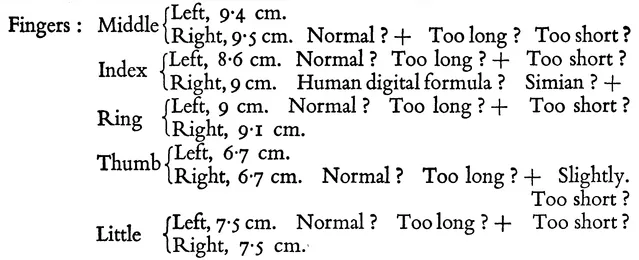
To exhibit the practical method as clearly as possible I take an actual pair of hands (Plate 17), those of a woman whom I will call 'M. C.' and in nine questionnaires or tables covering all the necessary data I provide the answers which should be given for the hands of this subject. Some hand features, such as the physical qualities, the form of the nails and certain measurements, are not, of course, visible in prints, but I have still filled in the answers to the questions on these points as furnished by M. C.'s hands in order to complete the foundation for the general portrait which follows.
In connexion with Table A it should be noted that Carus in the nineteenth century, some Italian morphologists in our own days, and more recently the psychiatrist Kretschmer, have worked out correlations between certain bodily proportions and character and mentality.
Tables A to I
A. Length Measurements
All measurements are made from the back of the hand except when the length is to be compared with the length of the face and the height of the head,1 when the measurement is made from the palmar surface beginning with the middle point of the first fold of the wrist (excluding the wrist itself) and ending with the tip of the middle finger.
Body: 160 cm.
Head: 18 cm.
Face: 19 cm.
Hand (including wrist): Left, 19.6 cm.; Right, 19.5 cm.
Palm (including wrist): Left, 10.2 cm.; Right, 10.0 cm.
Head: 18 cm.
Face: 19 cm.
Hand (including wrist): Left, 19.6 cm.; Right, 19.5 cm.
Palm (including wrist): Left, 10.2 cm.; Right, 10.0 cm.
Proportions
Hand to Head: hand too big.
Hand to Face: hand too long.
Palm to Fingers: fingers rather too long.
Hand as a Whole: Well proportioned? Badly proportioned? +
B. Circumference Measurements
The circumference of the hand is measured across the knuckles of the fingers.
Left Hand: 18.1 cm. Normal?+ Broad? Narrow? Much too broad? M to N?
Right Hand: 18 cm. Normal?+ Broad? Narrow? Much too broad? M to N?
Right-hander? Left-hander? +
C. The Form of the Fingers
Stout?+ Slender? Clumsy? Graceful?
Any deformities due to illness? + Slight rheumatic
Thumb: Long?+ Short? Normal? Stout?+ Slender?
Terminal Phalange? Thick, enlarged.
Basal Phalange? Strong.
Terminal Phalange? Thick, enlarged.
Basal Phalange? Strong.
Index: Long? + Short? Normal? Stout? + Slender?
Middle Finger: Long? Short? Normal? + Stout? + Slender?
Ring Finger: Long?+ Short? Normal? Stout? + Slender?
Little Finger: Too long? + Too short? Normal? Deformed?
The Phalanges
Basal: Normal? Thinned? Enlarged? + Slightly
Middle: Normal? + Thinned? Enlarged?
Terminal: Normal? Long? 4th and 5th jingers. Short? 2nd and 3rd fingers.
Middle: Normal? + Thinned? Enlarged?
Terminal: Normal? Long? 4th and 5th jingers. Short? 2nd and 3rd fingers.
Predominantly: Square? + Spatulate? Tapered? Pointed?
Degenerative Stigmata: Thumb? Little Finger? +
Degenerative Stigmata: Thumb? Little Finger? +
D. The Form of the Nails
| Type | ||
| Long and narrow ? | Long and broad ? + | |
| Curved ? | Flat ?+ | |
| Short and narrow ? | Short and broad ? | |
| Curved ? | Flat? | |
| Angular ? | Rounded ? + | Tubular ? |
| Any abnormalities in form ? | ||
| ” ” ” substance ? Striae. | ||
E. The Physical Qualities...
Table of contents
- Cover
- Half Title
- Title
- Copyright
- Original Title
- Original Copyright
- PREFACE
- ACKNOWLEDGEMENTS
- Contents
- ILLUSTRATIONS AT THE END OF THE BOOK
- PUBLISHERS’ NOTE
- I THE PLACE OF THE HAND IN SCIENCE
- II THE THEORY
- III THE FORM OF THE HAND
- IV THE PARTS OF THE HAND
- V THE PHYSICAL QUALITIES OF THE HAND
- VI THE NAILS
- VII THE LINES OF THE HAND
- VIII RIGHT HAND AND LEFT
- IX THE PRACTICAL METHOD
- REFERENCES
- INDEX
Trusted by 375,005 students
Access to over 1.5 million titles for a fair monthly price.
Study more efficiently using our study tools.
Frequently asked questions
Yes, you can cancel anytime from the Subscription tab in your account settings on the Perlego website. Your subscription will stay active until the end of your current billing period. Learn how to cancel your subscription
No, books cannot be downloaded as external files, such as PDFs, for use outside of Perlego. However, you can download books within the Perlego app for offline reading on mobile or tablet. Learn how to download books offline
We are an online textbook subscription service, where you can get access to an entire online library for less than the price of a single book per month. With over 1.5 million books across 990+ topics, we’ve got you covered! Learn about our mission
Look out for the read-aloud symbol on your next book to see if you can listen to it. The read-aloud tool reads text aloud for you, highlighting the text as it is being read. You can pause it, speed it up and slow it down. Learn more about Read Aloud
Yes! You can use the Perlego app on both iOS and Android devices to read anytime, anywhere — even offline. Perfect for commutes or when you’re on the go.
Please note we cannot support devices running on iOS 13 and Android 7 or earlier. Learn more about using the app
Please note we cannot support devices running on iOS 13 and Android 7 or earlier. Learn more about using the app
Yes, you can access The Human Hand by Charlotte Wolff in PDF and/or ePUB format, as well as other popular books in Psychology & History & Theory in Psychology. We have over 1.5 million books available in our catalogue for you to explore.