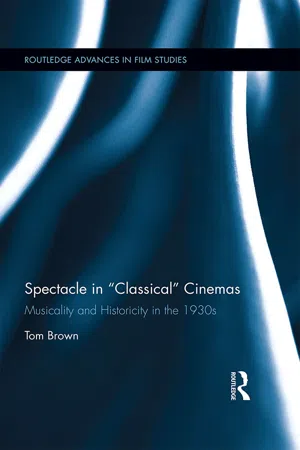
Spectacle is not often considered to be a significant part of the style of 'classical' cinema. Indeed, some of the most influential accounts of cinematic classicism define it virtually by the supposed absence of spectacle. Spectacle in 'Classical' Cinemas: Musicality and Historicity in the 1930s brings a fresh perspective on the role of the spectacular in classical sound cinema by focusing on one decade of cinema (the 1930s), in two 'modes' of filmmaking (musical and historical films), and in two national cinemas (the US and France). This not only brings to light the special rhetorical and affective possibilities offered by spectacular images but refines our understanding of what 'classical' cinema is and was.
- 278 pages
- English
- ePUB (mobile friendly)
- Available on iOS & Android
eBook - ePub
Musicality
1 Performance Space
Among genre study’s already crowded listings of genres and subgenres, work on musicals is particularly prone to problems of categorization. There are various proper-name categories such as “Warner”, “Berkeley” or “MGM musicals”.1 Altman distinguishes between “fairy-tale”, “folk” and “show musicals”, while the “backstage musical” is one of the most cited subsets. The choice of terminology clearly has important implications for how one conducts the analysis—the proper name categories might privilege the particular conditions of an individual studio or an individual artist; “fairy-tale” and “folk” evoke much broader cultural understandings of “the musical”. In order to begin the analysis here in as concrete a way as possible, I have chosen some key, historically situated strands of musical-theatre. The three main forms I will examine are vaudeville, revue and operetta. This choice does not pretend to offer an exhaustive account, and I treat these performances as, in essence, more discrete than they often were on screen.
In summary, vaudeville creates a space in which the individual musical star dominates; revue with its crowded performance space offers different kinds of spectatorial pleasure, subordinating the individual to the broader shape(s) of the show; operetta, the most narrativized form, focuses on the romantic couple, while often insisting on the lavishness of costume and décor.2 Their respective “cultural capital” also distinguishes these forms. As the cheaper ancestor of revue, vaudeville can be seen as the lowest form. Operetta, particularly of the Viennese tradition (which is central to the definition of operetta offered here), was certainly the most respectable, middle-class form, and it is its “high-class” associations that the early Marx Brothers films parody. Indeed, the decade sees various examples of citation, parody or exchange across these different varieties of musical theatre. For example, Lubitsch’s The Merry Widow (1934), based on one of the most famous and influential “Ruritanian operettas”3 combines the spectacle of the mass waltz with the more modern traditions associated with the “Berkeleyesque”4—one scene combines the machinations of mass ranks of dancers through very “visible” editing devices, creating elaborate patterns across numerous dance floors.
Though vaudeville, revue and operetta are the three main “performance spaces” discussed in this chapter, I also examine more particular, hybrid cases. Because in its pure form, “the revue musical” is not a very persistent strand within 1930s musicality (it is associated with the post-Jazz Singer (1927) boom in musical films in the late twenties), we will look at a particular inflection of the revue form, the “Berkeleyesque” (a tradition of spectacle not limited to Busby Berkeley or even the cinema5). The “Berkeleyesque” warrants particular attention, first because of its prominence in criticism on musical cinema and also because of its presence in some French films of the mid-1930s. Other case studies examined below are the specifically French form café-concert (or caf’conc’).
VAUDEVILLE
The considerable influence of French and American vaudeville on their respective cinemas is most broadly felt in the predominance of musical-comedy: “vaudeville ensured the predominance of comedy [in French musical films], and structurally dictated the way songs were inserted … as loosely connected and barely justified moments of pure spectacle”.6 And, similarly, in the American context: “Restricted to the operetta tradition, the film musical never would have developed its characteristic combination of musical and comedy. Borrowing from vaudeville, however, Hollywood found itself overrun with performers used to alternating between comedy and songs”.7 What is also worth underlining here is Altman’s emphasis on the performers, for indeed, one might say that vaudeville musicality of the 1930s is defined by the space afforded the individual comic or musical turn, a central characteristic French and American vaudevillian strands have in common. The inherent individualism of the American vaudeville circuit, which handed “star” performers the greatest power, was, according to capitalist models, a commercially destabilizing force remedied by the turn towards large-scale, chorus-based revues like the various Ziegfeld “Follies”.8 In the French context, it was also the enormous stardom of vaudevillian performers like Fernandel which make genres like the comique-troupier one of the most enduring and distinctive in 1930s French cinema.9 Indeed the persistence and preponderance of vaudevillian musical-comedy through the French cinema of the 1930s, as against its decline in Hollywood, gives some clue as to the roots of prevailing assumptions about the place of “the musical” in the two cinemas.
The French cinema of the 1930s did not consistently develop any overarching musical form that can be seen as independent of individual stars. On the other hand, Hollywood developed forms like the Berkeleyesque, which, following on from the Florenz Ziegfeld revue, made individual stardom subservient to particular formulations of narrative and spectacle; subsequent developments of the operetta format were also better suited to combining dance spectacle with romance narratives. As we shall see over the course of this chapter, the French cinema did not have the economic/technical means or, it seems, desire to develop such mechanics, and mechanics is the mot juste as what is at stake is the relationship of individual performative agency to a larger textual “machine”. From such a situation it seems reasonable to conclude that the American cinema had a musical genre, while the French cinema just had musical stars. However, as was suggested in the introduction, such an over-determination of the question of genre, with its inevitable favoring of “Hollywood”, is a barrier to understanding the deeper roots of the differences between national cinematic practices. To understand the terms by which vaudevillian musicality persisted throughout 1930s French cinema, but receded in Hollywood, some more historical context is needed.
American vaudeville emerged from the indecorous surroundings of mid-nineteenth century music hall. Early American vaudeville theatre was a predominantly male pastime emphasizing drinking, the space arranged as a “Beer Garden” with tables grouped in front of a stage.10 Subsequent drives to clean up vaudeville and make it more accessible to women and families (underpinned by the temperance movement) corresponded with the introduction of proscenium staging.11 This more respectable vaudeville was a major success, reaching a far wider audience than before, and has been seen as marking the entrance of big business into US entertainment. Entrepreneurs such as Keith and Albee and Marcus Loew, with their large circuits of theatres and contracted players, were pioneers of the modern entertainment industry (Loew would form MGM studios). Their circuits also borrowed acts from various entertainment forms, even from more “highbrow” arenas like opera and legitimate theatre, even attracting Sarah Bernhardt for a tour.12 However, the attraction of American vaudeville seems to have come from its capacity to contain a wide variety (“variety” is often synonymous with vaudeville)13 of, predominantly, musical, comic or acrobatic “turns”, rather than any narrative form, and thus the incorporation of legitimate theatrical actors stressed declamatory scenes, monological rather than dialogical skills, and spectacle over narrative.14
Typical US vaudeville shows comprised a disconnected series of ten to twenty acts,15 but “variety” not only describes the overall show’s combination of different performers, but also the variety of skills the individuals were expected to offer. As Jenkins writes, “The consummate entertainer was one who could do the broadest range of different specialities within the shortest period of time”.16 This emphasis largely explains the way in which musical performance is incorporated into the performance space of vaudeville. Performers (“characters” would be inappropriate to the prominence of personalities in the vaudeville tradition) move freely from comic puns, pratfalls to song and sometimes dance. Musical performance was therefore a very flexible part of the vaudeville aesthetic, which involved the “creation of a flexible and central performance space for the explosive spectacle of the comedian’s act, with individual scenes … conceived as set pieces … their narrative significance often added as an afterthought”.17 While some late twenties, early 1930s American films reproduced the non-narrative revue, no vaudeville programs were filmed. However, it is the flexible, explosive performance space described above that joins non-narrative vaudeville with its narrativized descendants.
There are few Hollywood films of the 1930s that represent directly the music of the vaudeville stage—the Mae West vehicle, She Done him Wrong (1933), and San Francisco (1936) are rare examples. This is not the extent of vaudevillian musicality, however. All the films starring the Marx Brothers, the performers most readily associated with vaudevillian American cinema (Groucho is on the cover of Jenkins’ 1992 study) contain at least one musical number, and most of them significantly more than that. More crucially, they move swiftly and easily between speech and song, often refusing the distinction between the two. However, they are almost entirely absent from scholarship on the Hollywood musical. This absence is, arguably, as much a consequence of the emphases and exigencies of the scholarship as of the particular qualities of the films themselves. For example, while Altman’s historical research reveals the key role vaudeville played in the formation of American musical cinema, his theoretical schema, more specifically his categories (the “show”, the “fairy-tale” and the “folk” musical), find no place for the Marx Brothers films. Neither do their films feature in the major monographs by Feuer,18 or the collections edited by Altman19 or Cohan20—the 1981 and the 2002 collections are the most clearly illustrative of the long preeminence of the Berkeley and Astaire and Rogers musicals in scholarship on the musical.21 However, comparing an early Marx Brothers film at Paramount with a later MGM vehicle reveals important aspects of the development of Hollywood musicality in the 1930s, and the means by which these particular performers were “tamed” in their later incarnations.
Considered “a musical”, Animal Crackers (1930) may seem rather incoherent. However, within the context of vaudevillian stage musicals, Henry Jenkins designates Animal Crackers and The Cocoanuts (1929) as “book musicals”,22 the theatrical form most often associated with the integrated musical. Little attempt was made to change the theatrical mise-en-scène of these texts; in fact, both pieces were filmed in the day and performed on stage in the evening.23 The theatricality of Animal Crackers extends to its use of parody, parody providing a particular kind of unity to its musical world. In particular, the film parodies the musicality of operetta, especially of the kind popularized by Gilbert and Sullivan. The comic musicality of Gilbert and Sullivan was very influential on American musical cinema,24 and their lyrical puns are clearly a direct influence on the Marx Brother’s brand of musicality, as well as one focus for their spoofing. For example, the entrance of Groucho’s character is anticipated and celebrated by a huge chorus of guests at the society home of Mrs. Rittenhouse (played by the recurring Marxes’ straight woman, Margaret Dumont), “Hooray for Captain Spaulding, the African explorer!” This repeated singing of the chorus becomes excessive, interrupting Groucho’s attempts to introduce himself.
As well as using the choruses of operetta, the film also makes some use of the romantic musicality derived from operetta—there is a love duet between the young couple Arabella Rittenhouse (Lilian Roth) and John Parker (Hal Thompson) who sing to each other, “Why am I so romantic?” However, in the consideration of the performance space represented by vaudeville, the crucial element is the very frontal relationship to the camera within “the flexible and central performance space [ready] for the explosive spectacle”. This performance space is established in the opening moments, in which the house servants, led by Hives the butler (Robert Greig), approach the camera and arrange themselves as if in front of a theatre aud...
Table of contents
- Cover
- Half Title
- Title Page
- Copyright Page
- Dedication
- Table of Contents
- List of Figures
- Acknowledgments
- Introduction and Critical Contexts
- PART I Musicality
- PART II Historicity
- Conclusion
- References
- Index
Trusted by 375,005 students
Access to over 1.5 million titles for a fair monthly price.
Study more efficiently using our study tools.
Frequently asked questions
Yes, you can cancel anytime from the Subscription tab in your account settings on the Perlego website. Your subscription will stay active until the end of your current billing period. Learn how to cancel your subscription
No, books cannot be downloaded as external files, such as PDFs, for use outside of Perlego. However, you can download books within the Perlego app for offline reading on mobile or tablet. Learn how to download books offline
Perlego offers two plans: Essential and Complete
- Essential is ideal for learners and professionals who enjoy exploring a wide range of subjects. Access the Essential Library with 800,000+ trusted titles and best-sellers across business, personal growth, and the humanities. Includes unlimited reading time and Standard Read Aloud voice.
- Complete: Perfect for advanced learners and researchers needing full, unrestricted access. Unlock 1.5M+ books across hundreds of subjects, including academic and specialized titles. The Complete Plan also includes advanced features like Premium Read Aloud and Research Assistant.
We are an online textbook subscription service, where you can get access to an entire online library for less than the price of a single book per month. With over 1.5 million books across 990+ topics, we’ve got you covered! Learn about our mission
Look out for the read-aloud symbol on your next book to see if you can listen to it. The read-aloud tool reads text aloud for you, highlighting the text as it is being read. You can pause it, speed it up and slow it down. Learn more about Read Aloud
Yes! You can use the Perlego app on both iOS and Android devices to read anytime, anywhere — even offline. Perfect for commutes or when you’re on the go.
Please note we cannot support devices running on iOS 13 and Android 7 or earlier. Learn more about using the app
Please note we cannot support devices running on iOS 13 and Android 7 or earlier. Learn more about using the app
Yes, you can access Spectacle in Classical Cinemas by Tom Brown in PDF and/or ePUB format, as well as other popular books in History & French History. We have over 1.5 million books available in our catalogue for you to explore.