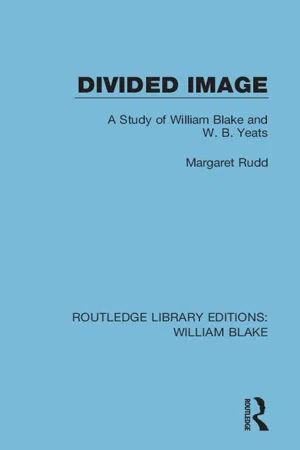
First published in 1953, this book examines Blake's vision and its impact on the work of Yeats who imitated Blake in the hope that he might find that same vision. Margaret Rudd's approach is literary as well as philosophical, and psychological and she discusses the work of both poets in this way.
- 254 pages
- English
- ePUB (mobile friendly)
- Available on iOS & Android
eBook - ePub
About this book
Information
6 ‘I, The Poet William Yeats’
DOI: 10.4324/9781315675152-6
In 1889 when Yeats and Ellis were well into their study of Blake, Yeats published the little volume of poems called Crossways. A quotation from Blake acts as a kind of motto: ‘The stars are threshed, and the souls are threshed from their husks.’ This, characteristically, is a misquotation1 which persists into the most recent editions of Yeats’ poems. The correct lines, from Blake’s Vala or the Four Zoas, are: ‘And all Nations were threshed out, and the stars threshed from their husks.’
The book itself, unlike any of Blake’s although the Blakean influence is evident, is altogether composed of sorrow and starbeams and other equally unsolid bits of poetic material, and is in style a mixture of the tired and wistful æsthete language prevalent at the end of the century, and of the Yeatsian idea that poetry must consist of and seek
‘those wavering, meditative, organic rhythms, which are the embodiment of the imagination, that neither desires nor hates, because it has done with time, and only wishes to gaze on some reality, some beauty … a little song made out of a moment of dreamy indolence, or some great epic made out of the dreams of one poet and of a hundred generations whose hands were never weary of the sword.’22 Yeats, Essays, p. 201.
Not, perhaps, a theory to lead to great poetry, as may be seen from the following random quotations from Yeats’ first volume. Because Yeats was a great poet, he quickly abandoned this theory and technique. There are, of course, single memorable lines such as the first two in the following passage, but they are not generally ‘wavering, meditative, organic’, but carved with a certain precision of line:
The woods of Arcady are dead,And over is their antique joy…. seek then,No learning from the starry men,Who follow with the optic glassThe whirling ways of stars that pass—Seek then, for this is also sooth,No word of theirs—the cold star baneHas cloven and rent their hearts in twain,And dead is all their human truth.Go gather by the humming seaSome twisted, echo-harbouring shell,And to its lips thy story tell,And they thy comforter will be ….I must be gone: there is a graveWhere daffodil and lily wave,And I would please the hapless faun,Buried under the sleepy ground….33 The poems quoted are all from Yeats’ Collected Poems unless otherwise indicated.
or, sooth!
There was a man whom Sorrow named his friend,And he, of his high comrade Sorrow dreamingWent walking with slow steps along the gleamingAnd humming sands, where windy surges wend.
and,
‘What do you make so fair and bright?’‘I make the cloak of sorrow:O lovely to see in all men’s sightShall be the cloak of sorrow,In all men’s sight.’
The dimmer, the more abstractly sorrowful, the paler and dreamier the better it seems, and this technique reaches its climax of the ridiculous in the dialogue poem ‘Anashuya and Vijaya’ which is set in ‘A little Indian temple in the Golden Age’:
Vijaya (entering and throwing a lily at her)Hail! hail my Anashuya….Anashuya … A sad thought went by me slowly:Sigh, O you little stars! O sigh and shake your blue apparel!The sad thought has gone from me now wholly.
Pensively, in its wavering organic way, the book draws to a close. Despite the insubstantiality of the nature imagery, there is more of it per se in this early period than at any later time in Yeats’ work. ‘The Stolen Child’ is famous for pleasant descriptive lines such as these:
Where dips the rocky highlandOf Sleuth Wood in the lake,There lies a leafy islandWhere flapping herons wakeThe drowsy water-rats;There we’ve hid our fairy vats,Full of berriesAnd of reddest stolen cherries.
Nevertheless, despite Yeats’ efforts to lure his readers into a trance by dreamy evocative rhythms and shifting outlines of nature, the poems do not strike the reader as truly magical in the strict sense. There is more in their fairy elusiveness that is decadent and weak, perhaps even insincere—the usual imitative offering of the young poet who may or may not find something more powerful to say. However, in his championship of fairies and such magical beings, Yeats undoubtedly felt that he was following in Blake’s footsteps, for in his Introduction to the small Blake volume of 1893 Yeats says:
‘Blake met all manner of kings and poets and prophets walking in shadowy multitudes on the edge of the sea, majestic shadows, grey but luminous, and superior to the common height of man! Other and more gentle beings likewise. “Did you ever see a fairy’s funeral?”’44 Yeats, William Blake, 1893, p. xli.
and here Yeats solemnly recounts the story of Blake’s saying this mischievously to a dull woman, forgetting that Blake scorned ghosts and all such shadowy beings as unspiritual. Yeats goes on: ‘He has elsewhere described the fairies as “the rulers of the vegetable world”. … Jacob Boehme is also said to have had a vision of the fairies.’5 Yeats conveniently forgets that to Blake ‘vegetable world’ was a term of opprobrium.
It is this sort of enquiry which we must carry over from Yeats’ prose into his poetry to see whether his search for belief is merely background mythology or an integral part of his creative work. The problem of how to believe in the invisible—as magician or as saint—is the main search in Yeats’ prose writings, although some critics make the evasive claim that ‘history and anthropology predominate clearly over supernaturalism.’
It is important to note at the outset that despite Yeats’ claim that as a poet he is the magician, there is, in his work, little of the hallmark of magic—an attempt to control through the hidden powers of nature. In fact, there is little nature imagery to be found at all in his poetry. Yeats’ magic manifests itself rather in theory, both in the occult and pantheistic background of Anima Mundi, and in the more geometrical doctrines of A Vision. And secondly, Yeats’ magic reveals itself in his technique of poetry. As corollaries to the primary concern about the effect of saint and enchanter on Yeats’ poetry, we must examine these three things—nature imagery, poetic technique, and background theory.
Four years after his first volume of poetry, the same year that the Blake volumes were publishe...
Table of contents
- Cover Page
- Half Title Page
- Title Page
- Copyright Page
- Title Page 01
- Copyright Page 01
- Dedication
- ACKNOWLEDGEMENTS
- Table of Contents
- INTRODUCTION
- I. THE PROPHET AND THE ENCHANTER
- II. THE QUARREL WITH OURSELVES
- III. ‘TIL I AM WILLIAM BLAKE’
- IV. ‘WITH ALL THE FURY OF A SPIRITUAL EXISTENCE’
- V. ‘THE WORLD IN A GRAIN OF SAND’
- VI. ‘I, THE POET WILLIAM YEATS’
- VII. SUMMARY
- VIII. DISCUSSION: THE POET, THE LOVER, AND THE SAINT
- APPENDIX
- BIBLIOGRAPHY
- INDEX
Trusted by 375,005 students
Access to over 1.5 million titles for a fair monthly price.
Study more efficiently using our study tools.
Frequently asked questions
Yes, you can cancel anytime from the Subscription tab in your account settings on the Perlego website. Your subscription will stay active until the end of your current billing period. Learn how to cancel your subscription
No, books cannot be downloaded as external files, such as PDFs, for use outside of Perlego. However, you can download books within the Perlego app for offline reading on mobile or tablet. Learn how to download books offline
Perlego offers two plans: Essential and Complete
- Essential is ideal for learners and professionals who enjoy exploring a wide range of subjects. Access the Essential Library with 800,000+ trusted titles and best-sellers across business, personal growth, and the humanities. Includes unlimited reading time and Standard Read Aloud voice.
- Complete: Perfect for advanced learners and researchers needing full, unrestricted access. Unlock 1.5M+ books across hundreds of subjects, including academic and specialized titles. The Complete Plan also includes advanced features like Premium Read Aloud and Research Assistant.
We are an online textbook subscription service, where you can get access to an entire online library for less than the price of a single book per month. With over 1.5 million books across 990+ topics, we’ve got you covered! Learn about our mission
Look out for the read-aloud symbol on your next book to see if you can listen to it. The read-aloud tool reads text aloud for you, highlighting the text as it is being read. You can pause it, speed it up and slow it down. Learn more about Read Aloud
Yes! You can use the Perlego app on both iOS and Android devices to read anytime, anywhere — even offline. Perfect for commutes or when you’re on the go.
Please note we cannot support devices running on iOS 13 and Android 7 or earlier. Learn more about using the app
Please note we cannot support devices running on iOS 13 and Android 7 or earlier. Learn more about using the app
Yes, you can access Divided Image by Rudd Margaret,Rudd E. Margaret in PDF and/or ePUB format, as well as other popular books in Literature & Literary Criticism. We have over 1.5 million books available in our catalogue for you to explore.