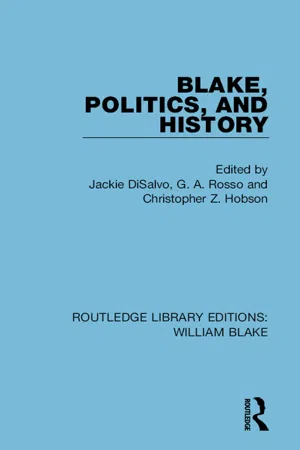
First published in 1998, this book formed part of an ongoing effort to restore politics and history to the centre of Blake studies. It adopts a three pronged approach when presenting its essays, seeking to promote a return to the political Blake; to deepen the understanding of some of the conversations articulated in Blake's art by introducing new, historical material or new interpretations of texts; and to highlight differing perspectives on Blake's politics among historically focused critics. The collection contains essays with varying methodological assumptions and differing positions on questions central to historicist Blake scholarship.
eBook - ePub
Blake, Politics, and History
- 466 pages
- English
- ePUB (mobile friendly)
- Available on iOS & Android
eBook - ePub
Blake, Politics, and History
About this book
Information
Part I Blake and the Question of Revolution
1. The Myth of Blake's “Orc Cycle”
Christopher Z. Hobson
DOI: 10.4324/9781315675176-1
Every student of Blake is acquainted with the “Orc cycle,” the masterful construction by which Northrop Frye argued that Orc embodies inherent patterns of cyclic repetition. Orc, Frye says, begins as rebel but grows into his seeming opposite, Urizenic restraint, in a process that will repeat endlessly unless transcended by the attainment of higher consciousness. This development also entails a turn from political or social revolution (the Orc principle) to mental apocalypse.
Like much of Frye’s reading of Blake, the “Orc cycle” has had enormous impact. Most major interpretations of Blake in the last thirty years have echoed or endorsed it, if often with qualifications. If Frye’s construct has been less discussed in the last dozen years or so, this may be partly because much Blake criticism has turned away from large-scale mythic interpretation. Yet, even in recent work one finds a continued litany of reference to the “Orc cycle” and its constituent elements. Though John E. Grant already suggested in 1982 that Frye’s idea “doesn’t work often enough to clarify much of what Blake actually wrote,” it remains today, as Grant complained then, “a current spectre”(440).1
Debate about the “Orc cycle” has largely involved thescope of the concept—whether it applies to all of Blake’s prophetic works, as Frye and perhaps a majority of interpreters have found, or “does not exist as a completed pattern in the Lambeth books” and emerges only with Orc’s serpent transformation in The Four Zoas, as argued by Morton D. Paley(Energy 80–81, 115) and others. Even left-wing interpreters, such as David V. Erdman and Michael Ferber, have acquiesced in its applicability to some of Blake’s works, especially later ones. In the 1970collection Blake’s Visionary Forms Dramatic, for example, Erdman argued that America andEurope showed a cycle of“enslavement-liberation-reenslavement,” not one of“rebellion-vengeance-tyranny,” and hence did not fit Frye’s model. Yet Erdman affirmed a “slave-rebel-tyrant” progression in post-Lambeth work, so that the challenge to Frye’s idea remained limited (“America: New Expanses” 112).2
In these and other commentaries the “cycle” has served as a marker of Blake’s political attitudes. Those who affirmed it, especially in early works, saw Blake as already ironic or negative toward Jacobin France and revolutionary violence, already conceiving apocalypse as mental transformation; those who minimized its significance dated his criticisms of Jacobinism much later. Despite these disagreements, there has been now for many years a rough consensus that “something like an‘Orc cycle’ can be said to exist” in Blake’s later work (Paley,Energy 115), with continuing uncertainty over whether it is also found in the early work. Though I mean to challenge this consensus, it has in part supplied the terms of my discussion. In what follows, I examine, first, the “Orc cycle” as presented by Frye and echoed by some more recent writers; next, the related questions of the affinity of Orc to Urizen and of Blake’s snake symbolism; and then the issue of Orc’s cyclicality in Blake’s later work. I close by considering the possible intellectual derivation of the “Orc cycle” idea.
Despite its wide influence, the “Orc cycle” is almost entirely a product of Frye’s imagination, not Blake’s. Frye’s construct fails the most conservative of all methodological tests, that of textual and graphic evidence. While the idea of an “Orc cycle” is not totally without foundation, Blake does not present Orc as having a cyclically recurrent existence, does not suggest that he develops organically into Urizen, and does not, through the snake symbolism frequently applied to Orc, associate him either with the idea of periodic renewal or with that of eternal recurrence. Many of the secondary elements of Frye’s Orc paradigm, repeated by other interpreters—such as Orc’s crucifixion and his resemblance to the ouroboros or tail-eating serpent—are also erroneous. And, though Blake is indeed concerned with repetition in history, he does not use Orc, as character or symbol, to explOrc that problem; separate systems of reference embody these concerns.3 Orc is and remains, for Blake, a multivalent symbol of oppression and opposition, though what this means and Blake’s attitude toward it change radically in the course of his career. The “cycle,” then, tells us less about Blake than about his interpreters and about the ideological uses to which a critical construction can be put.
Frye's Epic Machinery
At the risk of treading familiar ground, it is necessary to recall Frye’s formulation of the “Orc cycle” in some detail. The cycle is a recurrent process in which life is “born as Orc, ages as Urizen, dies as Satan, … and is reborn in another Orc” (234).4 Historically, Orc stands for “the power of the human desire to achieve a better world which produces revolution and foreshadows the apocalypse”(206). Yet:
If we turn from human history to nature ... we see that revolution, in the sense of a renewal of energy and the power to live, is not haphazard but cyclic… . Orc, then, is not only Blake’s Prometheus but his Adonis, the dying and reviving god of his mythology. ... If Orc represents the reviving force of a new cycle, whether of dawn or spring or history, he must grow old and die at the end of that cycle. Urizen must eventually gain the mastery over Orc, but such a Urizen cannot be another power but Orc himself, grown old.(207, 210)
Thus, if the desire “to achieve a better world” is expressed through revolt, it will undergo a natural life cycle in which its rebellious impulses, “grown old,” become repressive, or Urizenic.
To this set of associations connected with diurnal, seasonal, and life cycles, Frye adds a second set based on the snake imagery often used for Orc, which he links both to the idea of eternal recurrence and to the crucifixion:
The serpent with its tail in its mouth is a perfect emblem of the Selfhood: an earth-bound, cold-blooded and often venomous form of life imprisoned in its own cycle of death and rebirth… . [T]he zodiacal sun … symboliz[es] the fallen conception of eternity as indefinite or endless recurrence. The image for this is the circle; and the serpent in a circular form with its tail in its mouth is therefore a perfect symbol of the zodiac, being so employed by the Druids. (135, 140–41)Orc, or human imagination trying to burst out of the body, is often described as a serpent bound on the tree of mystery, dependent upon it, yet struggling to get free… . The energy of Orc which broke away from Egypt was perverted into the Sinaitic moral code, and this is symbolized by the nailing of Orc in the form of a serpent to a tree. This was a prototype of the crucifixion of Jesus, and the crucifixion, the image of divine visionary power bound to a natural world symbolized by a tree of mystery, is the central symbol of the fallen world. (136–37)
Frye extends these identifications—Orc as a cyclic process of organic death and renewal, Orc as visionary power “bound to a natural world”yet “struggling to get free”—in a widening series of associations. The “coming of Jesus is one of [Orc’s] reappearances” (129); others are Prometheus (137, 225); Adonis (207, 225); Samson (215); Moses, St. George, and “Albion in his fallen aspect” (225). In perhaps his broadest application of the idea, Frye explains the “Seven Eyes of God” of Blake’s later myth, which he sees as historical periods, as manifestations of the “cycle.” “Each runs from a youthful Orc to an aged Urizen,” beginning with “the birth and binding of Orc,” a period of “works of imaginative power,” proceeding through an era of“sophisticated rationalism … under the symbol of Urizen,” and finally dying in a paroxysm of war and tyranny “symbolized by the crucifixion of Orc, in the form of a serpent, on the tree of mystery” (211). Thus when Frye views the “cycle” as the life cycle of a culture, Orc appears twice, once in its youth as creative force(evolving into Urizen), and once in its old age as rebel and victim. Frye is particularly insistent on Orc’s crucifixion; he refers to the “crucifixion of Orc as Jesus” (212), mentions “the brazen serpent hung by Moses on a pole, which was accepted by Jesus as a prototype of his own death,” as a referent for Orc’s crucifixion as“hanged serpent” (213),5 states that “Orc dies on the cross”(228), and reverts to the idea frequently (215, 223, 283, 299).
Naturally, not every aspect of Frye’s formulation has been adopted by later critics, even those who directly acknowledge their debt to him. But it is striking how much has been taken over, often wholesale. Leopold Damrosch, discussing Blake’s use of snake symbolism, endorses “the ‘Orc cycle’ (as Frye has definitively named it),” and appends the passage quoted above, on Orc as bound and nailed serpent (107, 106). Hazard Adams, without specifically citing Frye, and while restricting the “cycle” to Blake’s later work, repeats several key elements of Frye’s formula:
The crucifixion of Orc in Blake’s prophetic books takes up this whole curious [Gnostic] tradition. In the earlier prophetic books Orc is political and spiritual regeneration.... In the later prophetic books, Orc has become a cyclical concept … and we find much irony in his Gnostic connections, his activity being circular and confining like the tail-eater. (“Synecdoche” 56)
And Nelson Hilton, though not concerned with the “cycle” per se, refers casually to its elements: “The ‘Orc cycle’ begins and ends in anorb, a fear-filled symmetry” (179). Other writers, similarly, adopt various elements of Frye’s system: the Orc-Urizen equivalence; Orc’s crucifixion with its referents to Christ and the serpent on the pole; the relevance of the tail-eating ouroboros.6
Even before one examines the evidence for the “cycle” in Blake’s texts, two characteristics stand out in Frye’s system. The first is that it is unusually dependent on its own internal logic. In the first long quotation above, Frye’s argument is internally generated in a series of “if-then” statements: “If we turn from human history to nature, … Orc, then, is not only Blake’s Prometheus but his Adonis … If Orc represents the reviving force of a new cycle, whether of dawn or spring or history, he must grow old and die at the end of that cycle” (207, 210, my emphasis). Frye does not show that Blake’s texts require us to make the turn to nature, but once Frye has made it, he derives conclusions and new premises from it until, in the end, it becomes self-confirming.7 Related to this characteristic is a disconcerting catholicity in which the “cycle” ceases to refer specifically to Orc or to rebellion and instead becomes “the entire process of life and death which goes on in our world” (234). Such inclusiveness allows the “cycle” to mean almost anything, and in what follows I shall confine myself rather strictly to the cOrc idea of Orc’s cyclicality and the evidence for it.
When we try to verify Frye’s statements about the “cycle” by turning to the texts, we encounter a kind of environmental disaster, in which rusted and broken epic machinery crowds the landscape, obsolete and nonfunctional, leaking contaminants into the soil. First and most important, Orc is never presented in any of Blake’s texts as having a cyclic existence, that is, as growing old, dying, and returning. Among the Lambeth books, Europeshows what may be Orc’s birth, The Song of Los his chaining on a mountain, and Urizen his birth and binding. Though they date his advent differently—the first two around the time of Jesus, the last soon after the primal organization of matter—none shows a cyclic return. In The Song of Los, for example, Orc remains chained during asingle sequence of historical decline traced through Jesus, Mohammed, and the Middle Ages to the eighteenth century. Orc, further, is never described as growing old and dying(Frye 210) or as aging into Urizen (234), nor is Urizen ever described as an older Orc (210).8
Orc is further never described or shown crucified—anywhere in Blake. He is not shown “[dying] on the cross” (Frye 228) or nailed or tied to a tree or a cross, either as boy or snake. Orc in his human form is described and shown bound or chained to a rock or mountain, or under the earth (A 1 and elsewhere), nailed to a mountain or rock (FZ Nights 5, 60:28, and 7A, 79:1,17–18), but never bound or nailed to a tree. Fuzon, after he is felled by Urizen, is nailed to a tree (Ah 4:5–8), as is Luvah in The Four Zoas (7B, 92:13), but these characters are best regarded as analogues rather than incarnations of Orc.9 The verbal and graphic images of Orc on mountain or rock do liken him to Prometheus, who, in turn, was frequently identified typologically with Jesus; Frye considers both figures “allotropic forms of Orc”(137). To identify Orc’s Promethean binding as crucifixion, however, would seem to require some fusion of imagery, as when Prometheus is shown bound to a cross in a seventeenth-century woodcut or, in Shelley’s Prometheus Unbound, the Chorus compares present social conditions to “a pillow of thorns” for Prometheus’s head (1:563).10Blake, in contrast, avoids using such emblems as the crown of thorns or the cross in his depictions of Orc.
If Orc as human youth is not shown crucified, what about his analogue, the snake? Though frequently described as a serpent on a tree, Orc is never described as “bound” to it or “struggling to get free” (Frye 136–37); whenever he appears on the tree, whether in positive or negative contexts, he is free of physical bonds and usually active:
The terror answerd: I am Orc, wreath’d round the accursed tree:The times are ended; shadows pass the morning gins to break; (A 8:1–2)
he [Urizen] made OrcIn Serpent form compelld stretch out & up the mysterious treeHe sufferd him to Climb that he might draw all human formsInto submission to his will (FZ 7A,81:3–6)
No snake in a design that can be shown on other evidence to refer to Orc is “hanged” (Frye 213), nailed, or chained to anything. As Frye and others have discussed, the serpent on a pole or cross is a traditional typology of the crucifixion, and Blake does show a serpent nailed to a cross in his illustrations for Paradise Lost, in “The Everlasting Gospel,” in an associated epigram, and in his pencil drawing of the Last Judgment (c. 1809)and its accompanying descriptive text, but these designs and texts are not associated with Orc.11 It is also true that Orc (implicitly as serpent) is described at several points as wreathing the tree and that some Gnostic traditions identify the snake on the tree in Eden as a type of Christ. In such traditions the serpent is redemptive because it induced Adam and Eve to disobey the creator of the fallen world; by extension, Jesus, who also sought transcendence of this world, could be regarded as either an incarnation or an analogue of the serpent.12But not all Gnostic traditions made this further identification, and in any case such a parallel does not allo...
Table of contents
- Cover Page
- Half Title Page
- Title Page
- Copyright Page
- Title Page
- Copyright Page
- Preface
- Dedication
- Contents
- Figure
- Acknowledgements
- Introduction
- Abbreviation
- Half Title
- Part I Blake and the Question of Revolution
- 1. The Myth of Blake's “Orc Cycle”
- 2. Blake's Bible of Hell: Prophecy as Political Program
- 3. The Anxiety of Production: Blake's Shift from Collective Hope to Writing Self
- 4. William Blake's Figurai Politics
- Blake and the Underground
- 5. “The Doom of Tyrants”: William Blake, Richard “Citizen” Lee, and the Millenarian Public Sphere1
- 6. Blake's Tiriel and the Regency Crisis: Lifting the Veil on a Royal Masonic Scandal
- Laboring Into Futurity: A Response
- Part II Art and Politics
- 7. “Lovers of Wild Rebellion”: The Image of Satan in British Art of the Revolutionary Era
- 8. The Mob and“Mrs Q”: William Blake, William Benbow, and the Context of Regency Radicalism
- The French Revolution, ‘America” and “Europe’
- 9. Politics and Desire in Blake's The French Revolution
- 10. “The Lion & Wolf shall cease”: Blake's America as a Critique of Counter-Revolutionary Violence
- 11. The Finite Revolutions of Europe
- 12. Re-Framing the Moment of Creation: Blake's Re-Visions of the Frontispiece and Title Page to Europe
- Par III Blake, Empire and Slavery
- 13. Empire of the Sea: Blake's “King Edward the Third” and English Imperial Poetry
- 14. Revolted Negroes and the Devilish Principle: William Blake and Conflicting Visions of Boni's Wars in Surinam, 1772–1796
- Blake and Women
- 15. Albion and the Sexual Machine: Blake, Gender and Politics, 1780–1795
- 16. Transfigured Maternity in Blake's Songs of Innocence: Inverting the “Maternity Plot” in“A Dream”
- 17. Maenads, Young Ladies, and the Lovely Daughters of Albion
- Blake, Gender and Imperial Ideology: A Response
- Works Cited
- Contributors
- Index
Trusted by 375,005 students
Access to over 1.5 million titles for a fair monthly price.
Study more efficiently using our study tools.
Frequently asked questions
Yes, you can cancel anytime from the Subscription tab in your account settings on the Perlego website. Your subscription will stay active until the end of your current billing period. Learn how to cancel your subscription
No, books cannot be downloaded as external files, such as PDFs, for use outside of Perlego. However, you can download books within the Perlego app for offline reading on mobile or tablet. Learn how to download books offline
Perlego offers two plans: Essential and Complete
- Essential is ideal for learners and professionals who enjoy exploring a wide range of subjects. Access the Essential Library with 800,000+ trusted titles and best-sellers across business, personal growth, and the humanities. Includes unlimited reading time and Standard Read Aloud voice.
- Complete: Perfect for advanced learners and researchers needing full, unrestricted access. Unlock 1.5M+ books across hundreds of subjects, including academic and specialized titles. The Complete Plan also includes advanced features like Premium Read Aloud and Research Assistant.
We are an online textbook subscription service, where you can get access to an entire online library for less than the price of a single book per month. With over 1.5 million books across 990+ topics, we’ve got you covered! Learn about our mission
Look out for the read-aloud symbol on your next book to see if you can listen to it. The read-aloud tool reads text aloud for you, highlighting the text as it is being read. You can pause it, speed it up and slow it down. Learn more about Read Aloud
Yes! You can use the Perlego app on both iOS and Android devices to read anytime, anywhere — even offline. Perfect for commutes or when you’re on the go.
Please note we cannot support devices running on iOS 13 and Android 7 or earlier. Learn more about using the app
Please note we cannot support devices running on iOS 13 and Android 7 or earlier. Learn more about using the app
Yes, you can access Blake, Politics, and History by Jackie DiSalvo,G. Rosso,Christopher Hobson,G. A. Rosso,Christopher Z. Hobson in PDF and/or ePUB format, as well as other popular books in Literature & Literary Criticism. We have over 1.5 million books available in our catalogue for you to explore.