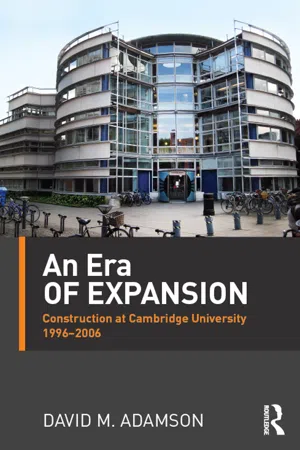
Changing conditions in Higher Education and national funding regimes preceded a proliferation of construction projects in universities between 1996 and 2006. This book reviews a hundred projects between 1996 and 2006, and uses 9 detailed case studies from the author's time in charge of capital projects at the University of Cambridge to show us how these projects were conceived, argued for, designed, procured, managed, constructed, and passed on to building users. Readers with an interest in project management, estate management, University management, or the history of the University of Cambridge will find this fascinating and wide-ranging book to be uniquely valuable.
eBook - ePub
An Era of Expansion
Construction at the University of Cambridge 1996–2006
- 302 pages
- English
- ePUB (mobile friendly)
- Available on iOS & Android
eBook - ePub
An Era of Expansion
Construction at the University of Cambridge 1996–2006
About this book
Information
1 A history of the estate of the University of Cambridge
DOI: 10.4324/9781315724591-1
Hinc lucem et pocula sacra.From this place, we gain enlightenment and precious knowledge.University of Cambridge motto
History always matters; to understand how the University of Cambridge meets its current challenges, understanding its history is crucial. How the University managed its estate in response to the sudden burst of building opportunities and demands at the end of the twentieth century is rooted in the way the estate was then configured and how people thought about it. The locations and nature of University buildings were shaped by centuries of decisions by small groups of highly motivated and highly intelligent academics dedicated to developing their own subject interests; only rarely were these decisions made within any sort of overall University-level planning. Further, a higher priority was given to implementing current academic leaders’ needs as current academic leaders saw them, than to anticipating the needs of those who would succeed them. So, while at the start of the decade documented in this book, some of the University estate was effective by current criteria, large chunks of it were far short of the top international standards of its researchers, teachers and students, and overall it was managed in a fragmented way serving laudable, and justifiable, but rather immediate aims. The estate challenge suddenly facing the University as it approached the Millennium was how to stitch together the best aspects of that fragmented past with the huge abilities of its current academics, and to meet the need to modernise and greatly expand its stock of buildings and infrastructure; and to fund and manage the tsunami of construction projects that swept through the University.
The early days
In the beginning there was Oxford and over to the east near the edge of the coastal swamps a market settlement around the bridge over the River Cam. As in other settlements in the Fens, diseases there were rife and strangers unwelcome, but when a small group of young men appeared saying that they’d come from Oxford fearing for their lives after a tavern brawl in which a young woman, maybe a bar-girl, was killed and a couple of the students involved were hanged by the townsfolk, they were allowed to settle. And settle they did, supported by the many religious foundations. And thus started the chain of events that led to the University of Cambridge.
That was in or around 1209. The Cambridge area had long been settled. Recent excavations in the grounds of Fitzwilliam College have unearthed flint tools and pottery from a farm that was flourishing around 3,500bc. The first known bridge over the Cam (or Granta as it was then called) was built by 875ad as a key link for the market town and, as the Domesday Book of 1086 noted, there were already prosperous residences and businesses, and many religious institutions with a lot of power and independence since the church had stood up to the King after the murder of Becket four decades earlier; it was into these institutions that the six scholars from Oxford settled. 1 One can only imagine what it must have been like for these young lads: tired and a bit frightened, rather confused, and probably rather unwelcome. But they set about continuing their studies, and increasingly teaching others: the logic of closely pairing research and teaching has long been one of the great strengths of the University, and has been stoutly defended through the ages.
The subjects that young students of those early days were studying were streamed: first a grounding course in grammar, logic and ‘disputation’, music, arithmetic, geometry and astronomy. Some students, on completing those studies, went on to study law, divinity and medicine at what we would now see as ‘University level’. The ‘scholars’ (students) were ‘clerks’, training to be clergymen. The considerable breadth of studies reflected well the breadth of what was seen as the world’s knowledge. (It is interesting to compare that breadth of education with the recent trend back towards inter-disciplinarity.)
There grew, certainly by 1226, an organised network of classes of scholars, the senior of whom acted as supervisors, or ‘Masters’; their leader, from 1412, was called ‘the Chancellor’. The scholar market soon became more regulated: King Henry III set out rules to protect scholars from the landlords who were ripping them off for rent, and to legislate that only scholars enrolled by recognised Masters could stay in town. Soon there was a body of Masters who, with the Chancellor, and later his deputy the Vice-Chancellor, were regulating examinations as well as classes, with different levels of scholars, then as now, differentiated by the length of their gowns and colour of their caps and hoods.
Extensive records of property, either privately owned or owned by the religious foundations, still exist. Over the centuries, property of both types were transferred to the nascent Colleges, from the thirteenth century onwards, and especially after the Dissolution of the Monasteries from 1536. An early significant property transfer, in 1284, by the Bishop of Ely (Hugh Balsham) was St Peter’s House, set up as Peterhouse, the first College to survive to the present day. From then on, the Colleges continued to grow in number and size. At times, the growth was stimulated and achieved by royal patronage (especially of Lady Margaret Beaufort and Henry VIII), at times stimulated when monarchs and governments had particular suspicion of Oxford. It is suggested, for example, that Henry VI’s worries about ‘Oxford’ influence in his court led him to the surprising decision to have King’s College set up in Cambridge; and later, for a while during the Reformation, Oxford was seen as a ‘hotbed of Lollardry’, though to be fair, a lot of key reformers were also in Cambridge.
‘The University’ as an organisation is not be conflated with the Colleges per se which were and are legally separate entities, albeit closely and generally amicably entwined with the University; they hold their own estates quite separate from the University estate with which this book is concerned: matters of College estates are only mentioned in this record when they affect the University estate directly.
The first building to be erected specifically for teaching in the University was the (Old) Divinity School. The site, a slight mound of gravel, later used by King’s College and the Old Schools, was bought in 1278 (so, the start of the University estate just before the foundation of the first College to survive), but it was not until about 1350 that the first building was started, to be completed around 1400 (the construction time hence being about five times as long as that of the 100-odd projects that were to expand the University by 33 per cent from 1996 to 2006). That first building, with its windows of irregular shape, was built for the purpose of teaching Divinity. There were further buildings on the site: in 1430–1460 for the teaching of canon law, and in 1457–1470 for teaching civil law and philosophy, with a library. The West Court of the Old Schools (including the Syndicate Room and offices for the Registrary and others) includes the Council Room (finished in 1466). Its ante-room, known as the Dome (the VC’s office, since 1975), was formerly part of King’s College: it was above the porters’ lodge of the original court of King’s College.

By courtesy of info@Cambridge 2000
It was during the mid fifteenth century that the University started to develop its estate. Land around the current Senate House was bought to put up buildings for teaching and ‘disputations’, a chapel and a library, and a ‘treasury’ for chests to hold the money paid by scholars. The University’s financial assets are still known as ‘The Chest’, and one such ‘chest’ lies in the office of the Registrary (Registrar in other universities). As long as the University estate was just the buildings around the Old Schools, it was relatively easy for its management to be sensibly controlled by a small group of the Masters under their Chancellor. Later however, when teaching and research requirements increased, and the actual and perceived autonomy of emerging Faculties (departments) grew (in a manner that in some ways reflected the well-established autonomy of the Colleges), it became more and more difficult to develop and maintain an overall plan of what the University owned and have some idea of how that should best be developed and managed. Indeed, it was not until nearly 800 years after the start of the University that it developed and agreed a coherent schedule of its estate, by then worth £2.4bn, and began to analyse how it should be developed.
The University estate grew non-contiguously, and in a manner which could be called haphazard, but which equally and more constructively can be seen as a series of generally sensible decisions by clever men who usually discussed matters sensibly: sometimes at huge length and repeatedly, sometimes briefly, often in caucuses deliberately limited and shaped to suit the dominant players. The decision-makers were, as now, leaders in their departments and in their Colleges: all academics for much of the University’s history had to have College Fellowships. (In recent decades with rapid growth in academic numbers but little increase in the number of Colleges, the proportion of academics with College Fellowships has fallen considerably.) It was from the mid-sixteenth century that the Colleges as such started to play a central role in how the University itself developed, with their Heads of House taking key University roles.
Although there was little expansion beyond the area of what now is the Old Schools, maintenance of those buildings was documented. An account of a contract dated 25 June 1466 notes: 2
A contract for Indenture of covenant for carpenter’s work on the old Schools [to] … supply, carriage and workmanship of timber for the floors and roof of the new Schools before Lammas Day for payment of £23 6s 8d in addition to the £10 paid at the making of the agreement.
A church existed on the site of Great St Mary’s (properly, the church of St Mary the Great) by 1205; however there was a major fire in 1290, with re-construction, and then re-consecration in 1351. An attack during the Peasants’ Revolt in 1381 led to the Statutes and Charters being taken out and burnt in the Market Place (later Square). The church was also the administrative centre of the University until 1730 when Senate House became the centre for meetings and discussions. Further work was done on the church from 1478, a tower being built from 1491 and the nave roof finished in 1508. Archbishop Parker, Master of Corpus Christi College, had much of these works done and left enough money for their completion. Nearly 500 years later, a scheme to erect a spire, which had probably been the original intention, did not come to fruition.
By the end of the sixteenth century there was an organisation of Proctors and two Esquire Bedells whose purpose was leading at official University functions and certifying University accounts (the Proctors held one of the two keys needed to gain access to the University Chest, where its money was kept, the Vice-Chancellor had the other), and also for keeping good order generally around the streets and Colleges. The University Marshall had a lesser ceremonial and administrative role. An annual report from 1575 includes a note of the work of Junior Proctors on ‘repairs – upkeep of building, street cleaning and night wonderers [sic]’. In 1630, the managers of the University estate decreed that bear-baiting should not take place on its premises.
From 1700
By the late seventeenth century, the well-being of local bears thus safeguarded, construction of the current Senate House was commissioned; this was required to release space for expansion of shelving in the University Library in the Old Schools, for the rapidly increasing number of printed books. (The University Library had begun as a collection of books stored in the tower of Great Saint Mary’s University Church in the mid-fourteenth century.) The procurement of the Senate House building was long and tortuous with endless argument about the specification of the building. A design idea was developed in 1713–1714 by Nicholas Hawksmoor, who was an assistant to Wren. That scheme got dumped, but in 1722 a design by James Gibbs (also the architect for King’s College Fellows’ Building) was accepted, and work started that year; but then part way through construction, money ran out and work stopped. Most of the Senate House was finally completed in 1730, the west end being finished 38 years later. It is an appropriate building, dignified, well placed in its setting and still big enough for today’s purposes. As might be expected, the heating system was primitive (it had a charcoal-burning stove and needed a lot of expensive upgrading over the years). Also, the acoustics were not good for the purposes for which the building would later be used. When electricity came along, it was provided by the Bailey Grundy Electric Company which generated electricity in a building behind Kenmare, a house on Trumpington Street (currently the home of Estate Management and Building Services), and transmitted at low voltage along underground cables to Senate House. There were various nugatory schemes to extend the area of the Old Schools: one was aborted by a counter-proposal from the Chancellor, which was then itself voted down.
An Observatory was built in 1822–1823 on land sold to the University by St John’s College, on its present site off Madingley Rd; an earlier construction in Trinity College was never completed. From 1824, a site was assembled by the University for the Pitt building, largely by buying (for £12k) and demolishing two houses as close to Pembroke College as possible. The building’s cost, some £11k, was partly funded by public subscription in memory of William Pitt the Younger, MP for Cambridge, and an alumnus of Pembroke College. It was to be used for printing books, at first largely of a religious nature, by Cambridge University Press. (Printing started in the University in 1583 following ‘a royal charter’ by way of ‘letters patent’ to the University by Henry VIII in 1534.) 3 The foundation stone was laid with great ceremony in 1831 and the Press with its high central tower and tall windows was opened in 1833: there is a wonderful description in Council papers of how ‘the University’ formed up by the Senate House and, led by the VC, ‘processed’ down for the opening. 4
From the mid nineteenth century
Estate development proceeded piecemeal, albeit purposefully. In 1853 a four-acre site (land once owned by the Austin Friars) around the area of the current New Museums Site was bought for £3,448 from the...
Table of contents
- Cover
- Halftitle Page
- Title Page
- Copyright Page
- Dedication Page
- Contents
- List of figures
- List of tables
- Foreword
- Preface
- Acknowledgements
- 1 A history of the estate of the University of Cambridge
- 2 Why did it all happen then, and why so fast?
- 3 Planning the estate – regional and local land planning
- 4 University management of capital expenditure
- 5 Management of building projects in the University
- 6 The Sidgwick story
- 7 The rise and rise of health research
- 8 Development of the University in the city
- 9 The road out of town
- 10 The West Side story
- 11 North West Cambridge – the planning stages
- 12 Overview and lessons from the estate expansion 1996–2006
- Index
Trusted by 375,005 students
Access to over 1.5 million titles for a fair monthly price.
Study more efficiently using our study tools.
Frequently asked questions
Yes, you can cancel anytime from the Subscription tab in your account settings on the Perlego website. Your subscription will stay active until the end of your current billing period. Learn how to cancel your subscription
No, books cannot be downloaded as external files, such as PDFs, for use outside of Perlego. However, you can download books within the Perlego app for offline reading on mobile or tablet. Learn how to download books offline
Perlego offers two plans: Essential and Complete
- Essential is ideal for learners and professionals who enjoy exploring a wide range of subjects. Access the Essential Library with 800,000+ trusted titles and best-sellers across business, personal growth, and the humanities. Includes unlimited reading time and Standard Read Aloud voice.
- Complete: Perfect for advanced learners and researchers needing full, unrestricted access. Unlock 1.5M+ books across hundreds of subjects, including academic and specialized titles. The Complete Plan also includes advanced features like Premium Read Aloud and Research Assistant.
We are an online textbook subscription service, where you can get access to an entire online library for less than the price of a single book per month. With over 1.5 million books across 990+ topics, we’ve got you covered! Learn about our mission
Look out for the read-aloud symbol on your next book to see if you can listen to it. The read-aloud tool reads text aloud for you, highlighting the text as it is being read. You can pause it, speed it up and slow it down. Learn more about Read Aloud
Yes! You can use the Perlego app on both iOS and Android devices to read anytime, anywhere — even offline. Perfect for commutes or when you’re on the go.
Please note we cannot support devices running on iOS 13 and Android 7 or earlier. Learn more about using the app
Please note we cannot support devices running on iOS 13 and Android 7 or earlier. Learn more about using the app
Yes, you can access An Era of Expansion by David Adamson,David M. Adamson in PDF and/or ePUB format, as well as other popular books in Technology & Engineering & Construction & Architectural Engineering. We have over 1.5 million books available in our catalogue for you to explore.