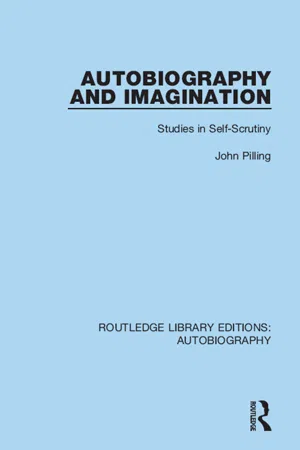
Originally published in 1981. This book looks at the autobiographical work of nine twentieth-century writers – Henry Adams, Henry James, W. B. Yeats, Boris Pasternak, Leiris, Jean-Paul Sartre, Vladimir Nabokov, Henry Green and Adrian Stokes. The author argues that often the writer has shaped his life through his craft, coming to understand the pattern of his own existence through the formalism of language. In each case the writer stamps his personality on the work by mean of a distinctive verbal surface whose discipline enables him to evade narrow egotism and forces both reader and writer into an act of collaboration and corroboration. Written at a time when criticism was turning to focus on the relation between the reader and the text, this study added a provocative dimension to the debate and is still an important read today.
- 178 pages
- English
- ePUB (mobile friendly)
- Available on iOS & Android
eBook - ePub
About this book
Information
1 Henry Adams: ‘The Education of Henry Adams’ (1907)
DOI: 10.4324/9781315674575-1
In a letter of 1903, the year in which he began to write the book for which he is best known, Henry Adams commended his erstwhile compatriot Henry James for a book that is now largely forgotten: ‘William Wetmore Story and his Friends’. ‘You have written’, Adams told him, ‘not Story’s life, but your own and mine, – pure autobiography.’(1) Four years later Adams sent out the first of a hundred privately printed copies of his own version of his life, ‘The Education of Henry Adams’. As early as 1883, in a letter to his lifelong friend John Hay, Adams explained in the ironical manner that was now second nature to him the advantages of the genre:
I am clear that you should write autobiography, I mean to do mine. After seeing how coolly and neatly a man like Trollope can destroy the last vestige of heroism in his own life, I object to allowing mine to be murdered by any one except myself. Every church mouse will write autobiography in another generation in order to prove that it never believed in religion.(2)
Despite his fondness for literature that was more or less autobiographical (he seems not to have drawn a distinction between biography and autobiography) Adams regarded it, as he came to regard almost everything, with suspicion and scepticism. Adams’s letters are peppered with splenetic outbursts against biographies, all predicated on the fact that he ‘never knew a mere biography that did not hurt its subject.’(3) His feelings were, not unnaturally, at their most intense where members of his family were concerned:
I’ve been trying to read my brother Charles’s Life of our father. Now I understand why I refused so obstinately to do it myself. These biographies are murder.… They belittle the victim and the assassin equally. They are like bad photographs and distorted perspectives … I have sinned myself … [but] I did not assassinate my father.(4)
The image of biography as a kind of murder was habitual to Adams, whether it was Morley ‘taking’ Gladstone’s life or the hypothetical biographer of John Hay as a strychnine poisoner.(5) And yet, as Adams admitted in the letter quoted above, he had often played the role of biographer himself. In 1879 he published the ‘Life of Albert Gallatin’; a biography of John Randolph followed in 1882, the same year in which he prepared a biography of Aaron Burr that was never published. In 1893 he printed privately his free adaptation of the memoirs of Queen Marau of Tahiti, later revised and enlarged for another private printing in 1901. His last major enterprise was ‘The Life of George Cabot Lodge’ published in 1911.
Adams had indeed ‘sinned’ so persistently against his own beliefs that it may seem difficult to absolve him of duplicity in the matter, especially when in March 1907 he wrote to Elizabeth Cameron that he would not write a memoir of his friend John Hay,(6) and yet in the following year a twenty-two page memoir by Adams (unsigned) appeared as a preface to Hay’s widow’s compilation of her husband’s letters and diaries. The truth would seem to be that, whilst Adams had genuine enough intellectual objections to this kind of literature, he never entirely freed himself of an emotional attachment to it that was endemic in the culture of his family.(7) His range of reading was so wide, so encyclopedic almost, that it would be wrong to single out personal literature as his particular obsession, but his suspicion of the various forms that such literature might take was clearly grounded in more than a nodding acquaintance with those forms. As a historian his commitment to written records of past lives could not be less than total, even if he later affected a devil-may-care attitude to facts and details. And when it came to writing a version of his own life, he was hyper-conscious of the formal problems that had attended previous enterprises in the genre, as perhaps only someone with a profound knowledge of such literature could have been.
Adams’s preference in the genre of personal literature seems to have been for ‘memoirs’. As early as 1869 we find him writing to his English friend Gaskell: ‘I am myself preparing a volume of Memoirs which may grow to be three volumes if I have patience to toil. It is not an autobiography – n’ayez pas peur. An ancient lady of our house has left material for a pleasant story.’(8) The hostility to autobiography that is evident here surfaces again in the letter to John Hay already quoted, and is an inseparable part of Adams’s distrust of egoism in all its forms. ‘The ego may pass in a letter or a diary’, he told his brother Brooks, ‘but not in a serious book.’(9) This takes up an idea mooted in a letter of 1882, to Henry Cabot Lodge (‘If we could only be impersonal, our books would be better than they are.…’)(10), and prepares us for the most striking feature of the ‘Education’, Adams’s rejection of the first person in favour of the third. By the time of the ‘Education’ Adams had come to believe that ‘annihilation of self’ was ‘the first condition before absorption in a higher unity,’(11) but it is clear from the John Hay letter that self-slaughter also had a less altruistic component in it. A very similar note is struck in a letter to Henry James a quarter of a century later, referring specifically to the ‘Education’: ‘The volume is a mere shield of protection in the grave. I advise you to take your own life in the same way, in order to prevent biographers from taking it in theirs.’(12) It is clear from this letter that, for Adams, ‘annihilation of self’ did not preclude a pre-emptive strike of self-creation. Indeed, as a number of commentators have noted, the adoption of a third-person form in the ‘Education’ thrusts ‘Adams’ before us more decisively than a first-person form would have done.(13)
A corollary of Adams’s stance of anti-egoism was his belief that the subject (in the sense of subject-matter) was more important than the subject in a narrowly grammatical sense. In an early letter to his eldest brother, Adams sees the two as interdependent:
If I write at all in my life out of the professional line, it will probably be when I have got something to say, and when I feel that my subject has got me as well as I the subject.(14)
Fifteen years later the dominance of the one over the other had become an article of faith: ‘I cannot conceive how any rule of prose can be made that shall not require the subject to stand first. This is a general law.…’(15) At the same time Adams was aware that this might lead to monotony and was careful to ‘insist on the law of variety’,(16) particularly where the length of sentences was concerned.(17) This in no sense committed Adams to a belief in ornamentation for its own sake:
the reader ought to be as little conscious of the style as may be. It should fit the matter so closely that one should never be quite able to say that the style is above the matter – nor below it.(18)
Adams was not, as this makes clear, opposed to the development of a personal style. But he certainly believed that the austerity and refinement of ‘styleless’ writing was an ideal to be aimed for. (His love-hate relationship with Carlyle pretty obviously originates from this.) Anything that might bring this ideal close to realization – in particular the erasure of superfluities – earned his strong commendation. ‘Writing is only half the art,’ he wrote to Gaskell in 1867, ‘the other being erasure’;(19) ‘you will find’, he told Henry Cabot Lodge, ‘it pays also to try to condense your sentences’;(20) ‘I am a little toqué about condensation,’ he told Lodge six years later;(21) and as late as 1904, when the ‘Education’ was being written, he reminded Sarah Hewitt: ‘When you come to writing, I can recommend only one rule:- Strike out every superfluous sentence, and, in what is left, strike out relentlessly every superfluous word.’(22) It may seem quixotic that a man who was clearly convinced that ‘what one leaves out contributes more to success than what one leaves in’ should have written a nine-volume history that is probably read, when it is read at all, in an abridged form. But Adams did not confine his strictures on condensation to writers other than himself. When Henry Cabot Lodge turned Adams’s own weapon against him after reading ‘The Life of Albert Gallatin’, Adams readily agreed with him_ ‘You are quite right in regard to Gallatin. Pruning would improve it. I think fifty pages might come out, to great advantage, and perhaps a hundred could be spared.’(23) There are those who would say the same of the ‘Education’, of course, and even in the absence of a manuscript version it is difficult to believe that Adams followed his own advice especially as, in the words of Ernest Samuels, ‘he wrote [it] with what must have been furious speed.’(24)
Adams’s emphasis on condensation is of a piece with his stress on the avoidance of egoism, and both are part and parcel of a very bifocal attitude to literature. Writing to Henry Cabot Lodge in 1880, whilst at work on his ‘History’, Adams told him_ ‘I get into a habit of working only for the work’s sake and disliking the idea of completing and publishing. One should have some stronger motive than now exists for authorship.’(25) In the same year he published his first novel, ‘Democracy’, anonymously, and protected himself from those who guessed his authorship by visiting it upon other authors. Adams’s ambivalence in regard to the question of authorship is memorably expressed in a letter of 1882, to John Hay:
I neither want notoriety nor neglect, and one of the two must be imagined by every author to be his reward. My ideal of authorship would be to have a famous double with another name, to wear what honors I could win. How I should enjoy upsetting him at last by publishing a low and shameless essay with woodcuts in his name! …(26)
In 1884 Adams came close to realizing this ideal by publishing, this time not anonymously but pseudonymously, his second novel ‘Esther’, a book that he described to the publisher as an ‘experiment … [in] whether authorship without advertisement was possible’(27) but which he always thereafter considered to have been written ‘in one’s heart’s blood’.(28) In the last twenty years of his life Adams attempted not so much ‘authorship without advertisement’ as ‘authorship without audience’, confirming his self-fulfilling prophecy that he had ‘printed volume after volume which no one would read’(29) by making it difficult, if not impossible, for anyone not personally selected by him to read his work at all. He could not keep his promise of 1892 that ‘I will never again appear as an author, but I don’t mind writing anonymously’(30) but he did what he could – in an external sense at least – to become as anonymous as possible.
As early as 1867 we find Adams telling Charles Eliot Norton ‘I have suffered so much from publicity that I prefer over-caution’(31) and it is clear that his desire for ‘impersonal’ books was conditioned by his need of what he later called ‘a shield of protection’.(32) In one remarkable letter concerning a book (‘John Randolph’) that was clearly far from ‘impersonal’, Adams went to great lengths to provide himself with a shield after the fact:
My John Randolph is coming into the world. Do you know, a book always seems a part of myself, a kind of intellectual brat or segment, and I never bring one into the world without a sense of shame. They are naked, helpless and beggarly, yet the poor wretches must live forever and curse their father for their silent tomb. This particular brat is the first I ever detested. He is the only one I never wish to see again; but I know he will live to dance, in the obituaries, over my cold grave. Don’t read him, should you by chance meet him. Kick him gently, and let him go.(33)
It is important to recognize that this complex amalgam of self-disgust and self-aggrandizement dates from before the tragic suicide of his wife Marian, after which it is not so much images of birth as images of death that cluster around the fact of book-making for Adams. But the germ of the post-suicide Adams, when he came to believe that ‘all books should be posthumous except those which should be buried before death’(34) can be discerned in his letters from before the time of his marriage, as he develops a stoical indifference to his disenchantment with politics and contentedly predicts that his career will be a failure. Literature offered a respite from his disappointed dreams of statesmanship, just as politics had ousted the law as a possible career. But literature – under which head Adams would have included the writing of articles on economics and books on history – soon revealed itself to him as a medium that was almost as unsatisfactory as those he had left behind, and before he had completed his ‘History’ he had lost confidence that it ‘would be what I would like to make it.’(35) Although he was congenitally incapable of maintaining the silence which he felt to be the only adequate response to life,(36) he grew more and more aware, especially when in the South Seas with his painter friend John La Farge, of the shortcomings of words in the face of reality. ‘Tahiti is not to be described. Don’t expect me to do it,’ he told one correspondent,(37) and only with paradoxes could he describe it to another: ‘I cannot get expression for the South Seas. Languor that is not languid; voluptuousness that is not voluptuous; a poem without poetry.’(38)
It was on the death of John La Farge that Adams, once again facing the question of biography that had so much haunted him, gave most memorable expression to what he saw as the inevitable failure of literature:
The task of painting him is so difficult as to scare any literary artist out of his wits. The thing cannot be done. It is like the attempt of the nineteenth-century writers to describe a sunset in colors. Complexity cannot be handled in print to that degree. La Farge used to deride his own attempts to paint sea and sky and shadow in the South Seas.… At a certain point of development, the literary artist is bound to fail still more, because he has not even color to help him, and mere words only call attention to the fact that the attempt to give them color is a pre-destined failure.(39)
In another letter to the same correspondent Adams developed his theme, adding to his analysis of the literary artist’s problems the motif of self-protection that even the ‘Education’ had not been powerful enough to exorcise:
Luckily, the painter’s world is relatively compact...
Table of contents
- Cover Page
- Half Title Page
- Title Page
- Copyright Page
- Title Page 01
- Copyright Page 01
- Dedication
- Dedication 01
- Table of Contents
- Acknowledgments
- Introduction
- 1 Henry Adams: ‘The Education of Henry Adams’ (1907)
- 2 Henry James: ‘A Small Boy and Others’ (1913)
- 3 W. B. Yeats: ‘Reveries Over Childhood and Youth’ (1914)
- 4 Boris Pasternak: ‘Safe Conduct’ (1931)
- 5 Michel Leiris: ‘L’Age d’homme’ (1939)
- 6 Jean-Paul Sartre: ‘Les Mots’ (1964)
- 7 Vladimir Nabokov: ‘Speak, Memory’ (1966)
- Conclusion
- Appendices
- Notes
- Index
Trusted by 375,005 students
Access to over 1.5 million titles for a fair monthly price.
Study more efficiently using our study tools.
Frequently asked questions
Yes, you can cancel anytime from the Subscription tab in your account settings on the Perlego website. Your subscription will stay active until the end of your current billing period. Learn how to cancel your subscription
No, books cannot be downloaded as external files, such as PDFs, for use outside of Perlego. However, you can download books within the Perlego app for offline reading on mobile or tablet. Learn how to download books offline
Perlego offers two plans: Essential and Complete
- Essential is ideal for learners and professionals who enjoy exploring a wide range of subjects. Access the Essential Library with 800,000+ trusted titles and best-sellers across business, personal growth, and the humanities. Includes unlimited reading time and Standard Read Aloud voice.
- Complete: Perfect for advanced learners and researchers needing full, unrestricted access. Unlock 1.5M+ books across hundreds of subjects, including academic and specialized titles. The Complete Plan also includes advanced features like Premium Read Aloud and Research Assistant.
We are an online textbook subscription service, where you can get access to an entire online library for less than the price of a single book per month. With over 1.5 million books across 990+ topics, we’ve got you covered! Learn about our mission
Look out for the read-aloud symbol on your next book to see if you can listen to it. The read-aloud tool reads text aloud for you, highlighting the text as it is being read. You can pause it, speed it up and slow it down. Learn more about Read Aloud
Yes! You can use the Perlego app on both iOS and Android devices to read anytime, anywhere — even offline. Perfect for commutes or when you’re on the go.
Please note we cannot support devices running on iOS 13 and Android 7 or earlier. Learn more about using the app
Please note we cannot support devices running on iOS 13 and Android 7 or earlier. Learn more about using the app
Yes, you can access Autobiography and Imagination by John Pilling in PDF and/or ePUB format, as well as other popular books in Literature & Literary Criticism. We have over 1.5 million books available in our catalogue for you to explore.