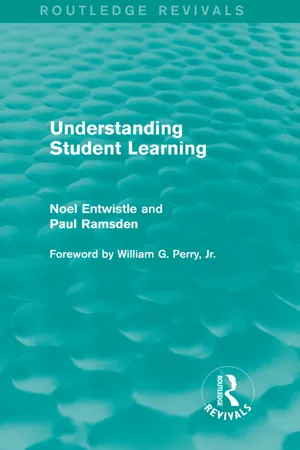
First published in 1983, Understanding Student Learning provides an in-depth analysis of students' learning methods in higher education, at the time. It examines the extent to which these learning methods reflected the teaching, assessment and individual personalities of the students involved. The book contains interviews with students, experiments and statistical analyses of survey data in order to identify successes and difficulties in student learning and the culmination of these techniques is a clearer insight into the process of student learning.
- 248 pages
- English
- ePUB (mobile friendly)
- Available on iOS & Android
eBook - ePub
Understanding Student Learning (Routledge Revivals)
About this book
Information
Chapter One
STUDENT LEARNING IN ITS CONTEXT
Higher education is a large and expensive under-taking. Its effects are felt by all of us. There are currently over half a million full-time students in the British system of education which builds on, and goes beyond, sixth-form studies and their equivalent. A sizeable proportion of the country’s wealth flows into the sixty-seven universities and polytechnics which dominate this sector. Many of the students who graduate from these institutions will eventually occupy some of the most powerful and prestigious positions in our society. Whatever contractions the system may face in the 1980s, no-one would wish to argue that an understanding of what goes on in higher education is unimportant.
It comes as something of a surprise to realise that, as recently as twenty years ago, there was hardly any research into higher education in Britain. Writing in 1972, the editors of a symposium of articles on research in this field could say that
a decade ago, the universities and colleges of Britain were open to the accusation that they did research on almost every topic but themselves … If they were aware of the need for a better understanding both of fundamental principles in teaqhing and learning and of human relationships in the quadrangle, they did singularly little about it. Ten years ago a book of this kind would necessarily have been very thin. (Butcher and Rudd, 1972).
Research into higher education has since established itself in this country, as the founding of new journals and periodicals (such as The Times Higher Education Supplement and Studies in Higher Education) demonstrates. It is interesting to examine Butcher and Rudd’s selection of papers; they give a flavour of the developing pattern of research. There are papers on the objectives and administration of higher education, including the academic profession and its role; discussions of economic and planning issues; articles on student protest; papers concerned with development and change in the student (including, for example, the effects of counselling); articles on experiment and change in teaching methods; and there is a section on the selection and academic performance of students. With the possible exception of the chapter on student protest, this list gives a good summary of the kinds of research which have taken place since, as well as before, 1972.
At the heart of higher education is the three-way transaction between the student, his teacher, and the material being studied. Students in higher education are expected to learn complex subject-matter and develop independence of judgment in the course of a dialogue with their teachers. But little direct attention has been given by researchers to the process of student learning and the effects of teaching on it. Although student performance - measured in terms of degree results - and student wastage have been examined, how the student learns has not, at least until very recently. Although research into teaching methods is well represented - and has expanded greatly since 1972 - inquiries relating the teaching to students’ learning are much less common. The research tradition in the field of higher education has touched on its central triangle but has barely begun to enter it.
How are we to explain this lack of interest? One of the reasons may be the dominant view of lecturers in higher education that success and failure is the responsibility of the individual student. Up to a point, this idea is a very reasonable one. It stems partly from the concern for the individual which distinguishes the British higher education system from its counterparts in other countries. It also has its roots in the experiences of the lecturers themselves when they were undergraduates. They were, by definition, very successful students. The general view seems to be that there are few “good” students - students able to become deeply involved in a subject and evaluate it critically - and many weak or mediocre ones (see Entwistle and Percy, 1974, for evidence of this view). Lecturers tend to think that the context or environment of student learning is not of great importance: they attribute success or failure to the characteristics of the student, not to their teaching.
As a consequence we know remarkably little about the effects of lecturers’ teaching, assessment, and course organization on student learning. Students in British universities and polytechnics spend a good deal of their time in one or two academic departments; it seems quite possible that the way students approach studying is influenced by the way the departments are run. What are the differing demands made on the students by learning tasks in both arts and science departments, and how do students respond to these demands? What makes one department a “better” place to learn than another? Students themselves are clearly aware that departments differ in their attitudes to them, just as they recognize that some lecturers are more effective at putting over their subject than others. Is student learning genuinely not a function of how well lecturers teach? (If not, the implications require at least some thought.)
The emphasis on individual attributes of students in the explanation of academic success and failure has been complemented by the research designs which have typically been used. A rather simple input-output model of students entering university with a bundle of characteristics and leaving it with or without a good degree has been adopted. The results of attempts to predict academic success by this method cannot be said to be unequivocal. Correlations between performance and student characteristics - personality traits, previous evidence of ability, scores in intelligence tests - are often disappointingly low. It seems that something happens during the period of the student’s university experience which traditional research has not examined.
All this does not mean, of course, that individual differences between students should be ignored. Students enter higher education with different interests, expectations, motivations, and personalities. It would be surprising if the ways they study were not related to their individual preferences. But it is quite another thing to argue that there is one best combination of individual charac-teristics which leads to success, or that “good” and “weak” students remain unchanged by the teaching and courses they encounter. Individual differences and the university environment interact subtly and con-tinuously, and a proper understanding of student learning needs to take both things into account.
This book contains the findings of the largest programme of research into student learning ever carried out in Britain, in a form which we hope will be accessible to students, lecturers, and all who have an interest in higher education. We hope it will be seen partly as a contribution towards a changing emphasis in research into higher education. Our focus is on the process of student learning itself, and on the way it is influenced for better or worse by the environment in which it takes place. The approach derives much of its impetus from the seminal work of a group of researchers at Gothenburg University in Sweden, whose research will be described in the next Chapter. Qualitative methods, such as semi-structured interviews, are one of the hallmarks of this perspective. More traditional quantitative techniques can, as we shall see, also be incorporated without losing sight of the main strengths of the approach; indeed, they can enrich it. This perspective cuts across disciplines: insights from sociology and anthropology complement psychological viewpoints. The interest is not so much in the conventional outcomes of higher education - degree performance and numbers of students as a proportion of resources invested - as in what learning means to the students. This kind of research examines different conceptions of subject-matter and differences in how students tackle learning tasks, and looks at how these differences arise and how they are related to the level of understanding reached. How do students approach every day academic tasks like reading, problem solving, and assessment? Why do they seem to prefer very different approaches? How do students’ ways of learning in different subjects differ? How is their learning influenced by personal preferences and the tasks and teaching they encounter? Which ways of studying are most likely to bring success and satisfaction?
Many of these questions start from the point of view of the student, rather than that of the teacher or researcher. We shall argue that they offer an understanding of the reality of student learning which other perspectives cannot. The answers to these issues also have some far-reaching practical implications. Many of the findings of this research have immediate relevance to lecturers who wish to improve their teaching, and for students who want to improve how they study. There are also important implications for increasing the efficiency of learning in the costly business of higher education.
Chapter Two
INTELLECTUAL DEVELOPMENT AND APPROACHES TO STUDYING
The research programme at Lancaster grew out of previous work there which had been funded by the Joseph Rowntree Memorial Trust. The main purpose of that six-year study, which began in 1968, was to examine the objectives of lecturers in higher education in relation to students’ academic performance. The research on students divided into two parts. One was a longitudinal survey designed to identify student attributes which might predict their subsequent degree performances. The other was an interview study intended to explore students’ reasons for entering higher education and their experiences of it. The experience gained in this study substantially influenced the planning of the new research programme. On the one hand, it had shown the importance of trying to marry qualitative and quantitative methods of educational research. On the other, it had shown clearly the limitations of the input-output model in thinking about higher education. Relatively stable psychological characteristics of students proved to be only weakly related to levels of academic performance. It became clear that greater attention would have to be placed on study processes and on the context, or academic environment, within which students learn.
These two directions of research have been developed out of quite separate sets of literature. In presenting this report, therefore, the conceptual basis for the research is also presented separately. In this chapter the literature relating to intellectual development and approaches to studying is discussed, while research into the academic context of learning in higher education is introduced in chapter 7.
The studies which have influenced the work of the programme are presented largely in historical order, although at least one of these studies was not in fact ‘discovered’ until quite recently.
LECTURERS’ EXPECTATIONS*
Part of the previous work at Lancaster was concerned with lecturers’ aims and objectives and with students’ experiences of higher education. Lecturers in various academic departments were asked questions about what they expected from ‘good’ students and what they saw as the characteristics of weaker students. Although there were, of course, great differences in the specific comments of lecturers in contrasting departments, there was an important common thread running through most of the replies. While knowledge and technical skills were expected, students had to be able to use these effectively - to combine and interrelate ideas. Short extracts from the comments of three of the lecturers provide an impression of what, in one way or another, most lecturers were demanding.
An English lecturer, for example, said:
“I would be expecting a kind of alertness and openness - that may sound very general. Alert to what? Alert to all the signs of interest or significance in passages of literature. We try to develop their evaluative skills … to develop the sense of what is the first hand piece of writing and what is purely derivative … the prime moral outcome of a literature course (should be the) ability to enter into different individual and social conditions … to be able to realise what it is like to be somebody else, so that we can properly interact with other people and not always expect them to be mutations of oneself or of one’s own culture.”**
A history lecturer saw the need for using evidence effectively, again combined with a form of social awareness.
“History, typically, does involve the assembly of evidence, coming to conclusions about certain problems … (you tend) to consider (an idea) from all angles with a critical eye. Basically if you’re treating it non-academically you tend merely to accept it and then to file it … (but) then there’s going to be no progress or change. Things are not going to move if you merely accept. You’ve got to scrutinize what you’re doing (to see) if the thing cannot be done better.”
In the science departments there was, of course, more emphasis on knowledge of facts, but even so there was also a recognition that factual information, in itself, is a rapidly diminishing asset. ‘Knowledge’ has to be reinterpreted to include
“techniques of analysis, rather than knowledge of facts; knowledge of techniques for finding facts, rather than the facts themselves.”
The unifying theme both in the interviews and in the general literature on the aims of university education is that of ‘critical thinking’, or as Ashby has described it - ‘post-conventional thinking’.
“The student (moves) from the uncritical acceptance of orthodoxy to creative dissent over the values and standards of society… (In higher education) there must be opportunities for the intellect to be stretched to its capacity, the critical faculty sharpened to the point where it can change ideas” (Ashby, 1973, pages 147–9).
What evidence is there that students do develop towards the intellectual goal described by lecturers?
RELATIVISTIC REASONING AND THE “REASONABLE ADVENTURER”
Two American interview studies shed light on this question. William Perry (1970) interviewed students once in each of their four years at Harvard or Radcliffe. Through all the transcripts of the interviews there seemed to run a dimension describing the progress students made from dualistic thinking to “contextual relativistic reasoning". Initially some students expected simple ‘black and white’ explanations in both their courses and their everyday life. Their experience of higher education was in conflict with this expectation; they found inconclusive evidence, alternative theories, and competing value systems. The enormity of this uncertainty challenges fundamental beliefs and values and can be a traumatic shock for some students.
Perry was able to identify nine positions along the dimension of intellectual and ethical development. Independent judges checked his categorizations. His summary of the nine positions is given below.
Position 1: The student sees the world in polar terms of we-right-good vs. other-wrong-bad. Right Answers for everything exist in the Absolute, known to Authority whose role is to mediate (teach) them. Knowledge and goodness are perceived as quantitative accretions of discrete rightnesses to be collected by hard work and obedience (paradigm: a spelling test).
Position 2: The student perceives diversity of opinion, and uncertainty, and accounts for them as unwarranted confusion in poorly qualified Authorities or as mere exercises set by Authority ‘so we can learn to find The Answer for ourselves’.
Position 3: The student accepts diversity and uncertainty as legitimate but still temporary in areas where Authority ‘hasn’t found the Answer yet’. He supposes Authority grades him in these areas on ‘good expression’ but remains puzzled as to standards.
Position 4: (a) The student perceives legitimate uncertainty (and therefore diversity of opinion) to be extensive and raises it to the status of an unstructured epistemological realm of its own in which ‘anyone has a right to his own opinion’, a realm which he sets over against Authority’s realm where right-wrong still prevails, or (b) the student discovers qualitative co...
Table of contents
- Cover Page
- Half Title page
- Title Page
- Copyright Page
- Original Title Page
- Original Copyright Page
- Contents
- Foreword
- Preface
- Acknowledgements
- Student Learning in its Context
- Intellectual Development and Approaches to Studying
- The Programme of Research
- Identifying Distinctive Approaches to Studying*
- Personality and Cognitive Style in Studying
- Approaches to Reading Academic Articles
- Identifying Students' Perceptions of Departments
- Students' Experiences of Learning
- Approaches to Learning in Contrasting Departments
- Learning and Teaching in Higher Education
- References
- Appendix
- Index
Trusted by 375,005 students
Access to over 1.5 million titles for a fair monthly price.
Study more efficiently using our study tools.
Frequently asked questions
Yes, you can cancel anytime from the Subscription tab in your account settings on the Perlego website. Your subscription will stay active until the end of your current billing period. Learn how to cancel your subscription
No, books cannot be downloaded as external files, such as PDFs, for use outside of Perlego. However, you can download books within the Perlego app for offline reading on mobile or tablet. Learn how to download books offline
Perlego offers two plans: Essential and Complete
- Essential is ideal for learners and professionals who enjoy exploring a wide range of subjects. Access the Essential Library with 800,000+ trusted titles and best-sellers across business, personal growth, and the humanities. Includes unlimited reading time and Standard Read Aloud voice.
- Complete: Perfect for advanced learners and researchers needing full, unrestricted access. Unlock 1.5M+ books across hundreds of subjects, including academic and specialized titles. The Complete Plan also includes advanced features like Premium Read Aloud and Research Assistant.
We are an online textbook subscription service, where you can get access to an entire online library for less than the price of a single book per month. With over 1.5 million books across 990+ topics, we’ve got you covered! Learn about our mission
Look out for the read-aloud symbol on your next book to see if you can listen to it. The read-aloud tool reads text aloud for you, highlighting the text as it is being read. You can pause it, speed it up and slow it down. Learn more about Read Aloud
Yes! You can use the Perlego app on both iOS and Android devices to read anytime, anywhere — even offline. Perfect for commutes or when you’re on the go.
Please note we cannot support devices running on iOS 13 and Android 7 or earlier. Learn more about using the app
Please note we cannot support devices running on iOS 13 and Android 7 or earlier. Learn more about using the app
Yes, you can access Understanding Student Learning (Routledge Revivals) by Noel Entwistle,Paul Ramsden in PDF and/or ePUB format, as well as other popular books in Education & Education General. We have over 1.5 million books available in our catalogue for you to explore.