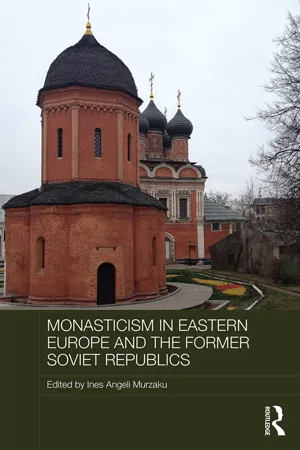
This book looks at Eastern and Western monasticism's continuous and intensive interactions with society in Eastern Europe, Russia and the Former Soviet Republics. It discusses the role monastics played in fostering national identities, as well as the potentiality of monasteries and religious orders to be vehicles of ecumenism and inter-religious dialogue within and beyond national boundaries. Using a country-specific analysis, the book highlights the monastic tradition and monastic establishments. It addresses gaps in the academic study of religion in Eastern European and Russian historiography and looks at the role of monasticism as a cultural and national identity forming determinant in the region.
- 404 pages
- English
- ePUB (mobile friendly)
- Available on iOS & Android
eBook - ePub
Monasticism in Eastern Europe and the Former Soviet Republics
About this book
Information
Monasticism in Eastern–Central Europe
1
Monasticism in Bulgaria
The foundations of monasticism in Bulgaria were laid in the course of its Christianization, launched by Prince Boris in 865. Until recently, however, this centuries-long tradition was not a subject of systematic research. One of the reasons is rooted in the scarcity of sources about the first millennium of Bulgarian monkhood. Its research was also hampered by a late start of academic studies in Bulgaria in the late nineteenth century. The negative effect of this delay was additionally aggravated by the monopoly of atheism, which was imposed on humanities in Bulgaria during the Cold War. Still, the study of monasticism has made some progress. The pre-communist generation of scholars created a good database of sources about the history of monasticism. These academics not only collected, systematized, and published old manuscripts, archival documents, and epigraphs but also produced high-quality case-studies. They owed their achievements to interdisciplinary academic training in the fields of history and philology, which included additional specializations in the fields of paleography, archaeography, archaeology, archival studies, and arts. The communist takeover on 9 September 1944, however, caused an overall stagnation in religious studies. The atheist paradigm and Marxist approach in humanities removed the issue of monasticism from the agenda of new Bulgarian scholarship. Interest in it has been revived after the political change of 1989, but the efforts of researchers are still quite distorted.
In general, the study of monasticism is focused on the centuries from the adoption of Christianity in Bulgaria (865) to its liberation from Ottoman rule (1878), while the subsequent epoch from 1878 to the present day remains almost unexplored. From a historiographical point of view, there are two groups of scholars who have been especially active in the research on monasticism. The leading role belongs to historians, who give preference to an institutionally oriented approach and analyze the impact of monasteries on the development of the Bulgarian nation and culture. Philologists also contribute to the study of monasticism, but the focus of their research is limited to the written legacy of individual monks. On account of these two competing perspectives, this chapter will take a historiographical approach to the issue of Bulgarian monasticism. The first two sections of this chapter discuss the pre-1989 achievements of historical and philological studies on monasticism, while the third traces the developments in this field after the collapse of communism. The chapter concludes with remarks about monasticism since 1878, which is the least studied era, and the economic state of monasteries in Bulgaria.
Historical studies on monasticism
The long-term interest of Bulgarian historians in monasticism was inspired by the Treaty of Neuilly (1919). This treaty not only caused a significant loss of Bulgarian territories and population but shook the irredentist dream of a union of all ethnic Bulgarians in a single state as envisioned in the Russian-Turkish Armistice signed in the village of San Stephano on 3 March 1878. According to the armistice, the new Bulgarian state had to embrace all former Ottoman territories where the majority of the population were ethnic Bulgarians, and it also included the region of Edirne and vast areas of Macedonia. In July 1878, however, this plan was revised by the Berlin Congress of the Great Powers, whose leaders decided to return the regions of Edirne and Macedonia to Ottoman rule. In this way, the territory of the new Bulgarian state turned out to be much smaller than that of the Bulgarian Exarchate, which had dioceses not only in Bulgaria but also in Turkey, namely those of Skopje, Ohrid, Debar, Bitojla, Veles, Strumitsa, Nevrokop, and Edirne. In the course of the Balkan Wars (1912–13) and World War I (1914–18), the governments in Sofia made a series of attempts to join the mentioned areas to their state territory. Bulgaria’s defeat in 1918, however, buried the hopes for a restored San Stephano Bulgaria. In addition, the Treaty of Neuilly facilitated the integration of the dioceses of Skopje, Ohrid, Debar, Bitojla, Veles, and Strumitsa in the Orthodox Churches in Greece and Serbia, a change that delivered a severe blow to the territorial jurisdiction of the Bulgarian Exarchate.
To heal these wounds, Bulgarian scholars focused their research on those pages of history that could nurture the national pride of their compatriots. As a result, the national historiography highlighted military victories, territorial growth, and medieval Bulgaria’s ecclesiastical independence. Within this framework, Vasil Zlatarski, the author of the first systematic history of medieval Bulgaria, explored the baptism of Bulgarians (865) and the development of their Christian Church in the late ninth and early tenth century (Zlatarski 1918). In his studies, he paid special attention to representatives of the episcopate but left almost untouched the issue of ordinary monkhood (Zlatarski 1906, 1897). Similarly, other Bulgarian medievalists focused their research on political and socio-economic problems and only occasionally touched on the issue of monasticism (Mutafchiev 1925; Nikov 1928). They gave preference to cenobitic monasticism; e.g. Peter Mutafchiev criticized anchoritic monasticism with the argument that the striving of hermits for individual salvation was socially counterproductive and contradictory to the altruist nature of Christianity (Mutafchiev 1993: 180–1).
Theologically oriented church historians also prioritized the institutional aspects of Bulgarian religious history. The major work in this field was written by Ivan Snegarov. In the two-volume History of the Archbishopic of Ohrid, he defended the thesis that this archbishopric, whose territorial jurisdiction formerly covered dioceses situated in the region of Macedonia, was a Bulgarian Church (Snegarov 1995). In a special chapter about the monasteries in Macedonia, Snegarov supported this thesis by quoting multiple sources that demonstrated their Bulgarian character (vol. 2: 422–50). During the interwar period civil and church historians also worked on the history of major monastic centers in Bulgaria proper, and especially that of the Rila Monastery (Bobchev 1898; Miletich 1902; Ihchiev 1910; Ivanov 1917). Very often, however, the emphasis was not on their religious development but on their contribution to the national struggles of Bulgarians against Ottoman rule; e.g. most publications about the Dryanovo Monastery, near Veliko Tarnovo, discuss the participation of its monks in the April Uprising in 1876 (Zhekov et al. 1926).
After the communist takeover, the new rulers launched an antireligious policy that was justified by the Marxist theses about religion as “the opium of the people” and about the Church as a tool of the exploiting classes. At the same time, under the Cold War influence, the Christianization of Bulgarians by the Patriarchate of Constantinople in 865 was regarded as a plot, aimed to destroy Bulgarian sovereignty by means of denationalization (Derzhavin 1948: 46–87). During Khrushchev’s détente, the regime softened its attitude toward some religion-related issues. In the 1960s, monasteries reappeared as objects of research but were treated exclusively as museums of church art and depositories of icons, architectural monuments, and historical landmarks. In parallel, historians began to discuss the role of monasteries in the socio-economic life of medieval Bulgaria from the perspective of the Marxist class approach. By employing a Marxist analysis of the charters that the Bulgarian czars and nobility granted to monasteries to guarantee their juridical and economic privileges, these works had to demonstrate the exploitative nature of the Church (Andreev 1968: 68; Andreev and Angelov 1968: 145–9).
The early 1970s marked another shift in Bulgarian communist historians’ attitudes toward religion. They adopted the view that in its initial phase Christianity had played a progressive role in the development of the ideology of exploited classes; for example, the spread of Christianity was now regarded as part of the class struggle (Stoychev 1974: 22). Within this framework, the notion of the Bulgarian Orthodox Church was linked with monasteries, and the emphasis was placed on their contribution to the preservation of the Bulgarian national consciousness during the five centuries of Ottoman rule (Neshev 1974: 151). The new wave of studies also praised monasteries as mediators between Bulgarian society and Russia and as promoters of the idea of Slavonic unity (Damyanov 1974: 154–5). An additional stimulus for this tendency became the 100th anniversary of the April Uprising (1876), when the communist historiography gave credit to the Bulgarian monasteries for “preserving and strengthening of the national consciousness” during the centuries of Ottoman rule (Neshev 1974: 151).
In 1981, the nationalist trend in historiography was strengthened by the celebration of the 1,300th anniversary of the founding of the Bulgarian state in 681. According to this new reading, the nineteenth-century struggle of Bulgarians to establish their own independent church only appeared to be religious, while being entirely “secular, socio-economic and aimed to national liberation” (Markova 1981: 232). Within this framework monasteries were discussed in two main ways: as Bulgarian educational and literary centers and as participants in the nineteenth-century struggles for national liberation. In comparison to the pre-communist historiography that emphasized church development in the medieval period, the late socialist one gave preference to the so-called Bulgarian Revival (1762–1878).
The new approach to the role of the Church in Bulgarian national history also assisted the start of a structural analysis of Orthodox clergy as a complex social group that consisted of monks, priests, and the episcopate. In 1986, Rumyana Radkova dedicated a special chapter to Orthodox and Catholic clergy in her monograph on the Bulgarian intelligentsia in the eighteenth and the first half of the nineteenth century. Especially significant is the subchapter on Orthodox monasticism that outlined the development and organization of monastic life from the start of the eighteenth century to the Crimean War (1853–6) (Radkova 1986: 120–43). Radkova paid particular attention to the educational and literary activities in monastic scriptoria and offered an analytical overview of the economic life of monasteries, their property statuses, their trade activities, and their fiscal duties to the Ottoman Empire and the Orthodox authorities, namely the Patriarch of Constantinople and the diocesan bishops. She also pointed to the economic inequality and social differentiation among monks. Finally, this subchapter shed light on the so-called taxidiots, i.e. itinerant monks. They were sent by monasteries to serve as their missionaries among lay Bulgarians. Their duties also included the management of distant monastery estates, the collection of donations, the organization of pilgrimages to their monasteries, the hearing of confessions, and the performance of liturgy and sacraments in areas without local priests.
In 1988, Nikolay Genchev attempted to summarize the main features of the Bulgarian monasteries between the fifteenth and nineteenth centuries. In his view, the Ottoman conquest transformed the monastery “from an inhabitation of hermits” into “a bulwark of the Bulgarian nationality” (116). During the centuries of foreign rule, the monasteries performed an additional task: the preservation of the old Bulgarian literature and religious art. No less important was their duty to maintain an elementary level of literacy. Finally, monasteries facilitated many kinds of communication between Bulgarians. They were the natural spiritual, and sometimes economic, centers for Bulgarians. They functioned as educational institutions and scriptoria, as networks of metochi (a monastery’s branches), and as a lieu de memoire thanks to the feasts of their patron saints and the regular pilgrimages. Therefore, Genchev defined the monastery as “the major cultural institute during the period of Ottoman rule” (116). At the same time, he pointed to the limits of this monastery-based culture, which was effective in keeping the past traditions of Bulgarians but had no potential to provoke a spiritual transformation that would give birth to a phenomenon of the magnitude of the Western Renaissance (116–18).
Communist historians were also interested in the life stories of individual monks. More specifically, they studied the literary and educational activities of monks who had contributed to the awakening of the Bulgarian national consciousness. However, the communist historiographers silenced the religious views of the monks. This trend in historiography started with the 200th anniversary of the Slav-Bulgarian History, written in 1762. Its author was Paisii Hilendarski (1722–73), a Bulgarian monk from Mount Athos. In this handwritten work he appealed to his compatriots to restore their state and church independence and to establish their own Bulgarian schools where children could study in their native language. Though he was quite popular before the communist takeover of 9 September 1944, the personality of Father Paisii disappeared from Bulgarian popular literature and school handbooks during the initial years of the new rulers. The first ideologically correct biography of Father Paisii was published in 1959 by Vladimir Topencharov, a member of the Central Committee of the Bulgarian Communist Party. It served as a pattern for the other biographers of Paisii (Dragova 1961; Neshev 1962). Similarly, the Bulgarian Academy of Sciences dedicated a special conference to this anniversary (Traykov and Dujčev 1962). Its major outcome was a change in the periodization of Bulgarian history. The conference rejected the views that the Bulgarian Revival had begun at the end of the eighteenth century or in the early nineteenth century and moved its start to 1762, linking it with Paisii’s History.
Another monk praised in communist historiography was Sofronii Vrachanski (1739–1813), one of the few Bulgarians who had been consecrated bishop during the centuries of Ottoman rule. He made many handwritten copies of Paisii’s history, thus spreading his ideas to a broader audience. Sofronii is also famous as an author of original works that had a strong impact on the nineteenth-century Bulgarian literature. His autobiography, The Life and Suffering of Sinful Sofronii, was the first work of this genre in Bulgarian. In 1806, he published a volume of Sunday sermons, which communist historians regarded as the first printed book in Bulgarian even though Abagar, another religious volume, was published by a Bulgarian Catholic bishop in 1651. At the same time, under the influence of Paisii, Sofronii Vrachanski became a fervent critic of the Greek hierarchy and Ottoman rule. He fled to Wallachia to avoid persecution, where, during the Russian Turkish War (1806–12), he issued appeals to his compatriots to support the Russian troops. During the Cold War, this Russophilia suited the Bulgarian communist propaganda well. Correspondingly, the major study about him appeared on the occasion of the 100th anniversary of the Russian-Turkish War (1877–8) and the Liberation of Bulgaria (1878) (Mutafchieva 1978).
For similar reasons, Neofit Bozveli (1785–1848) and Ilarion Makariopolski (1812–75) – monks who played a leading role in...
Table of contents
- Cover
- Title
- Copyright
- Contents
- Notes on contributors
- List of illustrations
- Acknowledgments
- Introduction
- PART I Monasticism in Eastern–Central Europe
- PART II Monasticism in Russia and the Former Soviet Republics
- Index
Trusted by 375,005 students
Access to over 1.5 million titles for a fair monthly price.
Study more efficiently using our study tools.
Frequently asked questions
Yes, you can cancel anytime from the Subscription tab in your account settings on the Perlego website. Your subscription will stay active until the end of your current billing period. Learn how to cancel your subscription
No, books cannot be downloaded as external files, such as PDFs, for use outside of Perlego. However, you can download books within the Perlego app for offline reading on mobile or tablet. Learn how to download books offline
We are an online textbook subscription service, where you can get access to an entire online library for less than the price of a single book per month. With over 1.5 million books across 990+ topics, we’ve got you covered! Learn about our mission
Look out for the read-aloud symbol on your next book to see if you can listen to it. The read-aloud tool reads text aloud for you, highlighting the text as it is being read. You can pause it, speed it up and slow it down. Learn more about Read Aloud
Yes! You can use the Perlego app on both iOS and Android devices to read anytime, anywhere — even offline. Perfect for commutes or when you’re on the go.
Please note we cannot support devices running on iOS 13 and Android 7 or earlier. Learn more about using the app
Please note we cannot support devices running on iOS 13 and Android 7 or earlier. Learn more about using the app
Yes, you can access Monasticism in Eastern Europe and the Former Soviet Republics by Ines Angeli Murzaku in PDF and/or ePUB format, as well as other popular books in Social Sciences & Regional Studies. We have over 1.5 million books available in our catalogue for you to explore.