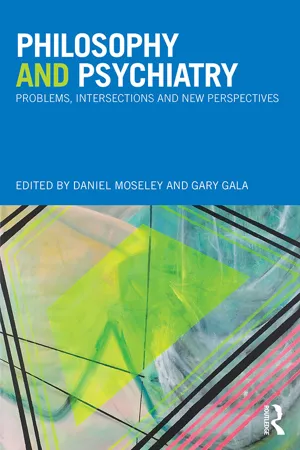
This groundbreaking volume of original essays presents fresh avenues of inquiry at the intersection of philosophy and psychiatry. Contributors draw from a variety of fields, including evolutionary psychiatry, phenomenology, biopsychosocial models, psychoanalysis, neuroscience, neuroethics, behavioral economics, and virtue theory. Philosophy and Psychiatry's unique structure consists of two parts: in the first, philosophers write five lead essays with replies from psychiatrists. In the second part, this arrangement is reversed. The result is an interdisciplinary exchange that allows for direct discourse, and a volume at the forefront of defining an emerging discipline. Philosophy and Psychiatry will be of interest to professionals in philosophy and psychiatry, as well as mental health researchers and clinicians.
eBook - ePub
Philosophy and Psychiatry
Problems, Intersections and New Perspectives
- 304 pages
- English
- ePUB (mobile friendly)
- Available on iOS & Android
eBook - ePub
Philosophy and Psychiatry
Problems, Intersections and New Perspectives
About this book
Information
Part 1
Psychiatric Diagnosis and Agency
1a
Can What’s in Your Head be “All in Your Head?”
Possibilities and Problems of Psychological Symptom Amplification
Nicholas Kontos
One can never be sick enough. Even the stricken can milk it.
Ben Marcus (Marcus 2013)
1. Introduction
The imperative to act in situations of uncertainty is a core characteristic of clinical medicine. In the presence of a suffering, scared, usually trusting, sometimes demanding, and always-expectant patient, a physician does not have the luxury of indefinite restraint (Montgomery 2006). Even if the required action is “just” the provision of explanation, a doctor often must perform it without the comfort of standing on solid factual ground (Pender 2006).
In psychiatry, this dilemma achieves a level of near absurdity that is, if not unheard of elsewhere in medicine, then distinguished by its pervasiveness. A psychiatrist’s daily role involves making mostly unprovable diagnoses, and mobilizing therapies about which one can at best assert what they do rather than how they work. Still, unless the brain is assigned a status of immunity from pathology denied to every other bodily organ (including its own motor and sensory components), the role is a necessary one.
Lacking confirmatory biomarkers, most psychiatric diagnosing starts and stops at the level of symptoms and signs. Signs tend to be evident and useful in only the most severe mental illness states (e.g., the motor signs of catatonia, disorganized thought in psychotic disorders). When it comes to other prevalent psychopathological entities, particularly mood and anxiety disorders, psychiatric diagnoses are almost exclusively based on the volunteered and elicited complaints of patients – that is, symptoms.
It is often said that the vast majority of medical diagnoses can be found in the history alone; that is, in the facilitated reporting of symptoms and their circumstantial and longitudinal contexts. This received wisdom may be somewhat overblown, though. In a recent study of emergency-room visits, history alone was considered diagnostically sufficient in only about 20 percent of patients. While symptoms probably are the “most potent single tool” in patient assessment (Paley et al. 2011), that potency is relative. Further, in outpatient settings, at least one third of symptoms end up medically unexplained (Kroenke et al. 2002), suggesting that in and of themselves, patient reports can be the packaging for contents that do not come “as advertised.”
Given our dependence on symptoms and magnified environment of uncertainty, psychiatrists ought to find these statistics troubling. Yet, one seldom encounters skepticism about the meaning or magnitude of patients’ expressions of their psychological complaints. Instead, for better or for worse, patients are said to “meet criteria” for one or another condition in the Diagnostic and Statistical Manual of Mental Disorders (DSM) (American Psychiatric Association [APA] 2013). Those criteria largely involve the accumulation of symptom endorsements, often obtained via a questionnaire, inventory, or mnemonic originally derived from those same criteria. The psychiatric diagnostic process thus becomes a circular one in which unexplained symptoms are impossibilities.
This chapter attempts to examine the idea of whether the medically unexplained symptom (MUS) concept, traditionally reserved for somatic symptoms, can or should be extended to psychological complaints. In alternative terms, this means asking if there exists a psychological analogue of somatizing. This is a fortuitous but potentially confusing time to pose such a question since the recently released DSM-5 reconfigured the MUS/somatization concept in its “Somatic Symptom and Related Disorders” category. In the current environment of controversy and flux regarding these terms, the reader will hopefully forgive their use in this chapter. Discussion of the psychological variant of MUS/somatization will use these terms in analogy; otherwise, the term “psychological symptom amplification” (PSA) will be used. This term is intended to be purely descriptive and to lack implication of intentionality, PSA refers to excessive symptom reports and impact regardless of the presence or absence of corresponding psychopathology as determined via reasonable and responsible medical assessment.
The issue of whether psychological symptoms are subject to amplification raises difficult questions touching upon dualism, identity, the nature of the doctor–patient relationship, and the validity of psychiatric diagnosing. Considering the possibility of PSA will not make psychiatric practice or research any easier, but hopefully this chapter will demonstrate how ignoring it might be making things harder.
2. Current Concepts of Somatic Symptom Amplification
The idea that psychological symptoms such as “depression,” “anxiety,” and “racing thoughts” may be over-endorsed or impactful in certain patients has not been accounted for. On the other hand, patients have long been known to represent somatic experiences such as pain in ways that are not necessarily diagnostically helpful. Examining a psychological analogue of this phenomenon requires taking a step back to look at some concepts of somatic symptom amplification.
“Medically” “Unexplained” “Symptoms”
Placing each of the component words of the term, MUS, in scare quotes is not intended to be cute or cynical. Instead, it highlights the contested status of each of these terms. How one thinks about “medically” depends upon what one considers to be the methods and objectives of medicine. Are they health-oriented, and directed toward the World Health Organization’s view of “a state of complete physical, mental and social well-being and not merely the absence of disease or infirmity” (World Health Organization [WHO] 1946)? A slightly more limited perspective might be that of “whole person medicine,” which attempts to identify and remove limitations of “functioning,” defined as the “achievement of goals or the realization of purposes” (Cassell 2013). A more bounded view of medicine reverse engineers it from the existence of disease, thus confining its activities to pursuing “the absence (or alleviation) of disease and infirmity” (Cantor 2003).
Invoking disease in any definition of medicine begs the question of what disease is, and evokes complex arguments (Humber and Almeder 1997) that are beyond the scope of this chapter. The ambiguity is worth mentioning, though, since explanation-as-disease is pertinent to the “unexplained” element of MUS. For most physicians, an adequate explanation for a patient’s symptom must be found in an anatomic lesion, a physiologic aberration, or a legitimized pattern of distress/impairment. The explanation ought to be sufficient in any patient with the same symptoms and clinical findings. Unfortunately, that explanation is often elusive or unsatisfactory to one or both parties in the doctor–patient relationship where “the physician and the great majority of his patients no longer share a similar view of the body and the mechanisms which determine health and disease” (Rosenberg 1979). This is especially true when the explanation is a negative one – that is, “I cannot find a (disease-based) cause for your problem.”
So the question of what constitutes medical explanation, and, by extension, its absence, is incompletely settled. It is nonetheless fair to say that people bring uncomfortable experiences to physicians when they believe them to fall within the purview of medicine – that is, when they consider those experiences “symptoms.” Eisenberg has gone so far as to say that a person’s presentation of an experience to a physician is enough to make that experience a symptom and that person a patient; that “patienthood is a psychosocial state … it is the patient who decides” (Eisenberg 1980). This formulation contrasts with others in which a person’s distress is interpreted by a physician who determines whether and which diagnosis applies. When affirmative and clear, that determination grants the experience symptom status, and the person patient or sick role status (Parsons 1951; Rosenberg 2003).
Somatization and DSM
For as long as medicine has been practiced, there have been patients who presented to their physicians with cryptogenic symptoms. The term “somatization” was first used in the 1920s by the psychoanalyst Welhelm Stekel to capture the idea that unacceptable emotional states could be transformed into the otherwise inexplicable somatic signs of conversion hysteria. Applications of the term expanded dramatically in the 1960s and 1970s, coming to refer not just to conversion phenomena, but to any individual or collective tendency to experience emotional states through somatic symptoms (Berrios and Mumford 1995).
The writers of DSMs I and II avoided the word “somatization.” This decision was apparently made in the interest of precision in delineating the psychodynamic mechanisms that underlie “psychophysiologic disorders” (“a chronic and exaggerated state of the normal physiological expression of emotion, with the feeling, or subjective part, repressed”), and “psychoneurotic reactions,” particularly conversion or “hysterical neurosis” (where loss of function was instrumental and carried symbolic meaning) (APA 1952; APA 1968).
The diagnostic debut of “somatization” occurred in DSM-III. Given its psychoanalytic heritage, “somatization” is a surprising term to see avoided in earlier DSMs, yet considered ready for prime time in DSM-III; the latter edition ostensibly being characterized by a commitment to an “atheoretical,” purely descriptive stance in the service of diagnostic reliability (Wilson 1993). Yet little attempt was made to alter somatization’s conceptual trajectory, with explicit mention made of the “positive evidence, or a strong presumption, that the (somatic) symptoms are linked to psychological factors or conflicts.” This explanation for why “the specific pathophysiologic processes involved are not demonstrable or understandable by existing laboratory procedures” (APA 1980) was used to explain not only conversion signs, but also the multi-organ-system complaints of patients with all manner of MUS, as seen in somatization disorder and hypochondriasis.
DSM-IV did not alter this “official” stance on somatization, but it did make at least one important change. Previously diagnoses of exclusion, somatoform diagnoses in DSM-IV could be made in situations where the presence of a patient’s complaint was medically explainable but its impact was not (APA 1994). Nearly 20 years later, this allowance has become the diagnostic standard. Responding in part to research indicating that it is the secondary impact, rather than the etiology, of symptoms that correlates with functional impairment and distress (Tomenson et al. 2013), and in accordance with voices raised against the “dualism” that informs distinctions between somatic and psychological etiologies of MUS, DSM-5 does away with terms derived from “somatization” (APA 2013).
Moving Forward
Ultimately, these changes in how the DSMs characterize MUS are more about American psychiatry’s own struggles with the psychoanalytically inherited somatization construct than they are about effacing all potential psychological explanations of MUS expression. Without declaring the extinction of the psychoanalytically informed version of somatization, a more integrative model has been in ascendance for a while now. In this model of somatization (Barsky and Borus 1999), patients presenting with MUS are thought to have low sensation thresholds as understood through biological mechanisms such as central sensitization (Cagnie et al. 2014) and/or more psychological ones such as low distress tolerance (Leyro et al. 2010). The “second hit” in this model involves a propensity to attach medical significance, concern, and responses to the experiences in question. This propensity has been observed in multiple studies of patients with hypochondriasis (Barsky et al. 1993; Weck et al. 2012; Gropalis et al. 2013).
Hypochondriasis is only one manifestation of MUS and the somatizing tendency, and fear is only one influence upon individuals’ responses to distressing sensations. Integrating the ideas of MUS, somatization, and current diagnostic and mechanistic frameworks for them, one can envision not so much a somatizing as a medicalizing tendency.
3. Medicalization and Psychological Symptom Amplification
For MUS to have any staying power in an individual, or for somatization or medicalization to be stable social options, there must be a perpetuating force available. What a person stands to gain from what otherwise appears to be bafflingly persistent suffering must be examined in any consideration of symptom amplification. One must also consider the ways and ease of accessing those gains.
Status of the Symptomatic
Socially, medicalization connotes the processes and products deployed by a culture to grant or impose medical status onto previously non-medical forms of suffering and deviance. That status includes “defining a problem in medical terms, usually as an illness or disorder, or using a medical intervention to treat it” (Conrad 2005). At the individual level, medicalization reveals itself in the propensity and intensity with which one seeks or claims sick role status for uncomfortable experiences. For physicians, medicalization means the socially or self-imposed expansion of one’s job description (whether as opportunity or burden).
Appropriately utilized, medicalization can reduce suffering and preserve the humanity of the sick. The benefits of medicalization include explanation/diagnosis and relief/treatment, not only as applied to distressing experiences themselves, but also to the fear and worry they engender. Medicalization’s benefits extend into other material and immaterial domains. Often invoked in medicine, but seldom linked to its sociological heritage, the sick role was described in detail by Talcott Parsons in his 1951 book, “The Social System” (Parsons 1951), and in his and others’ subsequent work (Parsons 1975; Williams 2005). For the purposes of this chapter, the patient-seated privileges of sick role status are most pertinent. These include blamelessness for the presence of symptoms, relief from obligations incompatible with sickness, and both expectation and entitlement to receive care. While Parsons confined “care” to medical care, there is some face validity to its extension into sympathy and succor from family and peers.
These desirable accompaniments of sickness, when not outweighed by the joys of healthier living, could account for the momentum that medicalization has culturally and, for many, individually. Who among us could not at one time or another use a little absolution, release, and nurturing? When viewed from the perspective of those already feeling “unworthy, beleaguered, and unloved,” the nature of primary gain in the context of somatization becomes much less mysterious (Gerstenblith and Kontos, 2015), as does the notorious chronicity of somatizing patients.
Stigma and Destigmatization
Sick role status does not come easily. Not merely a transaction in which suffering and effort are exchanged for relief and benefits, the sick role is granted only to categories of suffering that society (and medicine as a powerful subgroup of society) deems worthy. Selectivity in the sick role is necessary in order to avoid diluting its power. However, one person’s selectivity is another’s exclusivity. For many people with medically ambiguous states of suffering such as chronic fatigue syndrome (recently redubbed “systemic exertion intolerance disease” [Institute of Medicine 2015]), the need and longing for sick role status exists in tension with resentment over the experience of it being withheld. As Rosenberg points out, “the social legitimacy – and often social resources – associated with the sickness role constitutes a prize worth contesting” (Rosenberg 2006).
Contesting the “prize” of sick role legitimacy has long been a project for the mentally ill and their professional and personal advocates. Stigma is a heterogeneous phenomenon, significant aspects of which include prejudice and ostracism. Also, with mental illness itself being heterogeneous, stigma is expressed differently towa...
Table of contents
- Cover Page
- Half Title Page
- Title Page
- Copyright Page
- Dedication
- Contents
- Preface
- List of Contributors
- Introduction: Beyond the Philosophy of Psychiatry
- Part 1 Psychiatric Diagnosis and Agency
- Part 2 Ethical Dimensions of Psychiatric Treatment
- Part 3 Philosophy Out of Psychiatry
- Index
Trusted by 375,005 students
Access to over 1.5 million titles for a fair monthly price.
Study more efficiently using our study tools.
Frequently asked questions
Yes, you can cancel anytime from the Subscription tab in your account settings on the Perlego website. Your subscription will stay active until the end of your current billing period. Learn how to cancel your subscription
No, books cannot be downloaded as external files, such as PDFs, for use outside of Perlego. However, you can download books within the Perlego app for offline reading on mobile or tablet. Learn how to download books offline
Perlego offers two plans: Essential and Complete
- Essential is ideal for learners and professionals who enjoy exploring a wide range of subjects. Access the Essential Library with 800,000+ trusted titles and best-sellers across business, personal growth, and the humanities. Includes unlimited reading time and Standard Read Aloud voice.
- Complete: Perfect for advanced learners and researchers needing full, unrestricted access. Unlock 1.5M+ books across hundreds of subjects, including academic and specialized titles. The Complete Plan also includes advanced features like Premium Read Aloud and Research Assistant.
We are an online textbook subscription service, where you can get access to an entire online library for less than the price of a single book per month. With over 1.5 million books across 990+ topics, we’ve got you covered! Learn about our mission
Look out for the read-aloud symbol on your next book to see if you can listen to it. The read-aloud tool reads text aloud for you, highlighting the text as it is being read. You can pause it, speed it up and slow it down. Learn more about Read Aloud
Yes! You can use the Perlego app on both iOS and Android devices to read anytime, anywhere — even offline. Perfect for commutes or when you’re on the go.
Please note we cannot support devices running on iOS 13 and Android 7 or earlier. Learn more about using the app
Please note we cannot support devices running on iOS 13 and Android 7 or earlier. Learn more about using the app
Yes, you can access Philosophy and Psychiatry by Daniel Moseley, Gary Gala, Daniel D. Moseley,Gary Gala,Daniel Moseley, Daniel D. Moseley, Gary Gala in PDF and/or ePUB format, as well as other popular books in Philosophy & Ethics & Moral Philosophy. We have over 1.5 million books available in our catalogue for you to explore.