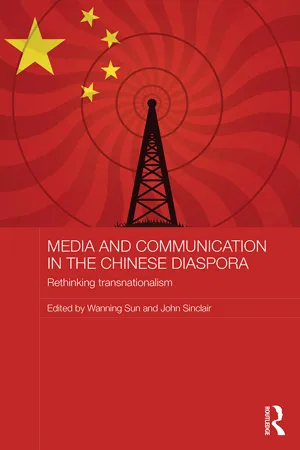
The rise of China has brought about a dramatic increase in the rate of migration from mainland China. At the same time, the Chinese government has embarked on a full-scale push for the internationalisation of Chinese media and culture. Media and communication have therefore become crucial factors in shaping the increasingly fraught politics of transnational Chinese communities. This book explores the changing nature of these communities, and reveals their dynamic and complex relationship to the media in a range of countries worldwide. Overall, the book highlights a number of ways in which China's "going global" policy interacts with other factors in significantly reshaping the content and contours of the diasporic Chinese media landscape. In doing so, this book constitutes a major rethinking of Chinese transnationalism in the twenty-first century.
eBook - ePub
Media and Communication in the Chinese Diaspora
Rethinking Transnationalism
- 230 pages
- English
- ePUB (mobile friendly)
- Available on iOS & Android
eBook - ePub
Media and Communication in the Chinese Diaspora
Rethinking Transnationalism
About this book
Information
1 “New Migrants” from the PRC and the Transformation of Chinese Media
The case of Cambodia1
Since the 1980s, the emergence of mainland China as a source of readers, contributors, content, investment, and advertising for Chinese-language media overseas has had different implications for those settler societies with provision for multilingual local media as part of multicultural policies or practices, such as Canada, the United States, Australia, New Zealand, and South Africa; for societies with established local traditions of Chinese media, such as those in Southeast Asia and parts of Western Europe and the Pacific; and for societies where Chinese media had not existed or existed in a very limited form before a recent wave of migration from the People’s Republic of China (PRC). This chapter, based on four research trips between 2008 and 2013, focuses on the case of Cambodia, where a tradition of local Chinese media has existed since the early twentieth century but was interrupted by anti-Chinese policies and warfare between 1970 and 1990. While the Cambodian case is in some ways unique, I will suggest that the impact of post-Cold War migration from China on media development shows parallels to countries where no prior tradition of Chinese media exists, such as in Eastern Europe.
The politics of Chinese ethnicity in contemporary Cambodia
“Today, no one identifies themselves as Chinese in Kampuchea,” wrote anthropologist William Willmott in 1981 (1981: 45). He was referring both to the physical decimation—through killing, starvation, and flight—of the once thriving Chinese-Cambodian (or Sino-Khmer)2 population under the Khmer Rouge regime (1977–79) and to the fact that those who remained in the country faced discrimination and a de facto ban on public displays of ethnicity, such as schools or festivals, until the withdrawal of Vietnamese troops in 1990. Between Lon Nol’s coup in 1970 and 1990, being Chinese in Cambodia was a private, and for much of that time dangerous and therefore hidden, matter. A generation whose parents were principally Teochew speakers but usually educated in Mandarin or French grew up speaking Khmer.3
The Vietnamese withdrawal and the removal of Soviet backing for the Vietnamese-installed Cambodian People’s Party (CPP) government prompted the rulers to scramble for domestic legitimacy and seek ways to avoid economic collapse. This simultaneously sparked the rapid resurgence of Chinese ethnicity and the beginning of a new migration from China. The infamous Circular 351, under which people of Chinese descent were discriminated against in job allocations, was rescinded; private business was permitted, as were ethnic minority associations. As shops reopened, business was reidentified with Chinese ethnicity through markers such as couplets in Chinese characters or small altars to the god of wealth. Along with masses of refugees, a few enterprising Sino-Khmer businessmen returned from Vietnam and laid the groundwork for later fortunes by engaging in largely unregulated cross-border commerce. A trickle of returning refugees began from farther afield—Thailand, Hong Kong, France, and the United States—and expanded over the years (Wijers 2013). In a few years, parts of Phnom Penh, one-third of whose pre-1977 population was estimated to be Sino-Khmer (Willmott 1967: 16), were once again visually dominated by Chinese shop signs.
In 1990, one of the CPP’s leaders, Chea Sim, president of the National Assembly and of Chinese descent, invited eleven Chinese-Cambodian businessmen to his office and encouraged them to form an association that came to be known as the Association of Chinese in Cambodia (ACC—Jianhua lishizonghui; Tan 2006: 188). “Most Khmers want to be government officials; they don’t like business and are not good at it,” a publication of the ACC quotes Chea Sim as saying. “You should unite and liaise with your relatives and friends overseas, attract foreign investment and become a bridge to developing the economy” (Yang 2003). This deal—the CPP encourages Chinese-Cambodians to pursue wealth and stay out of politics, offering successful businessmen political protection in return for expected financial support (cf. Hughes and Kheang 2011)—largely outlasted the pluralization of Cambodian politics during the United Nations intervention (1992/3) and the first period of the restored monarchy (1993–97) and became further entrenched after 1997, when the CPP returned to power by ousting its senior partner, the royalists, from a coalition government, and Chea Sim became president of the legislature once again—a post he has retained ever since. To a large extent it has shaped the politics of Chinese ethnicity.
The ACC was to function as the umbrella of the five dialect-based associations (huiguan) that had existed in the French colonial era and were being revived. Duong Chhiv, president of the Teochew association, the largest of the five, became president of the ACC and has remained in the post since its founding. Local Chinese associations that formed across the country after 1990 were gradually absorbed by the ACC as local chapters. The ACC had precursors both under the French and in the postcolonial era before Lon Nol’s coup, but it also fitted with the model of “democratic centralism” employed by Leninist parties across the state socialist countries. Indeed, one of Chea Sim’s tasks in the Soviet-allied Cambodian Party-state (1979–91) was “united front work,” or outreach to constituencies outside the Party: a fact no doubt related to his Chinese ethnicity and hence his presumed ability to build connections with the more urban and educated segments of Cambodian society that had been criminalized under the Khmer Rouge. The ACC, with its quasi-official status as an intermediary between the government and all ethnic Chinese—one of its publications describes it as “the highest leadership organ of … Chinese in Cambodia” (Qiu 2003)—was a product of united front politics that has remained untouched by the trappings of multiparty democracy. While Duong Chhiv cautions Chinese-Cambodians that they “shouldn’t meddle with politics” (bu gao zhengzhi) or get involved in the disputes of Cambodian parties (Xing 2008: 375), the continued closeness of the ACC leadership to the CPP is by no means hidden: the walls of its offices are adorned with Duong Chhiv’s photographs taken with Prime Minister Hun Sen, the country’s leader between 1979 and 1993 and again since 1997.
Both the rise of China as the CPP’s political patron from the mid-1990s onward and its role as Cambodia’s largest investor from the late 2000s have influenced the politics of Chinese ethnicity, but the Chinese government made high-profile public overtures to Chinese-Cambodians as early as 1995, little more than fifteen years after Chinese technical experts assisted the Khmer Rouge in their takeover of the country, to which most Chinese-Cambodians fell victim. In the early 1990s, Chinese-Cambodians were still distrustful of and antagonistic toward visiting Chinese officials, even organizing demonstrations protesting their visits (Edwards 2002). But by 1995, Li Ruihuan, a highly ranked member of the Politburo of the Chinese Communist Party (CCP), visited Phnom Penh and addressed ACC leaders as “our … married daughters,” calling Cambodia “their second home country” (Nyíri 2013). The fact that these somewhat inappropriate comments—considering both recent history and the fact that ACC members are required to be Cambodian-born—were made and publicized suggested that times were changing. Both China’s and Cambodia’s leaders were now interpellating Chinese-Cambodians and framing them as conduits of friendly political and economic relations. Soon, the ACC and its constituent organizations were reframing themselves as “a bridge to foreign trade, enjoying the ever-strengthening trust of successive [Cambodian and Chinese] governments” (Yang 2003). The ACC numbers two serving CPP ministers and a Chinese-Cambodian tycoon who is also a CPP senator among its honorary advisors.
Just as the ACC is regarded as the single representative of Chinese-Cambodians, the Cambodian Chinese Chamber of Commerce (CCCC, Jianpuzhai Zhongguo shanghui), founded in 1996, is seen as speaking for investors—both private entrepreneurs and managers of state-owned companies—from mainland China. Its president is a prominent private businessman who has acquired Cambodian citizenship, while its general secretary is the head of the Cambodian branch of the Bank of China. (The China Hong Kong Taiwan and Macau Expatriate and Business Association of Cambodia [Jianpuzhai Zhongguo Gang-Ao-Tai qiaoshang zonghui] is treated as the representative of ethnic Chinese businessmen from Hong Kong, Macau, Taiwan, Malaysia, and Singapore, but a separate Taiwanese chamber of commerce also exists.) The latest wave of Chinese migration to Cambodia started as early as 1991, when the Khmer Rouge were still ensconced in their jungle holdouts, but Cambodia opened its markets and borders, and there was great demand for consumer goods. At the time, China was suffering from a recession compounded by a production glut. State enterprises encouraged their employees to take voluntary retrenchment and seek new markets for their products, including beyond China’s borders. The future of the private sector was surrounded by uncertainty, causing private entrepreneurs, too, to seek options abroad. Cambodia, along with Eastern Europe but unlike most other places in the world, was easy to reach and enter for PRC citizens, and offered a ready market for cheap consumer goods (cf. Nyíri 2011). While there are no reliable figures on this migration, a consular official at the Chinese embassy estimated the number of PRC citizens in the country to be 70–80 thousand in 2013; this is roughly in the middle of the range of estimates by Chinese journalists and association leaders and in line with the estimate by scholar Zhuang Guotu (Zhuang 2008). (In comparison, the population of Chinese-Cambodians is usually estimated to be between 500 and 700 thousand.) While small-scale trade remains their most important occupation, some have succeeded in moving to more profitable and specialized niches, for example the import and distribution of scooters or construction materials or the construction industry itself, particularly as subcontractors to large-scale infrastructural projects carried out by investors from China or with concessional loans or grants from the Chinese state. Others have set up real estate agencies, investment consultancies, media companies, and other businesses whose main function is to locate investment opportunities, broker deals, find patronage connections, arrange official permits, and sometimes recruit labor for investors in China, and, conversely, to secure financing in China for state and private development projects in Cambodia.
In addition to the CCCC, there are now over a dozen associations founded by new migrants. Since their main function is to further members’ business interests (rather than, for example, to defend their rights), they seek to maintain good relations both with the Cambodian government and especially with the Chinese embassy and provincial and municipal governments of the Chinese localities from which their members hail. (It is said that when China’s current ambassador took up her post, CCCC leaders booked tickets on the plane she took from Beijing so as to be able to claim that they had accompanied her.) Related to this, the associations serve as hosts and interlocutors for official and business delegations from China. In all these respects, they resemble associations set up by recent Chinese entrepreneurial migrants in other countries, particularly in Eastern Europe and Africa (Nyíri 2011). These organizations, too, cultivate CPP officials—the association of migrants from Hunan Province has a secret service general among its advisors, and its ping pong cup is named after Heng Samrin, the third member of the CPP’s leading triumvirate—but they have little presence in the Khmer-language public sphere aside from the publicity they gain by making donations to charitable causes, especially the Cambodian Red Cross, which is run by Hun Sen’s wife. Their public identity is therefore framed solely in Chinese-language media and in occasional large-scale public events—typically celebrations of traditional Chinese or official PRC holidays—which generally feature officials from the Chinese embassy and the national anthems of both Cambodia and China. What is striking about the language and visual imagery of these presentations is the overwhelming presence of a Chinese national symbolism that conforms to the PRC’s official discourse of nationhood. The choreography of such events seems to take its cues from China Central Television’s (CCTV) Spring Festival Gala, the most important media event in the mainland that symbolizes the unity of the Chinese nation, including its overseas members (Sun 2007; Lü 2009). It is quite distinct from events organized by more traditional overseas Chinese associations, but strikingly similar among new migrant organizations across continents (Nyíri 2009). The Hunan association’s founding ceremony in 2013 began with a slide show accompanied by 1950s revolutionary songs that featured prominent natives of the province, beginning with Mao Zedong and ending with the popular army singer Song Zuying, rumored to be the mistress of former Party leader Jiang Zemin.
Although the distinction between the constituencies of “old” and “new” Chinese associations—the former represent Chinese citizens, the latter Cambodians—is frequently emphasized, in practice, the differences in the political fields within which they operate are narrowing. Increasingly, “old” associations also maintain close relations with the Chinese embassy and deploy references to a Chineseness infused with the state symbols of the contemporary PRC. Ahead of the Taiwanese presidential elections in 2008, “at the embassy’s suggestion,” the three large associations and numerous smaller ones joined in establishing the Cambodian branch of a global organization called Association for the Peaceful Reunification of China (Zhongguo heping tongyi cuijinhui), established at the behest of the CCP’s United Front Department to garner support among Chinese overseas for China’s Taiwan policy (see Nyíri 2010: 54–56). Duong Chhiv is the chairman of the Cambodian branch, while executives of the CCCC and the Hong Kong and Macau Associations are all represented in the leadership. Since all associations have dozens of honorary presidents and advisors, there is a great deal of “overlapping leadership” between them, which incorporates new migrants’ associations and the more traditional ones into the same nested structures observed by Lawrence Crissman among overseas Chinese in Southeast Asia (Crissman 1967). The three organizational elites are also linked through business and personal ties: for example, the country manager of China Shipping, one of the most important Chinese state enterprises operating in Cambodia, is a vice-president of the Hong Kong Business Association and a board member of the Association for Peaceful Reunification. CCCC’s chairman is a well-known businessman who has in fact acquired Cambodian citizenship and the noble title of oknha, while its secretary-general is the head of the local branch of the Bank of China.
The textual and visual language in which the ACC expresses its identity is also inching closer to that used by new associations. A booklet issued to celebrate its thirteenth anniversary in 2003 began with full-page congratulations from Chea Sim, Hun Sen, and the Chinese embassy, followed by those from officials of the central, provincial, and municipal governments in China, and contained photos of Duong Chhiv with Hun Sen and Jiang Zemin. There are photos from two “root-seeking voyages” to China, in Tiananmen Square, and from a National Day celebration in Guangzhou. There are also chapters on the “ten great marshals” and “ten great generals” of the Red Army, familiar from the CCP’s official histories. Although these references are not entirely new to Cambodia—in the 1960s, at a time of friendship with China, Mao Zedong Thought was taught at the country’s Chinese schools—it is nonetheless a stark departure from the usual politics of Chinese ethnicity in Southeast Asia, which tends to be formulated within the framework of local nation-state symbols.
In sum, the public politics of Chinese ethnicity in Cambodia is increasingly constructed not as a matter of celebrating ancestral origins or demanding rights in an officially multicultural society, as it is elsewhere in Southeast Asia, but rather within a transnational field that embraces the Party-state-nation rhetoric of both the CPP and the PRC, which are similar as they share both the heritage of Bolshevik propaganda work and the way they have embraced nationalism. In this narrative, Cambodia’s ethnic Chinese are celebrated as conduits of economic and political ties between two friendly nations, to both of which they owe a certain allegiance. We may, in other words, be seeing a return to an identity politics in which, as at the turn of the twentieth century, being Chinese is defined in relation to a territorial Chinese state (cf. Karl 2002; Vasantkumar 2012: 438).
It goes without saying that, notwithstanding their claim to do so, neither the ACC and its constituent organizations nor the CCCC and its members represent everyone in Cambodia who is of Chinese descent. Younger, educated, urban Chinese-Cambodians are unlikely to be attracted by the ACC’s formal banquets and the speeches of aging leaders. For many of them, Chineseness is a private issue and not a resource, therefore they are less likely to be susceptible to shifts in the discourse of what makes a Chinese person. Many mainland Chinese migrants, for their part, see the CCCC as nothing more than a bunch of wealthy, self-serving businessmen. Of particular note is the highly vocal founder of the Chinese Initiative for Int...
Table of contents
- Cover
- Half Title
- Title Page
- Copyright Page
- Table of Contents
- List of illustrations
- List of contributors
- Abbreviations
- Introduction: rethinking Chinese diasporic media
- 1. “New Migrants” from the PRC and the Transformation of Chinese Media: the case of Cambodia
- 2. The Conundrum of the “Honorary Whites”: media and being Chinese in South Africa
- 3. An Overseas Orthodoxy?: shifting toward Pro-PRC Media in Chinese-speaking Brazil
- 4. Bridge or Barrier: migration, media, and the sojourner mentality in Chinese communities in Italy and Spain
- 5. Unique Past and Common Future: Chinese immigrants and Chinese-language media in France
- 6. Politics of Homeland: hegemonic discourses of the intervening homeland in Chinese diasporic newspapers in the Netherlands
- 7. The Chinese Diaspora, Motherland, and “June Fourth”: a discourse analysis of the BBC Chinese “Have Your Say” forum, 2009–13
- 8. Geo-ethnic Storytelling: Chinese-language television in Canada
- 9. Cyber China and Evolving Transnational Identities: the case of New Zealand
- 10. Provisional Business Migrants to Western Australia, Social Media, and Conditional Belonging
- 11. Xin Yimin: “new” Chinese migration and new media in a Trinidadian town
- Index
Trusted by 375,005 students
Access to over 1.5 million titles for a fair monthly price.
Study more efficiently using our study tools.
Frequently asked questions
Yes, you can cancel anytime from the Subscription tab in your account settings on the Perlego website. Your subscription will stay active until the end of your current billing period. Learn how to cancel your subscription
No, books cannot be downloaded as external files, such as PDFs, for use outside of Perlego. However, you can download books within the Perlego app for offline reading on mobile or tablet. Learn how to download books offline
Perlego offers two plans: Essential and Complete
- Essential is ideal for learners and professionals who enjoy exploring a wide range of subjects. Access the Essential Library with 800,000+ trusted titles and best-sellers across business, personal growth, and the humanities. Includes unlimited reading time and Standard Read Aloud voice.
- Complete: Perfect for advanced learners and researchers needing full, unrestricted access. Unlock 1.5M+ books across hundreds of subjects, including academic and specialized titles. The Complete Plan also includes advanced features like Premium Read Aloud and Research Assistant.
We are an online textbook subscription service, where you can get access to an entire online library for less than the price of a single book per month. With over 1.5 million books across 990+ topics, we’ve got you covered! Learn about our mission
Look out for the read-aloud symbol on your next book to see if you can listen to it. The read-aloud tool reads text aloud for you, highlighting the text as it is being read. You can pause it, speed it up and slow it down. Learn more about Read Aloud
Yes! You can use the Perlego app on both iOS and Android devices to read anytime, anywhere — even offline. Perfect for commutes or when you’re on the go.
Please note we cannot support devices running on iOS 13 and Android 7 or earlier. Learn more about using the app
Please note we cannot support devices running on iOS 13 and Android 7 or earlier. Learn more about using the app
Yes, you can access Media and Communication in the Chinese Diaspora by Wanning Sun,John Sinclair in PDF and/or ePUB format, as well as other popular books in Social Sciences & Ethnic Studies. We have over 1.5 million books available in our catalogue for you to explore.