This book draws upon the author's first-hand clinical experience as an Expert Witness in child and family legal proceedings to explore the success of psychotherapy assessments and interventions. Focusing on families who are seeking to be re-united after the removal of their children into foster care, Mike Davies discusses critical aspects of therapy which can help to identify and engage those who will benefit from additional support.
Chapters combine heuristic, case studies, and narrative research methodologies, considering parents' stories, self-identity issues and assessment criteria, to uncover an emerging framework that illuminates an innovative therapeutic approach. Divided into three parts, the book develops a comprehensive overview of and thorough investigation into therapeutic assessment during childcare legal proceedings, including explorations into crucial issues such as how and why some families are granted therapeutic intervention, as well as the level of understanding and expertise that professionals and local services can provide in these contexts.
Therapeutic Assessment and Intervention in Childcare Legal Proceedings will be of key reading for researchers, academics and postgraduate students in the fields of child and adolescent mental health, law, social work and psychotherapy. The book will also be of interest to social workers, expert psychologists, psychotherapists, family therapists, psychiatrists, and those specialising in public law.
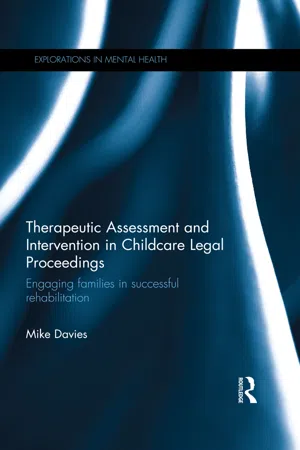
eBook - ePub
Therapeutic Assessment and Intervention in Childcare Legal Proceedings
Engaging families in successful rehabilitation
- 174 pages
- English
- ePUB (mobile friendly)
- Available on iOS & Android
eBook - ePub
Therapeutic Assessment and Intervention in Childcare Legal Proceedings
Engaging families in successful rehabilitation
About this book
Information
Part 1 Background
DOI: 10.4324/9781315719429-1
Chapter 1 Expert witness or psychotherapist
A personal development account
DOI: 10.4324/9781315719429-2
‘The happiness of your life depends on the quality of your thoughts’.(Marcus Aurelius 121–180 AD)
Reflecting on development
Becoming a therapeutic Expert, especially one recognised in legal proceedings, raises issues about your self-identity in the role, as well as your perceived status and expertise. Further reflection on the meaning of this role naturally requires you to ask questions of where you professionally and personally locate yourself; what journey brought you here; what key influences have helped shape your identity; and what past learning and experiences still drive you. Reviewing my experience as an expert over the previous 13 years and more than 400 cases I have become increasingly aware of the personal and professional evolution that brings me to this point, and the many issues that were raised in relation to who and what I have become. These are issues of personal and professional identity in which I have been challenged to accommodate different roles that do not necessarily sit comfortably together. For example, I am a therapist, at times a practitioner–researcher, a consultant to organisations, and an Expert to the courts among other things. The roles, having some common ground, are not homogeneous and require some adaptability as you step in and out of a role according to the context. This is not an uncommon position to be in. However, the shift between therapist and Expert, referred to a little later in this chapter, is the most demanding I have experienced. It raises (and challenges), issues of self-identity, and the extent to which you are able to make com promises to accommodate the roles. It challenges your motivation and rationale for undertaking this role and is worthy of constant personal review to ensure your healthy psychological functioning.
The nature of self-identity is not necessarily static and may still be evolving with new experience and reflection. This is certainly the case with therapeutic identity, which I consider is still shaped by new experience and collaboration with others in particular. Reflecting on my therapeutic development I was never sure whether I was a therapist who saw individuals, but who liked working with families, or a family therapist who also liked working with individuals. I disliked the limitations of therapeutic modalities that prevailed for many years and which I felt stifled creativity – though this has significantly improved in recent times. I certainly crossed modality boundaries in search of additional tools and ideas, often because of expediency and the demands of very complex cases. The creative search for ideas and being innovative I hoped would benefit families who were invariably difficult to help. It was also a process that, on reflection, has enhanced my development.
I have spent the biggest part of my therapeutic career working with complex cases involving children and families in a variety of contexts. Working with marginalised, hard to help families in particular often requires innovation and flexibility on the part of the therapist and her/his agency. With this in mind I have gained experience and sought to be competent in different approaches, including: individual child-work, direct work with adults, working with parents or couple/family work and ‘mixing and matching’ as necessary – often alongside like-minded colleagues in order to meet a variety of need. While this is a challenging environment in which to work it is an opportunity to build a level and range of expertise that is an asset working in the context of legal proceedings.
Becoming an Expert
Without being able to pinpoint the time exactly, there was a stage when I was increasingly recognised as some kind of ‘Expert’. It was somewhere between being a very experienced therapist manager, and then publishing research that lead to the development of specialist services for abused children. Because of the specialist nature of the work it naturally meant others came to me and my colleague who jointly led the service, for advice and consultation. A further development led to me giving evidence in court in relation to the complex cases referred to the specialist service. Leading the clinical development of this specialist team and providing consultation to others was the early preparation for the Expert role that was to follow. I enjoyed the consultative role but at that stage had no ambition to extend that to a court arena. The nature of working with abused children and their families/carers naturally leads to some court activity, which I undertook at that time on behalf of the service. As I gained experience I was increasingly asked to provide independent opinion on other cases outside of my clinical work.
The multiplicity of my clinical and research experience, alongside that of developing specialist services, and recent experience of giving evidence in cases of significant complexity, was the basis of my developing independent Expert status. The Law Society accepted me as an Expert in legal proceedings with children – something I had serendipitously become without any real ambition on my part. There are not many psychotherapists, who are not also psychiatrists or psychologists, who undertake Expert work, so I had no role model or framework to guide me. I was conscious of having to define who I was in relation to other Experts as well as the parameters of my expertise. I was also aware there are issues in relation to the Expert role including providing therapy in the context of legal proceedings.
There is a challenge concerning how you can truly incorporate the seemingly conflicting roles of psychotherapist and Expert in legal proceedings – without significant compromise. The legal context seeks ‘truth’ and certainty, while psychotherapy engages with the notion of several potential realities and unknowing. There are undoubtedly compromises to be made. Reflection and self-understanding are critical to your personal development as well as your well-being as you endeavour to accommodate both roles. As I gained experience I was increasingly motivated by the belief that psychotherapists have a great deal to contribute in legal proceedings, which benefits the legal process at times as well as families. Support for this is provided later in the case studies in Chapter 4.
I believe this view is supported by many of the professionals who work in legal proceedings who, despite being committed to the legal framework, also recognise its shortcomings in dealing with complex issues relating to children and families. Despite being (philosophically) diametrically opposed and potentially at odds with the legal system on many counts, psychotherapy and what it brings is often welcomed by other professionals, without completely understanding its value or relevance. In practical terms it seems to accept a certain amount of ‘unknowing’ so that it can pragmatically move cases on. In essence the professional/legal system is full of contradictions that paradoxically allow it some uncharacteristic flexibility at times.
The role of Expert is initially intimidating but also potentially seductive. It challenges your self-awareness and requires personal reflection, and high quality supervision. Your growing development in the role will benefit from feedback from others, including the agency commissioning your help, your peers, and most importantly your clients. I actively sought feedback from as many sources as possible from the outset. It is potentially seductive in that you can be treated with great reverence by other professionals – although beware, a good lawyer can also quickly undermine and expose the Expert who lacks caution and/or is unprepared. The term ‘Expert’ – not at all post-modern – is both a concept and a label that you have to accept and adjust to as it is unavoidable in the context of this work. Legal and other professionals will have expectations of you in the role beyond that of being a very experienced and competent psychotherapist. Establishing clarity about the parameters of your expertise in relation to each case as well as other professionals’ expectations of you in the role is paramount. For example in a case where you have provided an opinion on the therapeutic viability of working with a family you may wish to comment more widely on the complexity of the case as you understand it. This is part of your role as an Expert and is often framed in your letter of instruction as ‘anything else you consider relevant’. In my experience Experts deal with their role, and their perceived expertise in this context, very differently. Some are inclined to stay strictly within parameters while others are inclined to contribute more widely when they feel it is relevant. With the benefit of experience and growing expertise Experts perceive themselves, and are perceived by others, to have a particular identity in relation to their work. This is in part determined by your designation (e.g. psychologist) but also by your experience and generally acknowledged areas of known expertise (e.g. learning difficulties; substance misuse). Your self-identity as an Expert, and acknowledged areas of expertise, will naturally help shape the parameters of your assessment. It is also important to understand – and to be respectful of – the opinion and position taken by others in the case in relation to your own assessment, despite the adversarial nature of legal proceedings.
The role of ‘Expert’ in this context will be more challenging for some than others given many of the demands specific to the role. Perhaps a key capability, and a factor that concerns aspiring Experts more than anything else, is dealing with the process of being cross-examined on your own evidence as well as that of others. Being able to express your opinions clearly and revising them, if necessary, in light of new information while giving evidence, is demanding. In this respect having, or developing the ability to think on your feet when being cross-examined so that the best of your knowledge and expertise becomes available, is important in this role. Some Judges are more sympathetic than others toward the discomfiture of Experts when that occurs. There is often an expectation that you will contribute to untangling the complexity in cases so that the essence of the problems can be revealed and communicated in a way that is understood by lay or non-experts. Likewise there is often an expectation you will bring clarity to concepts such as ‘attachment’, ‘good enough parenting’, or emotional abuse so that they can be understood in more straightforward terms and related to the particular case.
While some Experts are very defined by their role (e.g. psychologist in learning difficulties or substance misuse) the role of psychotherapist requires a degree of systemic expertise – an ability to be almost constantly aware of the wider context in a case, particularly the impact of the professional/legal system, while also focusing on the specifics of the case. The demands made of you by others for information about some matter (e.g. depression) or for an opinion means the role is also more akin to that of being ‘consultative’ in other contexts – except here you may have to qualify your views and opinion via cross-examination at a later stage. The role of ‘Expert’ in legal proceedings, with all its inherent weaknesses, can be potentially transformative for some families affording a previously unforeseen opportunity for change. When the Expert (therapeutic) role is undertaken effectively the benefits of therapy – or the therapeutic approach – may not be just restricted to the family, but potentially make an impact with the professionals as well as the legal process.
The Expert experience
I first gave ‘Expert’ testimony in childcare legal proceedings in 1993 without realising I was doing so at the time. I was a manager of a multidisciplinary team of therapists providing specialist Child and Adolescent Mental Health Service (CAMHS) for abused children – called a Post-Abuse Service. In order to protect the therapists who were often very involved in direct therapeutic work with the children and/or families/carers I often took the responsibility for representing the work of the service in legal proceedings. If the therapist themselves gave evidence, then it could potentially undermine the therapeutic relationship and potentially sabotage work at a critical time. At that time we felt it was important for the therapists to feel they were free to get on with the work without these additional pressures. The other reason for me, as opposed to the individual therapist, giving evidence was, as I quickly learned, that most therapists are terrified at the prospect of giving evidence – it is very foreign, unfamiliar territory. I had experience of giving evidence in a previous professional life as a very young social worker and although apprehensive it was not completely unfamiliar – although the therapeutic versus the social work role was very different and proved to be a steep learning curve.
All professionals who give evidence have to lay before the court a summary of their qualifications, experience and areas of perceived expertise. Because I had, with a colleague, set up a specialist CAMHS for providing therapeutic assessment and intervention for abused children, their families and carers (largely based on my research and subsequent publications), I was increasingly perceived as an Expert and asked to consult with or give op...
Table of contents
- Cover Page
- Half-Title Page
- Title Page
- Copyright Page
- Table of Contents
- Acknowledgements
- Part I Background
- Part II Families on the edge
- Part III Findings and discussion
- Index
Trusted by 375,005 students
Access to over 1.5 million titles for a fair monthly price.
Study more efficiently using our study tools.
Frequently asked questions
Yes, you can cancel anytime from the Subscription tab in your account settings on the Perlego website. Your subscription will stay active until the end of your current billing period. Learn how to cancel your subscription
No, books cannot be downloaded as external files, such as PDFs, for use outside of Perlego. However, you can download books within the Perlego app for offline reading on mobile or tablet. Learn how to download books offline
Perlego offers two plans: Essential and Complete
- Essential is ideal for learners and professionals who enjoy exploring a wide range of subjects. Access the Essential Library with 800,000+ trusted titles and best-sellers across business, personal growth, and the humanities. Includes unlimited reading time and Standard Read Aloud voice.
- Complete: Perfect for advanced learners and researchers needing full, unrestricted access. Unlock 1.5M+ books across hundreds of subjects, including academic and specialized titles. The Complete Plan also includes advanced features like Premium Read Aloud and Research Assistant.
We are an online textbook subscription service, where you can get access to an entire online library for less than the price of a single book per month. With over 1.5 million books across 990+ topics, we’ve got you covered! Learn about our mission
Look out for the read-aloud symbol on your next book to see if you can listen to it. The read-aloud tool reads text aloud for you, highlighting the text as it is being read. You can pause it, speed it up and slow it down. Learn more about Read Aloud
Yes! You can use the Perlego app on both iOS and Android devices to read anytime, anywhere — even offline. Perfect for commutes or when you’re on the go.
Please note we cannot support devices running on iOS 13 and Android 7 or earlier. Learn more about using the app
Please note we cannot support devices running on iOS 13 and Android 7 or earlier. Learn more about using the app
Yes, you can access Therapeutic Assessment and Intervention in Childcare Legal Proceedings by Mike Davies in PDF and/or ePUB format, as well as other popular books in Psychology & Mental Health in Psychology. We have over 1.5 million books available in our catalogue for you to explore.