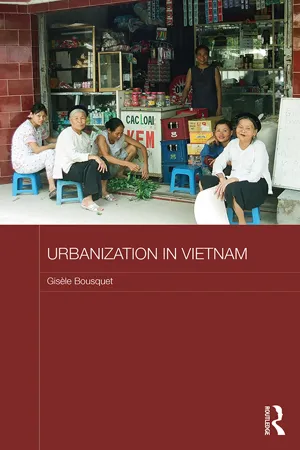
Most studies on urbanisation focus on the move of rural people to cities and the impact this has, both on the cities to which the people have moved, and on the rural communities they have left. This book, on the other hand, considers the impact on rural communities of the physical expansion of cities. Based on extensive original research over a long period in one settlement, a rural commune which over the course of the last two decades has become engulfed by Hanoi's urban spread, the book explores what happens when village people become urbanites or city dwellers – when agriculture is abandoned, population density rises, the value of land increases, people have to make a living in the city, and the dynamics of family life, including gender relations, are profoundly altered. This book charts these developments over time, and sets urbanisation in Vietnam in the wider context of urbanisation in Southeast Asia and Asia more generally.
- 148 pages
- English
- ePUB (mobile friendly)
- Available on iOS & Android
eBook - ePub
Urbanization in Vietnam
About this book
Information
1 Urban spacial reconfiguration
Introduction
Like many other peri-urban villages, Khương Hạ had economic links with the city because of its proximity. However, the industrialization of the region brought economic diversification with new employment opportunities to this rural community. Starting in 1956, the new Vietnamese administration scheduled the area to the south of Hà Nội for development as a new economic zone.1 Although the village was not included in the zone, it was only a few miles away from the factories. Khương Hạ’s proximity to these factories had irreversible socioeconomic consequences on the community. Young people, men and women alike, went to work in those factories. One of the characteristics of in situ urbanization is the diversification of a community’s occupations from those of the core agriculture-only based industry to those of other industries, such as services and manufacturing.2 However, in the case of Khương Hạ in the 1960s and 1970s, those factors had few consequences for the overall spatial configuration of the village. First, during the Vietnam War and collectivization, the lack of resources, and the government’s land policies, prevented people from investing in their homes through remodeling or rebuilding. They lived on ration tickets at little more than subsistence level. Second, factory workers who migrated from other provinces were provided with living accommodation such as dormitories and apartments and were not allowed to rent in private homes. However, as this chapter will show, some workers and their families were able to buy land and build homes inside the village in the late 1970s. The in situ urbanization of Khương Hạ only started in the late 1980s and early 1990s, when villagers were allowed to openly engage in real estate and other business transactions.
Khương Hạ, a Vietnamese village
Before being incorporated into the city as a new urban neighborhood, Khương Hạ, as a peri-urban village, was still very much a village for many Vietnamese people. The village, which the villagers refer to as quê,3, represents the birthplace and family origin; it is the locus of the patrilineage.4 Identity is grounded in village identity, i.e. “everyone has a village of origin,” so being from a city and without rural roots is not always culturally acceptable,5 but in fact family origins may shift because of migration. Some residents whose family moved away from their village of origin decades ago rarely visit the village and may no longer have a personal relationship with the current village residents. In Khương Hạ, families who have adopted the village as their new place of residence, and whose parents have been buried in the cemetery, still refer to their village of origin, although they no longer know anyone there. Women and men from other villages, who married in Khương Hạ, make a visit home, which they call the quê,6 or the returning home, về quê, during the new year festival, Tềt, for other family occasions, or simply to help with the rice harvest. While some family rituals are performed in Khương Hạ, others pertaining to lineage are performed in the village of origin.
In the literature, there are many scholarly debates as to what constitutes a Vietnamese village, since Vietnamese rural communities can differ in social organization and physical environment.7 As a political entity, the Vietnamese village has been the subject of many studies, in particular during the Indochinese and American wars. In the past, the bamboo hedges surrounding many but not all Northern Vietnamese rural communities, which were used for protection against foreigners, were understood as the symbolic representation of the village’s political autonomy. They represented an opposition between the central and local authorities.8 That opposition was codified in the cultural practices of the village, which contrasted with those of modern colonialized cities such as Hà Nội and Saigon.9 On the one hand, the hedges represented the corporate nature of the village, and, on the other, the roots of its collectivism and resistance to foreign domination.10 The village itself was the symbol of national resistance.
During French colonization, most Khương Hạ villagers had little contact with the French authority, and land tenure patterns prevailed. However, some of them joined the revolutionary anticolonial movements at different times and became active in the political and military Việt Minh Party.11 Before 1945, the village’s farmlands were held communally and allocated to resident families based on production and on social organization. Each patriarchal household was allotted lands according to its needs and the number of its working adults, and every year the village chief redistributed them to the households.12 This arrangement was not always fair or equitable. Some village notables were given more than their share because of their status.
In 1945, the Việt Minh occupied Hà Nội; Hồ Chí Minh proclaimed a provisional government and introduced the first land reform. In 1946, during the first Indochinese war against the French, the region became contested ground. Eventually, Khương Hạ and the neighboring villages were evacuated from January to October 1954 when the French cleared the area near the French military airport of Hà Nội, which was only a few kilometers away from Khương Hạ. With the colonial authority occupying Hà Nội, French and Việt Minh forces engaged in combat in and around the edge of the city. For the next seven or eight years, the people of Khương Hạ abandoned the village to live either in Hà Nội or in nearby villages that had not been cleared. In 1954, after the Geneva agreements, which marked the end of French colonization, Vietnam was divided into Hồ Chí Minh’s Democratic Republic of Vietnam in the north and the Republic of Vietnam in the south. The villagers were then allowed to return home.
In 1955, Hồ Chí Minh introduced collectivization. In the beginning, this was based on the voluntary participation of the peasants and was supposed to consist of work exchange or mutual aid groups, but this loose organization was gradually replaced with more socialist types of cooperatives which were meant to lead to the elimination of private property.13 These were experimental and were put into effect only in a few districts. The Central Committee issued a decree collectivizing agriculture in April 1959, but collectivization was unpopular, and many regional officials did not support it.
Cooperatives based on village structure were better accepted and, from 1965 to 1975, while Vietnam was at war, they were the most common mode of production. At the village level, the cooperatives were organized into smaller production teams, each one consisting of about thirty families. But even after a system of work points was installed, worker motivation remained a problem and the system was not successful. In the 1960s and 1970s, instead of openly opposing the government’s policies, farmers were involved in reluctant behaviour, which was counterproductive and eventually contributed to the collapse of collective farming.14 Kerkvliet15 referred to such behaviors as the power of “everyday politics.” As a form of resistance to a top-down type of authority, everyday politics was the way people lived, worked, and did—or did not do—the things they were supposed to do as collective members.16
In Khương Hạ, people rarely liked to talk about the period of collectivization. For many of those who grew up in the 1960s, collectivization was a dark period of their lives. Many hated the collectivization policy because they felt that the technocrats who imposed it upon them disregarded their way of life and work practices. The criticisms, however, were not directed at the governing party, but rather at the policies, which they perceived as discriminatory toward the farmers. In fact, in most Khương Hạ families, there was an active member of the Vietnamese Communist Party. Huyen, a sixty-year-old farmer, told me that “whoever came up with the idea of ‘collectivization’ never worked in the fields and was not a farmer.” Huyen, who was a teenager in the 1960s, said, “We worked ten to fifteen hours, from six to eleven in the morning and two to five in the afternoon, and it was the same schedule, winter and summer. In the summer this was a harsh regimen.” During the summer at midday, the sun was unbearable, and most people stayed in the shade. Farmers usually started their workday at four in the morning and returned home at ten in the morning before the sun was the hottest. They returned to the fields at four in the afternoon and worked until sunset. Often they did not have enough to eat while doing strenuous physical work. “It was an unfair system and was not working out,” she said. “Some people got away with working very little while others had to work very hard.”
When she was a child, Thi, a sixty-five-year-old woman, had to work with her mother and younger sister in the fields. Her father had passed away, and after only three years of school, she was pulled out by her mother to help in the fields. “Children were not officially part of a production team, but they worked alongside their parents,” she said.
During collectivization, the crops they grew were the same as those in the late 1990s: rice, eggplant, and vegetables. But the crops belonged to the work team or to the state. What they produced could not be used to feed their families. Minh argued:
Factory workers received a higher meat ration than farmers because farmers were thought to have a food surplus. This was not true as well as discriminatory against farmers, because in the early years of collectivization, farmers were not allowed to grow food in their gardens, nor could they sell whatever they did grow at the market.
Villagers, particularly men, died of exhaustion because of the harsh working conditions. As one widow recalled, “My husband was in his late twenties then when he came home from working all day in the fields. He said that he was very tired. He washed, had some dinner, and went to bed. The next morning he was dead.” There were other cases of young men, usually married, who died in their sleep.
The proximity of the factories also led to demographic changes. Young men and women from rural communities, including Khương Hạ, went to work at the state-owned factories. Although migrants in the past usually lived in government-built housing, some eventually married locals and moved to the village, where they lived with the families of their spouses.
The American War, as most villagers called it, which started in the 1960s, worsened the villagers’ living conditions. While the farmers disliked collectivization, they were equally bitter about the war and the Americans. The area was heavily bombarded by American planes, which targeted the factories in order to cripple Vietnamese industrial production. Khương Hạ villagers who were old enough in the early 1970s vividly remembered the bombing. The village itself was never targeted or bombed, but people remembered running for their lives and witnessing death and the destruction of factories. But life went on. Minh described that period as “exhausting” and “fearful.” She recalled: “Since the planes always arrived in the late morning, it allowed us to schedule the work in the fields in the early morning. When the siren started, we ran out of the exposed fields and rushed to safety.”
No houses in the village were ever hit, but it was not unusual for people to be killed near the nearby highway. One woman and a child were killed by an explosion on their way to the village. Another, who had ma...
Table of contents
- Cover
- Half Title
- Title Page
- Copyright Page
- Table of Contents
- Preface
- Acknowledgement
- Introduction
- 1. Urban spacial reconfiguration
- 2. Land tenure, property rights, and urban development
- 3. Farming at the edge of the city
- 4. Making a living in the city
- 5. The urban village
- 6. Gender relations in the new urban landscape
- 7. Conclusion: the building of a global city
- References
- Index
Trusted by 375,005 students
Access to over 1.5 million titles for a fair monthly price.
Study more efficiently using our study tools.
Frequently asked questions
Yes, you can cancel anytime from the Subscription tab in your account settings on the Perlego website. Your subscription will stay active until the end of your current billing period. Learn how to cancel your subscription
No, books cannot be downloaded as external files, such as PDFs, for use outside of Perlego. However, you can download books within the Perlego app for offline reading on mobile or tablet. Learn how to download books offline
Perlego offers two plans: Essential and Complete
- Essential is ideal for learners and professionals who enjoy exploring a wide range of subjects. Access the Essential Library with 800,000+ trusted titles and best-sellers across business, personal growth, and the humanities. Includes unlimited reading time and Standard Read Aloud voice.
- Complete: Perfect for advanced learners and researchers needing full, unrestricted access. Unlock 1.5M+ books across hundreds of subjects, including academic and specialized titles. The Complete Plan also includes advanced features like Premium Read Aloud and Research Assistant.
We are an online textbook subscription service, where you can get access to an entire online library for less than the price of a single book per month. With over 1.5 million books across 990+ topics, we’ve got you covered! Learn about our mission
Look out for the read-aloud symbol on your next book to see if you can listen to it. The read-aloud tool reads text aloud for you, highlighting the text as it is being read. You can pause it, speed it up and slow it down. Learn more about Read Aloud
Yes! You can use the Perlego app on both iOS and Android devices to read anytime, anywhere — even offline. Perfect for commutes or when you’re on the go.
Please note we cannot support devices running on iOS 13 and Android 7 or earlier. Learn more about using the app
Please note we cannot support devices running on iOS 13 and Android 7 or earlier. Learn more about using the app
Yes, you can access Urbanization in Vietnam by Gisele Bousquet in PDF and/or ePUB format, as well as other popular books in Social Sciences & Ethnic Studies. We have over 1.5 million books available in our catalogue for you to explore.